• Skip to main content
  • Skip to footer

Deliberative Citizenship Initiative

Building Democracy One Conversation at a Time

  • The Initiative
    • Programs
      • Deliberation Across the Curriculum
      • Deliberation on Campus
      • Deliberation in the Community
      • Research on Deliberation
    • Motivations
      • Why Deliberative Citizenship?
      • Why Davidson? Why Now?
    • Who’s Involved?
      • DCI Fellows Cohorts
        • 2025-2026 Fellows
        • 2024-2025 Fellows
        • 2023-2024 Fellows
        • 2022-2023 Fellows
        • 2021-2022 Fellows
        • 2020-2021 Fellows
      • DeeP Collaborative Cohorts
        • 2024-2025 DeeP Collaborative Faculty
        • 2023-2024 DeeP Collaborative Faculty
      • Advisory Council
    • History
      • What Sparked the Initiative?
    • Key Deliberative Dispositions
    • Frequently Asked Questions (FAQ)
    • Annual Report
  • Get Involved!
    • Participate in a Forum
    • Join a D Team
    • Become a Fellow
    • Take Courses
    • Get Training
    • Come to Guest Lectures
  • Events
    • Upcoming Events
      • 250th Anniversary Deliberative Forum Series on American Values
    • Past Events
  • Connections
    • The Deliberative Citizen: The DCI’s Monthly Newsletter
    • Efforts on Campus
    • Efforts in the Community
    • Efforts Elsewhere
    • Readings and Resources
      • DCI-Published Guides
      • DCI Guide to One-on-One Conversations
      • How to Disagree
      • Demonstration of Facilitation Styles
      • Deliberative Pedagogy Mini-Course
    • How We Can Help: DCI’s LET’S DELIBERATE! Partnership Opportunities
    • DCI in the News
  • DCI Blog Posts
    • Recent Blog Posts
    • All Blog Posts

Fellow Posts

Seeing in Color: Why Deliberation Shouldn’t Be Black and White

May 21, 2025 by Mohamed Mustafa

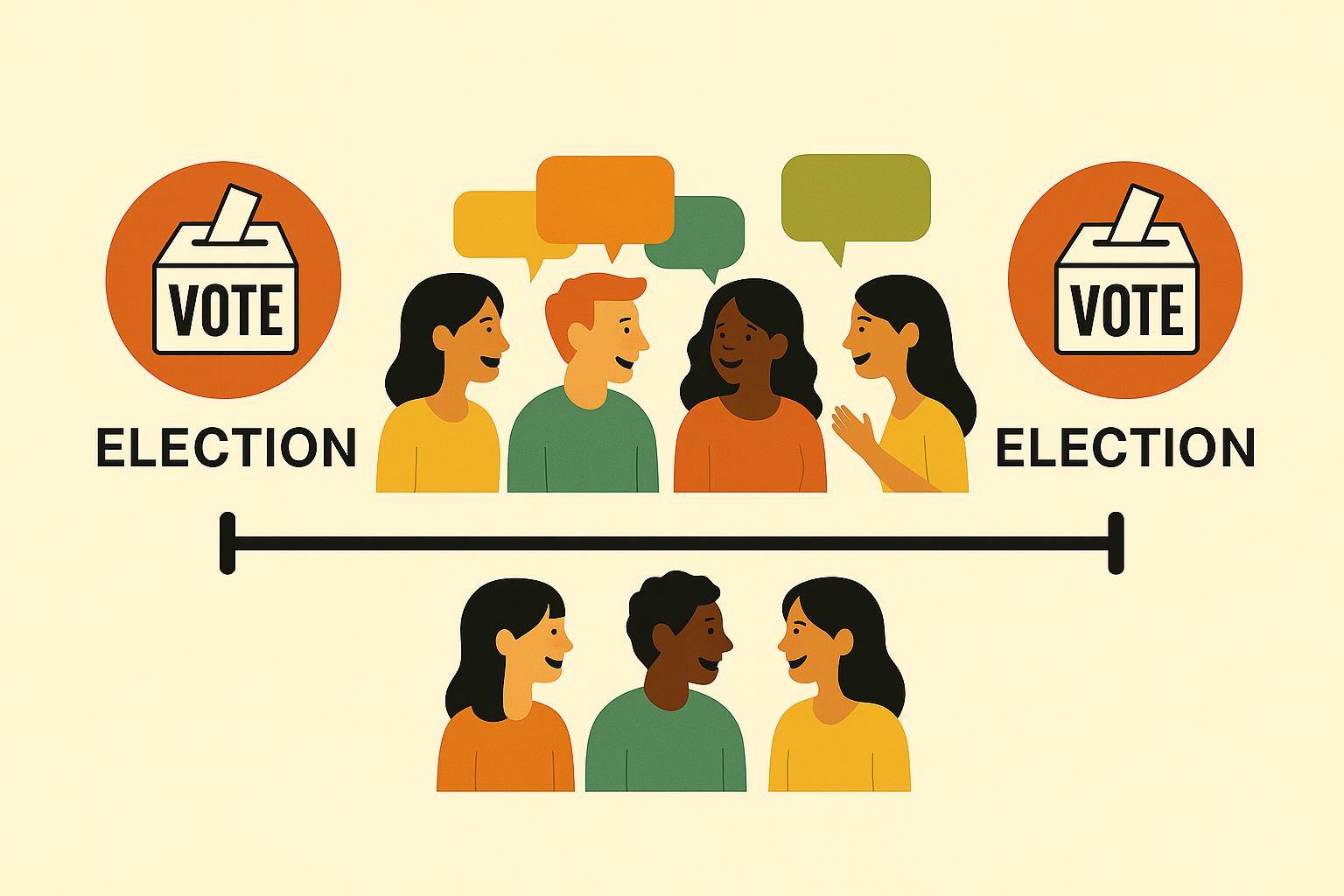
Image of black and white conversation next to conversation in color

By Mohamed Mustafa ’26 (DCI Fellow)

In a world where issues are often reduced to binary choices, we tend to jump to conclusions without acknowledging the nuances of complex topics. This black-and-white approach may be convenient, but it doesn’t reflect the reality of our diverse motivations, experiences, and values. Life is far more complex than a simple “right” or “wrong.” Deliberation offers a way to step back, suspend judgment, and embrace this complexity, helping us see beyond simplistic divisions.

At the start of the DCI Fellows journey, deliberation often seemed like a tool for finding compromise. But as I began engaging in conversations about difficult issues, I soon saw it as much more. Deliberation invites us to understand the “why” behind people’s beliefs and to appreciate the different motivations that drive their perspectives. One D Team discussion I recently facilitated on defensive democracy illustrated this dynamic, reminding me how deliberation can help unpack seemingly opposing views and reveal the complex motivations behind each stance.

Defensive democracy—a concept associated with the tension between protecting democratic principles and restricting certain freedoms in the name of security—tends to trigger strong emotions. For some, imposing restrictions on groups with anti-democratic agendas seemed essential for protecting democracy from internal threats. For others, any restriction on freedom seemed to risk eroding the very principles that democracy is meant to uphold. At first glance, it’s easy to view it as a black-and-white issue: either democracy is defended by limiting certain freedoms, or democracy is protected by preserving civil liberties at all costs. Yet as my D Team participants explored the topic, they discovered each perspective was rooted in motivations that were simultaneously personal, nuanced, and deeply held.

Some participants argued that limiting certain freedoms—such as banning groups with anti-democratic intentions—was crucial to safeguarding democracy itself. They highlighted examples from history where democracies fell because they allowed bad actors to act freely within their borders. Their approach was not about endorsing authoritarianism but about preserving democratic values by preventing harmful ideologies from undermining them.

Others voiced concerns that imposing restrictions, even in the name of democracy, might set a dangerous precedent. They emphasized the slippery slope, suggesting that banning one group could pave the way for further erosions of liberty. They viewed true democracy as strong enough to withstand dissenting voices, since suppressing ideas would betray democratic principles. For these participants, defending democracy meant holding firm to civil liberties, even at the risk of some vulnerability.

Deliberation allowed us to move beyond judging each stance as either “pro-democracy” or “anti-freedom.” Instead, this space provided a framework for examining the motivations behind each position. Listening to one another, participants began to realize that defensive democracy isn’t a straightforward issue with an easy answer; it’s a balancing act shaped by people’s lived experiences and their own personal interpretations of what democracy requires.

Perhaps the hardest part of this discussion—and of deliberation in general—was resisting the urge to label ideas as “right” or “wrong.” Through this experience, participants found that curiosity is essential in deliberative settings. When they approached each other’s motivations with curiosity rather than judgment, they opened themselves to new insights and ways of thinking. This curiosity allowed participants to understand not only each other’s concerns about freedom and security but also the complex values that guide their own views on defensive democracy.

Consider a hypothetical example where two groups debate banning extremist organizations to protect democratic stability. In a deliberative setting, participants from both sides would share why they feel as they do. Those advocating for restrictions might express fears about instability, sharing historical examples of democracies dismantled from within. Meanwhile, those defending free expression could argue that suppressing even dangerous ideas drives them underground, where they might thrive in secrecy. Through deliberation, each side could gain a fuller picture of the risks and values that shape the other’s position, seeing that their motivations stem from shared concerns for democracy, even if their conclusions differ.

Deliberation doesn’t mean everyone will end up on the same page. But it does foster a community in which we see each other as individuals with complex and diverse motivations. In the DCI Fellows Program and my individual D Team, I’ve seen how deliberation nurtures a more humane and compassionate community, one where people look for understanding rather than conflict. This empathy and respect are essential for a healthy democratic society, reminding us to pause, listen, and look for the colors in between the black and white arguments that are being made in a world increasingly polarized by oversimplified narratives.

Filed Under: Fellow Posts

The Value in Seeing Others’ End Goals

April 6, 2025 by Owen Brent-Levenstein

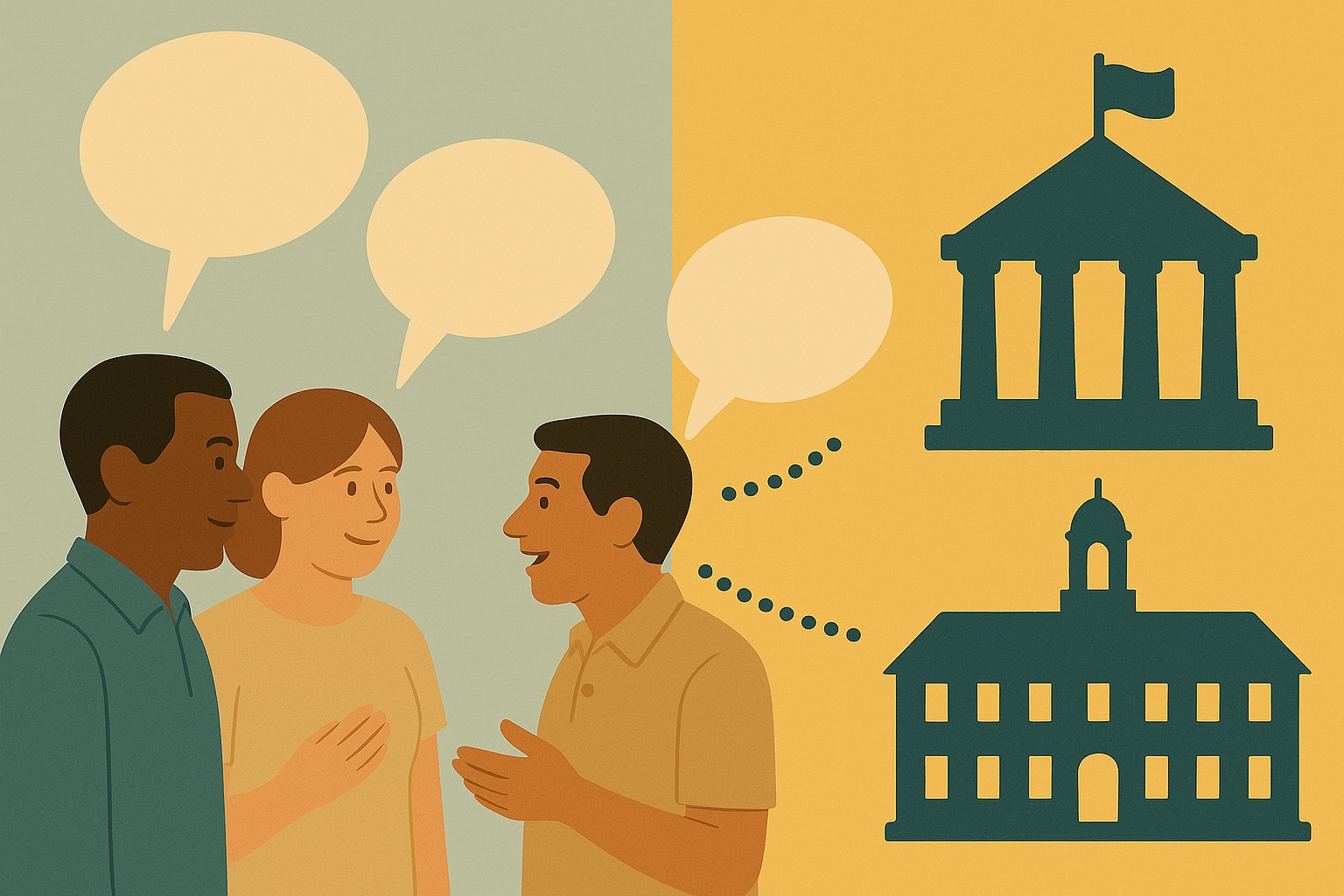
two figures facing each other, blue and red, with a star between them.

Owen Brent-Levenstein ’27 (DCI Fellow)

As a kid I understood the difference between Democrats and Republicans as this: Republicans take from the poor to give to the rich, while Democrats take from the rich to give to the poor. With this dichotomy, the choice was obvious. One side was the moral choice, wanting what was best for the world, while the other side was greedy, wanting to keep as much for themselves and exploit others to do so.

However, my experience facilitating a discussion after the DCI Income and Wealth Disparities forum showed how this assumption about people’s morals was not true. 12-year-old me would think that anyone arguing against policies such as redistribution or higher minimum wage were greedy and unsympathetic. In listening to the wide array of arguments across the spectrum of political ideologies, it was clear that this was not the case.

Someone who worked with unions talked about how high minimum wages have incentivized automation, meaning even more people lost jobs. Another member talked about the fear of how higher taxes and inflation can end up devastating the lower and middle class. Whether I agreed with what they said or not, one thing was clear, these views came from a desire to create the best world and economy for the majority of people, a goal that lined up exactly with mine.

This helped show me that finding common end goals can help everyone be more receptive to the other side. The goal can be as specific as wanting higher wages for all and as vague as wanting a better world for the majority of people. When everyone can realize they are working towards the same result, it can bring the group closer together and can turn a heated argument into more of an intellectual disagreement.

When the group can establish a clear end goal, it naturally brings them together. It’s easy to see the other side in a malicious light when you feel like their opinion is so far from your own. It makes it even worse when you feel as if their value system is far different, and doubt whether their morals are in line with your own. Finding a common goal can quell a lot of these doubts and points of tension between groupmates, and in turn rally the group around solving the common goal. It transforms points of heavy contention into a group problem-solving effort, bringing a sense of comradery and commonality to the deliberation.

Finding a common end goal also turns the discussion from more of an emotionally charged event, towards an intellectual disagreement. The more we are able to see that both sides are morally fighting for similar goals, we can focus the discussion on the specifics of how to achieve those goals. This can lessen the emotions that come with the topic that is being deliberated and allow participants to focus more on the logic and reasoning behind the arguments.

Overall, finding a common end goal, no matter how vague it is, can bring the deliberating group together, and turn the deliberation from a tense argument to a constructive problem-solving exercise.

Filed Under: Blog Posts, Fellow Posts

How to Foster External and Internal Inclusion in D Teams

April 6, 2025 by Luna Noguchi

cartoon people sitting around a table and walking towards the table

Luna Noguchi ’25 (DCI Fellow)

When I host and facilitate deliberation during DCI D Team sessions, I am very conscious of whether I am including enough diverse perspectives into the conversation as possible. Healthy deliberation is sparked through exploration of individual differences, and they make for a rich understanding of the issue being discussed. Without fostering inclusion, important voices lack a platform to share their experiences, and this can shape harmful norms surrounding the types of perspectives that should be shared. When preparing for a deliberation session, it is important to think about fostering both external and internal inclusion.

One of the most prominent barriers to productive deliberation at Davidson is the issue of exclusion. As a fellow, I see an important aspect of my role as fostering both internal and external inclusion. External inclusion involves dissolving the various physical barriers that prevent individuals from being involved in a D Team or a deliberative forum. Internal inclusion involves conceptual barriers to full participation and engagement in the deliberation process, like power dynamics.

I strive to use the framework set by Carcasson and Sprain to foster both internal and external inclusion in my D teams (1). They designed a cyclical process meant to improve the quality of public engagement in deliberation. The 5 steps are deliberative issue analysis, convening, facilitating deliberative engagement, and action.

During deliberative issue analysis, participants gain a deeper understanding of the topic or issue by learning about it through a thorough deliberation guide that cites research and historical events. The right deliberation guide includes a broad range of voices, is objective, and presents accurate and relevant information to participants. In my role as a fellow, I evaluate drafts of deliberation guides to check for areas where the background information could be presented in a more inclusive way.

Convening involves getting a representative sample to participate in the deliberation event. This is important for having a diverse and rounded group of people whose conclusions can be reflective of the broader whole. Removing barriers to people’s attendance to my D teams is essential. This can involve any planning details which make attending more accessible. For example, D teams which occur on campus are made accessible to many students through advertising, scheduling, and location.

Facilitating deliberative engagement is at the core of my role as a fellow. Through deliberation training, I have a strong understanding of how to frame conversation goals, lay down ground rules, prompt deeper thinking, and draw conclusions among participants. To foster internal inclusion, I introduce excluded perspectives into the conversation and ask questions that diversify participants’ way of thinking about the issue. When my group is on the larger side, I initiate smaller group discussions that may help someone feel more comfortable sharing their experiences.

In reporting the content of the deliberation, one should prioritize accurately capturing the perspectives of participants and the conclusions that were drawn from them. This may involve including important background information on the event, like the host of the event, the issue, the questions, and the people involved. It is important to follow up with participants and leave opportunities for further engagement. Inviting them to share thoughts they refrained from sharing during the event ensures their voices are included.

Ideally, the event would result in an attempt at acting on the issue. It should hinge on the conclusions drawn from the deliberation and represent the collective of diverse perspectives. Taking action on a wicked problem takes multiple trips around the cycle, as it can be very difficult to foster inclusion at this stage without hearing as many voices as possible. It can be helpful to inspire members to create a separate project or initiative that works to address the issue. It is also relevant to discuss methods that members can tackle the issue in their own communities.

Each stage of the cycle should build on themselves by fostering external and internal inclusion. This should promote the norm of listening and inviting diverse perspectives. Ideally, the momentum created by including more voices may contribute to a culture of deliberation in daily democratic engagements. While it is very difficult to reach sufficient inclusion with every event, following the outlined guidelines can be a good start.

Note:

(1) Martín Carcasson and Leah Sprain, “Beyond Problem Solving: Reconceptualizing the Work of Public Deliberation as Deliberative Inquiry,” Communication Theory 26, no. 1 (2015): 41–63.

Filed Under: Blog Posts, Fellow Posts

Embracing the Power of Deliberation: Why Thoughtful Conversations Matter

April 6, 2025 by TBC Takougnadi

image of people talking around a table

DCI Fellow Bosisso Charles Takougnadi ’27 (TBC)

Deliberation, to me, is more significant than just well-structured and healthy conversations; it is a true commitment to listening, understanding, inclusivity, and collective growth. During these polarized times, it is often overlooked, but deliberation has become a bridge between entrenched opinions and shared resolutions. Deliberation promotes not only effective and productive discussions but also the following values: attentiveness, listening, and openness. Thus, it challenges us to criticize our assumptions and empathize with perspectives that may at first, look foreign and sometimes create discomfort.

The potential to cultivate community and social resilience is one of the core principles that resonate with me as I navigate the practice of deliberation. Engaging with others’ views not only enriches one’s understanding. Furthermore, it strengthens one’s social fabric by developing trust, creating a sense of belonging as well as spreading knowledge and culture. Deliberation encourages participants to break down complex issues, dig deeper into underlying reasons and values, and collaboratively seek resolutions. Deliberation in that sense embodies a commitment to truth-seeking and a humility that acknowledges that we may not always have the solution, and we may not have all answers, but we are willing to find them together.

Furthermore, deliberation plays a vital role in fostering civic virtues. Deliberation not only encourages but also requires the following qualities: patience, empathy, and open-mindedness that enable a meaningful and effective deliberation. Every participant is should remain patient with the pace of the discussion while they confront biases, which is often a required stage to effective deliberation. They should also practice empathy and respect; indeed, these are essential aspects of democratic societies.

Excellent deliberators must concentrate on the “how” of the conversation, taking part not merely to prove a point of view but to collectively and collaboratively explore opinions and ideas. Its process-oriented nature portrays deliberation as an important skill in this interconnected world.

Reflecting on the deliberation sessions in the DCI D Teams program, it has been inspiring to witness the respect participants hold for each other’s viewpoints, no matter how diverse and different they are. These discussions around hard topics underscore the importance of creating welcoming spaces where people feel comfortable sharing their thoughts, even when they are not fully formed. This encourages vulnerability and honesty, thus easing the breakdown of walls of doubt as well as mistrust.

I believe DCI has made that possible at Davidson College in multiple ways. I am so thankful for the work the DCI has put in to give space for facilitated and respectful discussion around hard topics, as through this opportunity I was able to not only enrich myself but also enhance my skills as a deliberator and a facilitator.

As we continue to practice and refine these skills, I am hopeful that deliberation will not only foster more cohesive communities but also prepare us for the tough conversations ahead. As a student, deliberation as well as discussion about contentious issues will get more complex as we grow in the ‘real’ world where there is even more diversity in all aspects of life, from cultures to ideas. One should be able to continue to engage in the practice of deliberation as well as embody its values.

Filed Under: Blog Posts, Fellow Posts

Event Recap: Deliberating about the Legacies of War

April 6, 2025 by Luna Noguchi

photo of deliberative event with screen in the background

Luna Noguchi ’25 (DCI Fellow)

On March 5, the DCI invited students, faculty, and staff together to a forum entitled “Lessons of War, Prospects for Peace: What should we say about the legacies of World War II in the Asia-Pacific region?” It served to provide some historical background for the Ginkgo trees planted in Spring 2024 between Chambers, Wall, and the Library. Co-sponsored with the History Department, East Asian Studies Department, Political Science Department, and the Office of the Vice President of Academic Affairs (VPAA), the event presented the history of World War II in the Asia Pacific with attention to historical controversies, while encouraging reflection on the universal human cost of war beyond regional or political divisions. 

photo of Dr. Multhaup presenting

The Ginkgo trees were contextualized with informative presentations from Dr. Kristi Multhaup, Dr. Dáša Mortensen, and Dr. Keren Zhu. Dr. Multhaup, whose research focuses on memory, outlined the lasting memory of WWII in the Asia Pacific and her initiative to bring the Ginkgo trees to campus during her participation in the ASIANetwork in Japan in 2016. Dr. Mortensen provided a broad historical perspective of the war in the region, shedding light on the atrocities that occurred. Dr. Zhu gave a presentation on the causes and consequences of war through an international relations perspective. The presentations provided participants with a nuanced and inclusive understanding of the complexities of war. Participants also had the opportunity to watch a compilation of testimonials provided by survivors of WWII from across the Asia-Pacific region in a video created by Keya Zhou ’25, one of the event’s organizers.

photo of tables at event

In the second half of the event, participants — over dinner provided by local pan-Asian restaurant Sabi with support from the VPAA’s office — engaged in deliberations facilitated by DCI Fellows and guided by a deliberation guide (see below) developed by the event’s organizing team. The goal was to discuss the legacies of WWII in the Asia Pacific and foster meaningful conversation about the inhumanity of war’s moral atrocities. The forum was also intended to generate ideas for interpretive materials for the Ginkgo trees. As the discussions proceeded, fellows asked participants to write their ideas on post-it notes, stick them to a large sheet of paper, and explain their thought processes. Fellows made notes on the paper and moved the post-it notes around to indicate shared conclusions. Online participants shared their thoughts using Zoom’s whiteboard function in their breakout rooms.

Over 35 Davidson students, faculty, staff, community members, and alumni attended the event (24 in person and 14 online), and they included participants who had ties to countries throughout the region. The organizing team, which consists of Keya Zhou ’25, Luna Noguchi ’25, Flo Moser ’26, Romeo Norris ’27, Casey Scheiner ’28, Lily Ogawa ’28, and Dr. Graham Bullock, is currently in the process of collating and synthesizing the comments and ideas from both the post-it notes and submissions made to an anonymous online form that was shared with the participants. They will incorporate this input from the Davidson community into a proposal for how to introduce and contextualize the Ginkgo trees that have been planted on campus. Stay tuned for more info coming soon!

DCI-WWII-in-the-Asia-Pacific-Deliberation-Guide

Filed Under: DCI Posts, Events, Fellow Posts

  • « Go to Previous Page
  • Page 1
  • Interim pages omitted …
  • Page 8
  • Page 9
  • Page 10
  • Page 11
  • Page 12
  • Interim pages omitted …
  • Page 32
  • Go to Next Page »

Footer

Blog Post Categories

  • Announcements
  • Blog Posts
  • DCI Posts
  • Events
  • Faculty Posts
  • Fellow Posts
Image of a compass superimposed by the text "Deliberative Citizenship Initiative" and "Davidson College." Clicking on this image leads to the Initiative page.

Recent DCI Blog Posts

  • We Tried to Fix Jubilee’s “Middle Ground” – Here’s How It Went
  • A Case for Deliberation in the Natural Sciences
  • Welcoming New Staff to the DCI and DCN
  • Facebook
  • Twitter
  • Instagram
  • LinkedIn


Copyright © 2026 · Infinity Pro on Genesis Framework · WordPress · Log in