• Skip to main content
  • Skip to footer

Deliberative Citizenship Initiative

Building Democracy One Conversation at a Time

  • The Initiative
    • Programs
      • Deliberation Across the Curriculum
      • Deliberation on Campus
      • Deliberation in the Community
      • Research on Deliberation
    • Motivations
      • Why Deliberative Citizenship?
      • Why Davidson? Why Now?
    • Who’s Involved?
      • DCI Fellows Cohorts
        • 2025-2026 Fellows
        • 2024-2025 Fellows
        • 2023-2024 Fellows
        • 2022-2023 Fellows
        • 2021-2022 Fellows
        • 2020-2021 Fellows
      • DeeP Collaborative Cohorts
        • 2024-2025 DeeP Collaborative Faculty
        • 2023-2024 DeeP Collaborative Faculty
      • Advisory Council
    • History
      • What Sparked the Initiative?
    • Key Deliberative Dispositions
    • Frequently Asked Questions (FAQ)
    • Annual Report
  • Get Involved!
    • Participate in a Forum
    • Join a D Team
    • Become a Fellow
    • Take Courses
    • Get Training
    • Come to Guest Lectures
  • Events
    • Upcoming Events
      • 250th Anniversary Deliberative Forum Series on American Values
    • Past Events
  • Connections
    • The Deliberative Citizen: The DCI’s Monthly Newsletter
    • Efforts on Campus
    • Efforts in the Community
    • Efforts Elsewhere
    • Readings and Resources
      • DCI-Published Guides
      • DCI Guide to One-on-One Conversations
      • How to Disagree
      • Demonstration of Facilitation Styles
      • Deliberative Pedagogy Mini-Course
    • How We Can Help: DCI’s LET’S DELIBERATE! Partnership Opportunities
    • DCI in the News
  • DCI Blog Posts
    • Recent Blog Posts
    • All Blog Posts

Fellow Posts

Bridging Perspectives: Leadership Through Deliberation

August 11, 2025 by Tehinnah Kitcher

Chidsey and DCI logos and photos of Tehinnah and Atyantika

By Tehinnah Kitcher ’27 (DCI Fellow)

This past March, I had the opportunity to co-lead a project called “Bridging Perspectives: Empowering Leaders to Connect, Deliberate, and Drive Change Together” alongside senior DCI fellow Atyantika Mookherjee that united the Chidsey Program for Leadership Development and the Deliberative Citizenship Initiative (DCI).

The Chidsey Leadership Fellows’ Program emphasizes leadership as an intentional and evolving practice, focusing on personal choice, resilience, opportunity, and connection. It views leadership as a journey shaped by decisions, the courage to tackle challenges, the openness to see possibility, and the commitment to build connections. By embracing these pillars, Chidsey Fellows learn to grow as leaders who can positively impact their communities through empathy, responsibility, and collaboration. As both Chidsey and DCI Fellows, Atyantika and I both noticed that together, the DCI and Chidsey provide students with a powerful set of complementary skills: DCI cultivates the ability to navigate complex discussions, while Chidsey emphasizes leading with empathy and purpose.

In our session with the Chidsey Fellows, we gave them an overview of the four facilitation styles and specific techniques to enhance communication and build understanding. We drew from the same frameworks that we learned in our official DCI facilitator training. Each style offered a different way of guiding a conversation and shaping group dynamics. The Chidsey Fellows then had the opportunity to play these roles through a mock deliberation. Afterwards, they reflected on their facilitation styles and skills.

This unique collaboration between DCI and the Chidsey Leadership Program helps to create future leaders who are equipped not only with technical skills but also with a deeper understanding of how to navigate complex, real-world challenges. By integrating DCI’s facilitation skills, which are centered around being attentive, respectful, and open-minded, with Chidsey’s core values, we’re fostering leaders who can engage in constructive, inclusive conversations. Such leaders are more adaptable, open to diverse viewpoints, and skilled at finding common ground, all of which are critical in a rapidly changing and interconnected world.

I am excited to see the DCI continue to collaborate and engage with the campus and broader community. Future collaborations would undoubtedly provide greater insights as to how dialogue and deliberation influence other fields. In a world that is growing more polarized and intolerant, quality deliberation and dialogue are essential. If you are interested in getting connected with the DCI, be sure to join a D Team in the fall or attend one of our forums!

Filed Under: Blog Posts, Fellow Posts

Does Televising Senate Hearings Prevent Productive Deliberation?

July 29, 2025 by Liam Mann

Liam Mann ’27 (DCI Fellow)

In an age where transparency is expected and media dominates political life, the broadcasting of Congressional proceedings appears to be both inevitable and necessary. Televising congressional proceedings seems to be a great way for citizens to understand what is going on in the government as well as hold their representatives accountable. Representatives are also given the opportunity to speak about issues concerning their constituents. However, while televising Congress has increased public access, it has also reshaped how legislators deliberate—with significant consequences for the quality and sincerity of debate.

The House of Representatives began televising its sessions in 1979, and the Senate followed in 1986 with C-SPAN (a government operated television channel) coverage. Letting the people see how laws are made was seen as a way to improve public outreach and increase transparency. The expectation was that this would foster civic engagement, encourage better behavior from legislators, and enhance the legitimacy of government. In many ways, it worked. Americans could now see their representatives in action, and important Congressional events, such as impeachment hearings and the Iran Contra hearings, were viewable by the entire country. This helped lead to more dialogue and understanding around pertinent issues.

However, the camera does more than record; it alters behavior. Members of Congress, aware of their on-screen presence, often tailor their speeches not to persuade their colleagues, but to impress viewers back home or find sound bites and viral clips to increase their relevance. This shift turns deliberation into performance. In the modern social media sphere, the emphasis on short-form content incentivizes representatives to not deliberate but instead to grandstand. As philosophy professors Justin Tosi at Texas Tech University and Brandon Warmke of Bowling Green State University (2020) discuss in their book on the topic, grandstanding is “when you do or say something for the very purpose of impressing others with how righteous you are.”   

This phenomenon is now common in Congress and makes achieving compromise more difficult, ultimately hurting the lawmaking process, and in turn, the American citizen. Only 34 bills were passed in 2023, the first year of the 118th Congressional session (which lasts 2 years), less than one bill per week. This was the lowest number of bills passed in the first year of a session since the Great Depression (LoCascio et al).

Moreover, broadcasting can deter informal negotiation. Some of the most productive legislative work happens behind closed doors—in committees, in hallway conversations, or over lunch. These moments of privacy allow lawmakers to speak candidly, compromise, and build trust across the aisle. When this deliberation is televised, it becomes more difficult to deliberate and evolve one’s position, as it can be seen as “losing” an argument, lacking backbone, and not staying true to your party.

Of course, these issues are not supposed to imply that the television of Senate proceedings should be outright banned. Americans should have the ability to know how their representatives are advocating for them and understand the legislative process. However, it is vital to recognize how media can affect the behavior of those lawmakers. 

It is difficult to find balance between transparency and actually getting work done that helps America. From a cultural perspective, it is clear that our legislators should grandstand less and deliberate more. How to do so is more difficult. How do Americans incentivize our politicians to behave in their best interests? For starters, I believe that participating in deliberative sessions and putting into practice the deliberative dispositions in our own lives is a fantastic start. Without working with others ourselves, it is difficult to believe that the “other side” is ever willing to cooperate; it is difficult to believe that a middle ground ever exists. Knowing the benefits of deliberation firsthand will hopefully encourage constituents to demand the same out of our representatives, whether we voted for them or not.

LoCasio, Joe et al. 2024. 118th Congress on track to become one of the least productive in US history. ABC News. https://abcnews.go.com/Politics/118th-congress-track-become-productive-us-history/story?id=106254012

Tosi, Justin and Brandon Warmke. 2020. Why We ‘Grandstand’ and Why It Matters. Public Affairs Council. https://pac.org/impact/why-we-grandstand-and-why-it-matters

Filed Under: Fellow Posts

Creating a Community: The Importance of Deliberative Forums

July 22, 2025 by Isabella Neri

By Isabella Neri ’27 (DCI Fellow)

Over almost six years, the DCI has fostered a robust culture of deliberation at Davidson. Many might attribute this success to DCI’s Deliberative D Teams. However, a lesser-discussed DCI program is its Deliberative Forums. The DCI has hosted 19 forums since its inception in early 2020. These forums provide the community a chance to engage with their peers in group discussions surrounding a specific topic. For example, in the Fall of 2024, the DCI hosted a forum discussing income and wealth disparities where a panel of four participants, each with their own expertise and experience surrounding the topic, deliberated while being guided by a facilitator. After the panel discussion, groups of roughly seven participants and a facilitator had their own discussions. Other models of forums exist, though they all share the same purpose of fostering a conversation between participants on a specific topic. 

Deliberative forums can act as a gateway to deeper discussions and further deliberations within the community. Forums are an introduction to what deliberation can be for those who are hesitant to get involved. Additionally, forums allow participants to think in depth about topics they may not have previously considered. For instance, someone who attended the Honor Code Forum might not have heard the perspectives of professors or even fully understood how the Honor Code functions. Many participants have expressed their appreciation for hearing new perspectives and reflecting on their discussions. Some may even take on and accept new perspectives after talking to community members or their peers. 

Forums also allow for bridges to be built between those in a community. As I have previously highlighted, forums allow us to hear new perspectives through discussing often difficult topics. They can also help us form connections with each other that we might not have thought possible. One simple conversation could be what it takes for two people to understand each other. This act of listening and understanding could be all the difference in opening the conversation to find similarities between people as a community and as individuals. Additionally, with this one conversation, we can open so many doors to move forward with deliberation. 

After the forum, participants receive a Pathways Guide that gives a reflection of the event and how we can move forward with what we’ve learned. Once a forum has been attended, there are a variety of paths you can take to immerse yourself in a deliberative world where those around you also want to learn and grow by discussing a wide range of topics through deliberative D Teams, additional forums, blog posts, or speaker events. 

Forums do not simply end when the conversation is over. In reality, the conversation is never over. There are always topics to discuss or issues to be considered. Forums simply act as a gateway to understanding how you can become more involved in deliberation. Given our current climate, it is crucial that we come together and discuss complex and difficult topics. With this in mind, forums can act as an introduction to and pathway towards healthy deliberative discussion. 

Filed Under: Fellow Posts

The Challenges of Everyday Deliberation

July 14, 2025 by Owen Brent-Levenstein

illustration of people arguing across a table with a mediator in between

By Owen Brent-Levenstein ’27 (DCI Fellow)

During my spring D-team meeting on the opioid crisis, the group of nine community members and students were clearly eager to start deliberating. Before we could get started, I had to remind everyone that to start, we had to read over the conversation agreements. While reading over the conversation agreements is no one’s favorite part of a deliberation, it plays an important role. By making everyone formally acknowledge that they were agreeing to these norms, the participants felt a responsibility to uphold them, and kept the conversation agreements in mind throughout the deliberation. The participants ended up getting what they signed up for, a civil discussion on an important topic troubling our country. 

Unfortunately, the majority of deliberation does not happen under these ideal conditions. Whether it is debating with friends about the NBA Finals or arguing with family members over contentious political issues, disagreements often occur in unmediated spaces. Most of the time, people do not agree to disagree civilly, follow a certain set of norms, or allow a facilitator to step in when conversation gets overly contentious. 

While our facilitator training can be useful when facilitating DCI events, when working with people who are not accustomed to the norms of proper deliberation, it can be a struggle to help conversation stay productive and civil. Furthermore, in everyday conversation and debate there is no facilitator to lean on, and people have not already agreed defer to you as the person who will keep the conversation civil and on track. Reminding a family member to “approach fellow deliberators’ stories, experiences, and arguments with curiosity, not hostility” will likely not lead to tremendous results. Thus, it is crucial that we find ways of impacting and deepening everyday conversations outside of our formal deliberation techniques. 

To do so, I believe that leading by example is crucial. While there may not be an allotted time for everyone to read through conversation norms before a disagreement, by modeling productive deliberative behavior, one can strengthen a conversation. Instead of telling others that they need to be more respectful in deliberation, it is crucial that we put our money where our mouth is and do the work ourselves. While it is easy to point out what you think others are doing poorly, making a real effort to be as productive and respectful as possible takes real work, and will likely garner the respect of others. 

If one can commit to being respectful of differing opinions, not talking over others, taking other people’s arguments at their highest, looking for common ground, and accepting that winning an argument isn’t the goal, it’s coming to a mutual understanding, then others are more likely to follow suit. When a member of a conversation is incredibly respectful, it becomes uncomfortable for people to be disrespectful and illuminates others’ unproductive behavior. 

While leading by example may not always be enough, it is the best place to start. It changes one’s role from being a facilitator of a deliberation to being a model deliberator in a conversation. By ensuring you exemplify the behavior you want to see from others, you can practice what you preach and ensure that even without the formal constraints of a DCI deliberation, everyday disagreements go as smoothly as possible.

Filed Under: Fellow Posts

Deliberation Across Generations: Bridging the Gap Between Young and Old People

July 10, 2025 by TBC Takougnadi

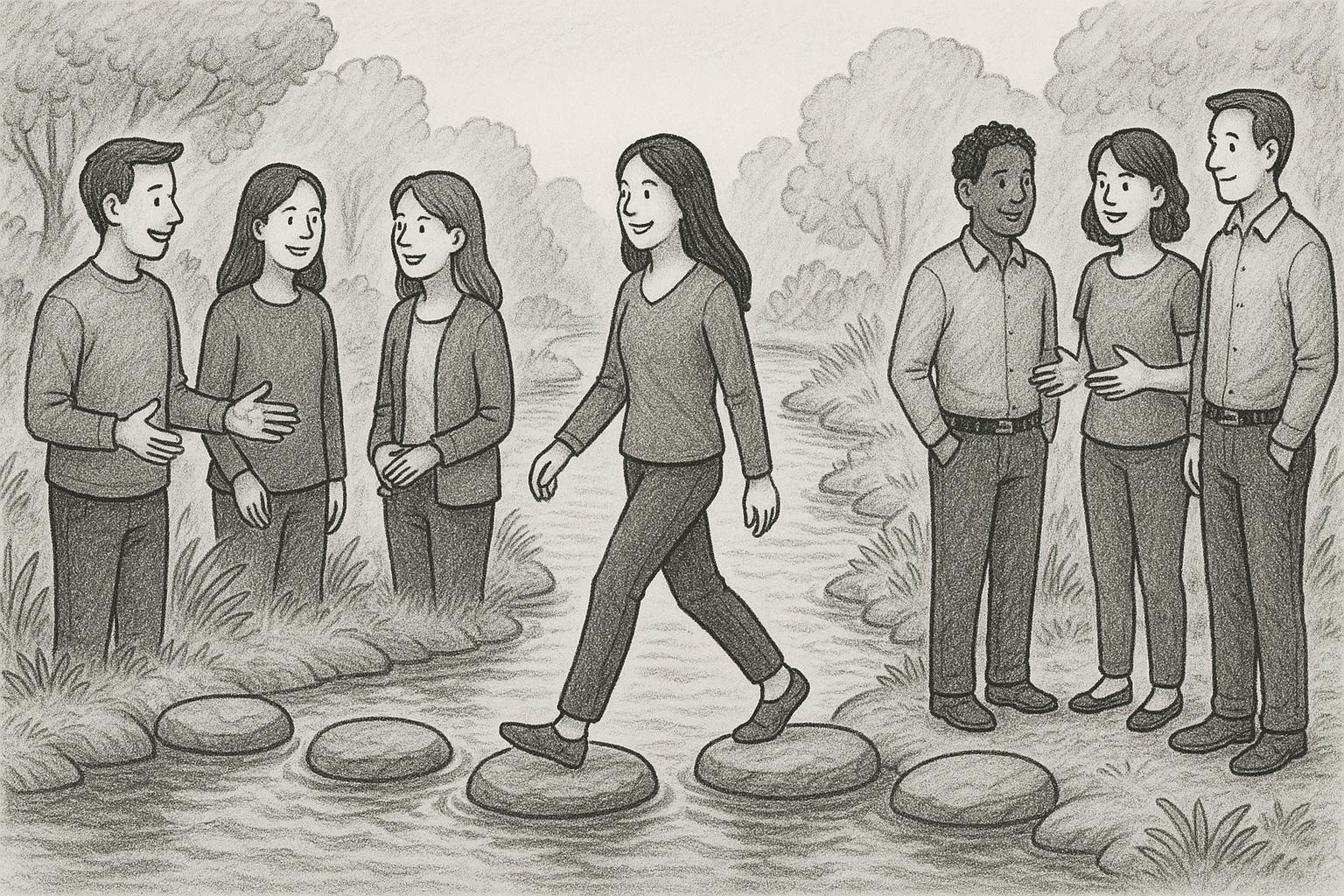
Illustration of a bridge with elders and young adults smiling at each other

By Bosisso Charles Takougnadi (TBC) ’27

Usually, we see deliberation as a practice based on mutual respect, critical thinking, and open dialogue. Yet how we engage in deliberation and how we view it can differ quite a lot from one generation to the next. As a DCI Fellow, I’ve learned that talking with both younger and older people comes with its own set of challenges and opportunities. When we recognize these differences as aspects of our identities, we can build more inclusive spaces to deliberate. To what extent do generational differences create a gap during discussions involving two or more generations?

To start off, contrasting methods of discussion are one way to achieve an effective deliberation. In my experience this year (which I fully acknowledge is limited and anecdotal), both young and old participants in a deliberation demonstrate two recurring patterns. Young people generally like having a more direct approach that is solution-oriented. This was common during my D Team meetings that I facilitated, as I observed very quick and short points and responses from young people aiming to reach a resolution and action plan. 

The older folks tended to make longer contributions to the conversation, giving, or requesting in the form of questions, a lot of information sometimes less directly relevant to the discussion. They valued taking their time, deep thinking, and a more ordered way of doing things. Not that younger people do not have similar values, but they seemed to exhibit them less often. I noted that while young people might prefer direct responses and be willing to shift the paradigm (although not always), older people often insist on how much past events and ways of doing things matter. 

Neither approach is necessarily better, but these differences can cause friction when people discuss contentious issues. I have seen older people asking younger participants (generally students) to explain their points further when the younger people thought they were clear enough. In a couple of instances, I noticed how older people in my group discussions can be more likely to directly confront other participants about their views. This made some of the younger people uncomfortable and upset. 

Dealing with contentious issues in cross-generational discussions can therefore be particularly challenging. For some young people, being direct and focusing on the present is vital to getting one’s point across in the room. Older people, on the other hand, often preferred a more experience-based analysis of the issue. When people of different ages come together, young folk sometimes feel ignored if others don’t agree with their ideas. Meanwhile, older people might think others don’t value the insights they have gained in their lives enough. 

Our approaches to addressing issues also shape how well we are received during a conversation. Young people often see conversations as a way to push for fast social change. But older people might be more careful thinking about long-term effects and consequences, taking into consideration their own experiences. This difference in how urgent things seem to different groups of people can make it feel like two separate talks are happening instead of one big conversation. 

Nonetheless, discussions between different age groups can be helpful. Older generations bring opinions based on decades of life experience that can be combined with the new ideas and paradigms that are popular with younger generations. One good way to bring generations together is to make sure everyone listens well so each person feels heard and valued.

Along these lines, the DCI Fellows Program taught me that adaptability represents the essential element for effective deliberation. Allowing generational differences to partially shape our discussions is necessary for a good deliberation. It will enhance understanding of one another and enable us to have meaningful dialogues. New ways of thinking emerge from younger generations while older generations provide experiential knowledge and historical depth. The process of deliberation must remain free from exclusive ownership by specific groups or engagement techniques. 

By recognizing generational differences as an aspect of people’s identities, we create opportunities for these differences to become valuable conversational topics. The evolution of future deliberative processes hinges upon our capacity to acquire knowledge from one another across divides, and particularly generational divides. Through patient and respectful dialogue combined with openness to new ideas, we need to develop a deliberative culture that empowers individuals of all ages to participate actively in deliberative democracy.

Filed Under: Fellow Posts

  • « Go to Previous Page
  • Page 1
  • Interim pages omitted …
  • Page 6
  • Page 7
  • Page 8
  • Page 9
  • Page 10
  • Interim pages omitted …
  • Page 32
  • Go to Next Page »

Footer

Blog Post Categories

  • Announcements
  • Blog Posts
  • DCI Posts
  • Events
  • Faculty Posts
  • Fellow Posts
Image of a compass superimposed by the text "Deliberative Citizenship Initiative" and "Davidson College." Clicking on this image leads to the Initiative page.

Recent DCI Blog Posts

  • We Tried to Fix Jubilee’s “Middle Ground” – Here’s How It Went
  • A Case for Deliberation in the Natural Sciences
  • Welcoming New Staff to the DCI and DCN
  • Facebook
  • Twitter
  • Instagram
  • LinkedIn


Copyright © 2026 · Infinity Pro on Genesis Framework · WordPress · Log in