• Skip to main content
  • Skip to footer

Deliberative Citizenship Initiative

Building Democracy One Conversation at a Time

  • The Initiative
    • Programs
      • Deliberation Across the Curriculum
      • Deliberation on Campus
      • Deliberation in the Community
      • Research on Deliberation
    • Motivations
      • Why Deliberative Citizenship?
      • Why Davidson? Why Now?
    • Who’s Involved?
      • DCI Fellows Cohorts
        • 2025-2026 Fellows
        • 2024-2025 Fellows
        • 2023-2024 Fellows
        • 2022-2023 Fellows
        • 2021-2022 Fellows
        • 2020-2021 Fellows
      • DeeP Collaborative Cohorts
        • 2024-2025 DeeP Collaborative Faculty
        • 2023-2024 DeeP Collaborative Faculty
      • Advisory Council
    • History
      • What Sparked the Initiative?
    • Key Deliberative Dispositions
    • Frequently Asked Questions (FAQ)
    • Annual Report
  • Get Involved!
    • Participate in a Forum
    • Join a D Team
    • Become a Fellow
    • Take Courses
    • Get Training
    • Come to Guest Lectures
  • Events
    • Upcoming Events
      • 250th Anniversary Deliberative Forum Series on American Values
    • Past Events
  • Connections
    • The Deliberative Citizen: The DCI’s Monthly Newsletter
    • Efforts on Campus
    • Efforts in the Community
    • Efforts Elsewhere
    • Readings and Resources
      • DCI-Published Guides
      • DCI Guide to One-on-One Conversations
      • How to Disagree
      • Demonstration of Facilitation Styles
      • Deliberative Pedagogy Mini-Course
    • How We Can Help: DCI’s LET’S DELIBERATE! Partnership Opportunities
    • DCI in the News
  • DCI Blog Posts
    • Recent Blog Posts
    • All Blog Posts

Blog Posts

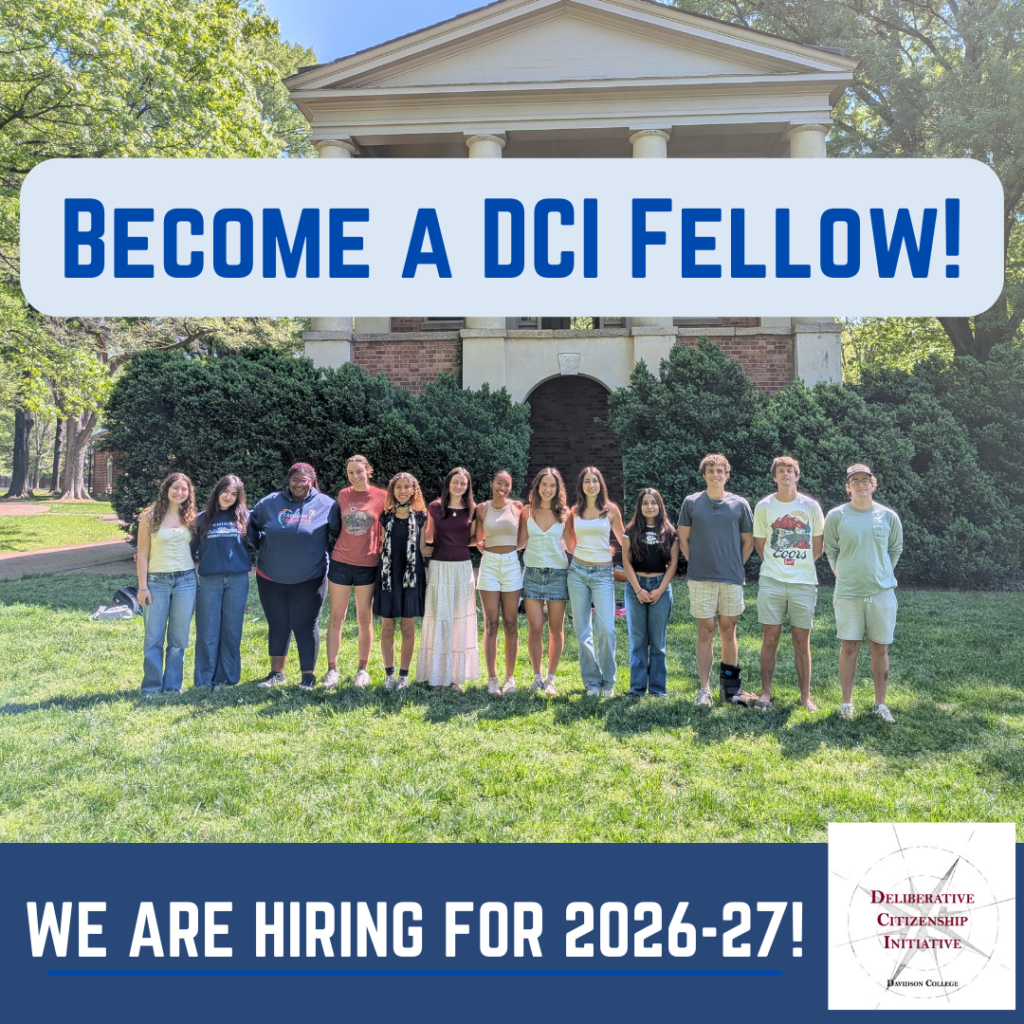
Apply Today to Become a 2026-27 DCI Student Fellow!

April 17, 2026 by Graham Bullock

Each year, the DCI selects 15-20 students to serve as Deliberative Citizenship Fellows. These fellows spend the year playing a leadership role in the initiative. They immerse themselves in deliberative theory and methods, help choose the issues for the year’s focus, facilitate robust deliberations on those issues, and reflect on and document their experiences as sponsors of these discussions.

Applications for the 2026-27 Fellowship Program are now open. All Davidson students are welcome to apply. To submit your application, please complete the ‘Deliberative Citizenship Initiative – Fellows Application’ form on WildcatSync. The priority application deadline is May 11. Applications will remain open and new submissions accepted on a rolling basis until all positions have been filled by qualified candidates. To learn more and apply for this opportunity, check out the short videos about the program that features several of the DCI’s past fellows and the Fellows Job Description below.

20265-26 Fellows Share Their Thoughts on the DCI Fellows Program

2024-25 Fellows Share Their Thoughts on the DCI Fellows Program

2023-24 Fellows Share Their Thoughts on the DCI Fellows Program
DCI-Fellows-2026-27-Job-Description

Filed Under: Announcements, Blog Posts

Introducing the Davidson Deliberates Radio Show and Podcast

March 12, 2026 by Graham Bullock

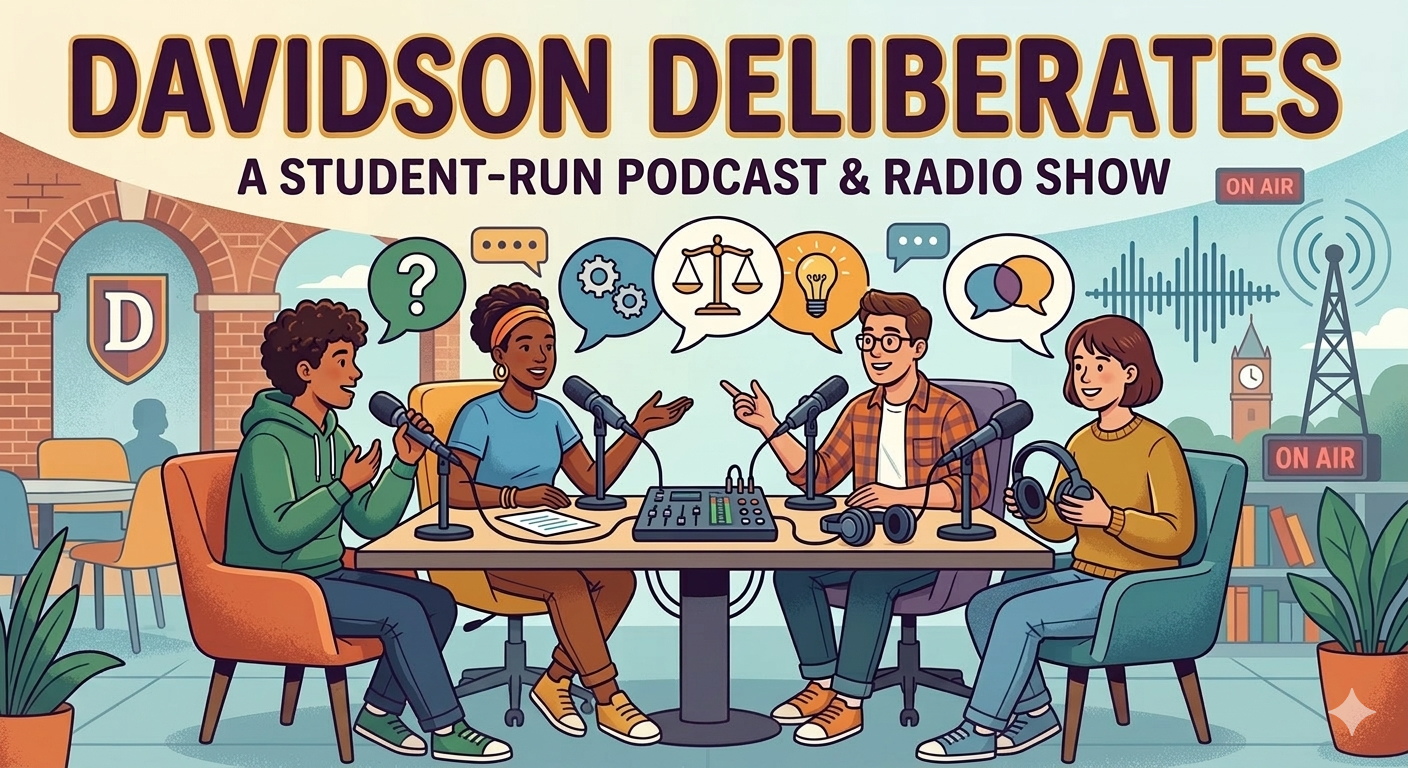
Davidson Deliberates cartoon image with four students sitting around a table talking to microphones.

Ezra Minard ’28 (DCI Fellow)

Davidson Deliberates is a new podcast and radio show dedicated to exemplifying the DCI’s deliberative spirit while offering members of the Davidson community a space to thoughtfully engage with contentious issues. The show, which airs from 1 pm to 2 pwm on Tuesdays on the Davidson student radio station (WALT 1610), aims to be a platform for examining challenging questions as close to home as campus and Davidson politics and as global as foreign affairs. At its core, the podcast is both a forum for serious discussion and an introduction to the DCI itself, highlighting its mission and events while also modeling good argument and deliberation.

The topics of deliberation have ranged from the low-stakes yet controversial “is a hotdog a sandwich?” question (see the February 3rd Episode below) to examinations of the benefits, shortcomings, and potential reforms to contemporary American society safety nets, such as Social Security (See the February 21st Episode below). The first pilot episode was hosted by DCI Fellows Grace Zagoria ’27 and Zach Abdulahi ’27 last spring, and then Zak and I continued the series this past fall as Grace is studying abroad this year. With Zak off campus as well this spring, DCI Fellow Bolling Lewis ’28 has stepped up to co-host the show with me this spring.

Rather than following a traditional question-and-answer interview format, Davidson Deliberates is more interested in the genuine exchange of ideas. Bolling and I have and will continue to alternate between modeling deliberation in conversation with one another and serving as facilitators whenever we host guests. Also, we perform the role of the devil’s advocate when necessary to promote productive dialogue. Intellectual diversity is paramount to the show’s purpose, as reflected by our desire to bring differing perspectives and experiences to the WALT studio table. By doing so, we hope to encourage open and rigorous participation from any and all groups that may be interested in participating in productive dialogue.

Questions surrounding the issue of platforming inevitably arise from this work. As I argue in my recent blog post, “The Case Against Denunciation,” condemnation often hardens opposition to one’s position, producing the very resistance that persuasion seeks to overcome. Persuasion, on the other hand, better preserves the possibility of changing minds because it invites its interlocutor to engage in good faith. Furthermore, I argue that deplatforming rarely prohibits conversation from occurring, but instead relocates those conversions to spaces where they are less likely to be challenged, thereby encouraging echo chambers.

Davidson Deliberates functions as a location where those conversations are not only allowed but encouraged and sought out. Finally, I do not assert that there is not a time nor a place for denunciation or for deplatforming. In fact, these practices may be justified in certain circumstances. But, here, in this moment marked by polarization and cynicism against good faith conversation, Davidson Deliberates seeks to meet the need for productive dialogue.

Check out some of our shows below…

“Davidson Deliberates” Radio Show and Podcast (Feb. 3, 2026 Episode)

“Davidson Deliberates” Radio Show and Podcast (Feb. 21, 2026 Episode)

Filed Under: Announcements, Blog Posts, Fellow Posts

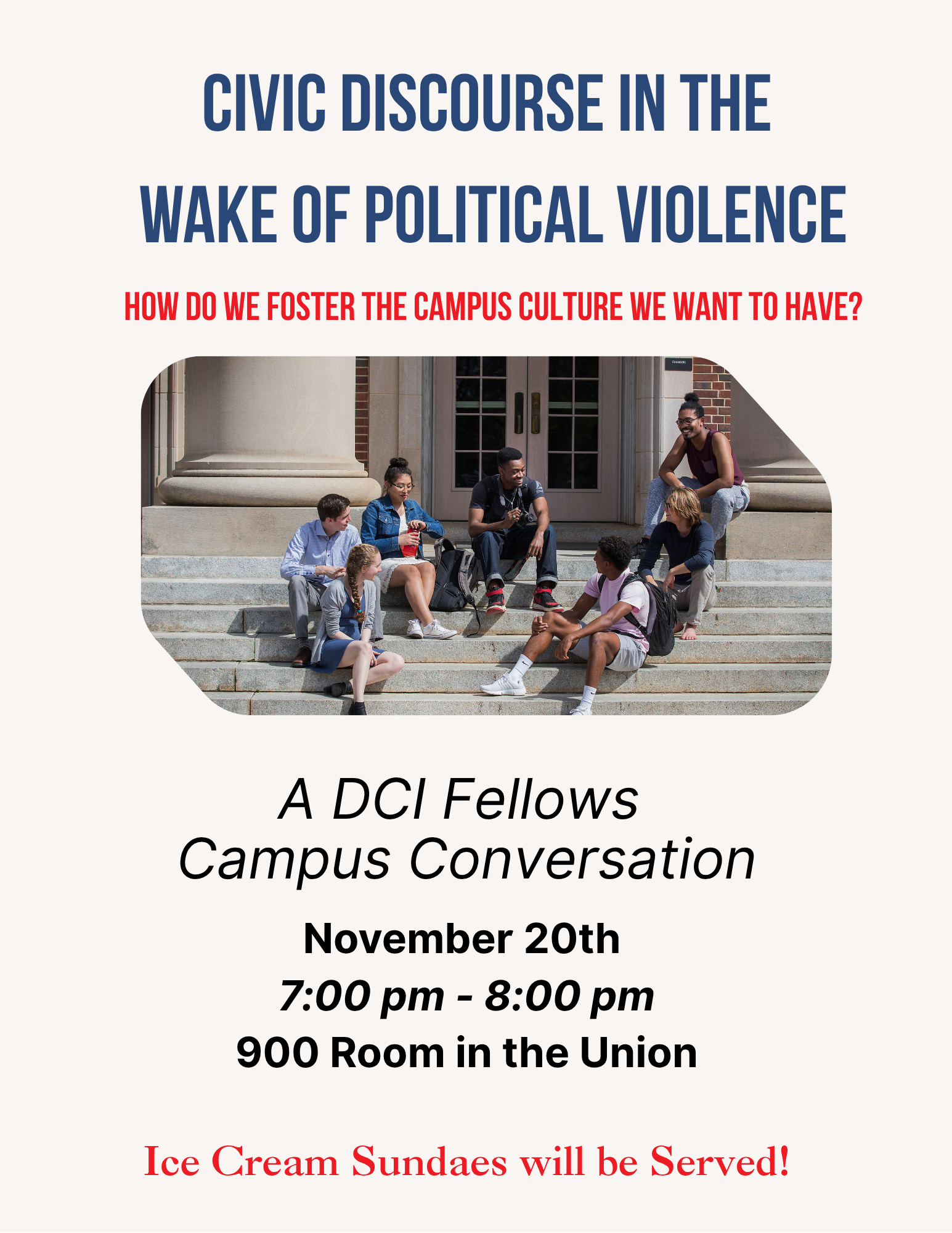
Civic Discourse in the Wake of Political Violence: A DCI Fellows Campus Conversation

November 13, 2025 by Graham Bullock

Thursday, November 20 | 7:00 p.m. | 900 Room

Ice cream sundaes will be served! Join us and bring some friends!

In a time marked by a troubling rise in political violence, how can we, as a campus community, model the kind of civic discourse our society so urgently needs? This campus conversation invites students, faculty, and staff to reflect together on how we can foster a culture of free expression, respectful dialogue, and robust deliberation at Davidson. This event seeks to follow-up on the September joint editorial in The Davidsonian by the presidents of the College Democrats, College Republicans, and College Libertarians that included a multi-part pledge to promote a culture of free expression that rejects political violence. Several Deliberative Citizenship Initiative Fellows have been developing a set of aspirational commitments designed to build on that pledge by articulating specific, community-driven principles to help us navigate the tensions inherent in public discourse today. 

After the Fellows present their initial ideas, attendees will break into small groups to explore how these aspirations might play out in specific campus scenarios. They’ll also be invited to offer their own ideas on how we might develop a shared vision for an inclusive and deliberative culture of civic discourse at Davidson. The goal is not to generate new rules or regulations, but to cultivate a meaningful and authentic grassroots framework for how we engage with one another across differences, an approach that could serve as a model for other campuses across the country. 

Filed Under: Blog Posts, DCI Posts, Events

Economic Anxiety in Political Discourse: Bridging Perceptions, Reality, and Inequality through Deliberation

October 9, 2025 by Zak Abdulahi

By Zak Abdulahi ’27 (DCI Fellow)

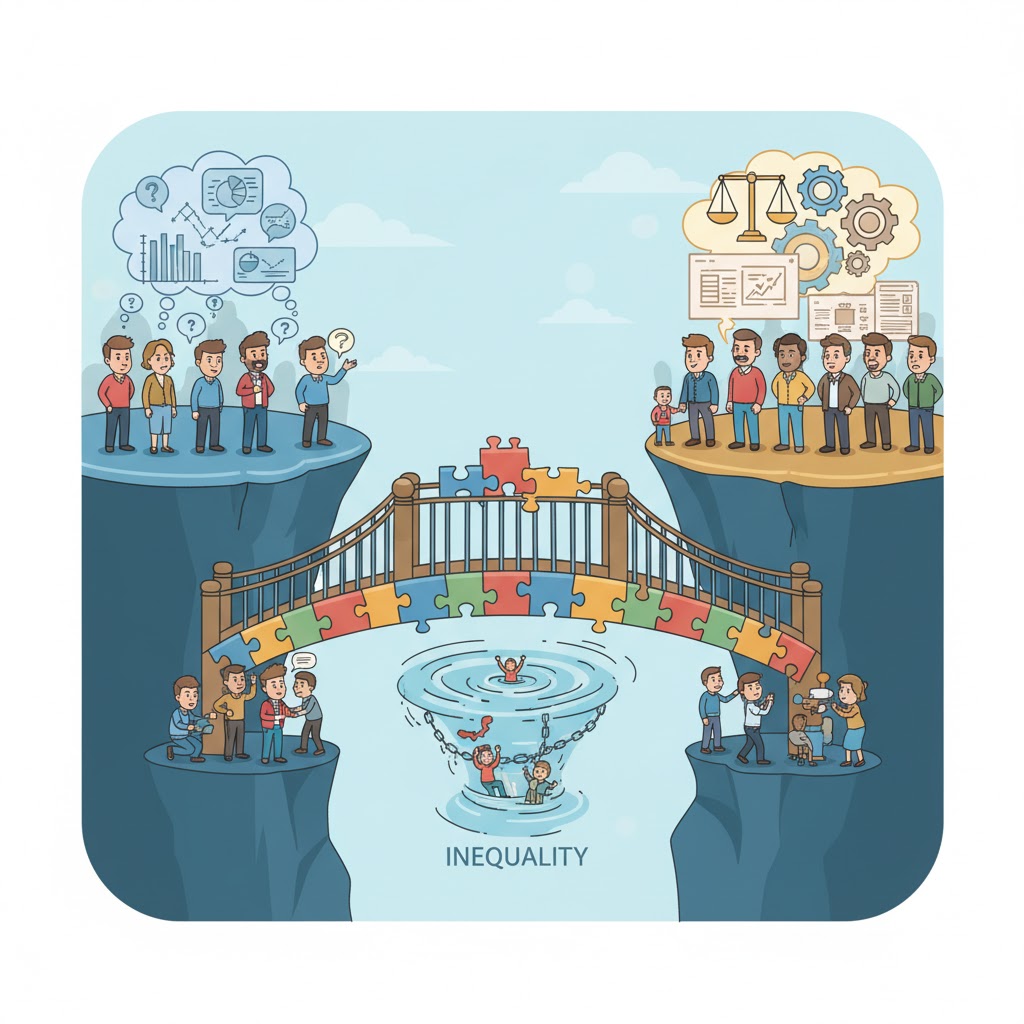
Why does economic anxiety seem more divisive than ever? Anxiety and uncertainty regarding the economy have shaped and dominated our conversations recently in a rapidly changing geopolitical environment. This trend has been compounded by rising costs and the inequality of economic growth and development. Our perceptions regarding the economy have become increasingly tied to our political beliefs and leanings. We see a pricey carton of eggs and either fully comprehend the complex interplay of inflation, commodity prices, and H5N1 containment germ theory—or we incessantly blame it on whichever politician we already dislike. Despite consistent economic growth, inflation and cost of living concerns have created a large gap between economic reality and perceptions – and public perceptions of the economy has remained consistently negative. 

This raises a key question: Can deliberation cut through partisan framing, misinformation, and economic anxiety? And more importantly—what would our society look like if it did?

How Our Experiences Shape Our Perceptions: Economic perceptions are shaped by a multitude of factors: geography, background, and income level. Rising wealth inequality has exacerbated the differences in lived experiences between the “haves” and “have-nots,” creating a society where economic realities are filtered through vastly different lenses. One person sees a thriving market, tainted with green S&P indexes. Another person sees their grocery bills become less affordable each week through painfully clear lenses. Despite these disparate experiences, it is incredibly important to attempt to create space to bridge these divides. 

Deliberation creates that space. Valuing both data and lived experience, it allows people to share how the economy feels to them, bridging that divide between perception and reality, looking beyond the data to unlock more productive, human centered conversations. 

Deliberation in Action: Davidson College’s Forum on Income Inequality: A powerful example of this approach in action was the November 2024 Deliberative Forum hosted by the Deliberative Citizenship Initiative (DCI) at Davidson College, where nearly 200 students and community members gathered to ask: “How should Americans respond to income inequality?” The event began with a panel of experts from a range of ideological and professional backgrounds, followed by small-group deliberations focused on listening and understanding—not winning arguments.

Comments from participants in the post-event survey revealed how such structured, respectful economic dialogue—especially when rooted in real experiences—can overcome surface-level disagreements and address deeper economic divides.

  • “Deep assessment of a complex problem from multiple perspectives. Outstanding experience.”
  • “Participating in the Deliberative Forum on wealth and income inequality helped me learn more information about these topics and also to discover strategies for finding common ground on the topic.”
  • “The facilitated small group deliberations are… such a breath of fresh air and source of hope amidst our current polarization and paucity of thoughtful discussions across differences.” 

The Wisdom (and Limits) of Deliberation: Scholarly work supports this idea. A 2024 article by Franz Dietrich and Kai Spiekermann in Economic Theory shows how deliberation can improve group decision-making by reducing common voting failures, such as overcounting popular ideas or ignoring valuable minority perspectives. When done right, deliberation allows us to weigh diverse forms of evidence more fairly and make wiser collective choices.

However, they also caution that deliberation isn’t inherently good—it must be structured, inclusive, and balanced to avoid simply reinforcing dominant narratives. That’s especially important in economic conversations, where loud voices or dominant ideologies can drown out marginalized experiences.

Reclaiming Economic Discourse through Dialogue: If we want to confront economic anxiety, inequality, and barriers to growth head-on, we must first change how we talk about them. That means moving past soundbites and toward spaces that prioritize empathy, curiosity, and real listening. It means holding space for both the data and the day-to-day stress of rising costs. It means deliberating.

When we engage with each other across economic experiences—guided by the principles of deliberative citizenship—we don’t just debate policy. We understand each other better. And in today’s political climate, that may be the most valuable form of progress we can make.

Opinions expressed on the DCI Blog are solely those of the author and do not necessarily represent the official views or positions of the Deliberative Citizenship Initiative.

Filed Under: Blog Posts, Fellow Posts

Bridging Perspectives: Leadership Through Deliberation

August 11, 2025 by Tehinnah Kitcher

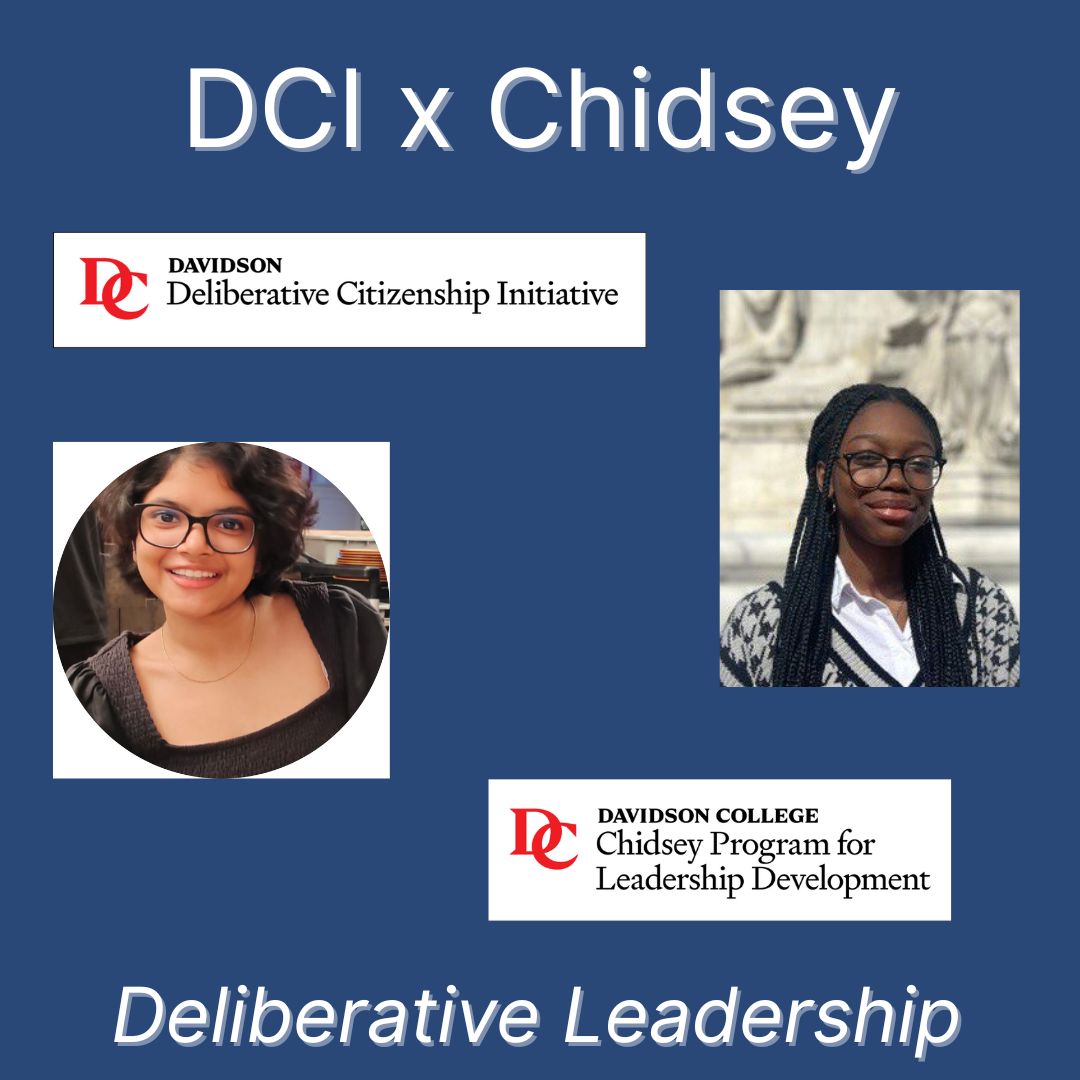
Chidsey and DCI logos and photos of Tehinnah and Atyantika

By Tehinnah Kitcher ’27 (DCI Fellow)

This past March, I had the opportunity to co-lead a project called “Bridging Perspectives: Empowering Leaders to Connect, Deliberate, and Drive Change Together” alongside senior DCI fellow Atyantika Mookherjee that united the Chidsey Program for Leadership Development and the Deliberative Citizenship Initiative (DCI).

The Chidsey Leadership Fellows’ Program emphasizes leadership as an intentional and evolving practice, focusing on personal choice, resilience, opportunity, and connection. It views leadership as a journey shaped by decisions, the courage to tackle challenges, the openness to see possibility, and the commitment to build connections. By embracing these pillars, Chidsey Fellows learn to grow as leaders who can positively impact their communities through empathy, responsibility, and collaboration. As both Chidsey and DCI Fellows, Atyantika and I both noticed that together, the DCI and Chidsey provide students with a powerful set of complementary skills: DCI cultivates the ability to navigate complex discussions, while Chidsey emphasizes leading with empathy and purpose.

In our session with the Chidsey Fellows, we gave them an overview of the four facilitation styles and specific techniques to enhance communication and build understanding. We drew from the same frameworks that we learned in our official DCI facilitator training. Each style offered a different way of guiding a conversation and shaping group dynamics. The Chidsey Fellows then had the opportunity to play these roles through a mock deliberation. Afterwards, they reflected on their facilitation styles and skills.

This unique collaboration between DCI and the Chidsey Leadership Program helps to create future leaders who are equipped not only with technical skills but also with a deeper understanding of how to navigate complex, real-world challenges. By integrating DCI’s facilitation skills, which are centered around being attentive, respectful, and open-minded, with Chidsey’s core values, we’re fostering leaders who can engage in constructive, inclusive conversations. Such leaders are more adaptable, open to diverse viewpoints, and skilled at finding common ground, all of which are critical in a rapidly changing and interconnected world.

I am excited to see the DCI continue to collaborate and engage with the campus and broader community. Future collaborations would undoubtedly provide greater insights as to how dialogue and deliberation influence other fields. In a world that is growing more polarized and intolerant, quality deliberation and dialogue are essential. If you are interested in getting connected with the DCI, be sure to join a D Team in the fall or attend one of our forums!

Filed Under: Blog Posts, Fellow Posts

  • Page 1
  • Page 2
  • Page 3
  • Interim pages omitted …
  • Page 38
  • Go to Next Page »

Footer

Blog Post Categories

  • Announcements
  • Blog Posts
  • DCI Posts
  • Events
  • Faculty Posts
  • Fellow Posts
Image of a compass superimposed by the text "Deliberative Citizenship Initiative" and "Davidson College." Clicking on this image leads to the Initiative page.

Recent DCI Blog Posts

  • We Tried to Fix Jubilee’s “Middle Ground” – Here’s How It Went
  • A Case for Deliberation in the Natural Sciences
  • Welcoming New Staff to the DCI and DCN
  • Facebook
  • Twitter
  • Instagram
  • LinkedIn


Copyright © 2026 · Infinity Pro on Genesis Framework · WordPress · Log in