• Skip to main content
  • Skip to footer

Deliberative Citizenship Initiative

Building Democracy One Conversation at a Time

  • The Initiative
    • Programs
      • Deliberation Across the Curriculum
      • Deliberation on Campus
      • Deliberation in the Community
      • Research on Deliberation
    • Motivations
      • Why Deliberative Citizenship?
      • Why Davidson? Why Now?
    • Who’s Involved?
      • DCI Fellows Cohorts
        • 2025-2026 Fellows
        • 2024-2025 Fellows
        • 2023-2024 Fellows
        • 2022-2023 Fellows
        • 2021-2022 Fellows
        • 2020-2021 Fellows
      • DeeP Collaborative Cohorts
        • 2024-2025 DeeP Collaborative Faculty
        • 2023-2024 DeeP Collaborative Faculty
      • Advisory Council
    • History
      • What Sparked the Initiative?
    • Key Deliberative Dispositions
    • Frequently Asked Questions (FAQ)
    • Annual Report
  • Get Involved!
    • Participate in a Forum
    • Join a D Team
    • Become a Fellow
    • Take Courses
    • Get Training
    • Come to Guest Lectures
  • Events
    • Upcoming Events
      • 250th Anniversary Deliberative Forum Series on American Values
    • Past Events
  • Connections
    • The Deliberative Citizen: The DCI’s Monthly Newsletter
    • Efforts on Campus
    • Efforts in the Community
    • Efforts Elsewhere
    • Readings and Resources
      • DCI-Published Guides
      • DCI Guide to One-on-One Conversations
      • How to Disagree
      • Demonstration of Facilitation Styles
      • Deliberative Pedagogy Mini-Course
    • How We Can Help: DCI’s LET’S DELIBERATE! Partnership Opportunities
    • DCI in the News
  • DCI Blog Posts
    • Recent Blog Posts
    • All Blog Posts

Zak Abdulahi

Economic Anxiety in Political Discourse: Bridging Perceptions, Reality, and Inequality through Deliberation

October 9, 2025 by Zak Abdulahi

By Zak Abdulahi ’27 (DCI Fellow)

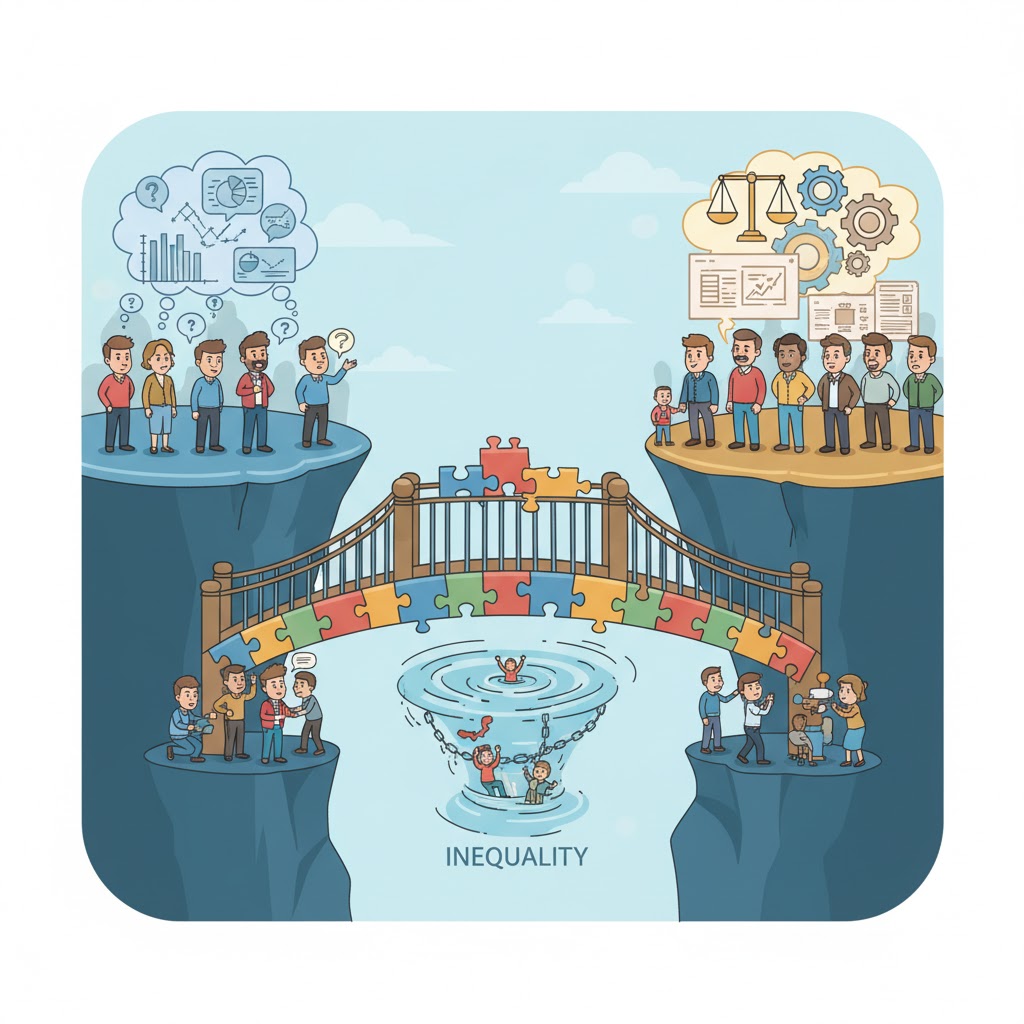
Why does economic anxiety seem more divisive than ever? Anxiety and uncertainty regarding the economy have shaped and dominated our conversations recently in a rapidly changing geopolitical environment. This trend has been compounded by rising costs and the inequality of economic growth and development. Our perceptions regarding the economy have become increasingly tied to our political beliefs and leanings. We see a pricey carton of eggs and either fully comprehend the complex interplay of inflation, commodity prices, and H5N1 containment germ theory—or we incessantly blame it on whichever politician we already dislike. Despite consistent economic growth, inflation and cost of living concerns have created a large gap between economic reality and perceptions – and public perceptions of the economy has remained consistently negative. 

This raises a key question: Can deliberation cut through partisan framing, misinformation, and economic anxiety? And more importantly—what would our society look like if it did?

How Our Experiences Shape Our Perceptions: Economic perceptions are shaped by a multitude of factors: geography, background, and income level. Rising wealth inequality has exacerbated the differences in lived experiences between the “haves” and “have-nots,” creating a society where economic realities are filtered through vastly different lenses. One person sees a thriving market, tainted with green S&P indexes. Another person sees their grocery bills become less affordable each week through painfully clear lenses. Despite these disparate experiences, it is incredibly important to attempt to create space to bridge these divides. 

Deliberation creates that space. Valuing both data and lived experience, it allows people to share how the economy feels to them, bridging that divide between perception and reality, looking beyond the data to unlock more productive, human centered conversations. 

Deliberation in Action: Davidson College’s Forum on Income Inequality: A powerful example of this approach in action was the November 2024 Deliberative Forum hosted by the Deliberative Citizenship Initiative (DCI) at Davidson College, where nearly 200 students and community members gathered to ask: “How should Americans respond to income inequality?” The event began with a panel of experts from a range of ideological and professional backgrounds, followed by small-group deliberations focused on listening and understanding—not winning arguments.

Comments from participants in the post-event survey revealed how such structured, respectful economic dialogue—especially when rooted in real experiences—can overcome surface-level disagreements and address deeper economic divides.

  • “Deep assessment of a complex problem from multiple perspectives. Outstanding experience.”
  • “Participating in the Deliberative Forum on wealth and income inequality helped me learn more information about these topics and also to discover strategies for finding common ground on the topic.”
  • “The facilitated small group deliberations are… such a breath of fresh air and source of hope amidst our current polarization and paucity of thoughtful discussions across differences.” 

The Wisdom (and Limits) of Deliberation: Scholarly work supports this idea. A 2024 article by Franz Dietrich and Kai Spiekermann in Economic Theory shows how deliberation can improve group decision-making by reducing common voting failures, such as overcounting popular ideas or ignoring valuable minority perspectives. When done right, deliberation allows us to weigh diverse forms of evidence more fairly and make wiser collective choices.

However, they also caution that deliberation isn’t inherently good—it must be structured, inclusive, and balanced to avoid simply reinforcing dominant narratives. That’s especially important in economic conversations, where loud voices or dominant ideologies can drown out marginalized experiences.

Reclaiming Economic Discourse through Dialogue: If we want to confront economic anxiety, inequality, and barriers to growth head-on, we must first change how we talk about them. That means moving past soundbites and toward spaces that prioritize empathy, curiosity, and real listening. It means holding space for both the data and the day-to-day stress of rising costs. It means deliberating.

When we engage with each other across economic experiences—guided by the principles of deliberative citizenship—we don’t just debate policy. We understand each other better. And in today’s political climate, that may be the most valuable form of progress we can make.

Opinions expressed on the DCI Blog are solely those of the author and do not necessarily represent the official views or positions of the Deliberative Citizenship Initiative.
Filed Under: Blog Posts, Fellow Posts

Beyond the Ballot: The Power of Between-Election Deliberative Small Talk

May 22, 2025 by Zak Abdulahi

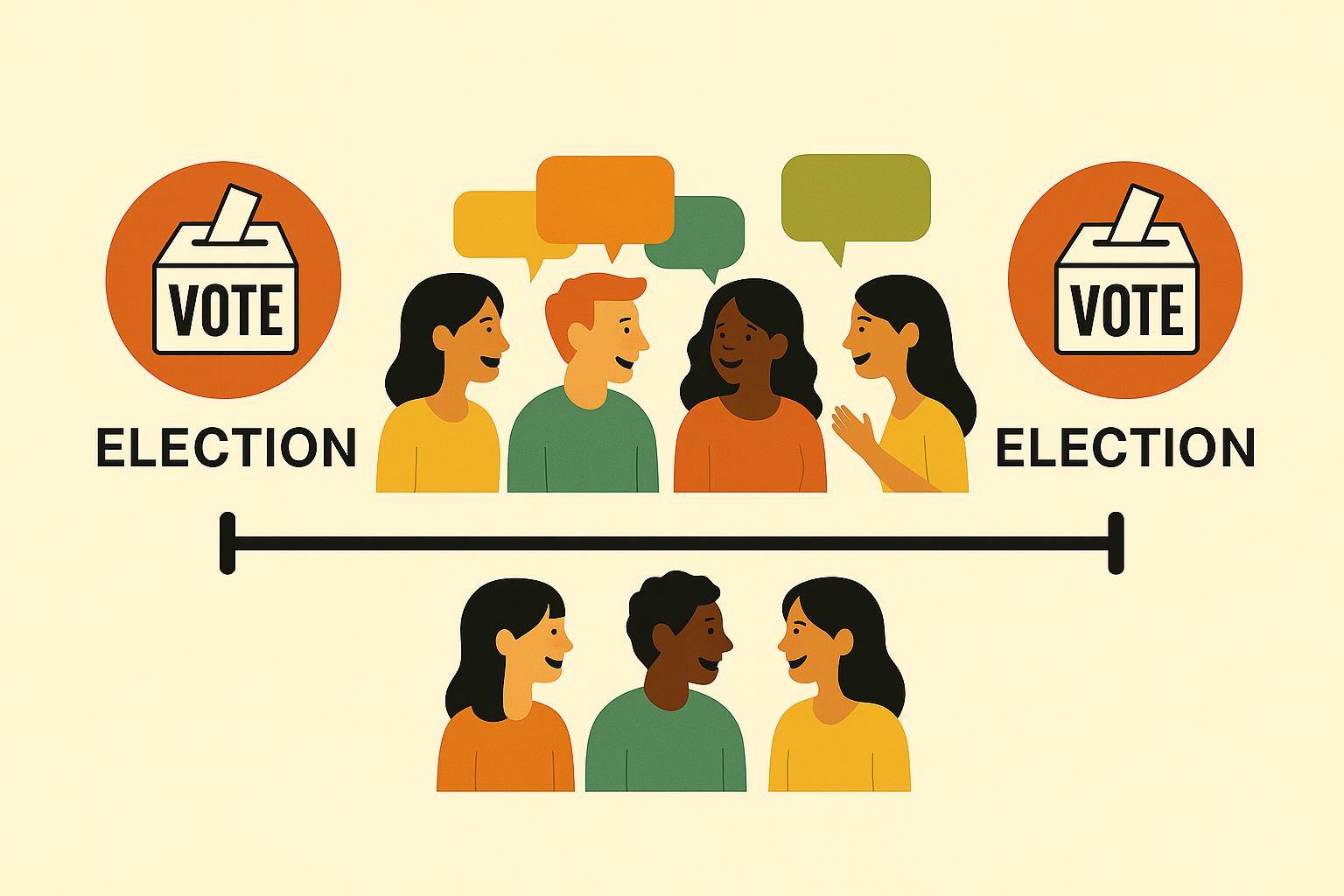
Image of an election timeline with people deliberating between two elections.

By Zak Abdulahi ’27 (DCI Fellow)

This month marks six months from the 2024 elections. Looking back, I can see how as the election dust settled, as the banners began to come down and a collective sigh of relief or anger echoed across the nation, we were tempted to push the whole ordeal to the back of our minds. Irrespective of how we felt about the outcome, most of us did not miss the phone calls from pollsters, constant campaign messages, and barrage of attack ads on TV. 

However, in the wake of the election our emotions, opinions, and beliefs may still be running high, and the euphoria or anxiety stemming from the election outcome is focused on the actions of the current administration and their implications for the next election cycle. But what if instead of sprinting towards the next campaign, we began to utilize this time between elections to engage in something rare but important: small intentional bouts of deliberation? 

Unlike the sweeping national discourse that dominates election season, post-election deliberative “small talk” thrives on localized conversations among friends, neighbors, colleagues and peers. These individuals gather to discuss the outcome and what it means for their communities. These conversations are a vital way to process election results and examine how new policies being implemented are affecting our local community, neighborhoods, and daily lives. In the wake of elections, we can re-engage with each other beyond these sweeping platitudes and campaign rhetoric. 

We can now take time to ask questions like:  What does this outcome mean for my town or city? How might this impact the services we rely on, or issues we care about? These questions are essential in the sense that they can help ground campaign sound bites and platitudes into tangible concrete personal terms. Moreover, smaller, consistent deliberation makes civic engagement sustainable. As opposed to tuning in every 4 years, intentionally creating lower-stakes and regular check-ins with your community will create a collective sense of involvement and shared responsibility.

Though these conversations may not be extremely formal, it is important to adopt and maintain a few key deliberative dispositions during our conversations. We should strive to engage in egalitarian-minded discussions, whether that be at a coffee shop, lunch, or any other social gathering. What matters most is that these conversations ensure everyone has a chance to speak, listen, and be heard. 

Finally, between-election deliberation is critical because it fosters accountability—not just of elected officials to their constituents but also among community members to one another. By coming together to discuss election outcomes and their implications, we build a shared sense of responsibility for staying informed and proactive. These conversations encourage us to reflect on how policies and decisions affect our neighborhoods and daily lives and motivate us to collaborate on solutions to address local issues.

It’s one thing to vote; it’s another to stay informed and invested in the outcomes of those votes on our communities and daily lives. Through small informal bouts of deliberation with our neighbors, colleagues and peers, we remind ourselves that democracy is a constant practice, not a one-time event, and that our engagement doesn’t end on election day.  

The late civil rights activist Kwame Ture once said, “You vote once in four years, and that’s your political responsibility? Politics is every day.” As we live in this time between elections, we must recognize that our democracy neither begins nor ends at the ballot box. By engaging in ongoing deliberation, we can foster lasting, sustainable change and ensure that our communities thrive—not just during election years, but every day.

Filed Under: Fellow Posts

Footer

Blog Post Categories

  • Announcements
  • Blog Posts
  • DCI Posts
  • Events
  • Faculty Posts
  • Fellow Posts
Image of a compass superimposed by the text "Deliberative Citizenship Initiative" and "Davidson College." Clicking on this image leads to the Initiative page.

Recent DCI Blog Posts

  • We Tried to Fix Jubilee’s “Middle Ground” – Here’s How It Went
  • A Case for Deliberation in the Natural Sciences
  • Welcoming New Staff to the DCI and DCN
  • Facebook
  • Twitter
  • Instagram
  • LinkedIn


Copyright © 2026 · Infinity Pro on Genesis Framework · WordPress · Log in