• Skip to main content
  • Skip to footer

Deliberative Citizenship Initiative

Building Democracy One Conversation at a Time

  • The Initiative
    • Programs
      • Deliberation Across the Curriculum
      • Deliberation on Campus
      • Deliberation in the Community
      • Research on Deliberation
    • Motivations
      • Why Deliberative Citizenship?
      • Why Davidson? Why Now?
    • Who’s Involved?
      • DCI Fellows Cohorts
        • 2025-2026 Fellows
        • 2024-2025 Fellows
        • 2023-2024 Fellows
        • 2022-2023 Fellows
        • 2021-2022 Fellows
        • 2020-2021 Fellows
      • DeeP Collaborative Cohorts
        • 2024-2025 DeeP Collaborative Faculty
        • 2023-2024 DeeP Collaborative Faculty
      • Advisory Council
    • History
      • What Sparked the Initiative?
    • Key Deliberative Dispositions
    • Frequently Asked Questions (FAQ)
    • Annual Report
  • Get Involved!
    • Participate in a Forum
    • Join a D Team
    • Become a Fellow
    • Take Courses
    • Get Training
    • Come to Guest Lectures
  • Events
    • Upcoming Events
      • 250th Anniversary Deliberative Forum Series on American Values
    • Past Events
  • Connections
    • The Deliberative Citizen: The DCI’s Monthly Newsletter
    • Efforts on Campus
    • Efforts in the Community
    • Efforts Elsewhere
    • Readings and Resources
      • DCI-Published Guides
      • DCI Guide to One-on-One Conversations
      • How to Disagree
      • Demonstration of Facilitation Styles
      • Deliberative Pedagogy Mini-Course
    • How We Can Help: DCI’s LET’S DELIBERATE! Partnership Opportunities
    • DCI in the News
  • DCI Blog Posts
    • Recent Blog Posts
    • All Blog Posts

DCI Posts

Welcoming New Staff to the DCI and DCN

July 21, 2026 by Graham Bullock

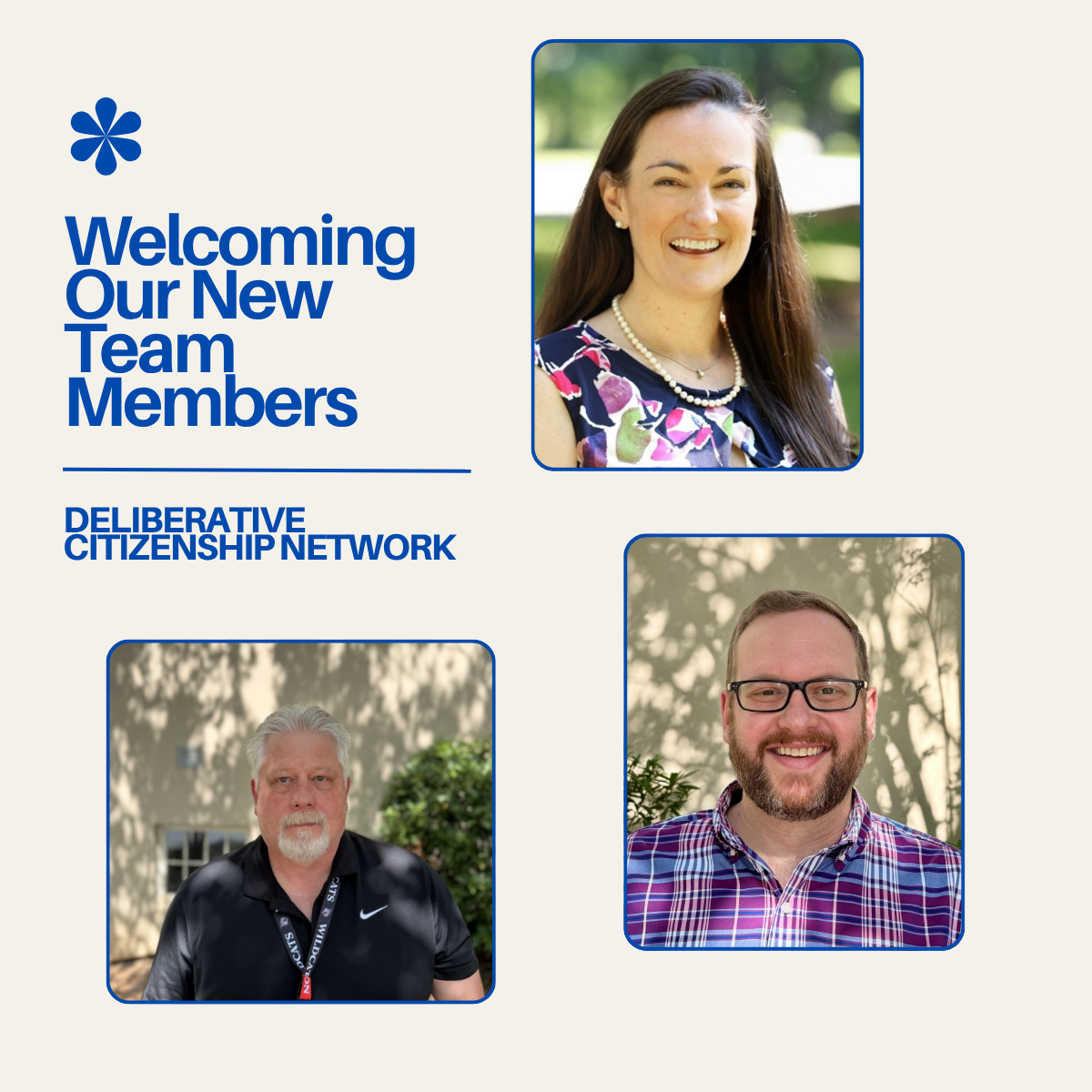
As we begin implementing our federal FIPSE grant to assist 100 higher education institutions in developing their own civil discourse programs, the Deliberative Citizenship Initiative (DCI) and Deliberative Citizenship Network (DCN) are delighted to welcome three new staff members to our growing team.

Anne-Marie Moehring joins us as Program Director for the DCI and DCN. She will serve as the programs’ chief operational leader, coordinate our work with DCN partner institutions and support the implementation of our interconnected training, deliberation, and outreach programs. Anne-Marie brings extensive experience in strategic communications, change management, and the administration of federally and state-funded initiatives.

David Callaway will serve as Assistant Director for Training Programs. David will lead the design and delivery of training experiences that equip faculty, staff, students, and community members to facilitate productive dialogue and deliberation. He brings more than a decade of experience working at the intersection of public policy, education, pluralism, religious freedom, and civic engagement.

Bob Ritchie is our new Assistant Director for Civil Discourse Programs. Bob will coordinate DCI programs hosted at Davidson that partner institutions in the Deliberative Citizenship Network will be able to join. These include the DCI Fellows Program, Deliberative Forums, D Teams, and guest speaker events. His background combines higher education teaching, civic engagement, public sector leadership, and extensive federal and local public service.

We are thrilled to have Anne-Marie, David, and Bob on board as we expand opportunities for productive engagement across differences at Davidson and throughout the growing Deliberative Citizenship Network. Please join us in welcoming them!

Filed Under: DCI Posts

Davidson Represented at Leadership Symposium on Civil Discourse

March 2, 2026 by Graham Bullock

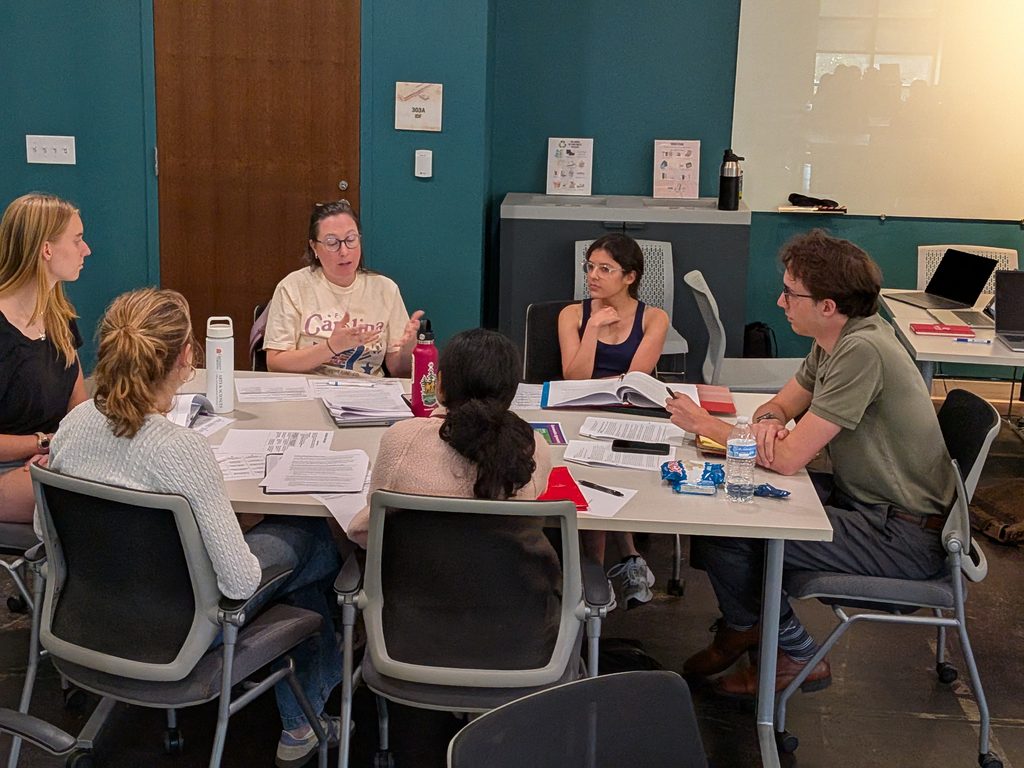
people sitting around a large conference table

By Graham Bullock (DCI Faculty Director)

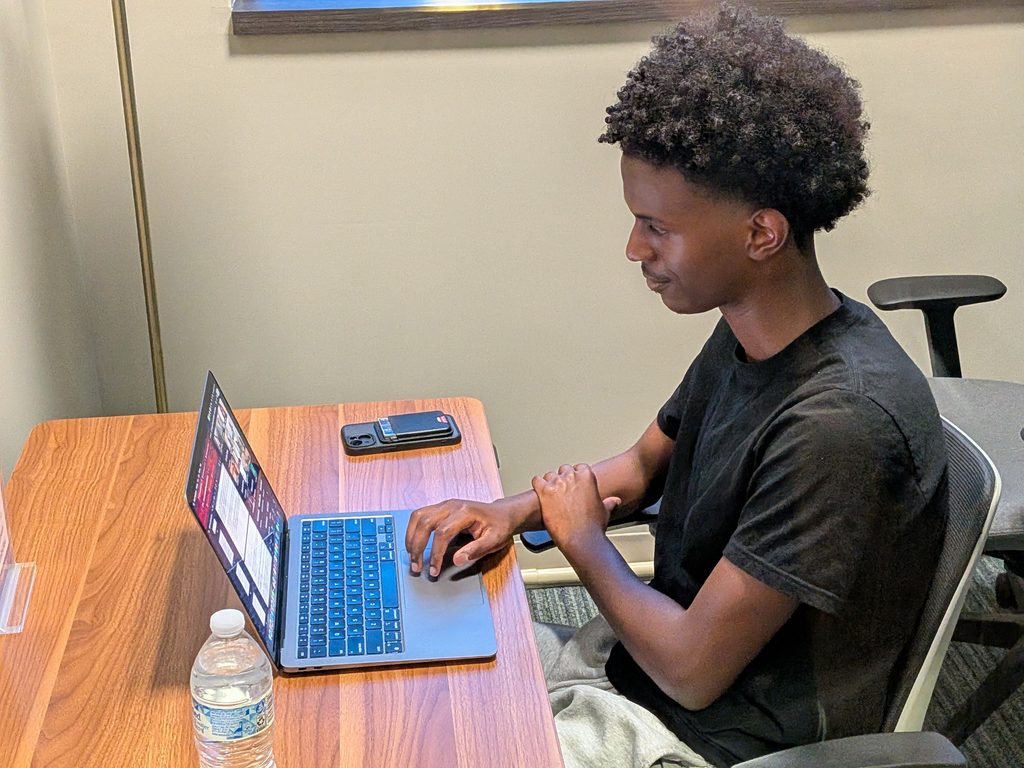
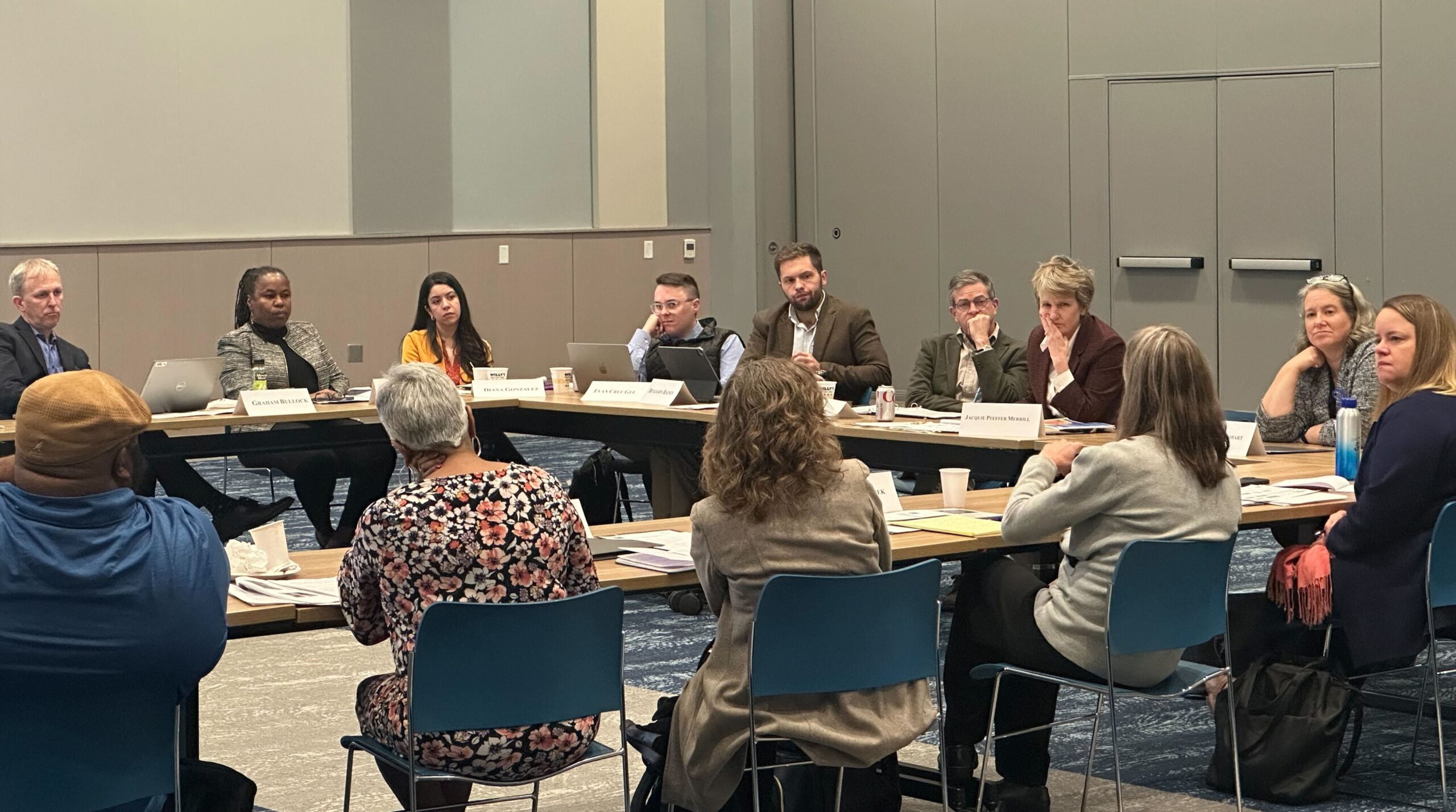
On November 13–14, 2025, I had the opportunity to participate in a Leadership Symposium on Civil Discourse: Conversations in the Classroom, Quad, and Community, hosted by Jacqueline Pfeffer Merrill and the Council of Independent Colleges (CIC) in partnership with Emory University.

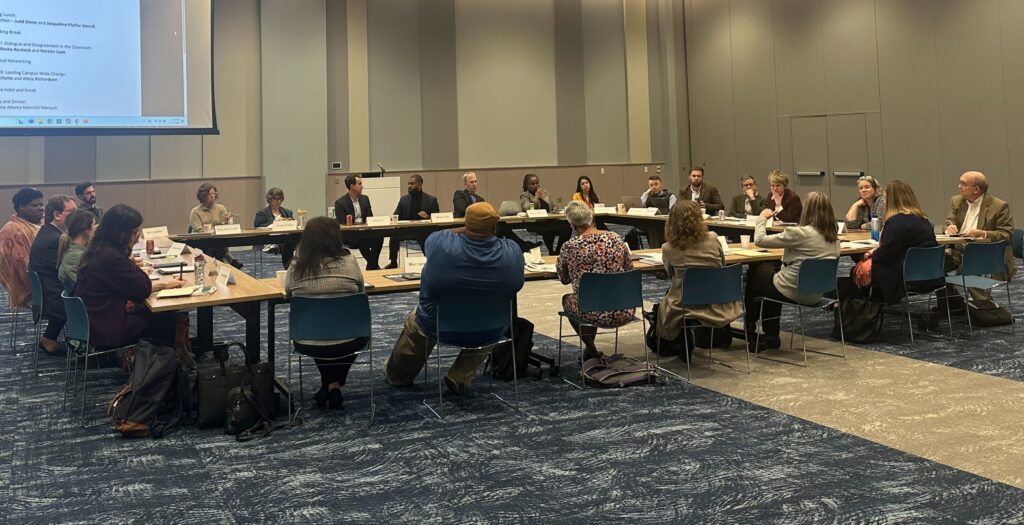
Dr. Merrill, CIC’s Senior Director for Civic Learning and Free Expression Projects, used the  symposium to bring together faculty members and higher education leaders from across the country to share ideas and strategies for strengthening civil discourse on our campuses. The gathering, held in Emory’s Student Center, focused on how institutions can foster thoughtful dialogue in classrooms, co-curricular programming, and the broader campus community.

I was honored to have the opportunity to co-lead Session III, “Civil Discourse Co-Curriculars,” with Daryl Lowe, Associate Vice President for Student Affairs at Spelman College. Our session explored how colleges can build meaningful opportunities outside the classroom that equip students to engage across difference with curiosity, respect, and intellectual rigor.

Wide angle view of conference attendees at main table

The symposium featured an impressive range of institutions and perspectives. Participants and session leaders represented colleges and universities including Emory University, Spelman College, Trinity University, Dickinson College, Hartwick College, Agnes Scott College, Oglethorpe University, Dalton State College, The University of the South, Carnegie Mellon University, Presbyterian College, The College of Wooster, Goshen College, and the University of Wisconsin, Eau Claire.

Throughout the two days, discussions emphasized practical approaches to navigating disagreement, supporting faculty and student development, and embedding civil discourse into the fabric of campus life. I was grateful for the chance to share insights from Davidson’s Deliberative Citizenship Initiative and to learn from colleagues who are leading innovative programs in dialogue, free expression, and student engagement at their institutions. At a moment when many in higher education feel under siege from multiple fronts, the symposium offered a powerful reminder that colleges and universities remain vital spaces for rigorous inquiry, principled disagreement, and meaningful community-building. I look forward to continuing the conversations that we started in Atlanta and following up on the great ideas we discussed together. The more we can share, the more we can make our own work better.

Filed Under: DCI Posts, Events

Fall 2025 Kickoff Party Re-Cap: Building the Best Democracy…with Legos!

January 27, 2026 by Graham Bullock

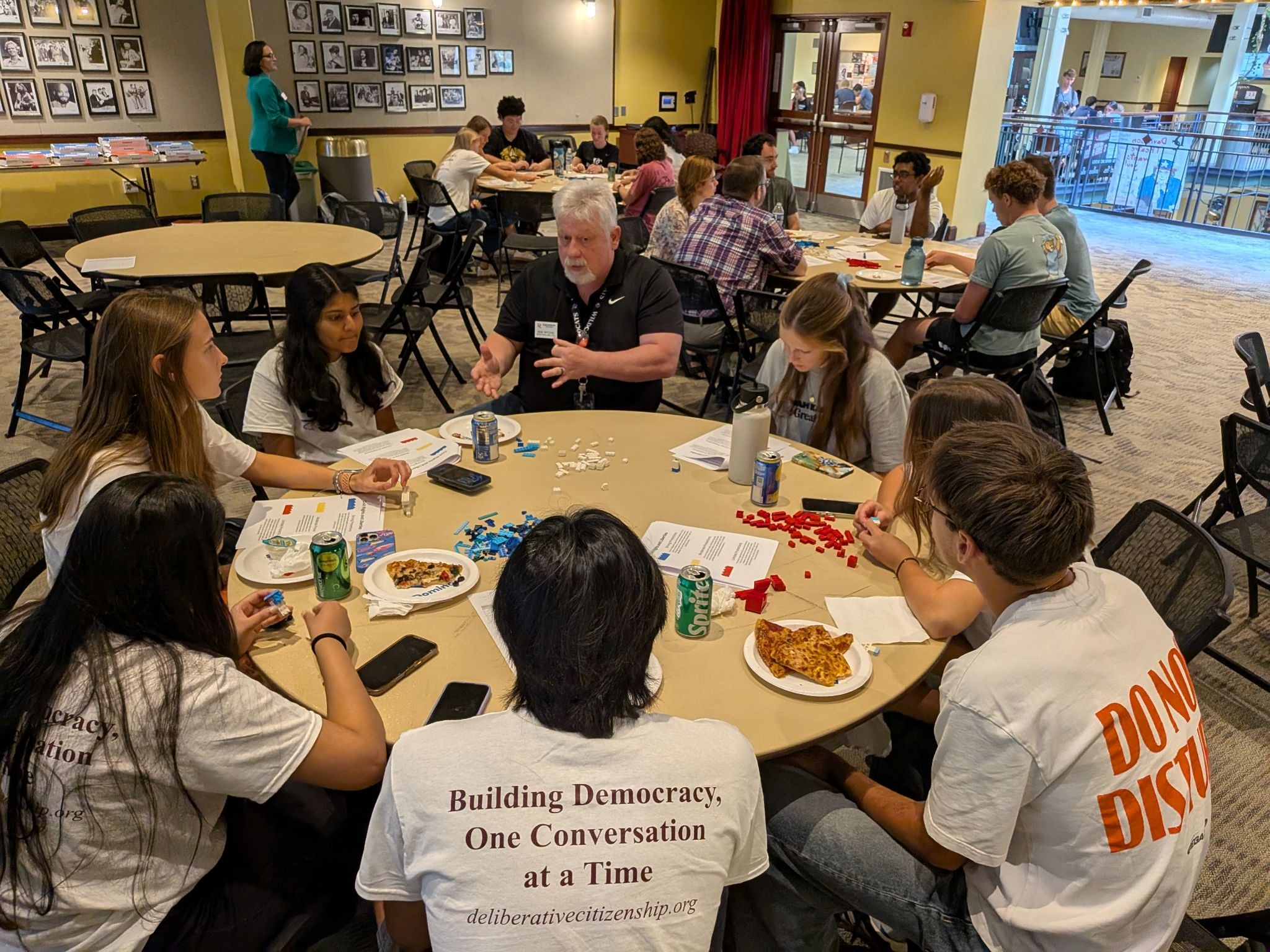
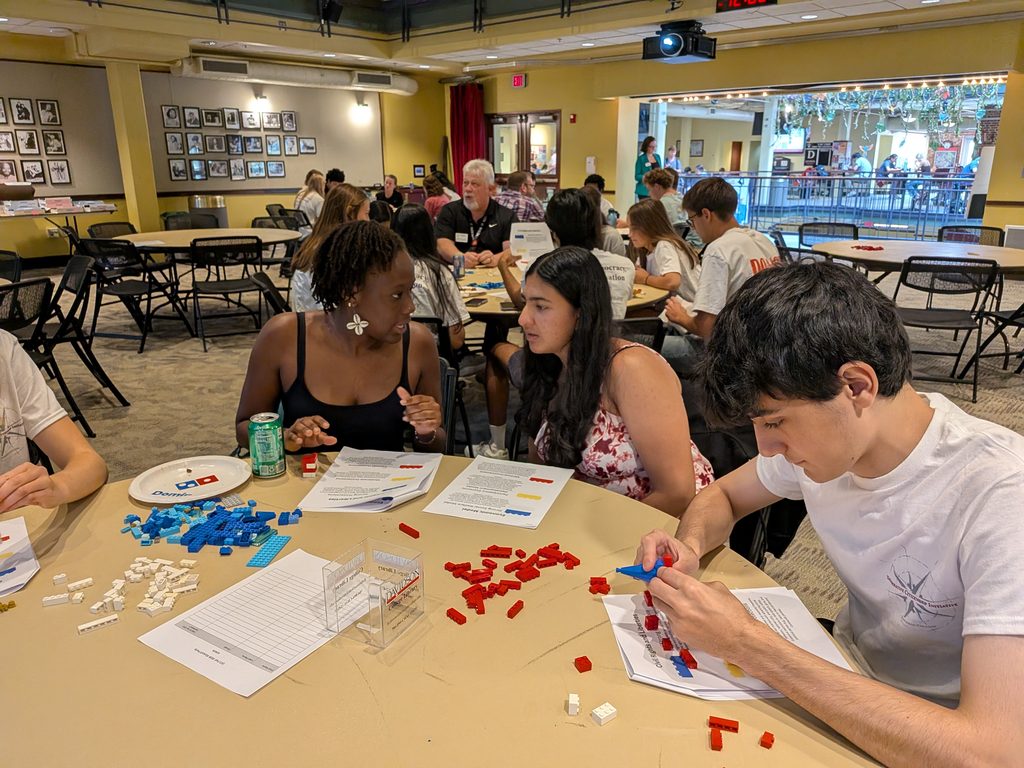
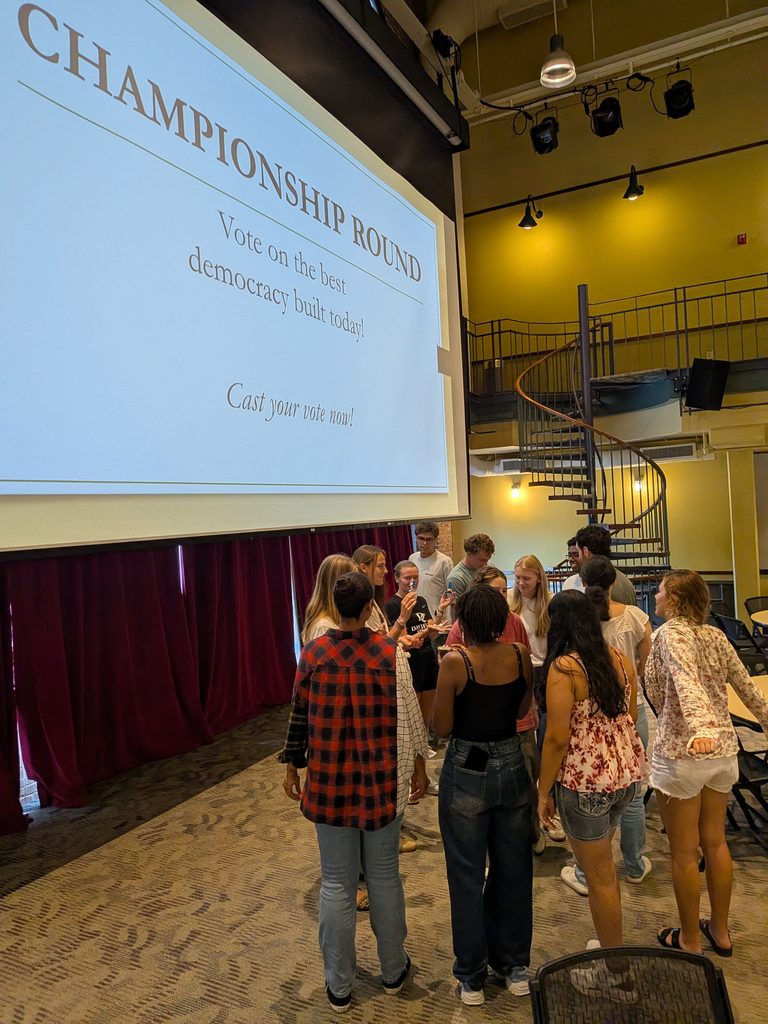
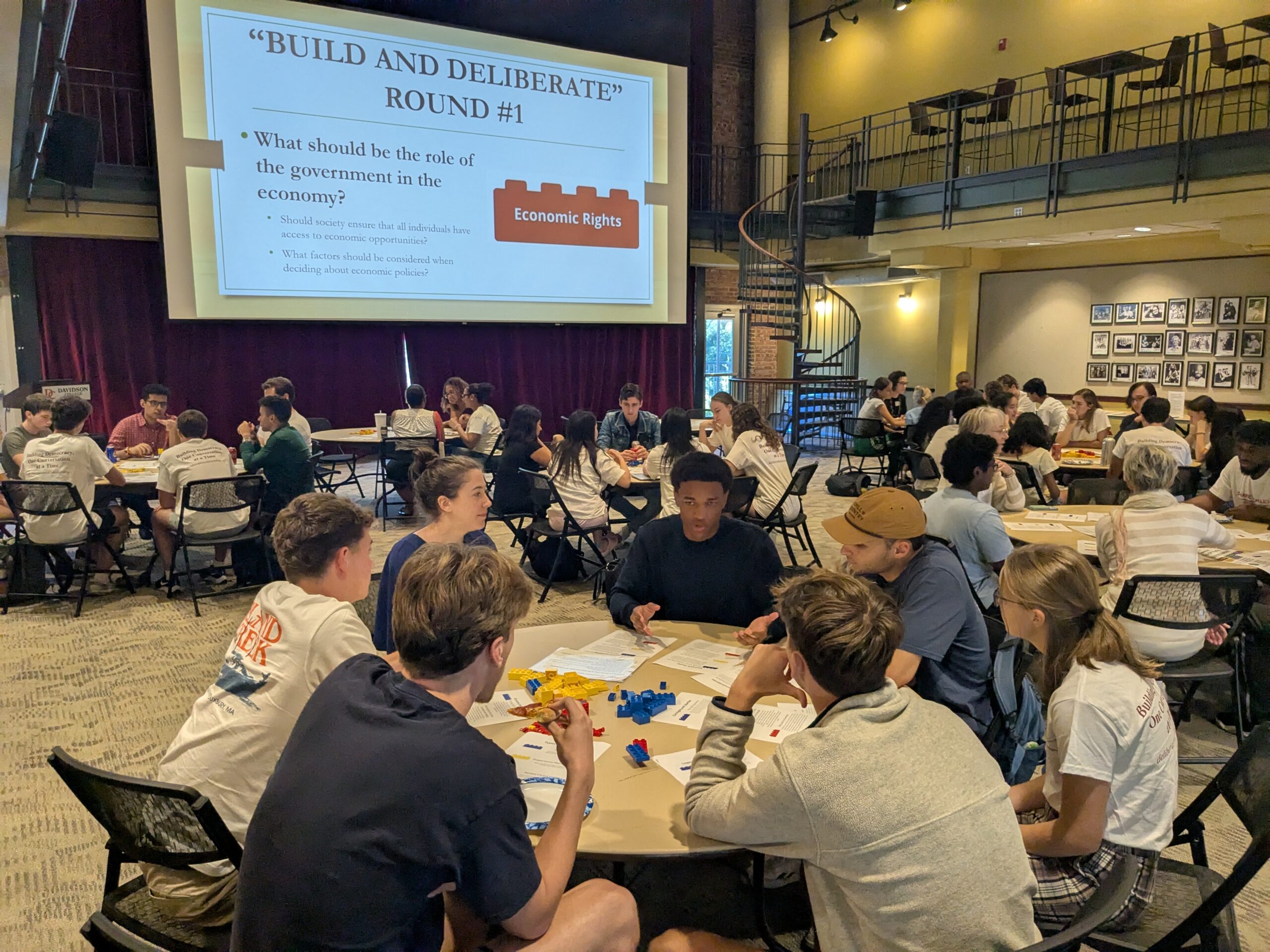
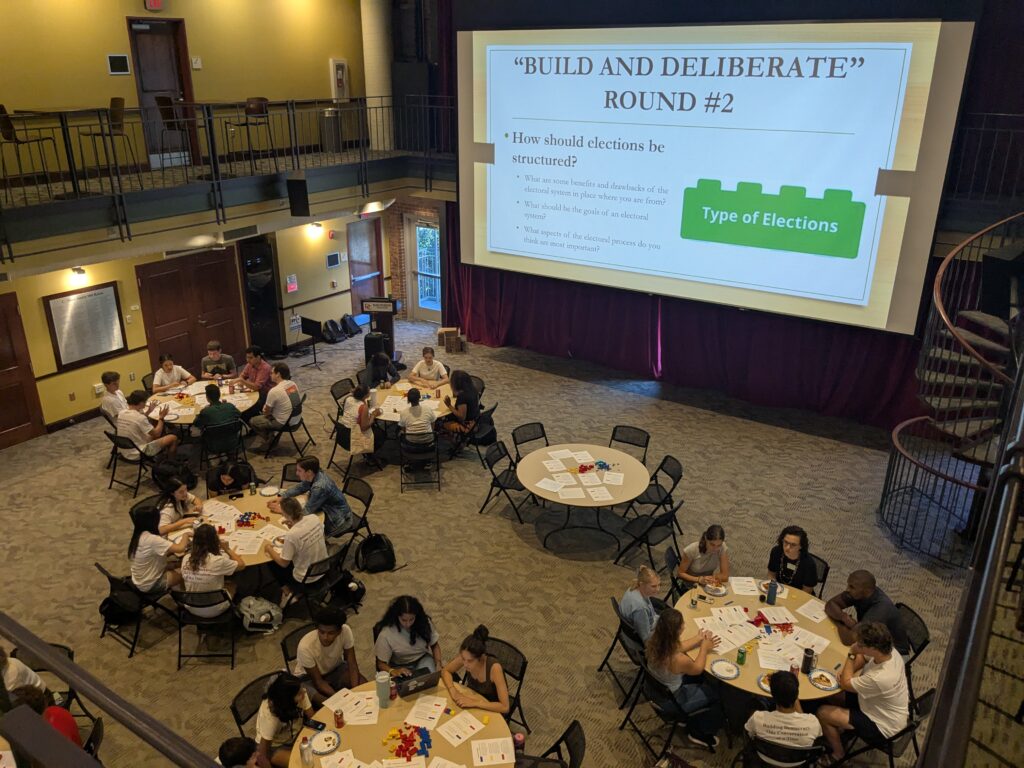
Every fall, the DCI hosts a Semester Kickoff Party to welcome students back to campus and introduce them to the principles and practices of deliberation and dialogue. We continued this tradition this year on August 29th in the Union’s 900 Room, and it was a blast. We had a great turnout, with over 40 students, staff, and community members engaging in active discussions over pizza. A range of people both new to and familiar with the DCI were there to listen to each other and share their perspectives.

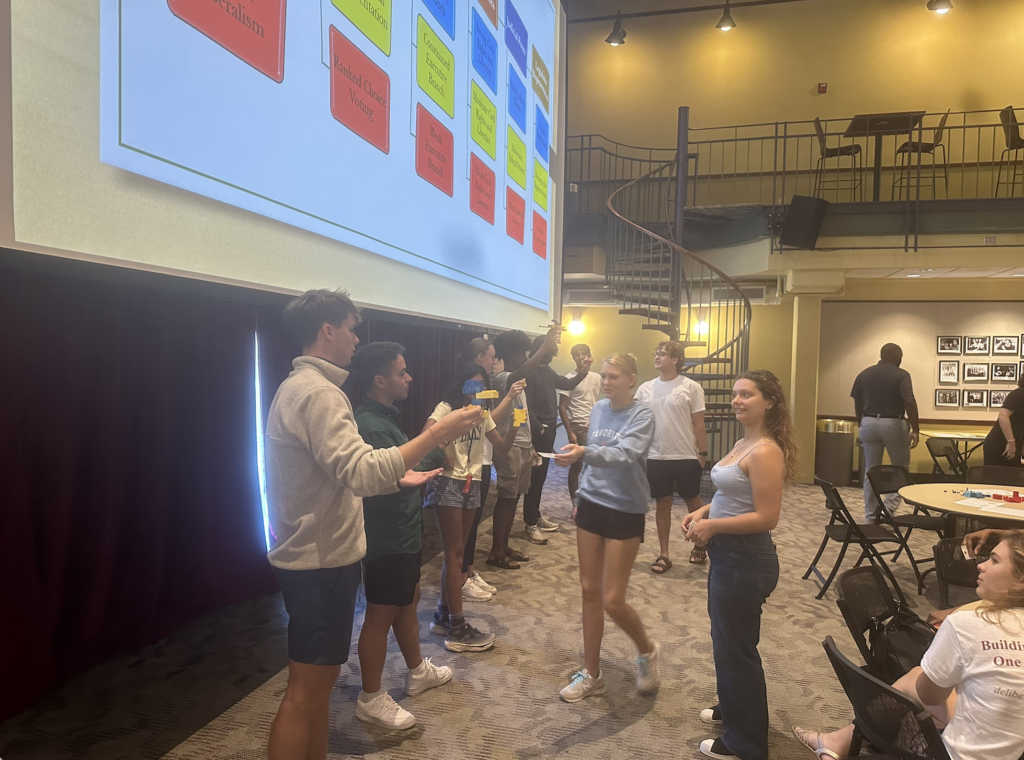
This year, in addition to being able to learn about upcoming DCI programs, participants also had a chance to practice their deliberative skills as they worked to “Build the Best Democracy…” using Legos! They discussed with each other what they thought are the most important aspects of a democracy and then built a Lego structure that reflected those democratic elements. They ended up creating some colorful objects that represented different combinations of economic rights, types of elections, executive authority, judicial power, legislative representation, and civil rights and liberties that they argued made for the most responsive, resilient, and effective democratic republic.

Attendees had a blast discussing some key questions in a low-key context, and then they got to vote – in good democratic fashion – which creations – first at their tables and then overall – were the best representations of democracy. The overall winner took home a grand prize and the honorable mentions all won some prizes as well!

The event was a wonderful kickoff to the school year, providing participants with a meaningful opportunity to connect in new and fun ways. It highlighted the DCI’s efforts to foster meaningful dialogue about important topics facing our society, one Lego piece at a time!

Filed Under: DCI Posts

Passing Along Some Tips for Holiday Conversations

December 23, 2025 by Ruby Aaver

In this holiday season of gathering with loved ones, you may be wondering what to do if sensitive topics come up that stimulate disagreement and discord. Should you follow the age-old dictum to “not talk about politics and religion” with loved ones? Or is there a way to navigate these conversations effectively?

Two organizations recently published some tips on how to best handle discussions over the holidays on contentious issues. The Constructive Dialogue Institute’s “Holiday Conversation Guide” and the Difficult Dialogues National Resource Center  “Six Strategies for Staying Productive During Holiday Conversations”  both emphasize that meaningful conversations during emotionally charged moments—especially around politics and identity—depend first on managing tensions rather than winning arguments.

When conversations escalate, people become less capable of listening and more likely to entrench their views. Both guides therefore stress slowing down, pausing before responding, and stepping away when emotions run high. De-escalation is framed not as avoidance, but as a necessary condition for understanding: conversations improve when participants shift their goal from persuasion or “being right” to maintaining connection and openness. This reframing helps prevent conflict from damaging relationships and creates space for mutual learning.

A second shared insight is the importance of curiosity, dignity, and perspective-taking. Both texts encourage asking questions that surface the sources, values, experiences, and emotions underlying people’s beliefs rather than reacting to positions alone. Ask someone you disagree with to share a resource that influenced their perspective. By acknowledging emotions and inviting others to share their stories, participants signal respect even amid disagreement. Research cited in the two documents suggests that perspective-taking, especially when people share vulnerabilities, can reduce biases and deepen understanding over time. Importantly, neither document suggests agreement is required; instead, they argue that recognizing others’ humanity and moral frameworks is central to sustaining constructive engagement across difference.

Finally, both documents underscore that productive conversation is a skill that requires judgment and practice. Not every comment demands a response, and timing matters as much as content. Choosing when to engage, when to listen, and when to step back can help preserve relationships and maintain connections. Tools such as storytelling, feeling-based language, and structured approaches like pausing, acknowledging, listening, and sharing help participants respond deliberately rather than reactively. Taken together, the documents present a hopeful message: with practice, intentionality, and care, difficult conversations, especially with those closest to us, can become opportunities for growth, connection, and shared understanding rather than sources of division.

Filed Under: DCI Posts

DCI Contributes to ACUE Deliberative Dialogue Quick Studies

December 15, 2025 by Graham Bullock

ACUE logo with Deliberative Dialogue: A Catalyst for Critical Thinking

One of the big challenges — and opportunities — for encouraging more robust deliberation on college campuses is providing faculty members with the tools and frameworks that can help them create more deliberation-based courses. The DCI has contributed to this work through its Deliberative Pedagogy (DeeP) Collaborative, which has included over 60 faculty members from 28 institutions who have integrated deliberation about contentious topics into their syllabi. But how do we scale that work to include more faculty at more institutions, both across the country and around the world?

With support from the Arthur Vining Davis Foundations, the Association of College and University Educators (ACUE) recently launched a five-part online series about deliberative dialogue that can help many more faculty members incorporate these strategies into their teaching. The series will be available to the more than 60,000 faculty at over 600 higher education institutions that partner with ACUE to help them improve the quality of their teaching. As a series of short Quick Studies, the series includes expert videos, student voices, real classroom examples, and an accessible “Engage, Envision, Experience, Explore” framework that makes deliberation both compelling and feasible for faculty members to adapt to their classrooms. An introduction to the series is available below.

DCI Faculty Director Graham Bullock served as the featured expert for the first two Quick Studies in the series, “What is Deliberative Dialogue?” and “Integrating Deliberative Dialogue into Your Course.” In his first short video, he explains how deliberative dialogue differs from other forms of discourse (conversation, discussion, dialogue, and debate), and why it is a useful framework for the college classroom. You can view the full video below.

“What is Deliberative Dialogue?”

In his second video, Dr. Bullock discusses why and how faculty might integrate deliberative dialogue into their courses. He explores how to introduce the principles and practices of deliberation to students, how to select topics for deliberation, how to design deliberative classroom activities, and how to assess student engagement. The short video is available below.

“Integrating Deliberative Dialogue into Your Course“

The other Quick Studies focus on “Preparing for Deliberative Dialogue Through Practice,” “Launching a Deliberative Dialogue,” and “Facilitating a Deliberative Dialogue,” and they feature insights from other experts on deliberation in higher education, including Nick Longo and Quincy Bevely from Providence College, John Rose from the University of North Carolina, Chapel Hill, Sandy Marshall and Jennifer Uno from Elon College, and Sarah Donovan from Wagner College.

If you are interested in viewing all of these Quick Studies and completing ACUE’s full series on deliberative dialogue, inquire with your institution to see if it is a member of ACUE. If so, you can access the series via the ACUE Commons.

Filed Under: DCI Posts

  • Page 1
  • Page 2
  • Page 3
  • Interim pages omitted …
  • Page 11
  • Go to Next Page »

Footer

Blog Post Categories

  • Announcements
  • Blog Posts
  • DCI Posts
  • Events
  • Faculty Posts
  • Fellow Posts
Image of a compass superimposed by the text "Deliberative Citizenship Initiative" and "Davidson College." Clicking on this image leads to the Initiative page.

Recent DCI Blog Posts

  • We Tried to Fix Jubilee’s “Middle Ground” – Here’s How It Went
  • A Case for Deliberation in the Natural Sciences
  • Welcoming New Staff to the DCI and DCN
  • Facebook
  • Twitter
  • Instagram
  • LinkedIn


Copyright © 2026 · Infinity Pro on Genesis Framework · WordPress · Log in