• Skip to main content
  • Skip to footer

Deliberative Citizenship Initiative

Building Democracy One Conversation at a Time

  • The Initiative
    • Programs
      • Deliberation Across the Curriculum
      • Deliberation on Campus
      • Deliberation in the Community
      • Research on Deliberation
    • Motivations
      • Why Deliberative Citizenship?
      • Why Davidson? Why Now?
    • Who’s Involved?
      • DCI Fellows Cohorts
        • 2025-2026 Fellows
        • 2024-2025 Fellows
        • 2023-2024 Fellows
        • 2022-2023 Fellows
        • 2021-2022 Fellows
        • 2020-2021 Fellows
      • DeeP Collaborative Cohorts
        • 2024-2025 DeeP Collaborative Faculty
        • 2023-2024 DeeP Collaborative Faculty
      • Advisory Council
    • History
      • What Sparked the Initiative?
    • Key Deliberative Dispositions
    • Frequently Asked Questions (FAQ)
    • Annual Report
  • Get Involved!
    • Participate in a Forum
    • Join a D Team
    • Become a Fellow
    • Take Courses
    • Get Training
    • Come to Guest Lectures
  • Events
    • Upcoming Events
      • 250th Anniversary Deliberative Forum Series on American Values
    • Past Events
  • Connections
    • The Deliberative Citizen: The DCI’s Monthly Newsletter
    • Efforts on Campus
    • Efforts in the Community
    • Efforts Elsewhere
    • Readings and Resources
      • DCI-Published Guides
      • DCI Guide to One-on-One Conversations
      • How to Disagree
      • Demonstration of Facilitation Styles
      • Deliberative Pedagogy Mini-Course
    • How We Can Help: DCI’s LET’S DELIBERATE! Partnership Opportunities
    • DCI in the News
  • DCI Blog Posts
    • Recent Blog Posts
    • All Blog Posts

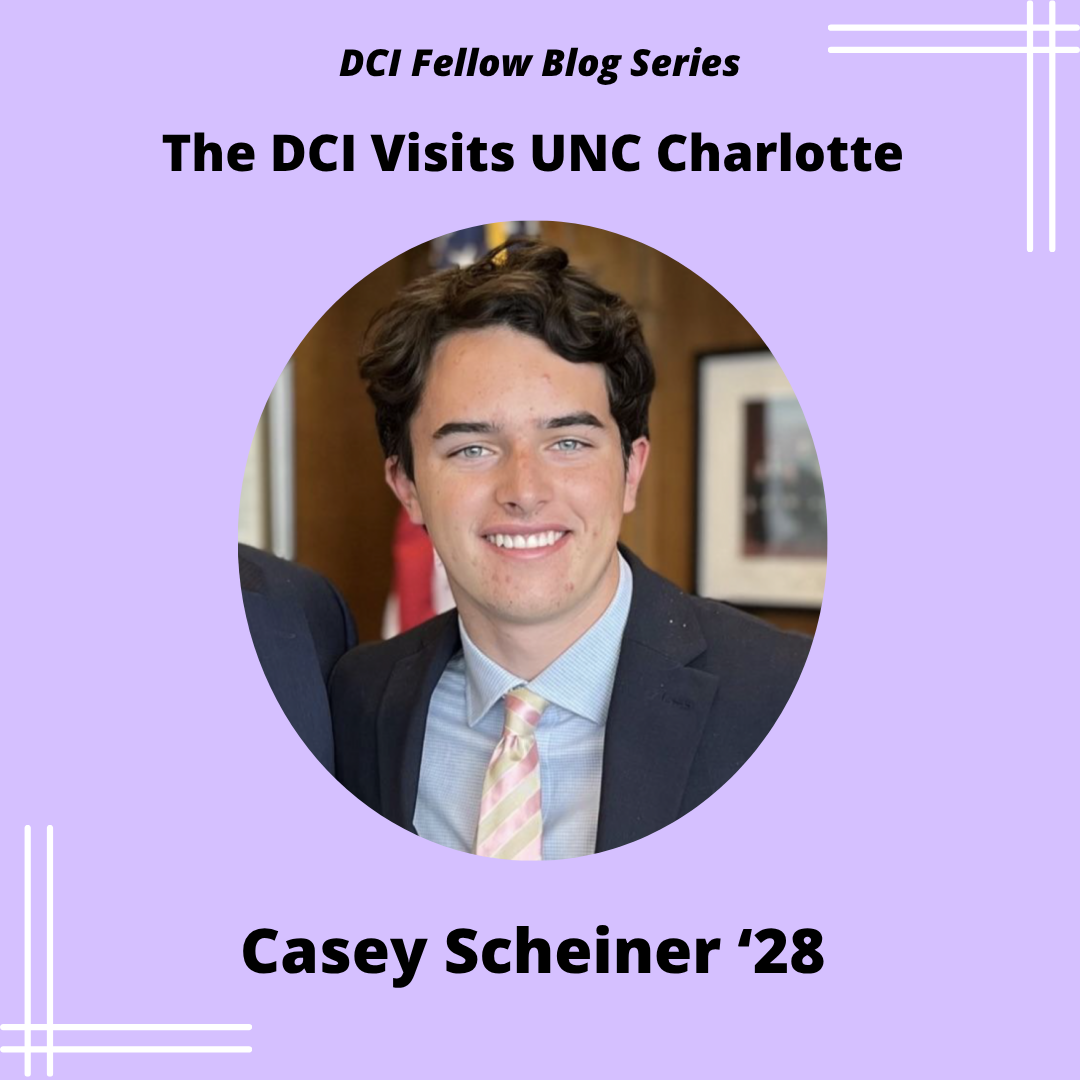
Casey Scheiner

The DCI Visits UNC Charlotte

July 9, 2026 by Casey Scheiner

By Casey Scheiner ’28 (DCI Senior Fellow and Co-Convener)

In anticipation of the beginning of the Deliberative Citizenship Network, which will support over 100 universities in their development of deliberative programs on campus, the DCI took its show on the road this spring to UNC Charlotte. In Professor Jon Overton’s 60 student sociology course on Polarization and Social Conflict in America, Dr. Bullock, Co-Convener Stephen Walker, Fellow Aditya Pratap Singh Phogat, and I presented on what the DCI is, the kinds of conversations we host, and how students can apply our deliberative dispositions and conversation agreements in their own discussions. With deep background knowledge from the class they were taking, the students were well-equipped to understand the importance of conversations like the ones the DCI hosts for bridging divides in a deeply polarized society.

After we spoke to the class for about 20 minutes, we launched into the deliberation. Our topic was one that students with various degrees of political knowledge could all get invested in, given its universal importance to members of our generation: economic mobility and the American Dream. Professor Overton selected this guide from the early years of the DCI, and it held up remarkably well as an issue of consistent concern for the students in the class. With the four of us from the DCI as well as Professor Overton’s two graduate student TAs facilitating, students brought various perspectives to the table, agreeing on affordability and economic opportunity as major issues of our time, but disagreeing on how to solve or even diagnose the problems. For instance, when we discussed the housing crisis, some deliberators contended it was an issue of insufficient supply, while others felt it boiled down to excessive corporate ownership of a sufficient housing supply. This then informed how they approached solutions, with the former group advocating more for policies to incentivize greater housing development and the latter group pushing to deconsolidate large companies’ property ownership.

All in all, both the presentation and the deliberation were major successes. The students were engaged and interested in our presentation, seeming to crave a deliberative outlet where they could express their thoughts. In the deliberation, they made my job easy, participating eagerly and asking thoughtful follow-up questions of one another. As we prepare to share the DCI’s approach next year through the DCN, the experience at UNC Charlotte was a terrific reminder of the number of campuses around the country rich with enthusiasm to deliberate on our nation’s biggest issues.

Filed Under: Fellow Posts

DCI Hosts Young European Leaders on State Department Visit

February 2, 2026 by Casey Scheiner

DCI x International House image with map of Europe in the background

By Casey Scheiner ’28 (DCI Senior Fellow and Co-Convener)

A group of ten European leaders, ranging from a member of the Croatian Parliament to an Austrian democracy advocate, paid the DCI a visit on Wednesday, August 20. As part of their tour of the United States with the State Department’s International Visitor Leadership Program, they spent a couple of days in Charlotte, where International House Special Projects Coordinator and Davidson alum Olivia Norten ‘25 brought the leaders to Davidson. On campus at the Cunningham Theater Center, Dr. Bullock and I led them in a deliberation on defensive democracy.

During the deliberation, I was in my usual spot as the facilitator moderating the discussion. However, this was uncharted territory for me: as a news junkie and DCI deliberation guide writer, I was accustomed to having a strong base of knowledge on the topic that would allow me to support deliberators’ thoughts with relevant factual insights. In this deliberation, I found myself by far the least versed member of the conversation in the inner workings of European politics and the defense of democracy across the Atlantic.

This made the experience all the more enriching for me, allowing me to learn so much from my deliberators, who were actively shaping the future of European democracy. Asking follow-up questions and calmly moving us from one section to the next, I did my best to play my usual role of the even-keeled facilitator, but I was awestruck by the sheer amount of knowledge, experience, and capacity to change the world in one room.

Insights from the delegation provided important reminders on things showing up in my own life, trivial and consequential. On the seemingly most mundane side, the leaders’ utter joy and fascination at seeing the pomp and circumstance surrounding Davidson freshman move-in that day let me appreciate the smaller things I don’t always recognize as a Davidsonian and American accustomed to certain things.

And on the promotion and defense of democracy, one of the defining issues of our time, the variety of different perspectives and solutions with which they approached the issue gave me hope that democracy does not require coalescence around a single correct solution, but rather a commitment to wrestle openly and honestly with its challenges.

It also reminded me that deliberation is not just an exercise for curious Davidson students, staff, and community members. It is equally, if not even more important, for leaders like these participants in the International Visitor Leadership Program who are the future (and, in many cases, the present) of European democracy to both embrace their differences and strive to find common ground in deliberative settings in ways that can solve the problems dominating our headlines.

Filed Under: Events

Deliberation as Resistance: Dialogue in a Time of First Amendment Backsliding

October 19, 2025 by Casey Scheiner

Image of people sitting around a table with cityscape behind, American flag in front, fragmented

Casey Scheiner ’28 (DCI Fellow)

For one of the first times in American history, the hallowed practice of deliberation is under attack. For years, conservatives have clung to the First Amendment as its source of authority to oppose a homogeneous liberal narrative from emerging on college campuses, companies, and the government. However, today, enjoying majorities in both houses of Congress, control of the Oval Office, and a sympathetic majority in the Supreme Court, Republicans have gone after one of the fundamental rights defining our country for over two centuries: free speech.

Free speech is a bedrock of all of the deliberations hosted by the Deliberative Citizenship Initiative. At the DCI’s Forums and D Teams, deliberators have a space they can enter where they can share their views without fear of retribution. In fact, understanding diverse perspectives is a key part of the mission of this organization. Tragically, in its first months in office, the current administration has not practiced such a reverence for the heterogeneity of viewpoints that have previously defined American politics.

The Trump administration has wasted no time decimating our right to deliberate. Its primary tool? The immigration system. While the (attempted) deportation of Columbia graduate student Mahmoud Khalil, a pro-Palestine activist, has drawn the most media attention, one does not have to publicly espouse politically sacrilegious viewpoints themself to draw consequences from ICE. Badar Khan Suri, a Georgetown researcher, was detained in pursuit of deportation for the crime of marriage to a pro-Palestine activist. While DCI participants could freely deliberate on their views of Israel-Palestine campus protests and espouse any viewpoint, American permanent residents like Khalil and Suri could be deported for their position (even if indirectly caused by marriage) on the same issue.

However, Middle Eastern politics aren’t the only area of the world fraught with political landmines if one dares to challenge the administration’s orthodoxy. After immigration officials searched a French scientist’s devices upon his arrival in Houston for a research conference and discovered messages criticizing President Trump’s cuts to scientific research, they forbid his entry to the country, citing a fear of terrorism. While the Trump administration alleges that this action pertained to other information found on the phone, the French government maintains the grounds for his removal revolved around his dissident speech. Indeed, the bar for reprehensible conduct is even lower than highly public deliberation expressing heterodox views—just deliberating with friends and disagreeing with US policy, as this scientist did, is now grounds for expulsion from the country.

Even the world of TV and culture is not exempt from such an onslaught. In July, CBS cancelled The Late Show with Stephen Colbert days after its eponymous host criticized CBS owner Paramount for its settlement with the Trump administration as it sought executive approval for a merger. In September, Disney suspended Jimmy Kimmel, another late night television host, following criticisms of his characterization of Charlie Kirk’s murderer and concerns that his planned remarks would further inflame the situation. The suspension came shortly after Federal Communications Chairman Brendan Carr, a Trump appointee, threatened punitive action against Disney if they did not take disciplinary action against Kimmel. When our most high-profile late-night talk show hosts cannot speak freely without facing retribution at the behest of the federal government, ordinary citizens doubt their ability to deliberate without fear.

Regardless of one’s position on the war in Gaza, US funding of science, or Paramount’s merger, this renunciation of deliberation as a core element of American political culture should be disturbing to everyone. An attack on free expression is an attack on the foundation of authentic deliberation. Be it pineapple on pizza or the ethics of abortion, everyone has an opinion that does not conform with the majority view. In a world without pluralist tolerance, the saying “Show me the man and I’ll show you the crime” often attributed to Soviet secret police chief Lavrentiy Beria manifests itself. Seeing as few political outlooks align perfectly with that of the “approved” government stance, most worldviews will at some point fall in the crosshairs of a retributive administration. Without free deliberation, we all are left with two unappealing options: stay silent on any dissenting viewpoints or face potentially life-changing punitive consequences.

Worse yet, these assaults on free speech betray the logic preached by conservatives for years. Though conservatives have (often correctly) lamented the prevalence of “cancel culture” on the left, the Trump administration now seeks to cancel those who do not submit to its orthodoxy. Though conservatives have successfully campaigned for the end of racial affirmative action in college admissions, the Trump administration now pressures universities to functionally practice affirmative action for conservative professors. Though conservatives have previously decried Democratic administrations’ weaponization of the IRS against dissident groups, the Trump administration has influenced the IRS to audit high-profile critics and review Harvard’s tax-exempt status. As many Republicans recognized during the years when they were in the minority, freedom of speech is largely a mechanism to protect those out of power. But now that the shoe is on the other foot, Trump does not appear keen on respecting his foes’ liberties.

So, how do we resist the end of American deliberation? The answer is not that different from the Trump administration’s strategy of “flooding the zone.” One political dissident will go to prison; one million will cause a revolution. This “revolutionary” action is nothing disturbing or foreign to Americans—not violence or even disobedience, but simple conversation. As notable law firms and universities capitulate to financial incentives to be silent, individuals must express their constitutional right to free expression.

Daring to say one disagrees with the government is a tradition of American culture preceding any of us. Today is not the day to abandon that brand of criticism—whether you concur with 1% or 99% of this administration’s agenda. Be it on a social media account with one million followers, a DCI forum with a dozen companions, or a text chain with a friend, our comfort with dissent defines our position as the leader of the free world. Fear of retribution for such unassuming critiques only transpires under an authoritarian political climate that Americans should only be reading about in world history textbooks.

To avoid that reality becoming a defining chapter of our own history, it is time to assertively claim our right to deliberate. It doesn’t matter whether or not you echo the views of the government, your university, or any other important institution, so long as you do deliberate. Go respectively disagree with your uncle at the Thanksgiving dinner table. Go to a town hall and tell your representative how you feel about the government. Go explain your perspective and listen to the perspective of those who feel differently about a particular policy. Go celebrate and claim your constitutionally enshrined ability to deliberate.

Opinions expressed on the DCI Blog are solely those of the author and do not necessarily represent the official views or positions of the Deliberative Citizenship Initiative.

Filed Under: Fellow Posts

Sports Talk as a Model For Deliberation 

November 20, 2024 by Casey Scheiner

LeBron James or Michael Jordan? College football or NFL? Summer or Winter Olympics? Tarheels or the Wolf Pack? Spirited debate topics like these are just as integral to sports fandom as tailgating on a Saturday or filling out a March Madness bracket. Yet, though widely revered as a fun topic of idle chatter, sports are viewed as a less intellectual subject for truly stimulating conversation than politics, science, philosophy, or any other academic discipline. However, in my experience, sports talk is underrated as an effective model for constructive deliberation. 

Before I delve into the substance of what makes sports a valuable domain for deliberation, it’s important to understand that sports are inherently valuable because they provide a space where disagreement is not only acceptable, but welcomed because of its lower stakes nature that features less villainization of opposing viewpoints. It can be scary to challenge someone’s staunchly held view on a hot button issue like abortion due to the inherent vitriol that surrounds such a topic. On the other hand, when talking about sports, disagreement easily elicits laughs, kinship, and new ways of approaching sports analysis, which can serve as a valuable “appetizer” to test out deliberation before diving into more contentious themes. While I’ve never felt comfortable walking up to a stranger and starting an immigration debate, I’ve made many random friendships simply by asking who’s their greatest baseball player of all time.  

Sports don’t just allow us to deliberate more – they also help us deliberate better. In politics, deliberation can be so challenging when both sides come in with very different conceptualizations of the facts, and thus different conclusions. For example, someone who watches MSNBC coverage of Hurricane Helene relief efforts will have a different understanding of their efficacy than a Fox News viewer. In sports, a level of universal objectivity exists: everyone who watched the Super Bowl saw the exact same game. Everyone agrees that Michael Phelps has won 23 gold medals.  

Working from an agreed-upon set of facts makes deliberation easier. Instead of having to get bogged down in how many gold medals Michael Phelps has won, people can cut straight to debating its implications for his legacy or how it compares with Usain Bolt’s achievements. Meanwhile, political deliberators often must spend far more time establishing their agreement on factual details than delving into the implications of those details. More time on meaning equals more time achieving goals of deliberation like mutual understanding. 

Sports also provide a crucial source of unity that invites future deliberation. Democrats and Republicans are more hesitant than ever to engage with one another; however, sports provide a universal topic to discuss. After establishing a shared interest in a particular sports league (If no common sports interest exists, other points of cultural overlap like music and television can be an effective substitute as well), I can easily befriend someone, even amidst differing political beliefs. Once we’ve formed that trust and kinship, it becomes far easier to engage on a more controversial topic. With these norms of civility, respect, and thoughtfulness that we initially establish through sports talk, we can apply this model to a hot-button issue.  

Nonetheless, there exists no easy answer for the question of how to apply the lessons of sports talk to more contentious deliberations. We can’t snap our fingers and make immigration comfortable to talk about or the economy easy to summarize objectively. Still, by applying some practices that we subconsciously practice during our sports conversations—searching for a set of facts to agree upon, recognizing the humanity of the other deliberators, and not being afraid to disagree—we can move towards stronger conversations in the sphere of political deliberation.  

Filed Under: Blog Posts, Fellow Posts

Footer

Blog Post Categories

  • Announcements
  • Blog Posts
  • DCI Posts
  • Events
  • Faculty Posts
  • Fellow Posts
Image of a compass superimposed by the text "Deliberative Citizenship Initiative" and "Davidson College." Clicking on this image leads to the Initiative page.

Recent DCI Blog Posts

  • We Tried to Fix Jubilee’s “Middle Ground” – Here’s How It Went
  • A Case for Deliberation in the Natural Sciences
  • Welcoming New Staff to the DCI and DCN
  • Facebook
  • Twitter
  • Instagram
  • LinkedIn


Copyright © 2026 · Infinity Pro on Genesis Framework · WordPress · Log in