By Zak Abdulahi ’27 (DCI Fellow)
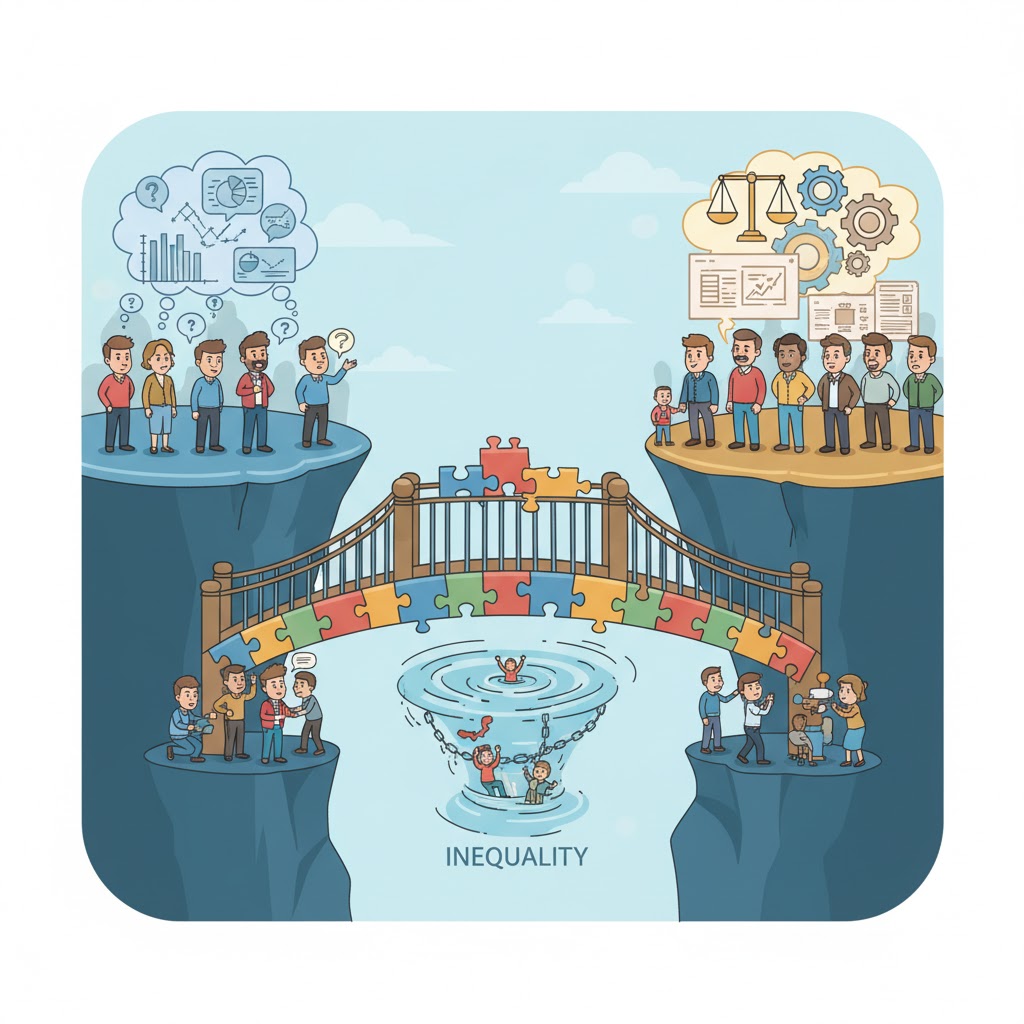
Why does economic anxiety seem more divisive than ever? Anxiety and uncertainty regarding the economy have shaped and dominated our conversations recently in a rapidly changing geopolitical environment. This trend has been compounded by rising costs and the inequality of economic growth and development. Our perceptions regarding the economy have become increasingly tied to our political beliefs and leanings. We see a pricey carton of eggs and either fully comprehend the complex interplay of inflation, commodity prices, and H5N1 containment germ theory—or we incessantly blame it on whichever politician we already dislike. Despite consistent economic growth, inflation and cost of living concerns have created a large gap between economic reality and perceptions – and public perceptions of the economy has remained consistently negative.
This raises a key question: Can deliberation cut through partisan framing, misinformation, and economic anxiety? And more importantly—what would our society look like if it did?
How Our Experiences Shape Our Perceptions: Economic perceptions are shaped by a multitude of factors: geography, background, and income level. Rising wealth inequality has exacerbated the differences in lived experiences between the “haves” and “have-nots,” creating a society where economic realities are filtered through vastly different lenses. One person sees a thriving market, tainted with green S&P indexes. Another person sees their grocery bills become less affordable each week through painfully clear lenses. Despite these disparate experiences, it is incredibly important to attempt to create space to bridge these divides.
Deliberation creates that space. Valuing both data and lived experience, it allows people to share how the economy feels to them, bridging that divide between perception and reality, looking beyond the data to unlock more productive, human centered conversations.
Deliberation in Action: Davidson College’s Forum on Income Inequality: A powerful example of this approach in action was the November 2024 Deliberative Forum hosted by the Deliberative Citizenship Initiative (DCI) at Davidson College, where nearly 200 students and community members gathered to ask: “How should Americans respond to income inequality?” The event began with a panel of experts from a range of ideological and professional backgrounds, followed by small-group deliberations focused on listening and understanding—not winning arguments.
Comments from participants in the post-event survey revealed how such structured, respectful economic dialogue—especially when rooted in real experiences—can overcome surface-level disagreements and address deeper economic divides.
- “Deep assessment of a complex problem from multiple perspectives. Outstanding experience.”
- “Participating in the Deliberative Forum on wealth and income inequality helped me learn more information about these topics and also to discover strategies for finding common ground on the topic.”
- “The facilitated small group deliberations are… such a breath of fresh air and source of hope amidst our current polarization and paucity of thoughtful discussions across differences.”
The Wisdom (and Limits) of Deliberation: Scholarly work supports this idea. A 2024 article by Franz Dietrich and Kai Spiekermann in Economic Theory shows how deliberation can improve group decision-making by reducing common voting failures, such as overcounting popular ideas or ignoring valuable minority perspectives. When done right, deliberation allows us to weigh diverse forms of evidence more fairly and make wiser collective choices.
However, they also caution that deliberation isn’t inherently good—it must be structured, inclusive, and balanced to avoid simply reinforcing dominant narratives. That’s especially important in economic conversations, where loud voices or dominant ideologies can drown out marginalized experiences.
Reclaiming Economic Discourse through Dialogue: If we want to confront economic anxiety, inequality, and barriers to growth head-on, we must first change how we talk about them. That means moving past soundbites and toward spaces that prioritize empathy, curiosity, and real listening. It means holding space for both the data and the day-to-day stress of rising costs. It means deliberating.
When we engage with each other across economic experiences—guided by the principles of deliberative citizenship—we don’t just debate policy. We understand each other better. And in today’s political climate, that may be the most valuable form of progress we can make.
Opinions expressed on the DCI Blog are solely those of the author and do not necessarily represent the official views or positions of the Deliberative Citizenship Initiative.