• Skip to main content
  • Skip to footer

Deliberative Citizenship Initiative

Building Democracy One Conversation at a Time

  • The Initiative
    • Programs
      • Deliberation Across the Curriculum
      • Deliberation on Campus
      • Deliberation in the Community
      • Research on Deliberation
    • Motivations
      • Why Deliberative Citizenship?
      • Why Davidson? Why Now?
    • Who’s Involved?
      • DCI Fellows Cohorts
        • 2025-2026 Fellows
        • 2024-2025 Fellows
        • 2023-2024 Fellows
        • 2022-2023 Fellows
        • 2021-2022 Fellows
        • 2020-2021 Fellows
      • DeeP Collaborative Cohorts
        • 2024-2025 DeeP Collaborative Faculty
        • 2023-2024 DeeP Collaborative Faculty
      • Advisory Council
    • History
      • What Sparked the Initiative?
    • Key Deliberative Dispositions
    • Frequently Asked Questions (FAQ)
    • Annual Report
  • Get Involved!
    • Participate in a Forum
    • Join a D Team
    • Become a Fellow
    • Take Courses
    • Get Training
    • Come to Guest Lectures
  • Events
    • Upcoming Events
      • 250th Anniversary Deliberative Forum Series on American Values
    • Past Events
  • Connections
    • The Deliberative Citizen: The DCI’s Monthly Newsletter
    • Efforts on Campus
    • Efforts in the Community
    • Efforts Elsewhere
    • Readings and Resources
      • DCI-Published Guides
      • DCI Guide to One-on-One Conversations
      • How to Disagree
      • Demonstration of Facilitation Styles
      • Deliberative Pedagogy Mini-Course
    • How We Can Help: DCI’s LET’S DELIBERATE! Partnership Opportunities
    • DCI in the News
  • DCI Blog Posts
    • Recent Blog Posts
    • All Blog Posts

Fellow Posts

“Only a Sith Deals in Absolutes:” Tips for Productive Confrontation

October 7, 2022 by Heidi Meyer

Yoda image with blurred background

“Yoda Figurine,” by Kate Haskell, licensed under CC BY 2.0

By Heidi Meyer, DCI Fellow

Times have changed since Yoda said, “Only a Sith deals in absolutes.” Nowadays it seems most people speak in absolutes. Walking around campus, which is supposed to be an incubator of thought-provoking and open-minded discussions, I frequently hear statements such as “Ew, they’re a Republican,” or “I don’t want to talk to a crazy liberal,” or “I hate talking about politics.” 

None of these mindsets are productive. Making assumptions about someone’s beliefs or characters based on a broad label, or completely shunning a topic due to its potential to stir up emotions and controversy makes us as individuals and as a society more polarized and less suited to deal with the increasing number of serious problems we face.

We, therefore, need to change the negative connotations around confrontation. Instead of fearing that if two people disagree on a topic, chaos will ensue, we need to practice leaning into disagreements and intentionally practicing having discussions and deliberations on sensitive topics. Confrontation is something that does not have to divide individuals, but instead can be a productive tool to help people come together. 

I’ve always had an affinity for confrontation, stemming from my experiences with debate in high school, which showed me how productive confrontation can be in helping individuals grow and communicate effectively and respectfully. Here are a few of the most important lessons I learned.

1) Seek first to understand before seeking to be understood. 

In the type of debate I did, participants would not know what side they would be arguing for until a coin flip at the start of each round. This meant that participants had to prepare arguments for both sides, which provided an important framework that there was no side with no good arguments defending it. Both sides had logical reasons for their stance, and it was up to each side to best articulate those reasons and weigh them against the other. This format forced participants to be open-minded enough to put themselves in the shoes of each side and try to understand the reasons behind those stances. 

2) Each side must actively listen to the other in order to respond effectively. 

To be successful in debate, one couldn’t ignore the other side, walk away, or make rude faces or comments. This is also true when trying to make important progress in life. Shutting out the other side without listening or trying to understand where they are coming from is not productive. When people feel attacked, it makes them defensive and less likely to compromise, halting progress.

3) Asking questions is an effective way to make a point 

In debate, there were specific sections of each round designated for asking questions. Through this structure, I learned that questions are useful in pointing out flaws in the logic of an argument without making the other side defensive. Questions can disarm people and force them to evaluate the reasoning behind their stances, making them more open to changing their minds if they cannot come up with an effective answer to the question. 

4) Be respectful

To make a question or any other type of point more effective, a respectful and inquisitive, rather than aggressive, tone is essential. A big part of debate was about presentation and those who were rude or aggressive tended to distract from their arguments, while those who were respectful and more diplomatic tended to deliver their arguments in a more convincing manner. 

All of these lessons apply far beyond the context of debate and are important for productive deliberations. As Walter Sinnott-Armstrong said, “We cannot address a problem if we cannot talk about it,” and I think these lessons are a great place to start the conversation.

Filed Under: Blog Posts, Fellow Posts

Contending with Contentious Issues: The Power of Deliberation

September 28, 2022 by Miles Charles

DCI Fellow

Miles Charles

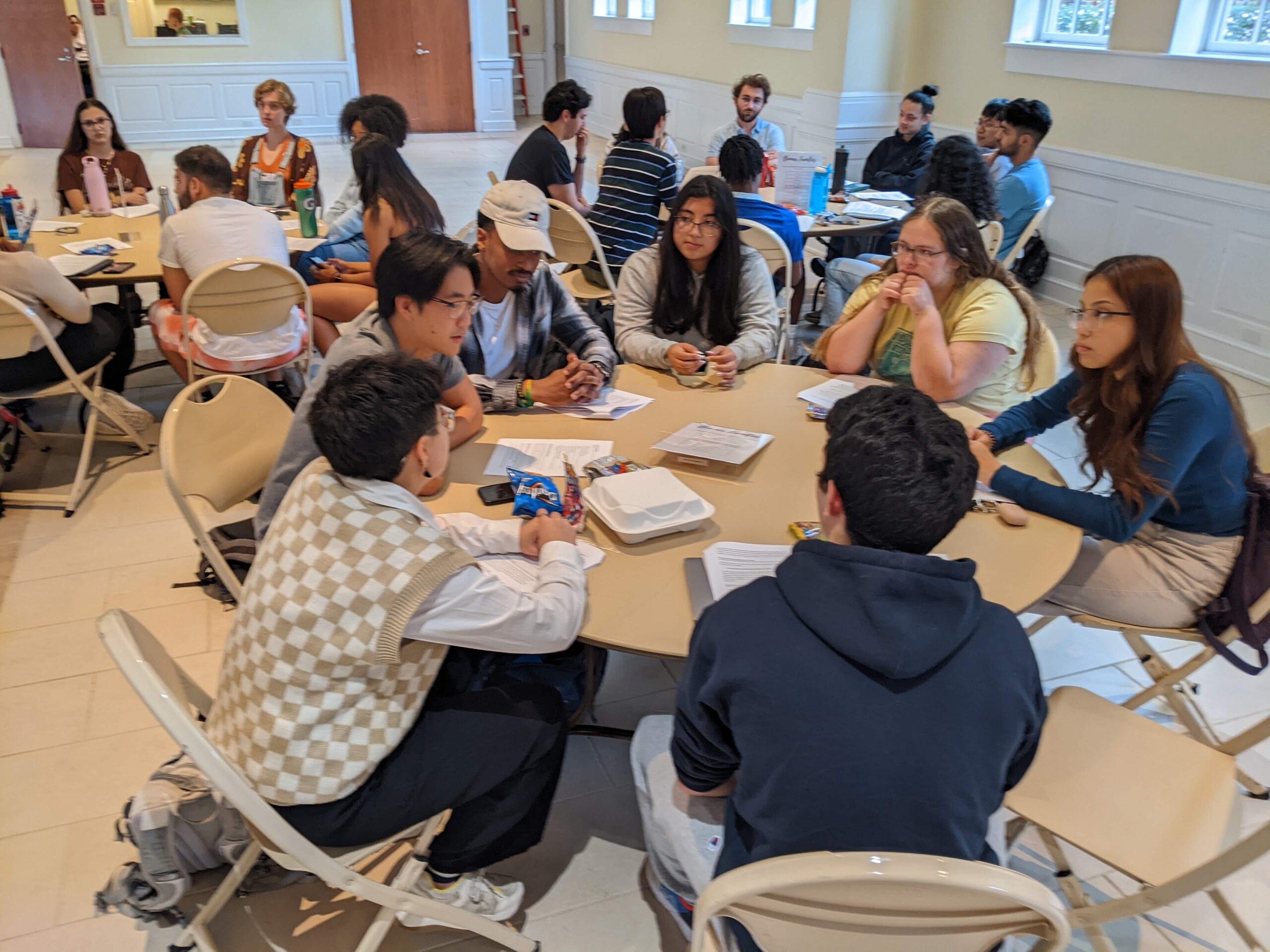
Students training for DCI Deliberations at round tables in the Davidson College 900 Room.

Deliberation, as defined by Longo and Shaffer in their work “Discussing Democracy,” is a process in which a diverse set of individuals convene and move towards making a collective decision on a contentious issue. Deliberation has the power to change the discourse in our country, away from the harmful rhetoric currently used and towards open dialogue, where everyone’s opinions on every facet of the political spectrum are heard and understood.

 While issues such as race, abortion, religion, and more have always carried a certain weight and importance within American society, throughout the past several years these issues have become more and more relevant in everyday American lives. It has culminated to a point where it is almost taboo to even mention any of the previously named topics. This is where I see the greatest potential of deliberation. It allows us to pry open issues such as race and abortion, open them to dialogue, and begin the process of understanding or at a minimum hearing the other side. 

Contentious issues, such as race, abortion, and religion, are like a powder keg. They are issues that are real, extremely prevalent, and are not going away; and by ignoring them we are simply adding powder to the keg, making the explosion of these issues worse and worse. We saw a preview of this dynamic during the summer protests of 2020 where millions of dollars worth of public and private property were destroyed nationwide. The result of negligence towards these issues is all too clear; a different approach must be taken. Deliberation and its advantages offer that opportunity.

Through my 10+ hours of facilitator training and readings, such as Longo and Shaffer’s “Discussing Democracy,” I’ve already been able to comprehend opposing viewpoints at a level I was unable to beforehand. For example, when deliberating whether to teach critical race theory (CRT) in the classrooms I was presented with a viewpoint I had yet to consider. This was the idea that while CRT is a must-teach topic, it is too complex for youth to understand. This raised the question in my mind of when and how to introduce CRT to our youth and allowed me to understand CRT, not only as a way to learn about race, but instead, view it also as a way to help young people connect with each other and understand, accept and celebrate our differences.

This broadening of my understanding is a small example of the power deliberation holds. A better example is Xernona Clayton, the civil rights legend who befriended a KKK leader and changed his mind. Xernona Clayton was leading the Model Cities Program, a federally funded program to end urban poverty, and despite the strong presence of the KKK, began to drop by Calvin Craig’s Atlanta office in an attempt to befriend him. Appealing to his Christian beliefs, Xernona would teach Clayton to change his use of words, understand the concept of black suffrage, and open his mind to desegregation.


Filed Under: Blog Posts, Fellow Posts Tagged With: facilitation

The DCI’s Kickoff Party: An Example of Fun and Meaningful “Labor in Organization”

September 19, 2022 by Anthony Toumazatos

DCI Fellow

Anthony Toumazatos

kickoff party for DCI with Students at a round table.

Teddy Roosevelt, when discussing the duties of an American citizenship, said, “If freedom is worth having, if the right of self-government is a valuable right, then the one and the other must be retained exactly as our forefathers acquired them, by labor, and especially by labor in organization, that is in combination with our fellows who have the same interests and the same principles.”

As of now, it has become increasingly difficult to execute this freedom into meaningful discussion, let along tangible results. Insulation between opposing perspectives seems to have proliferated in society, and the fine line between disagreement and disrespect has blurred considerably.

To combat these increasingly worrisome trends, we must begin, as Roosevelt puts it, through “labor in organization.” To me, the DCI embodies this important work. The objective of the initiative is to foster an environment where individuals can productively disagree, learn about differing perspectives, and, most importantly, humanize one another.

My interest in the democratic health of our country sparked when I took the fittingly named course “Democracy in America.” The course was deliberation based, and it was intriguing to hear my peers’ perspectives on topics as diverse as the increasing threat to populism to steps on how to improve American democracy. This rewarding experience made me a supporter of a deliberative framework, so I happily joined the DCI as a new Fellow when presented the opportunity.

kickoff party

The DCI kickoff event on September 2 was a fun, productive event that I consider having been quite successful. Students were attracted to the event by virtue of pizza and prizes and remained in the event by virtue of compelling discussion. While eating, participants had to work together with their peers at the table to find solutions to “puzzles,” or questions ranging from the lighthearted to pressing political issues.

To illustrate the spectrum of topics discussed, the discourse began with “what is the best type of pet?” and slowly worked its way to “how should the United States deal with the invasion of Ukraine?” and “how can we prevent mass shootings?” It was more informal than the structured deliberations also hosted by the DCI, but successful, nonetheless. The participants especially bought into the question regarding how to prevent mass shootings, and extensive deliberation took place. Everyone at the table, which included nine of us, were able to share their thoughts and ponder the options put in front of us.

The conversation was fun because we were all so invested in it, and despite varying views on the root causes of such a sensitive topic, we were able to come to a consensus. We all agreed that part of the issue was at least due to a lack of accessible care for mental health, so if we could find a way to normalize the discussion of mental health with wellbeing in general that that can lead to a better outcome. Of course, a multifaceted issue such as this requires a multifaceted solution, but to even see some sort of solution derived from an informal deliberation shows the strengths of the process.

While the quality of the conversation is why I primarily consider the kickoff event a success, a subsidiary reason to that is that many people were attracted to future DCI events. Afterwards, multiple people came up to me and asked how they can be a part of the DCI and what future events we will be holding. To see such a response of such enduring interest in the DCI by people who initially came to eat free pizza is a testament to not only the experience of the event, but the enchantment of deliberation.

I am looking forward to partaking in further DCI discussions and learning the art form of deliberation. The DCI provides the tools and frameworks to improve as both an interlocutor and citizen. By working cohesively with people who value free speech and diversity of perspectives, we can begin to improve the democratic health of four little corner of the country.

Filed Under: Blog Posts, Events, Fellow Posts

Enclave Deliberation: How to Highlight Common Goals and Develop Creative Solutions

June 2, 2022 by Kevin Garcia-Galindo Leave a Comment

By Kevin Garcia-Galindo, DCI Fellow

For my DCI Fellowship Project, I decided to center on the issues of diversity and inclusion that have been so pertinent on campus throughout my time at Davidson. I, however, chose to experiment more with different kinds of deliberations.

Specifically, my DCI project centered on something very different from the goals of the DCI’s usual style of deliberation. My project could be categorized as an enclave deliberation, meaning that there was a clear selection bias that I took into account when I chose my participants. The goal of my deliberation was not to try to change anyone’s opinions but rather to encourage the dispersion of ideas within a group who all share one common characteristic.

Research often gives the practice of enclave deliberation a bad name. Some question how if it is so easy to wall oneself off from views from the other side (through who you follow on social media or which cable news stations you watch, for example), then why should we focus any more on bringing similarly minded people together? Moreover, political scientists often argue that enclave deliberation can lead to increased group polarization.

Enclave deliberation, however, is the most common type of deliberation we encounter in daily life, and it is a fundamental part of a healthy working democracy. This is because most of us learn about our own stances and positions from people who are most like us. Furthermore, because enclave deliberations tend to be less formal and structured, more people tend to be more comfortable attending them, especially with how much work a more structured deliberation can seem to require.

I believe my DCI personal project proves that enclave deliberations do not have to encourage political polarization, and even more, enclave deliberations can actually lead to a broad diffusion of diverse ideas even when most of the members share at least one major characteristic together.

For my personal project, the point of connection for all my participants was that they were all part of the Chidsey Leadership Fellows program. As a Fellow myself, I knew that If I wanted to talk about diversity and inclusion with student campus leaders, then there was no better way to do this than to talk directly with the group on campus that focuses on forming a group of diverse leaders. Moreover, I knew that because of the high level of diversity within Chidsey Leadership, they would be disproportionately more likely to have been affected by recent controversies on campus.

To give a short synopsis of these issues: Students in the past year have expressed resentment towards Davidson’s administration because they have perceived some of its decisions as disproportionately and negatively affecting low-income, first-generation, gender and racial minority students. From the current controversy around the administration preventing Dining Dollars being used to buy Plan B, and the past controversies that came and went, such as the movement to add Asian Studies as a major, the petition to change the name of Chambers, and the ruckus that was caused when students heard that our Summit coffee shop could be shut down, many students on campus believe that the administration takes issues of diversity and inclusion far too lightly. As a first gen person of color (POC) student myself, I was privy to a lot of the conversations that happened directly around these issues, and I can confirm they reinforced many of the feelings about how POC were being valued on campus.

The issue, however, was not that there was not enough communication between administration and students, but rather what I personally saw was that there was not enough communication among affinity groups and students for them to be able to reach common ground on these issues. Student government and the quotidian student petition of the day signaled to me that there was already enough student-administration communication; whether it was effective was not something I could really determine or had the energy to do.

As a result, I instead focused on creating an enclave deliberation where I could bring together this already close-knit group to discuss an issue that they were all being affected by. A difference I would point out between what I did here as opposed to the kind of enclave deliberation that most of the research points to is that my participants only related to each other in one specific way as opposed to sharing a multitude of characteristics. As a result, I am more inclined to call this a hybrid style of deliberation that had characteristics of both a more structured and broad-based style of deliberation and an enclave deliberation.

The goal of my deliberation was not necessarily to change anyone’s mind but to encourage people from different groups to share their own perspectives on an issue that affects all of them. The defining difference between what I did here and a more traditional deliberation is that I did not focus on discussing whether diversity and inclusion is an issue to begin with, but rather I focused on bringing together people who had already reached that conclusion and instead focused on encouraging them to work together to find solutions.

Spending so much time on just discussing the validity of an issue and never getting to proposing a solution is something that you see ad nauseam in many kinds of debates. For example, we often see this dynamic in debates around abortion where the pro-life and pro-choice sides never change their opinions but rather opt instead only to make small adjustments to their proposals. Consider how pro-life advocates who believe that abortion is immoral in all cases concede allowing abortion in cases of rape or incest, or how even pro-choice absolutists sometimes concede banning the most invasive and late-term types of abortions. Rarely is there anyone brave enough to concede more than is necessary to still come out winning.

But what happens when the most common proposals are not so concretely defined? Or when the topic is centered directly at giving those who normally do not have an outlet a chance to speak? What I think you get is an enclave deliberation where you truly get the chance to work together to find solutions and proposals.

Some may critique my thinking by saying that this kind of deliberation is not very effective at bringing the complete spectrum of ideas into discussion and that no meaningful consensus can ever be found unless you bring together people who represent the entire spectrum of possible views. To this I respond by saying that the task of my deliberation was not to start and end the debate around diversity and inclusion, but rather it was to create an effective starting point for a future more-representative deliberation.

I am very aware that there is still a lot of dialogue that needs to happen, but I take my project to represent a starting point for students to be better equipped to engage with the administration robustly, thoughtfully, and productively by first deliberating among themselves. Without this type of enclave conversation, I think it would be hard to be able to move very far in an actual deliberation between the administration and students.

What I think my deliberation proves is that there can exist many ways to maneuver through a difficult issue using structured deliberation as a tool. The approach we took represents an important way to do so that brings together different stakeholders who may not otherwise have the opportunity to reflect on their shared objectives.

Filed Under: Blog Posts, Fellow Posts Tagged With: facilitation

Implementing Deliberative Mechanisms

May 20, 2022 by Henry Griffith Leave a Comment

By Henry Griffith, DCI Fellow

As part of my work as a DCI Fellow this year, I had to complete a personal deliberation project of my own design and implementation. As a scholar-athlete, I have engaged in several conversations around marijuana policy during my time at Davidson. With the broader landscape around marijuana shifting so much in the United States in recent years, the discussions within Davidson have consequently responded. However, it seemed to me that there was a gap in that conversation for Davidson as a whole. To me, that gap was between the policy conversations occurring within the athletic administration and the beliefs, knowledge, and experiences of scholar-athletes at Davidson. I firmly believe that most members of the Davidson community agree about various points in the conversation around marijuana, and yet, the topic continues to drag with it a burden of potentially unnecessary conflict. In this blog post, I wish to discuss my small implementation of a deliberation between students and administration around a specific Davidson policy to demonstrate how a deliberative mechanism could clarify policies and amplify agreement within the Davidson community.

My project intended to bridge the perceived gap between students and administration by creating the place to hold a constructive, structured, and facilitated conversation around marijuana policy at Davidson. The deliberation was created with the broad intent to answer, “How lenient or strict should Davidson’s marijuana policy be to best foster the growth of scholar-athletes?” To create the space for this conversation, I invited a few administrators from the athletics department, several scholar-athletes, and an administrator from the Dean of Students (their office is involved with the marijuana policy for all of Davidson). While scheduling and organizing this deliberation with many people was quite the challenge, it was quickly clear to me that those who entered the conversation wanted to better understand the current policy and its possible path forward.

Following along with the deliberation guide created for the conversation, the participants quickly engaged with one another and managed to settle into the deliberative space. Perhaps most importantly, it became clear that they understood that getting on the same page about the current policy was a sufficiently successful outcome; they did not need to come away having proposed radical changes to the policies. Rather, it was beneficial simply to create a space for all parties involved to better understand one another’s perspectives. They engaged with one another directly, including by asking clarifying questions and asking to hear more about individuals’ experiences. Deliberation guides can be useful in providing a formal structure for conversations; however, I think that conversations like this which were intentionally trying to bridge a gap are best served by allowing for flexibility in the conversation’s path.

Before the deliberation, I was quite worried about a student vs. administration dynamic. However, deliberation continues to surprise me with its ability to cool off such dynamics and produce unexpected agreements by the end of the conversation. I believe a large source of this surprising agreement comes from engaging with the nuanced areas of the policies. By focusing on specific components of and reasons for Davidson’s policy, students and administrators were able to agree where I believe they didn’t expect it. In the final section of each deliberation, there is a period reserved for reflections on the conversations in which each participant shares some reflection. And in these reflections, several participants noted that they were pleasantly surprised by the group’s areas of agreement.

It is due to the success of this small implementation of a deliberative policy conversation that I seek to argue for a broader use of deliberations in Davidson’s policy decisions. This year, students have seen policy changes such as the “Wellness Wendy” and non-food dining dollars change that created some backlash among the student body. I believe that deliberation could present an intermediary in these kinds of decisions for the future of Davidson. From my perspective, much of students’ frustration was that the policy was changed without consulting students. These situations are those which I believe deliberation could represent a powerful tool for aiding.

It might be somewhat foolish of me to assume that deliberation could help or change all policy choices that presently occur within Davidson. However, I do believe that creating a deliberative mechanism before a policy conversation even begins could be instrumental in helping get students, faculty, and administrators on the same page. These deliberations would not have to be lengthy. But I believe they would present a beneficial environment for members of the Davidson community to engage with one another as equals, per deliberation’s egalitarian agreement.

One of the factors for success in the deliberation around marijuana policy was that it took place shortly before the administration were planning to have a formal discussion on the matter. Thus, the deliberation allowed for the administrators to preemptively test their ideas with students before taking them to the formal conversation. It is this type of mechanism that I believe could be very beneficial for Davidson, not only in hopefully continuing to improve and adapt policies, but also in simply allowing all parties to be heard. Producing equitable, fair policies is quite a challenge. However, I believe that this mini deliberation around marijuana policy could set the stage for a consistent implementation of deliberative environments in future Davidson policy discussions.

Filed Under: Blog Posts, Fellow Posts Tagged With: facilitation

  • « Go to Previous Page
  • Page 1
  • Interim pages omitted …
  • Page 23
  • Page 24
  • Page 25
  • Page 26
  • Page 27
  • Interim pages omitted …
  • Page 32
  • Go to Next Page »

Footer

Blog Post Categories

  • Announcements
  • Blog Posts
  • DCI Posts
  • Events
  • Faculty Posts
  • Fellow Posts
Image of a compass superimposed by the text "Deliberative Citizenship Initiative" and "Davidson College." Clicking on this image leads to the Initiative page.

Recent DCI Blog Posts

  • We Tried to Fix Jubilee’s “Middle Ground” – Here’s How It Went
  • A Case for Deliberation in the Natural Sciences
  • Welcoming New Staff to the DCI and DCN
  • Facebook
  • Twitter
  • Instagram
  • LinkedIn


Copyright © 2026 · Infinity Pro on Genesis Framework · WordPress · Log in