• Skip to main content
  • Skip to footer

Deliberative Citizenship Initiative

Building Democracy One Conversation at a Time

  • The Initiative
    • Programs
      • Deliberation Across the Curriculum
      • Deliberation on Campus
      • Deliberation in the Community
      • Research on Deliberation
    • Motivations
      • Why Deliberative Citizenship?
      • Why Davidson? Why Now?
    • Who’s Involved?
      • DCI Fellows Cohorts
        • 2025-2026 Fellows
        • 2024-2025 Fellows
        • 2023-2024 Fellows
        • 2022-2023 Fellows
        • 2021-2022 Fellows
        • 2020-2021 Fellows
      • DeeP Collaborative Cohorts
        • 2024-2025 DeeP Collaborative Faculty
        • 2023-2024 DeeP Collaborative Faculty
      • Advisory Council
    • History
      • What Sparked the Initiative?
    • Key Deliberative Dispositions
    • Frequently Asked Questions (FAQ)
    • Annual Report
  • Get Involved!
    • Participate in a Forum
    • Join a D Team
    • Become a Fellow
    • Take Courses
    • Get Training
    • Come to Guest Lectures
  • Events
    • Upcoming Events
      • 250th Anniversary Deliberative Forum Series on American Values
    • Past Events
  • Connections
    • The Deliberative Citizen: The DCI’s Monthly Newsletter
    • Efforts on Campus
    • Efforts in the Community
    • Efforts Elsewhere
    • Readings and Resources
      • DCI-Published Guides
      • DCI Guide to One-on-One Conversations
      • How to Disagree
      • Demonstration of Facilitation Styles
      • Deliberative Pedagogy Mini-Course
    • How We Can Help: DCI’s LET’S DELIBERATE! Partnership Opportunities
    • DCI in the News
  • DCI Blog Posts
    • Recent Blog Posts
    • All Blog Posts

Fellow Posts

In the Midst of the Midterms: Timely D Team Deliberations about Electoral Reform

November 17, 2022 by Peter Beck

map of 2020 us election

By Peter Beck ’25 (DCI Fellow)

With the highly anticipated November 2022 elections being held this fall, our D Team discussions on electoral accessibility, integrity and reform have been highly relevant to current events. People closely watched the 2022 Midterm elections for a plethora of reasons, but especially for its status as the first set of national elections since the January 6th Insurrection. Democracy and the response to the attack on the Capitol were, in many ways, on the ballot. Indeed, there were a host of candidates running for state and federal office who continue to deny the results of the 2020 Presidential Election (shown in the image above). According to a New York Times-Siena College poll, over seventy percent of voters believe American democracy to be at risk.

Like many other Americans, the efficacy and integrity of election administration are close to my heart. I believe in a patriotic duty to participate in our democracy by casting a vote. Beyond voting, enlisting in the military, serving on a jury, and paying taxes, there are several other ways in which citizens can involve themselves with supporting our nation’s governance. Another such mechanism for people to participate and ensure the success of our democracy is by volunteering for local election offices.

Amidst the Presidential election and the COVID-19 pandemic, election officials expected a record-breaking sum of mail-in ballots for the November 2020 elections. With this in mind, my friend (Mills Jordan, a fellow member of the Davidson Class of 2025) and I recruited over forty high school students to help the Charleston Election Commission process mail-in ballots. 

Spanning six different high schools, students took time off from school and worked three arduous days sorting nearly a hundred thousand envelopes and ballots. This involved navigating health and safety concerns as well as arcane and ambiguous election laws. For the first time in Charleston County history, the sum of votes cast by mail surpassed the number of in-person voters. Miraculously, the team of students and I completed sorting ballots on Election Day before in-person polling places closed.

Election officials across the country also struggled to keep up while facing a flood of mail-in ballots. Areas with higher populations and underwhelming resources could not possibly count all of the votes before the end of election night. This led to the proliferation of conspiracy theories, threats, and even attacks on election officials. These false accusations of election manipulation were essential in creating the climate that led to the storming of the U.S. Capitol.

This context and the current political atmosphere made elections all the more important as a topic for D Team discussion. In our past two sessions, my D Team came together from different backgrounds and ideologies to share their concerns about American democracy. Every participant agreed about the importance of the present moment. We had a robust conversation discussing and coming up with solutions to increase election transparency and accessibility, like expanding peoples’ ability to vote by mail.

Initially, I expected our conversation not to produce many changes of heart, given the fact-based approaches to election integrity. Seeing whether a person believes in the validity of the 2020 election is pretty straightforward. However, I found my D Team participants to be especially responsive and compassionate towards the experiences of their peers. Our country’s current election laws, largely left up to the states, allowed for a conversation that incorporated a diversity of experiences and methods for voting. People’s individual stories were accepted and informed the group’s understanding of voting in the United States.

Residents of different states could compare the methods of how they vote and what they felt most comfortable with. This was an extremely useful exchange of ideas when considering which voting reforms to implement. My D Team deliberation led to a helpful, even necessary, broadening of perspectives on how to improve our electoral process and preserve our democracy.


Filed Under: Blog Posts, Fellow Posts Tagged With: D Teams

First Words and First Steps: Introductions, Identities, and Deliberation

November 11, 2022 by Mae Corley

nametags

By Mae Corley ’25 (DCI Fellow)

Without knowing about the Deliberative Citizenship Initiative, I took Dr. Bullock’s American Politics class last spring. An important component of our class was participation in Deliberation Teams hosted by DCI. With the intention to learn about deliberative democracy, I joined my first group on a Sunday afternoon.  

As usual, our D Team group began with introductions. We were called to express several points of our identity that might have influenced how we think or what we believe. As always, I stressed my hometown, Seattle, as the primary contributor to my opinions and beliefs. Coming to Davidson, I was reaching outside of my comfort zone in, perhaps, more ways than I realized. Not only does the state of North Carolina lean in a different direction politically, but there are many unspoken social norms and behaviors that I have found to be different and foreign to me. 

In some sense, I miss the Pacific Northwest. It is beautiful, comfortable, and breeds its own type of person. Yet, I came to Davidson to find people unlike myself who could shape me into a well-rounded, liberal-arts-inspired adult. I wanted to be introduced to others who don’t share a similar identity produced from a Seattle upbringing.  

While, obviously, there is much more to a D Team than introductions, I still find myself fascinated by how each person in the conversation chooses to introduce themselves. When I was a participant last year, I liked to reference each other person’s introduction when I heard their opinions and thoughts during our deliberation. How did the identity factors they chose to share correspond with the opinions they hold and what they could bring to the discussion? What did they choose to focus on when they spoke and added to our deliberation? Conversely, as a facilitator this year, how can I understand each person who has chosen to participate in my deliberation? What ultimately brought them to the discussion?  

Deliberative democracy fundamentally calls for citizens to engage in discussions to understand each other, see other sides of issues, and gather a holistic perspective. While sharing identities may seem like one of the simpler parts of a D Team discussion, I believe it is the most important. Deliberative dialogue encourages participants to recognize the identities and perspectives inside of the conversation, as well as those left out and missing. By understanding the perspectives, opinions, and identities of each person in a D Team, we can create a productive deliberation in a small, intimate setting. 

Through my experience as a participant and a facilitator, I have interacted with many people – most of them connected through Davidson somehow – who offer countless different experiences, identities, and perspectives. I have been excited to find where people find agreement and disagreement and how that can relate to their identities. Deliberation is important to me because I can understand my past – a Seattle upbringing fueled by the outdoors, rainy winters, and Pacific Northwest attitudes – as it can relate to my present.  

Now, as a facilitator and participant of deliberative dialogues, I can see where my opinion, perspectives, and ideas originate from. I have also learned to appreciate where others are coming from, heard new ideas, and formed connections with people very different from myself. I believe that conversations with people different than you are essential, and, as always, they start with those easily overlooked but critically important introductions. 

Photo above is by Travis Wise and is licensed under the Creative Commons Attribution 2.0 Generic license.

Filed Under: Blog Posts, Fellow Posts Tagged With: facilitation

Discovering Public Happiness in Deliberation

October 31, 2022 by Daniel Lee

key to happiness stock image.


By Daniel Lee ’26 (DCI Fellow)

Happiness is a timeless virtue that colors the human condition. It is powerful, bringing light into the darkness and hope to the meek. Our fondest memories are often accompanied by this emotion, which comes back alive in reminiscence and nostalgia. And perhaps it is the presence of happiness itself—whether large or small—that allows us to march on past the burdens of a broken world.

There are, arguably, two distinct forms of happiness: private and public. Private happiness is found within the comfort of one’s private life, without interaction with other individuals. For example, one might achieve private happiness through the independent indulgence of food, entertainment, or physical activity. The duration of happiness created out of these activities tends to be short and temporary, leaving individuals unsatisfied in the aftermath.

Public happiness, on the other hand, is found exclusively by interacting with other individuals. The etymology of “happiness” is critical in understanding this phenomenon. The word originates from happ (Old Norse for chance or luck) and -ness (the state of being). Together, it signifies the state of being encompassed by chance and luck. So how does this apply to the creation of public happiness, and how does one go about bringing it to life?

The answer to that question can be found in the art of public discourse and deliberation. When individuals gather to hold a genuine conversation, void of preconceived scripts or narratives, the potential and possibility of the conversation are limitless, led by the force of spontaneity and chance. The contribution of one individual’s ideas will prompt others to react and contribute their own thoughts by chance, leading to the creation of something new. More often than not, this creation of something new is the birth of public happiness, brought forth into existence out of meaningful and exciting interactions between people.

This pursuit of public happiness is what I believe to be at the core of the DCI’s mission. In a world plagued by the impasse of ideological polarization and serious mental health crises, we need to work actively to bring back the virtue of public happiness into our communities. Whether the DCI deliberation model is implemented in local coffee shops or at large academic conferences, each step is crucial in ensuring a path forward. Without this important work, I am afraid that future generations of humanity may forgo ever experiencing public happiness altogether.

Although the present circumstances may seem dim, hope dances with my every heartbeat because of the meaningful interactions I have experienced through DCI this semester. Working with the DCI Fellows, D Team participants, and Dr. Bullock has helped restore my faith in our ability to move past the self-centered narrative and rather pursue great conversations created out of a bridge of respect and humility. And yes, much work is still left to be done. However, insofar as the possibility exists, the pursuit of public happiness is worth the struggle toward a better and healthier democracy.

Filed Under: Blog Posts, Fellow Posts Tagged With: facilitation

Deliberation at Davidson: What’s the Point?

October 24, 2022 by Ahtziri Gonsalez

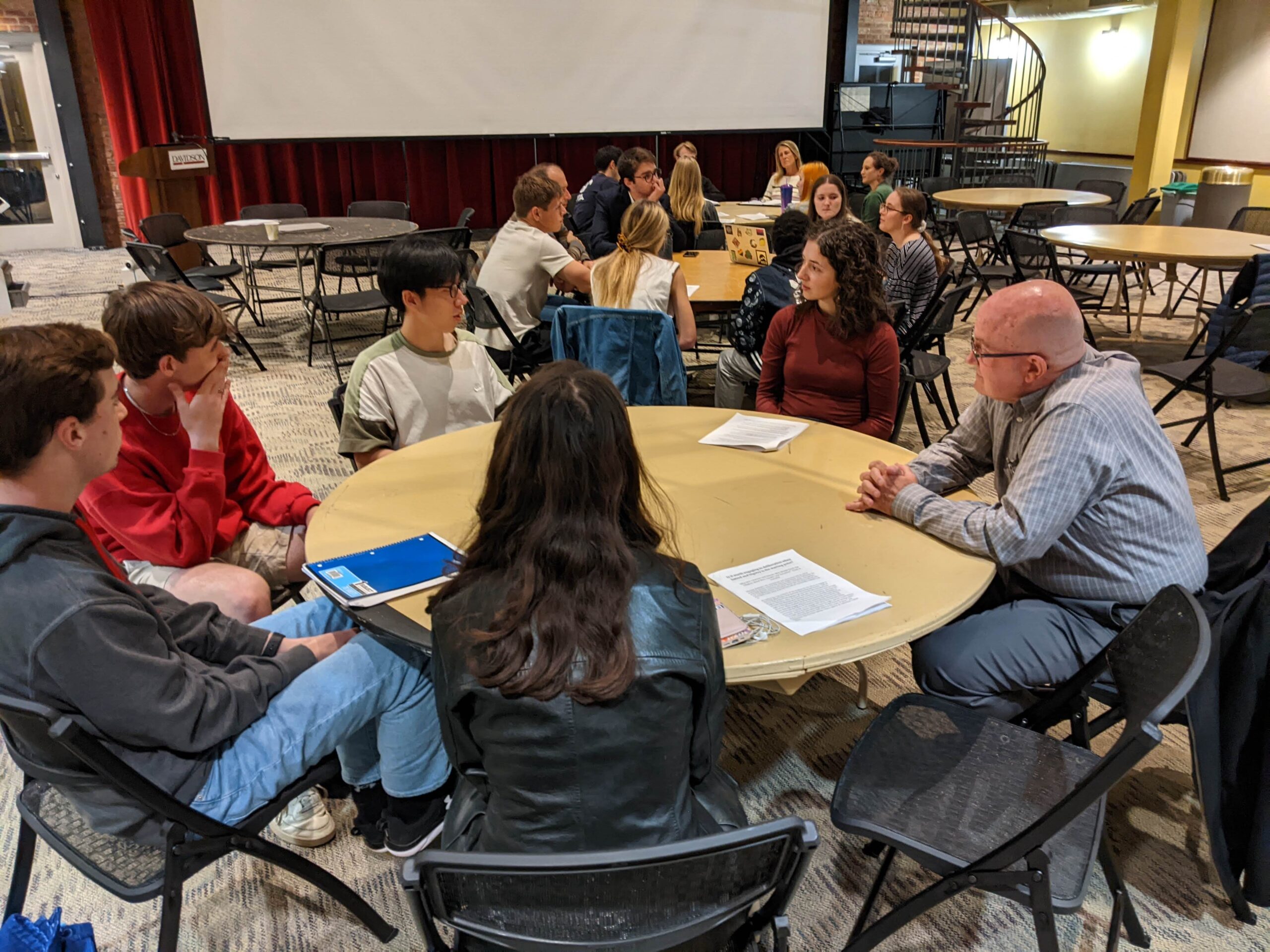
Bonner Scholars deliberating at Davidson College Lilly Gallery.

By Ahtziri Gonsalez (DCI Fellow)

Over the past few years, I have noticed that students are very vocal about bringing attention to issues in their communities. We have conversations about current issues, discuss different opinions, and help educate one another through platforms like Instagram or even the infamous YikYak. Still, when it comes to sitting down to have a conversation about different issues outside of a classroom or with people that you are not that close to, not a lot of people tend to participate. Does this matter?

Deliberation can be a word often associated with confrontation or arguments. Still, it can also be thought of as reflecting or just being open to listening to other points of view. At Davidson, getting caught up in conversations with people who feel the same way about specific issues is easy. While these conversations are essential, it is also important to remember that others might not react the same to things you might think are today’s societal norms.

Even if you have a conversation with someone who you know has completely different opinions about something you feel passionate about, shutting them out entirely and immediately forming a negative image of the person is less productive than having a conversation with them. If you sit down and talk, you might understand how they came to form their opinions while they get to hear why you believe certain things.

However, these conversations can only be productive if there is a mutual level of respect and understanding. Without these dispositions, it can be difficult to not jump to conclusions or into unproductive and accusatory argument. When this happens, it can be feel like you are arguing with the person and all of what you think they believe rather than engaging with the specific topic and question that you are actually talking about. as arguing with a person about what they think instead of arguing against the idea itself.

These conversations are very difficult to have, especially when it comes to a topic you feel strongly about. Yet, acknowledging the steps that you are taking to be able to have productive conversations still counts for something! Being open-minded is a challenging but essential skill, and practicing this in the classroom, by reading articles with views different from yours, or by attending events like the ones hosted by DCI can help broaden your understanding of various subjects.

You can also learn more about why it is so important to be able to deliberate while keeping in mind that it is not your job to educate others and that you can’t force someone to change their views. What matters is that you took the time to discuss your experiences while listening to the experiences of others and discovering how they came to think about different issues in particular ways.

Filed Under: Blog Posts, Fellow Posts

Commons Conversations and the Effects of Food on Deliberation

October 14, 2022 by LJ Phillips

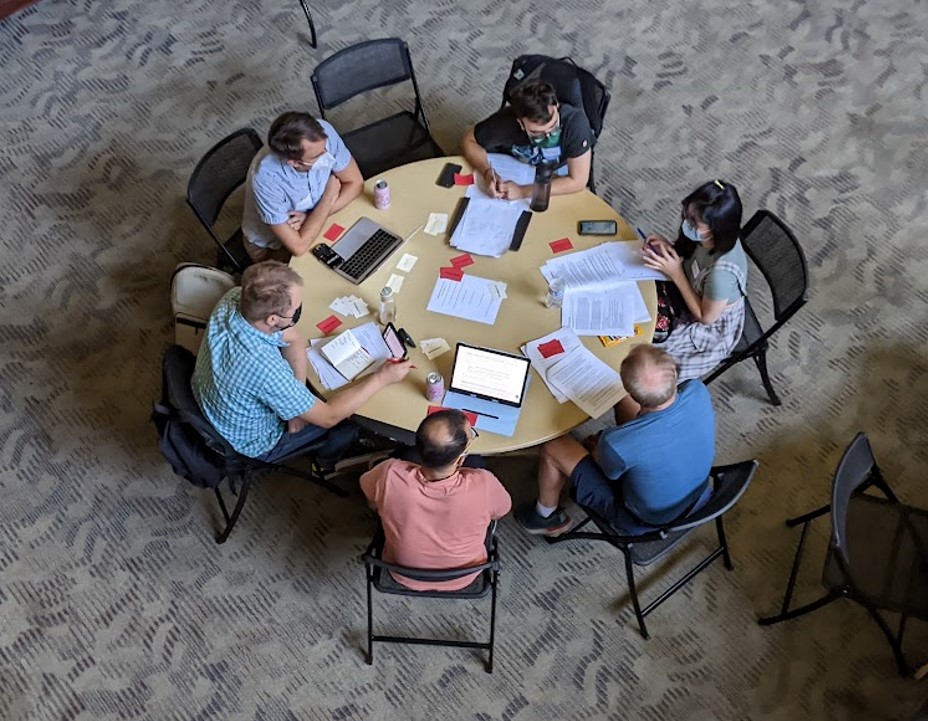
Conversations at Davidson College Commons

By LJ Phillips (DCI Fellow)

According to celebrity chef James Beard, “Food is our common ground, a universal experience.” Food always has a unique way of bringing people together. The most prominent conversations or interactions that I can remember in my life almost always involved food in some fashion. The act of eating with another person or persons makes people more sociable. We are less on-edge and are more vulnerable to one another when we share a meal.

I found this realization to be even more supported by the first Commons Conversation this semester. As a facilitator, I found it difficult at first to find people who wanted to engage in a deliberation during their lunch. People did not seem to want to spend their lunch time deliberating in the beginning but decided otherwise once we started to deliberate.

Our deliberative topic was about mental health. It is a sensitive topic for some but eating together eased the tensions throughout the table and you could visibly tell that people are not only comfortable but eager to speak to one another.

I wonder about that change in tone and mood from previous deliberations. As conversation went on people seamlessly felt accepted and were glad to share their personal opinions on the topic. This was the effect of deliberating in a less stressful environment under serene circumstances.

With regards to the actual conversation we had, it went well and the crosstalk and conversation among deliberators was orderly and coherent. The easy-going and well-meant nature of the discussion made my job as a facilitator more enjoyable and pleasant. Interruptions were not needed by me because the subsequent group respected each other despite their differences and lack of knowledge of each other.

I think the reason for such cordiality was that we were dining with one another. We can all relate in that we not only need food as humans but desire it. Eating with another person has shown to be a great way to ease tension and be more relational with someone. Whether you are eating at Vail Commons, Davis Cafe, or Zaxby’s, the personal act of sharing a dining experience brings comfort and familiarity even when it wasn’t present before.

As our deliberation continued, people also became better listeners ironically. Naturally, most would assume that when we eat and converse we become worse listeners because eating takes some of the attention away from the conversation. However, this did not happen; everyone listened intently to each person’s perspective.

What I saw that Friday in Vail Commons was an intentional, genuine conversation about a delicate matter such as mental health. It was an experience that was elevated by the act of eating lunch with other people. It really makes you ponder about how much our surroundings have on our mood and attitude toward speaking to people. Food has a positive impact on our interactions with one another. If we have more conversations where people are in comfortable settings, better and more productive deliberations will occur.

Filed Under: Blog Posts, Fellow Posts Tagged With: facilitation

  • « Go to Previous Page
  • Page 1
  • Interim pages omitted …
  • Page 22
  • Page 23
  • Page 24
  • Page 25
  • Page 26
  • Interim pages omitted …
  • Page 32
  • Go to Next Page »

Footer

Blog Post Categories

  • Announcements
  • Blog Posts
  • DCI Posts
  • Events
  • Faculty Posts
  • Fellow Posts
Image of a compass superimposed by the text "Deliberative Citizenship Initiative" and "Davidson College." Clicking on this image leads to the Initiative page.

Recent DCI Blog Posts

  • We Tried to Fix Jubilee’s “Middle Ground” – Here’s How It Went
  • A Case for Deliberation in the Natural Sciences
  • Welcoming New Staff to the DCI and DCN
  • Facebook
  • Twitter
  • Instagram
  • LinkedIn


Copyright © 2026 · Infinity Pro on Genesis Framework · WordPress · Log in