• Skip to main content
  • Skip to footer

Deliberative Citizenship Initiative

Building Democracy One Conversation at a Time

  • The Initiative
    • Programs
      • Deliberation Across the Curriculum
      • Deliberation on Campus
      • Deliberation in the Community
      • Research on Deliberation
    • Motivations
      • Why Deliberative Citizenship?
      • Why Davidson? Why Now?
    • Who’s Involved?
      • DCI Fellows Cohorts
        • 2025-2026 Fellows
        • 2024-2025 Fellows
        • 2023-2024 Fellows
        • 2022-2023 Fellows
        • 2021-2022 Fellows
        • 2020-2021 Fellows
      • DeeP Collaborative Cohorts
        • 2024-2025 DeeP Collaborative Faculty
        • 2023-2024 DeeP Collaborative Faculty
      • Advisory Council
    • History
      • What Sparked the Initiative?
    • Key Deliberative Dispositions
    • Frequently Asked Questions (FAQ)
    • Annual Report
  • Get Involved!
    • Participate in a Forum
    • Join a D Team
    • Become a Fellow
    • Take Courses
    • Get Training
    • Come to Guest Lectures
  • Events
    • Upcoming Events
      • 250th Anniversary Deliberative Forum Series on American Values
    • Past Events
  • Connections
    • The Deliberative Citizen: The DCI’s Monthly Newsletter
    • Efforts on Campus
    • Efforts in the Community
    • Efforts Elsewhere
    • Readings and Resources
      • DCI-Published Guides
      • DCI Guide to One-on-One Conversations
      • How to Disagree
      • Demonstration of Facilitation Styles
      • Deliberative Pedagogy Mini-Course
    • How We Can Help: DCI’s LET’S DELIBERATE! Partnership Opportunities
    • DCI in the News
  • DCI Blog Posts
    • Recent Blog Posts
    • All Blog Posts

Blog Posts

Celebrating Community and Conversation: The DCI’s Kickoff Party Success

September 12, 2024 by Willow Paul

On Friday, August 30th, the DCI kicked off the school year with a burst of energy and enthusiasm! Around 40 people gathered to dive into lively discussions over pizza, connecting with fellow Davidson students, faculty, and staff. The event was a vibrant mix of newcomers to the DCI and seasoned veterans, all eager to mingle and engage.
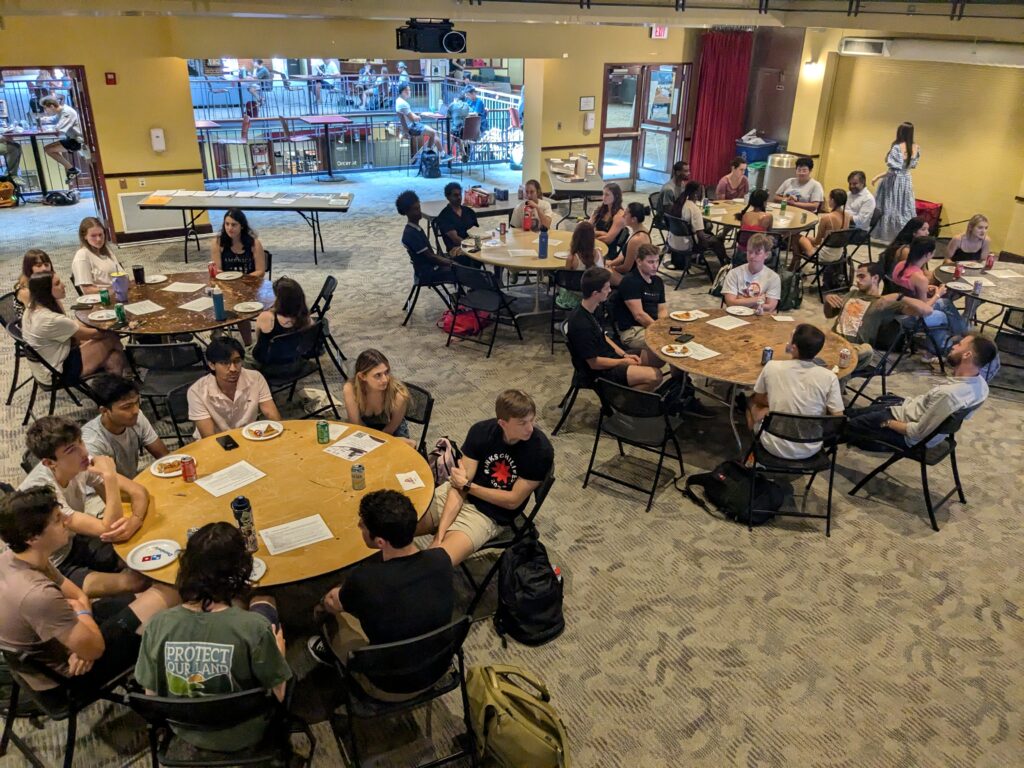
photo of students deliberating

The celebration took place in the College Union’s 900 Room, where tables engaged in conversation on a diverse array of topics. Our new cohort of DCI Fellows did an exceptional job inviting students, staff, and faculty from the College Union, creating a welcoming atmosphere that encouraged dialogue. Each table was thoughtfully equipped with Conversation Agreements and Deliberative Dispositions to help guide discussions.

Every 15 minutes or so, the DCI Faculty Director, Dr. Graham Bullock took the floor to briefly highlight upcoming DCI events and offer useful deliberation tips. To keep the energy high, we also held a fun raffle— each attendee had a chance to win a coveted DCI T-shirt. The excitement was palpable as names were drawn, and every winner received their prize with a smile, adding a festive touch.
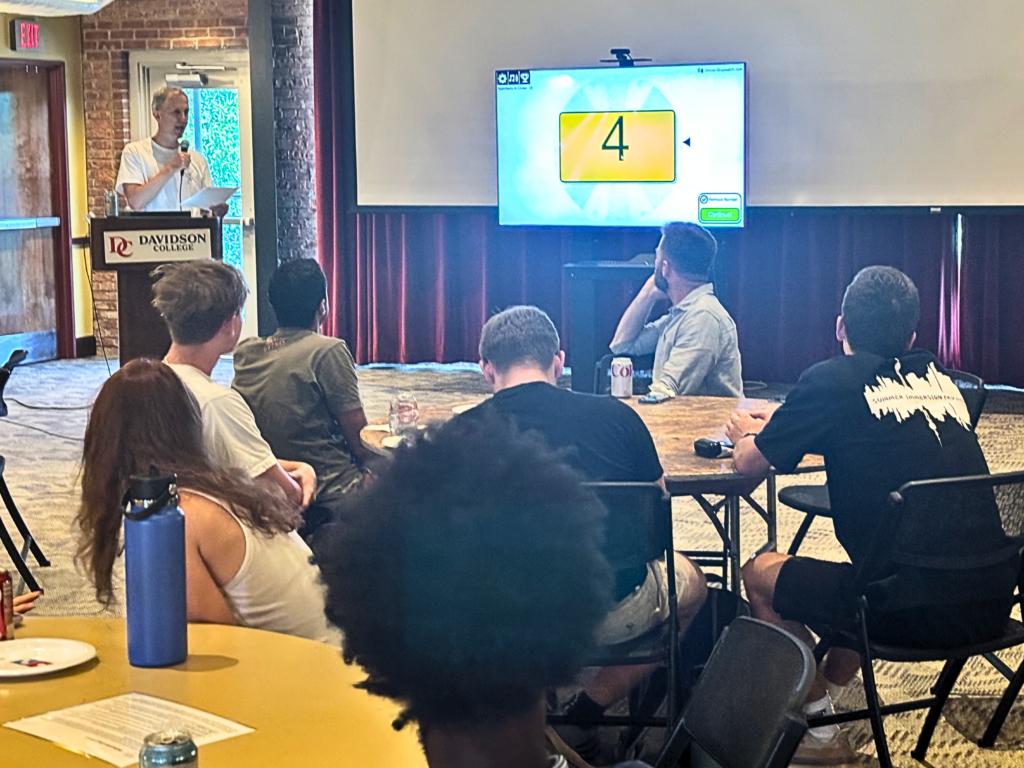
The event proved to be a fantastic start to the school year, providing participants with a meaningful opportunity to connect in new and engaging ways. It highlighted the DCI’s dedication to fostering respectful and thoughtful dialogue in today’s polarized climate. By embodying the DCI spirit of building democracy, one conversation at a time, the event set a wonderful tone for what promises to be an enriching year of DCI programs and events.
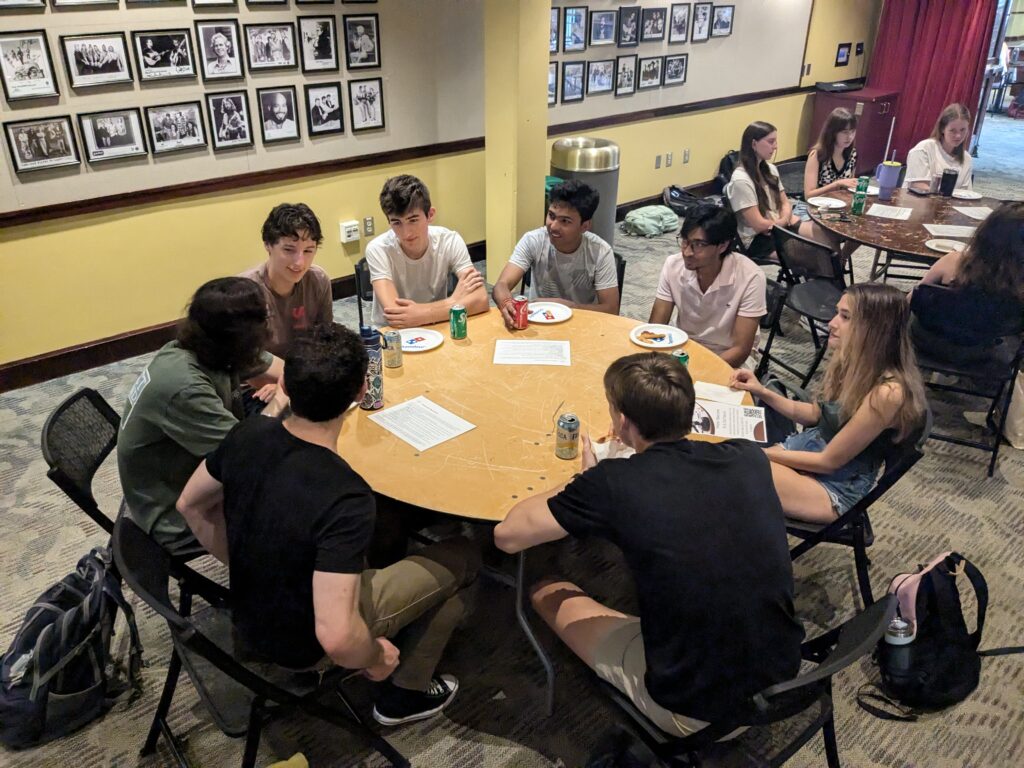
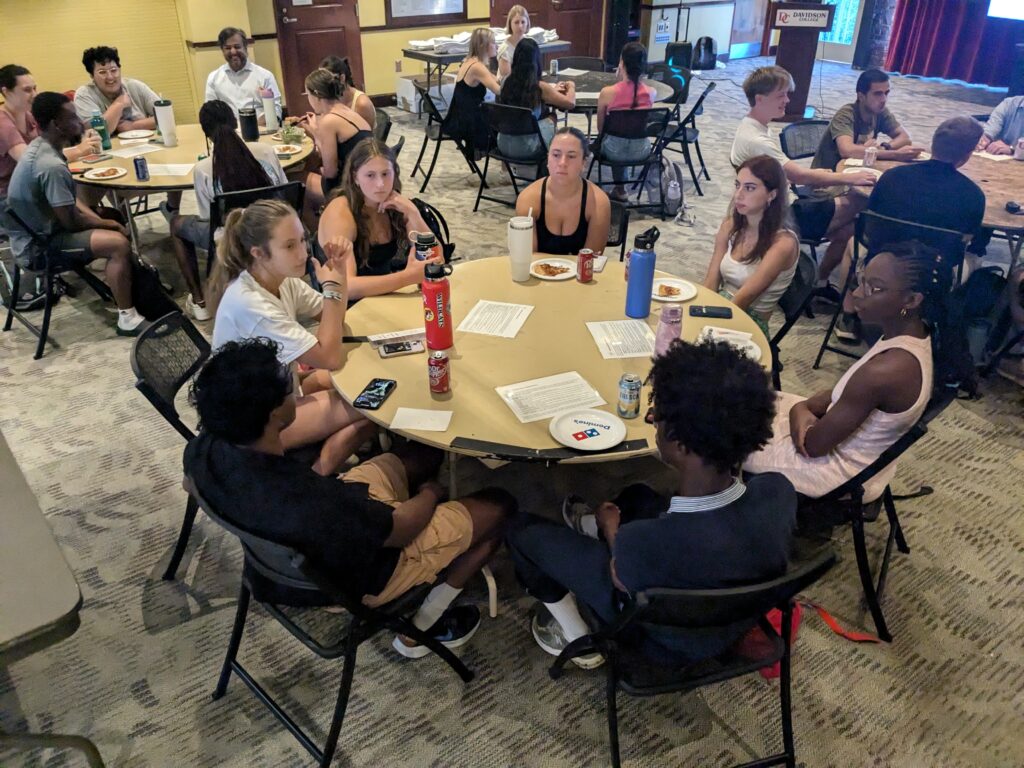
photo of students deliberating
photo of raffle numbers being drawn

Filed Under: Blog Posts, Events

Deliberation: From Initial Doubts to Ultimate Endorsement

September 6, 2024 by Willow Paul

The Deliberative Pedagogy (DeeP) Faculty Collaborative consists of faculty from Davidson College and other higher education institutions who are committed to learning and implementing new ways to improve and deepen the quality of their class discussions. These faculty come from a wide array of disciplines and backgrounds to study and discuss deliberative pedagogy methods, share their ideas and questions with one another, and work to embed deliberation in their classrooms. In this special blog series, members of the Collaborative describe and reflect on their experiences developing and teaching their deliberation-involved courses.

As an anthropologist, I feel most comfortable in discussion seminars, working through texts and data with students as a group. The issue, of course, is that undergraduate students may feel more accustomed to lectures and thus may hesitate to contribute to discussion, even when they have worthwhile observations or arguments to make. This holds true particularly at institutions not typically regarded as “elite.” The students are, in my opinion, just as intelligent as at elite institutions in a general sense. However, they often lack the confidence in their own opinions and perspectives that an elite institution instills. I often feel as though I must coax their perspectives out of them. Facilitating discussion has proven difficult at times, and the Deliberative Pedagogy (DeeP) Collaborative offered me the chance to experiment with deliberation in the classroom. 

Anthropology requires nuance and encourages political stances, and I initially resisted the framing of many mainstream issues with which DeeP engages. Indeed, I feel that one of the primary goals of anthropology as a discipline is to interrogate the way that we commonly frame political or social questions. My breakthrough came when I asked students to watch “How to Blow Up a Pipeline” and debate the ethical and political merits of the argument espoused by the film (a fictionalized narrative drawing from Andreas Malm’s essay “How to Blow Up a Pipeline”). In other words, I asked my students whether it was ok to blow up a pipeline, given the risks posed by climate change and government inaction. 

The ensuing debate surprised me, both in terms of the range of opinions within a relatively small class, and in the way that students drew on the texts that we had already read in the first three weeks of the semester. Offering them a yes/no question with strong ethical and political implications and then asking them to justify their opinions led to a far more animated discussion requiring far less guidance from me. They also, eventually, reached a consensus where they agreed that blowing up a pipeline might be ethically permissible but was likely politically counterproductive. 

I realized that simplifying complex issues into a single question on which students could take sides allowed them to mobilize complex readings in new ways and explore their nuances. I think that this stands as the key insight offered by the deliberative literature, though it is not an insight that is frequently made explicit. Operationalizing these insights required some thought, of course. Not every weekly topic can or should be reduced to this format, particularly as I cannot always develop relevant questions. How, for instance, would I develop a deliberation on a unit engaging Indigenous worldviews? Is a deliberation even necessary? Probably not! In some cases, I can and perhaps should continue to guide the students through the literature and highlight any relevant debates. However, I began to formulate questions that would allow students to engage in deliberation while drawing from 3-4 weeks of more complex readings. In turn, I think that the periodic deliberations further encouraged students to talk during the weekly units. 

Filed Under: Blog Posts, Faculty Posts

Deliberating on Gender, Family, and Policy

August 30, 2024 by Angela Cools

The Deliberative Pedagogy (DeeP) Faculty Collaborative consists of faculty from Davidson College and other higher education institutions who are committed to learning and implementing new ways to improve and deepen the quality of their class discussions. These faculty come from a wide array of disciplines and backgrounds to study and discuss deliberative pedagogy methods, share their ideas and questions with one another, and work to embed deliberation in their classrooms. In this special blog series, members of the Collaborative describe and reflect on their experiences developing and teaching their deliberation-involved courses.

In Fall 2023, I incorporated deliberation into Economics 227: Economics of Gender and Family. This class covers gender, race, and class differences in labor market experiences and uses economic analysis to examine trends in marriage, divorce, fertility, and government policy surrounding families. This class mostly consists of economics majors and minors in their sophomore through senior years. Previous iterations of the course had been lecture-based; while students engaged in small group discussions and Moodle discussions on economic analysis and the costs and benefits of different policies, they only sometimes brought their own thoughts or experiences to class material. I decided to incorporate deliberation into this class because of the complexity of topics covered, the potential for different viewpoints among students, and the difficulty of translating values into effective policy.

One of the key methods of incorporating deliberation into the class was the use of deliberative assessments, in which students participated in a self-facilitated deliberation. Three assessments covered important areas of debate in both the economics literature and policy circles: 1) whether (and how) government policy should address the fact that boys and men have fallen behind girls and women in school performance and high school and college graduation rates; 2) the use of artificial intelligence in hiring and how it might exacerbate or mitigate discrimination; and 3) how the tax system promotes and discourages marriage and whether the government should promote, remain neutral, or discourage marriage (especially among parents). 

In all deliberations, I asked students to prepare an “opening statement” of about 60 seconds to give their individual views. We then launched into deliberation on the main issues. In the final 20 minutes, the students worked together to develop a policy proposal surrounding the issue. I experimented with different forms of grading (individual grades, a group grade, or a combination of the two), and always had students turn in notes they had prepared ahead of time. At the end of each deliberation, I also asked students to give a brief reflection. Students particularly liked the group grading or group + individual grading. One remarked, “I think that getting graded as a group allowed everyone to relax a little bit and work together rather than independently.”

Relative to unstructured discussions from previous semesters, I noticed several key benefits of structured deliberation (including the assessments, micro-deliberations, and full-class deliberation). First, students focused on listening to each other and making sure everyone’s views were included in the conversation. The “goal” was not to each say something that sounded impressive; the goal was to have a conversation in which everyone’s views were heard and considered, and the best policy proposals could prevail. After one deliberation, a student asked if he had talked “too much;” he and I were able to discuss the balance between sharing his own views and making space for others. I also witnessed students inviting quieter students into the conversation by name. 

Second, students brought their own experiences and values into the conversation at a much greater level than I had seen previously. For example, in the first deliberative assessment, many talked about their experiences with single sex education. 

Third, in preparing for the deliberation, students engaged more deeply with the material than in previous semesters when they just prepared for a test; some even did extra research ahead of the deliberations. They were also able to think more about the complexity of issues such as the use of artificial intelligence in hiring by trying to design a policy. Finally, deliberating with other students allowed them to more deeply understand the topics. Several students provided comments to this effect:

  • “I liked how the deliberations brought up new points I had not considered. I really enjoyed hearing people’s different perspectives.”
  •  “I learned from other students’ experience[s] and perspective[s], and definitely gain[ed] more nuance[d]…understanding [of] the matters.”
  • “Often, we think that our opinion is the only right one, but hearing everyone’s views and creating our unique policy where everyone had to agree was super helpful.”
  • “Every time the discussion helped me to understand the readings and topic in a deeper and diverse way.”

The primary limitations involved time constraints inherent in any course. To make space for several class periods to be solely devoted to deliberation, some material was cut from the syllabus. The deliberative assessments also suffered from time constraints: many students remarked that the 50-minute class period was not sufficient to fully explore the topics. In the future, I may consider requesting longer class periods or out-of-class (e.g., evening) deliberative assessments. Another challenge was ensuring that students had sufficient knowledge to engage in meaningful deliberation. While this could be accomplished with a couple class periods and 2-3 hours of preparatory material in the case of gender gaps in education, topics like use of artificial intelligence in hiring may have benefitted from even more background reading and/or preparation in class lectures. In the future, I will try to prepare students better ahead of time (including with in-class lectures) and try to choose topics on which students have sufficient background to fully engage in deliberation.

Overall, bringing deliberation into Economics of Gender and Family improved students’ engagement with the material and appreciation of the complexity of issues. It enabled them to draw meaningful connections between academic material, their own experiences, and their values. I plan to incorporate deliberation into this course in the future as well as in the Economics senior seminar. 

Filed Under: Blog Posts, Faculty Posts

Incorporating D Teams into an Educational Studies Course

August 30, 2024 by Willow Paul Leave a Comment

Headshot of  Rick Gay.

Guest Post by Professor Rick Gay, Professor of Educational Studies at Davidson College

Having students work with the D Teams was a positive experience for both students and instructor. Perhaps the most important benefit was that it encouraged students to consider positions on controversial issues in education other than my own. For example, I am against tuition vouchers for any reason; I am against for-profit charter school management organizations; and I favor college admissions officers considering demographic data. Even though I tell students that they don’t have to agree with me if they approach these disputes with logical support and argument, I realize that they are reluctant to challenge me in class. 

As one student wrote in their reflection about their D Team experience: “The best and most important part of the DCI was the respect shown toward each person and our differing opinions. Practicing the ability to argue or deliberate about a topic without getting hostile, defensive, or personal is something I think is lost in today’s society and deserves more effort.” Another wrote about how much they valued the opportunity to meet new people and hear their perspectives on the issues discussed by their D Team: “Overall, my favorite part of the DCI meetings was being introduced to different people I would not have met without going to each meeting and hearing all their different stories and experiences.”

Students also appreciated the opportunity to learn different ways to engage with each other. As one student wrote, “My participation in this D Team not only provided me with new knowledge, but also with new ways of thinking and interacting with my peers. I consider my participation to have been a great success and hope that students across our campus can be exposed to these great DCI D Teams in the future.”

D Teams include not only Davidson students but also staff, faculty, alumni, and members of our broader community. They are led by the DCI’s student fellows who are trained in how to facilitate challenging conversations. If you’re curious about this experience and would like to try it out, registration is now open for our Fall D Teams (the deadline is Sept. 6). They meet three times every three weeks in October and November. This semester’s topics are campus protests, defensive democracy, and diversity, equity, and inclusion initiatives. Sign-up today and enjoy some robust and respectful discussions about some important and salient topics facing our society. 

Filed Under: Blog Posts, Faculty Posts

Deliberation in a Course on the Good Life: Cultivating Critical Thought and Community

August 19, 2024 by Graham Bullock Leave a Comment

The Deliberative Pedagogy (DeeP) Faculty Collaborative consists of faculty from Davidson College and other higher education institutions who are committed to learning and implementing new ways to improve and deepen the quality of their class discussions. These faculty come from a wide array of disciplines and backgrounds to study and discuss deliberative pedagogy methods, share their ideas and questions with one another, and work to embed deliberation in their classrooms. In this special blog series, members of the Collaborative describe and reflect on their experiences developing and teaching their deliberation-involved courses.

I joined the DCI DeeP Collaborative because I wanted to learn about deliberative pedagogy and examine my own discussion-oriented teaching within a supportive community of practice. The course I decided to incorporate deliberation into was a new one for me: an interdisciplinary seminar in the Honors College at UNC Charlotte called Labor, Leisure, Learning, and a Good Life. The course asks students to consider how work, play, rest, and education contribute to a well-lived life, and to examine how U.S. systems and policies influence individuals’ occupational and educational choices.

The course (CTCM 2530) fulfills the Critical Thinking and Communication requirement within UNC Charlotte’s updated general education curriculum and includes a semester-long central inquiry project. We consider CTCM 2530 to be like a “mini-capstone” course for the general education curriculum. It’s particularly important in the Honors College because it helps prepare students for the more intensive capstone projects they’ll undertake as juniors and seniors.

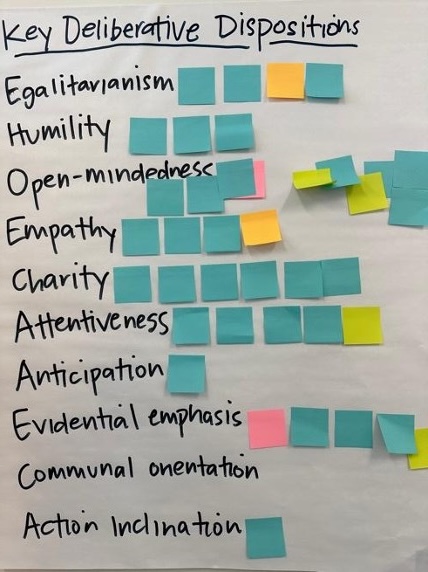
Adding deliberative pedagogy to a course focused on critical thinking and communication seemed like a natural fit from the start, but I didn’t fully realize how well the course content would align with deliberation until we got underway. On the first day of class, I shared the DCI’s key deliberative dispositions as a starting point for our conversation about the type of classroom community we wanted to build. The class reviewed descriptions of the dispositions and each student chose their top two, “voting” via sticky notes. This resulted in a frequency histogram showing which dispositions students initially deemed most important (check out our results in the picture below!). Unsurprisingly, open-mindedness was the top choice.

We discussed what it would take for students to show up with open-mindedness, charity, evidential emphasis, and attentiveness in class this semester. I also asked students to speak up for the dispositions that were less popular and to consider why they might be important as well.

We carried these agreements with us into all of our class discussions over the course of the semester, but particularly into two full-length deliberations on universal basic income and standardized testing policies. As preparation for these deliberations, students split into two groups and collaboratively wrote the content for the deliberation guides, deciding what to include and each providing an overview on one dimension of the issue. I set the deliberation structure and prompts, and ended each deliberation with a short “case study”—a wonderful idea that my DCI partner, Dr. Nick Triplett, tried first and recommended to me.

Overall, the deliberations were an incredibly successful component of our class that helped set the tone for the semester as a whole. When debriefing the first deliberation on Universal Basic Income (UBI), one student shared that she appreciated the opportunity to talk about something substantive with her classmates because “it helped her know them as humans.” This was a theme in our class that echoed the Aikin and Talisse (2019) reading we did early in the semester: students felt that their engagement with their peers’ ideas during the deliberation was a form of care for one another’s cognitive health.

This “cognitive care” spilled over into other forms of generosity with one another as well. For instance, when one student broke her foot and couldn’t get to class, I emailed to see if anyone could help and got an immediate volunteer. Students also offered rides to The Dubois Center, the UNC Charlotte uptown campus to hear from our guest speakers during the semester, and stayed late to hang out with each other and me at 7th Street Market. And perhaps most tellingly, toward the end of the semester the class buzzed with energy and chatter as I attempted to start class each week, a welcome change from a roomful of students scrolling on phones or finishing assignments.

Integrating deliberation into the course wasn’t without challenges, however. For me as the instructor, one of the biggest challenges was assessing performance during the deliberations. During each deliberation, our 21-person class was split into 3 groups. They self-facilitated, passing facilitation duties around as they moved through the deliberation guide. I rotated between groups to assess deliberation performance using a rubric adapted from Sara Drury’s 2019 chapter in Creating Space for Democracy: A Primer on Dialogue and Deliberation in Higher Education.

I narrowed the rubric to just four elements most closely aligned to the key deliberative dispositions identified during our conversation on the first day, deciding to err on the side of brevity while we all learned this new format for discourse. I asked students to assess their peers and also assess themselves using the same rubric. While the rubric was helpful in providing shared language and a reminder of deliberative goals, it did not produce much variation in scoring. It was difficult for me to assess particular elements when I only heard parts of each deliberation, and the students (mostly) gave each other and themselves high marks.

While this is consistent with the tight-knit community described above, I will likely try to assess using different methods in the future. I don’t want to take away the self-facilitated deliberation: the opportunity to engage each other in substantive, structured dialogue without an evaluator presence was empowering for the students. They often clammed up when I joined them, and their remarks became more performative than contemplative.

Next time I incorporate deliberation in a course (and there will definitely be a next time!) I will be more intentional about norming expectations for scoring using the rubric, and will also try to devise a way to evaluate the students’ full contributions, perhaps by video or audio recording. Despite these challenges with assessment, I am excited to incorporate deliberation into future courses and continue to use it a means to build critical thinking skills and class community.

References

Aikin, S., & Talisse, R. (2019). Why we argue (and how we should): A guide to political disagreement in an age of unreason. Second Edition. New York: Routledge.

Drury, S. A. M. (2019). Cultivating dialogue and deliberation through speech, silence, and synthesis. In Shaffer, T. J. & Longo, N.V. (Eds.), Creating Space for Democracy: A Primer on Dialogue and Deliberation in Higher Education (pp. 69-82).  Stylus Publishing, LLC.

Filed Under: Blog Posts, Faculty Posts

  • « Go to Previous Page
  • Page 1
  • Interim pages omitted …
  • Page 6
  • Page 7
  • Page 8
  • Page 9
  • Page 10
  • Interim pages omitted …
  • Page 38
  • Go to Next Page »

Footer

Blog Post Categories

  • Announcements
  • Blog Posts
  • DCI Posts
  • Events
  • Faculty Posts
  • Fellow Posts
Image of a compass superimposed by the text "Deliberative Citizenship Initiative" and "Davidson College." Clicking on this image leads to the Initiative page.

Recent DCI Blog Posts

  • We Tried to Fix Jubilee’s “Middle Ground” – Here’s How It Went
  • A Case for Deliberation in the Natural Sciences
  • Welcoming New Staff to the DCI and DCN
  • Facebook
  • Twitter
  • Instagram
  • LinkedIn


Copyright © 2026 · Infinity Pro on Genesis Framework · WordPress · Log in