• Skip to main content
  • Skip to footer

Deliberative Citizenship Initiative

Building Democracy One Conversation at a Time

  • The Initiative
    • Programs
      • Deliberation Across the Curriculum
      • Deliberation on Campus
      • Deliberation in the Community
      • Research on Deliberation
    • Motivations
      • Why Deliberative Citizenship?
      • Why Davidson? Why Now?
    • Who’s Involved?
      • DCI Fellows Cohorts
        • 2025-2026 Fellows
        • 2024-2025 Fellows
        • 2023-2024 Fellows
        • 2022-2023 Fellows
        • 2021-2022 Fellows
        • 2020-2021 Fellows
      • DeeP Collaborative Cohorts
        • 2024-2025 DeeP Collaborative Faculty
        • 2023-2024 DeeP Collaborative Faculty
      • Advisory Council
    • History
      • What Sparked the Initiative?
    • Key Deliberative Dispositions
    • Frequently Asked Questions (FAQ)
    • Annual Report
  • Get Involved!
    • Participate in a Forum
    • Join a D Team
    • Become a Fellow
    • Take Courses
    • Get Training
    • Come to Guest Lectures
  • Events
    • Upcoming Events
      • 250th Anniversary Deliberative Forum Series on American Values
    • Past Events
  • Connections
    • The Deliberative Citizen: The DCI’s Monthly Newsletter
    • Efforts on Campus
    • Efforts in the Community
    • Efforts Elsewhere
    • Readings and Resources
      • DCI-Published Guides
      • DCI Guide to One-on-One Conversations
      • How to Disagree
      • Demonstration of Facilitation Styles
      • Deliberative Pedagogy Mini-Course
    • How We Can Help: DCI’s LET’S DELIBERATE! Partnership Opportunities
    • DCI in the News
  • DCI Blog Posts
    • Recent Blog Posts
    • All Blog Posts

Blog Posts

Commons Conversation Reflection: Discussing Sports Betting with Chris Clunie

June 14, 2024 by Graham Bullock

Poster for Chris Clunie event on sports betting

By Graham Bullock, Stephen Walker ’26, and Emre Guvenilir ’25

The DCI’s final Commons Conversation of the spring semester was hosted by Chris Clunie, Athletics Director and Vice President for Athletics. The topic was “Sports Betting: What are the Issues,” and Mr. Clunie started the conversation by explaining the College’s current rules related to sports betting. In short, employees and students are not allowed to 1) engage in any form of betting on sports competitions in which Davidson College athletes are competing, 2) share nonpublic information about Davidson College athletes that is relevant to sports betting, or 3) attempt to influence the outcome of a sporting event that includes Davidson College athletes.

He also discussed how sports betting can erode the sense of community and trust within the campus community if students place bets on their fellow Davidson student-athletes. Doing so can also ruin relationships between those individuals. When the performance of a team or individual can materially affect a classmate or staff members financial well-being, that places enormous pressure on both the athletes and how they connect with others on campus.

After Mr. Clunie concluded his introduction to the topic, the Commons Conversation’s participants weighed in with their perspectives and questions. Some were in favor of sports betting and not regulating it too rigidly, while others were more skeptical and concerned about its recent rapid growth. Everyone weighed the effects of betting on student-athletes on those specific-athletes themselves, and they benefited from insights from two track team members taking part in the discussion. They considered how the practice might harm them personally, especially considering the fact that they are Division I athletes at a school as small as Davidson. 

The participants also considered the benefits for people engaged in betting markets, including generating revenue and pure fun, and the limits of those benefits. Some highlighted how enjoyable sports betting is for a lot of people. Others suggested that betting is largely only experienced by groups of a higher socioeconomic status and emphasized that it can be highly addictive and harmful. They talked about how gambling is different from many other types of addictions in that its effects are less visible and that treatment and recovery resources are generally less available.

Mr. Clunie’s contributions to the conversation gave everyone insight into the rationale of different stakeholders considered by the athletics department as it works to develop betting rules for the college community to abide by that ensure they protect athletes and support the Honor Code. In discussing these rules, the participants emphasized the limits of the ability of the College to regulate the practice and the importance of the ethos of the honor code in ensuring sports betting does not adversely affect athletes, students, and teams. 

The participants discussed the honor code more generally and expressed a shared sense of declining reverence for the guidelines in the post-COVID era. They then explored possible solutions to this problem and deliberated about what the administration can and should do to address it. One participant argued that grade inflation is contributing to less concern about the Honor Code, while another stated that they came to Davidson because of it. Circling back to the issue of sports betting, especially on student athletes, participants emphasized that students must point out to one another what is and is not acceptable.

The conversation concluded with some discussion about the practice of sports betting more generally, and how people across the ideological spectrum may take issue with it. We highlighted the ways cultural shifts in society at large can impact college campuses in unpredictable and important ways. 
Filed Under: Blog Posts, Fellow Posts

Deliberation in Popular Media: The Case of Jubilee’s “Middle Ground”

June 14, 2024 by Declan O'Donoghue

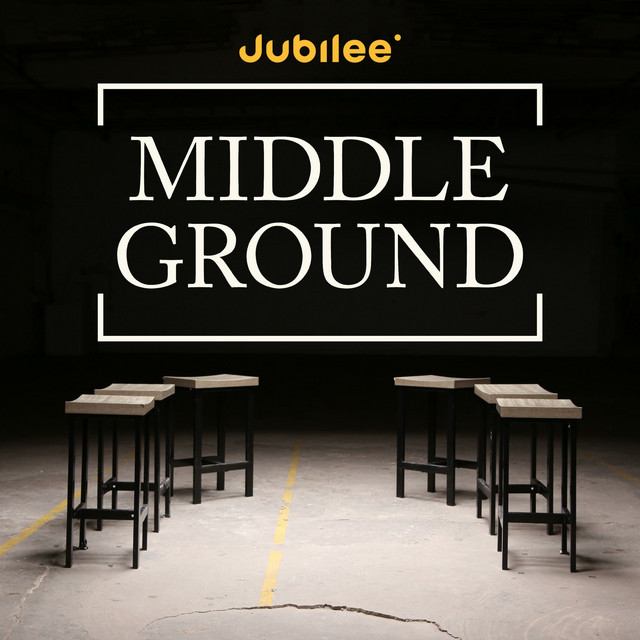
Image with six chairs and the text Jubilee Middle Ground.

By Declan O’Donoghue ’26

Deliberation is a unique concept. Although it exists in many facets of our lives and we often partake in it without even realizing it, deliberation can be rare in our consumption of popular media. The rise of music television and social media has introduced many new forms of entertainment to the public, yet much of this media is either fictional or not typically categorized under deliberation. In my view, mass media may be responsible for some stagnation in public deliberation. Fortunately, there is still hope for intentional conversations on often contentious issues, especially on media platforms like YouTube. Unlike many others, this site still allows for profitable long-form content. Media companies have taken advantage of this opportunity to create more critical content than what is typically posted on apps like Facebook or Instagram.

Jubilee Media is one company that, in recent years, has made a significant impact on both YouTube and the world of deliberation with its series addressing contentious social issues and showcasing diverse groups of people. Officially, Jubilee’s mission statement is to ‘bridge people together and inspire love through compelling stories, create shareable, human-centric videos that create connection, challenge assumptions, and touch the soul, and ultimately to inspire people to live deeper.’ While this sounds quite serious, they also produce playful videos like ’20 vs 1′ speed dating, which garners millions of views. However, some content has shifted toward more serious topics. A series titled ‘Spectrum’ brings together groups of people with shared identities—from teenage mothers to Muslims—and asks them a series of questions, which they rate on a spectrum from ‘strongly disagree’ to ‘strongly agree.’ These types of questions are similar to those a trained facilitator might ask in a deliberation. Here, because the group participants all have lived experiences, Jubilee can simplify their format. After taking their mark on the spectrum, participants have the opportunity to defend their position without crosstalk, before the conversation opens up to the group, just like in a DCI deliberation. Yet, with a mid-length runtime of around 20 minutes, Jubilee’s ‘Spectrum’ series fails to delve too deeply into any one topic.

Although Jubilee features a variety of video formats with elements of deliberation, their ‘Middle Ground’ series most closely aligns with the DCI style of deliberation that I have been trained to facilitate. The format is essentially as follows: A group of 6-8 people, who presumably hold contrasting worldviews or identities, come together. Popular matchups include scientists versus flat earthers, police versus criminals, or even unique twists like former liberals versus former conservatives. The participants are generally presented with a series of serious prompts, such as ‘Criminals who commit violent felonies don’t deserve certain legal rights. Step forward if you agree.’ All participants from either side who agree with the statement step forward into the spotlight, sit down, and then deliberate on the concept. After some time, those who disagree step forward and join the discussion.

Jubilee has created an impressive platform that brings new perspectives and fosters deliberation across the internet, the format of their ‘Middle Ground‘ videos still has room for improvement. One major criticism relates to their selection of participants: they sometimes fail to include any voices that truly represent the middle ground, missing an opportunity for more comprehensive deliberation. This is occasionally justifiable, especially in scenarios where few individuals represent a moderate viewpoint between extremes, such as between flat-earthers and mainstream scientists. However, in episodes like ‘liberal teachers vs. conservative parents,’ including both fringe and more center-aligned voices could enrich the discussion, allowing for a broader spectrum of opinions and a fuller exploration of the issues at hand.

Most importantly, Jubilee’s ‘Middle Ground’ series lacks a serious facilitator, which significantly hinders the videos from becoming exemplary models of deliberation. Currently, the producer, acting as a voice behind the scenes, reads out the prompts and occasionally steps in to manage the group. This absence of dedicated facilitation often leads to tense interactions among participants and permits some to make harmful, sweeping generalizations. Moreover, time is rarely distributed equitably among participants. Without effective facilitation, some individuals dominate the conversation, turning their participation into a spectacle that is then perpetuated online. While this approach might attract views, it risks alienating viewers and driving wedges between different audience segments, ultimately detracting from the potential for meaningful dialogue and understanding.

These discussions can be fruitful and build genuine connections between participants. Additionally, Jubilee has changed their format, likely sacrificing profit to make these videos more effective as deliberations. Videos initially fell within the YouTube AdSense sweet spot of 8-12 minutes, featuring catchy clips and more clickbait interactions. They have since transitioned to longer-format videos, which are more costly and less favored by the YouTube algorithm. Now, videos can reach up to 90 minutes after editing, similar to the length of most DCI deliberations. These longer videos allow participants to dive much deeper into deliberation than before, and viewers have continued to watch. Some longer videos have even surpassed 25 million views.

All in all, Jubilee’s ‘Middle Ground’ video format has pioneered deliberation in a socially valuable and highly educational manner. The success of their content paves the way for other creators to do the same while still profiting. Regardless, they could certainly benefit from acquiring a trained facilitator for their deliberations.

Image above from Podtail.

Filed Under: Blog Posts, Fellow Posts

Commons Conversation Reflection: Discussing the First Year Experience with Dean McCrae

June 5, 2024 by Graham Bullock

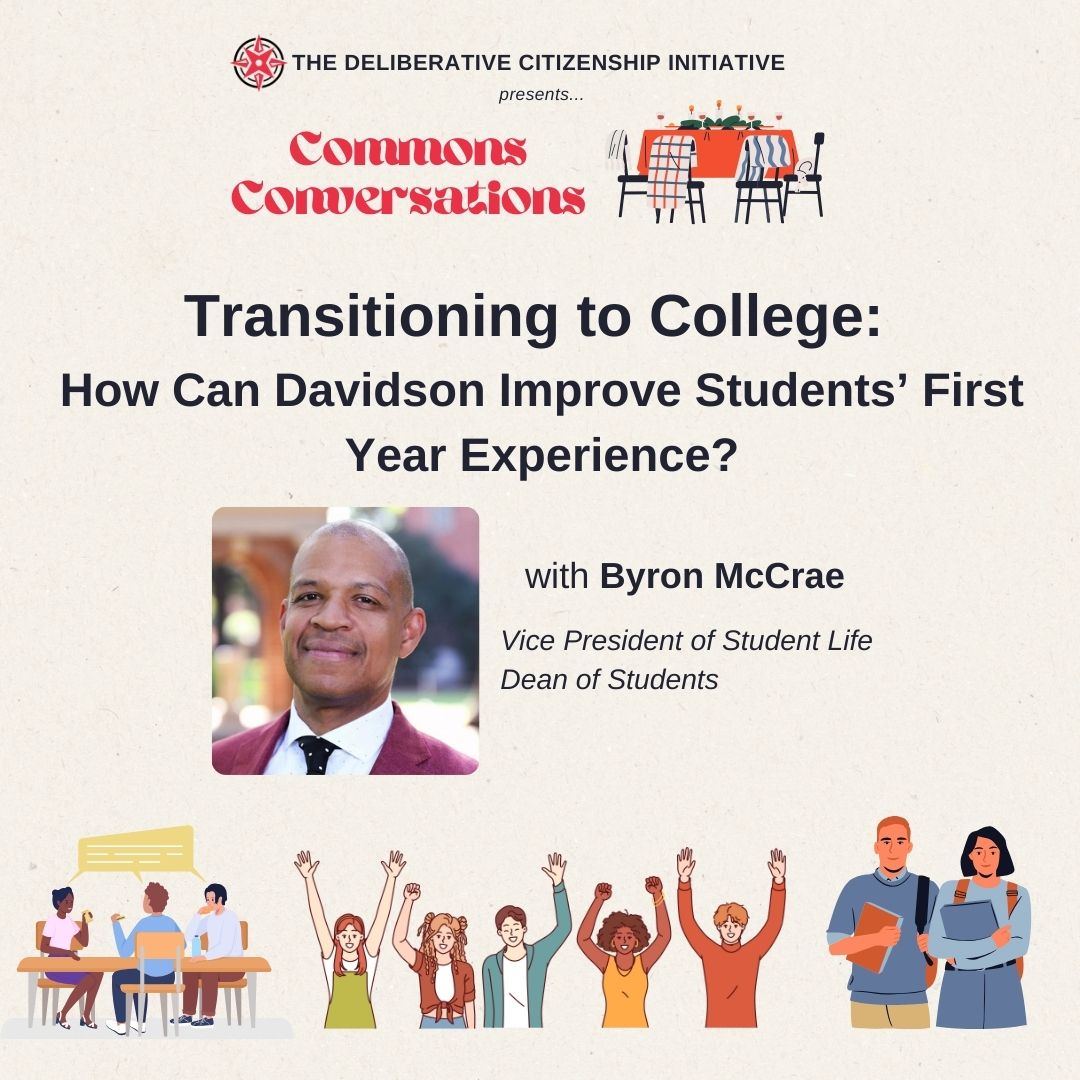
Commons Conversation flyer with Dean McCrae

By Graham Bullock, Logan Jain ’26, and Grace Gallagher ’26

On Thursday, April 4, Dean of Students Byron McCrae hosted a discussion with students about the first year experience at Davidson as part of the DCI’s ongoing Commons Conversation series. Dean McCrae framed the discussion with some of his initial thoughts and questions and then opened it up for the students to share their impressions related to the first year experience at Davidson.

Students quickly began to ask questions about the goals of first-year programming. Do we want students to make connections and feel at home? Should we focus more on affinity-based programming for different identity groups (e.g., first gen, minority students, etc.)? Or do we want to work on building a broader sense of community and creating groups that include a cross-section of identities?

One theme of the conversation was the schedule and design of freshman orientation. They discussed the tradeoff between having too many required events that exhaust students and giving them a comprehensive enough introduction to life at Davidson – and to each other. Along those lines, the value of class trips also came up – last year the entire first year class went to a Charlotte FC game together.  

The question of whether there are important topic areas that are not currently covered during Orientation was also raised, which precipitated a discussion about whether orientation programs should be extended throughout the whole first semester. There was a sense among some of the conversation participants that orientation shouldn’t end on the first day of classes, and that we need to ensure that first year students continue to receive the necessary support and have access to resources to ease the academic and social transition as they need them.

Others argued that there are a lot of resources currently available but students don’t take advantage of them. How do we increase the publicity of these resources? Some suggestions included creating a website with first-year resources (versus the current strategy of a pamphlet/handbook) as well as de-stigmatizing the use of these resources.

The value of the holistic advising program was discussed, and questions were raised about how students are paired with their advisors and what the tradeoffs of having a staff vs. faculty advisor are. Some students reported having advisors who were really helpful, while others reported that they were helpful in some regards but less helpful in others. Some of the students were unaware that advisors had funding to host social events with their advisees; others wondered how first-year students can be convinced that it is worth their time to show up at these and other events hosted for them.

Another general theme was whether the College should continue to work within the current orientation framework or develop new methods to introduce first years to Davidson. One specific idea that came up was to create more Pre-Orientation Programs that build on the experiences of Davidson Outdoors, the International Students Program, the STRIDE Program, and other similar initiatives.

All in all, it was a rich conversation that generated lots of ideas, questions, and areas of both agreement and disagreement. Dean McCrae took lots of notes; it was a great opportunity for him to both share this thoughts on the topic as well as hear directly from students about their perspectives on what worked well for them and what might be improved in the future.   

Filed Under: Blog Posts, Events, Faculty Posts, Fellow Posts

The Importance of Silence in Deliberation

June 5, 2024 by Logan Jain

ripples in water

By Logan Jain ’26

We hate silence. We play music while driving, turn the TV volume up when no one is in the room, and often whistle, sing, or even talk to ourselves while alone. But perhaps the silence that we hate the most occurs in social settings. The eerie silence that can consume a room full of people when no one knows what to say next. We find ourselves scrambling to break the silence, saying the first thing that comes to mind. Often, this manifests itself in a snide remark along the lines of “this is awkward.” The words we use to describe this silence (awkward, uncomfortable, etc.) demonstrate our inability, as a society, to embrace silence and the many positives that it allows for.

As a DCI facilitator, one of the first skills I had to learn was managing silence. Too much of it can stymie the flow of a deliberation and leave participants struggling to come up with meaningful contributions. Conversely, too little can turn a deliberation into a break-neck sprint, with participants unable to gather their thoughts and remain patient. But with the right balance, silence can enhance a deliberative experience for all participants without feeling “awkward” or “uncomfortable.”

Before I delve into the myriad ways that I believe silence can aid deliberation, I want to discuss my own relationship with silence. While not a Quaker myself, I spent all but 2 years of my K-12 education at Quaker institutions. Once a week, I would gather with the rest of my classmates in a large, chapel-like building (called a Meeting House) and sit in silence for an hour. This practice, known as Meeting for Worship, invites participants who feel moved to speak to do so by standing up and sharing their thoughts with the rest of the Meeting. In some Meetings, people share their thoughts every few minutes. In others, the silence remains unpenetrated for the duration of Worship. While my younger self was frequently annoyed and bored by having to sit in silence for such a long time, I believe that Meeting for Worship taught me the reflective and calming powers of silence.

I now want to posit what I see as the three main, although certainly not exhaustive, benefits that silence can provide to a deliberation. First, silence allows people to gather their thoughts. High-quality discourse relies on thoughtful opinions and contributions, and silence allows people to form their remarks appropriately. One of the central tenets of deliberation is the emphasis placed on listening to others, and so the only time in which one can devote all of their mental energy to their own contributions to the deliberation occurs during moments of silence. Additionally, by having a few extra seconds to develop their thoughts, participants are more likely to adhere to both the conversation agreements and deliberative dispositions, two foundational elements of the DCI’s deliberative practices.

Secondly, silence plays an important role in actively listening to and acknowledging the contributions of others. My 3rd-grade teacher would equate the vocal sharing of a thought in Meeting for Worship to dropping a stone onto a still lake. After the thought is shared, appropriate time must be given for the water ripples to cease and the lake to become still again before someone else stands up and shares. While deliberation has a different cadence, the sentiment holds. A brief (less than five seconds) moment of silence after a participant shares their thoughts gives the appropriate gravity to what was just said and allows other participants the opportunity to absorb the information or opinion that was shared.

Lastly, and most importantly, silence provides a natural space for reflective thought and an emotional pause if needed. Many of the topics that are deliberated on can be emotional for participants, particularly those with issue-specific experiences or identities. Little moments of silence throughout a deliberation allow participants to reflect on the conversation and what others have shared, while also providing an avenue to diffuse some of the emotional fervent that might build up throughout a deliberation.

While my education in silence was arduous at such a young age, I now understand just how critical it is to a successful deliberative enterprise. Next time you find yourself in one of those “awkward” moments of silence, I encourage you to lean into it. Use it to reflect on what others have shared, to collect your thoughts, or even to just take some deep breaths. Silence enables more intelligent, thoughtful, and impactful discourse — let’s work to embrace and destigmatize it.

Filed Under: Blog Posts, Fellow Posts

The Complementary Roles of Deliberation and Disruptive Communication in Political Discourse

May 31, 2024 by Emre Guvenilir

Graphics showing protestors and people deliberating around a table

By Emre Guvenilir ’25

In my view, deliberation is a tool that can help facilitate healthy conversation. When done correctly, it can bring together those who hold opposing views to find common values or goals, which can in turn orient policy solutions in less extreme directions. This is critical in a free democracy, where everyone is given a voice and empowered to advocate for different policy solutions and points of view in a respectful manner. A good deliberation is a peaceful, reasonable discussion that involves individuals with different perspectives, a clear shift from what is often portrayed on national television between politicians and the most outspoken advocates.

It is important to recognize that political discourse comes in many forms, including protest and other forms of citizen activism. A few weeks ago, the DCI Fellows had an opportunity to read a paper titled “Deliberation and Non-Deliberative Communication” by Edana Beauvais at Harvard University. The article develops a typology of communication that distinguishes between communication that is collectively-oriented and communication that is reason-giving. This raises the question concerning how deliberative communication fits into the wider political discourse, and if viewed within the context of a deliberative framework, whether more disruptive political communication can be considered part of a healthy deliberative democracy.

To address the first question, we must identify who engages and does not engage in political communication. In my view, political engagement in rallies, protests, and other events typically involves the most partisan among us. Then, there are those who may be loosely engaged with politics by reading and watching news stories, or through social media. Finally, there are those who are turned off from the nature of political discourse, so do not engage. However, it is important to recognize that all these people still have values that are important to them.

The hardest group to engage are those disconnected from politics. However, we can make deliberation more attractive to this group if it is focused through a lens of values, rather than concrete political issues. This means focusing on larger scale topics such as family, individualism, equality, and other core values. Those who are already engaged in partisan politics might be inclined to participate in a deliberation. However, when they engage for the first time with those who hold directly opposing views, even for this group, deliberation should also focus on values rather than specific issues. This will help everyone find common ground or at least better understand how they are emphasizing different values.

To answer the second question of how more disruptive political communication fits in to our broader political discourse, it is important to recognize that acts like protests aim to publicize a particular perspective and influence government and public opinion. Generally speaking, the aim of protesting is not to understand the other side. In my view, this differs from the goal of deliberation, and therefore deliberative theorists do not need to classify those forms of political communication as forms of deliberation.

However, deliberation can fail. To me, deliberation fails if deliberators fail to uphold the conversation agreements. This could happen for any number of reasons; for example, some involved in the deliberation feel they cannot express their thoughts because of a power imbalance that exists, deliberators fail to respect each others’ values, or any number of reasons. If deliberation fails, deliberative theorists should recognize that more disruptive acts can give a platform for stakeholders to come back to the table. As Edana Beauvais explains, “disruptive communication…is an effective tool for calling people to arms, to capture their interest, focus their energies, draw them tightly together.”

If deliberative communication fails partly because of a perceived power imbalance, protest can aid in bringing a voice to those who feel they do not have one and get the attention of those who are perceived to hold power. When individuals turn to disruptive forms of political communication, deliberation may appear to be the antithesis of what is needed. Protesters do not usually demand compromise; they demand the entirety of what they are fighting for. This leaves those in power resistant to any change since it seems to be an “all or nothing” deal. When that point is reached, I believe deliberation is a tool that should be used to better understand the differences of the parties involved and find common ground where possible.

So, to bring it back to the bigger question: where does deliberation fit into the larger political discourse? As Edana Beauvais concludes, different types of communication play different roles in public discourse. It is important for deliberative theorists to understand that deliberation has its limits, and only works when individuals are willing to recognize that others may be focusing on different values than they are. If individuals are willing to take this step and acknowledge that their own views may be wrong (or at least limited), deliberation can indeed be used as a tool that helps us move beyond competing slogans and sound bites, and empower us to create a more inclusive, functional, and dynamic democracy.


 [BG1]Can you say more about what you mean here?

Filed Under: Blog Posts, Fellow Posts

  • « Go to Previous Page
  • Page 1
  • Interim pages omitted …
  • Page 8
  • Page 9
  • Page 10
  • Page 11
  • Page 12
  • Interim pages omitted …
  • Page 38
  • Go to Next Page »

Footer

Blog Post Categories

  • Announcements
  • Blog Posts
  • DCI Posts
  • Events
  • Faculty Posts
  • Fellow Posts
Image of a compass superimposed by the text "Deliberative Citizenship Initiative" and "Davidson College." Clicking on this image leads to the Initiative page.

Recent DCI Blog Posts

  • We Tried to Fix Jubilee’s “Middle Ground” – Here’s How It Went
  • A Case for Deliberation in the Natural Sciences
  • Welcoming New Staff to the DCI and DCN
  • Facebook
  • Twitter
  • Instagram
  • LinkedIn


Copyright © 2026 · Infinity Pro on Genesis Framework · WordPress · Log in