• Skip to main content
  • Skip to footer

Deliberative Citizenship Initiative

Building Democracy One Conversation at a Time

  • The Initiative
    • Programs
      • Deliberation Across the Curriculum
      • Deliberation on Campus
      • Deliberation in the Community
      • Research on Deliberation
    • Motivations
      • Why Deliberative Citizenship?
      • Why Davidson? Why Now?
    • Who’s Involved?
      • DCI Fellows Cohorts
        • 2025-2026 Fellows
        • 2024-2025 Fellows
        • 2023-2024 Fellows
        • 2022-2023 Fellows
        • 2021-2022 Fellows
        • 2020-2021 Fellows
      • DeeP Collaborative Cohorts
        • 2024-2025 DeeP Collaborative Faculty
        • 2023-2024 DeeP Collaborative Faculty
      • Advisory Council
    • History
      • What Sparked the Initiative?
    • Key Deliberative Dispositions
    • Frequently Asked Questions (FAQ)
    • Annual Report
  • Get Involved!
    • Participate in a Forum
    • Join a D Team
    • Become a Fellow
    • Take Courses
    • Get Training
    • Come to Guest Lectures
  • Events
    • Upcoming Events
      • 250th Anniversary Deliberative Forum Series on American Values
    • Past Events
  • Connections
    • The Deliberative Citizen: The DCI’s Monthly Newsletter
    • Efforts on Campus
    • Efforts in the Community
    • Efforts Elsewhere
    • Readings and Resources
      • DCI-Published Guides
      • DCI Guide to One-on-One Conversations
      • How to Disagree
      • Demonstration of Facilitation Styles
      • Deliberative Pedagogy Mini-Course
    • How We Can Help: DCI’s LET’S DELIBERATE! Partnership Opportunities
    • DCI in the News
  • DCI Blog Posts
    • Recent Blog Posts
    • All Blog Posts

Blog Posts

Sports Talk as a Model For Deliberation 

November 20, 2024 by Casey Scheiner

LeBron James or Michael Jordan? College football or NFL? Summer or Winter Olympics? Tarheels or the Wolf Pack? Spirited debate topics like these are just as integral to sports fandom as tailgating on a Saturday or filling out a March Madness bracket. Yet, though widely revered as a fun topic of idle chatter, sports are viewed as a less intellectual subject for truly stimulating conversation than politics, science, philosophy, or any other academic discipline. However, in my experience, sports talk is underrated as an effective model for constructive deliberation. 

Before I delve into the substance of what makes sports a valuable domain for deliberation, it’s important to understand that sports are inherently valuable because they provide a space where disagreement is not only acceptable, but welcomed because of its lower stakes nature that features less villainization of opposing viewpoints. It can be scary to challenge someone’s staunchly held view on a hot button issue like abortion due to the inherent vitriol that surrounds such a topic. On the other hand, when talking about sports, disagreement easily elicits laughs, kinship, and new ways of approaching sports analysis, which can serve as a valuable “appetizer” to test out deliberation before diving into more contentious themes. While I’ve never felt comfortable walking up to a stranger and starting an immigration debate, I’ve made many random friendships simply by asking who’s their greatest baseball player of all time.  

Sports don’t just allow us to deliberate more – they also help us deliberate better. In politics, deliberation can be so challenging when both sides come in with very different conceptualizations of the facts, and thus different conclusions. For example, someone who watches MSNBC coverage of Hurricane Helene relief efforts will have a different understanding of their efficacy than a Fox News viewer. In sports, a level of universal objectivity exists: everyone who watched the Super Bowl saw the exact same game. Everyone agrees that Michael Phelps has won 23 gold medals.  

Working from an agreed-upon set of facts makes deliberation easier. Instead of having to get bogged down in how many gold medals Michael Phelps has won, people can cut straight to debating its implications for his legacy or how it compares with Usain Bolt’s achievements. Meanwhile, political deliberators often must spend far more time establishing their agreement on factual details than delving into the implications of those details. More time on meaning equals more time achieving goals of deliberation like mutual understanding. 

Sports also provide a crucial source of unity that invites future deliberation. Democrats and Republicans are more hesitant than ever to engage with one another; however, sports provide a universal topic to discuss. After establishing a shared interest in a particular sports league (If no common sports interest exists, other points of cultural overlap like music and television can be an effective substitute as well), I can easily befriend someone, even amidst differing political beliefs. Once we’ve formed that trust and kinship, it becomes far easier to engage on a more controversial topic. With these norms of civility, respect, and thoughtfulness that we initially establish through sports talk, we can apply this model to a hot-button issue.  

Nonetheless, there exists no easy answer for the question of how to apply the lessons of sports talk to more contentious deliberations. We can’t snap our fingers and make immigration comfortable to talk about or the economy easy to summarize objectively. Still, by applying some practices that we subconsciously practice during our sports conversations—searching for a set of facts to agree upon, recognizing the humanity of the other deliberators, and not being afraid to disagree—we can move towards stronger conversations in the sphere of political deliberation.  
Filed Under: Blog Posts, Fellow Posts

Using Deliberation to Foster Critical Thinking in the Classroom 

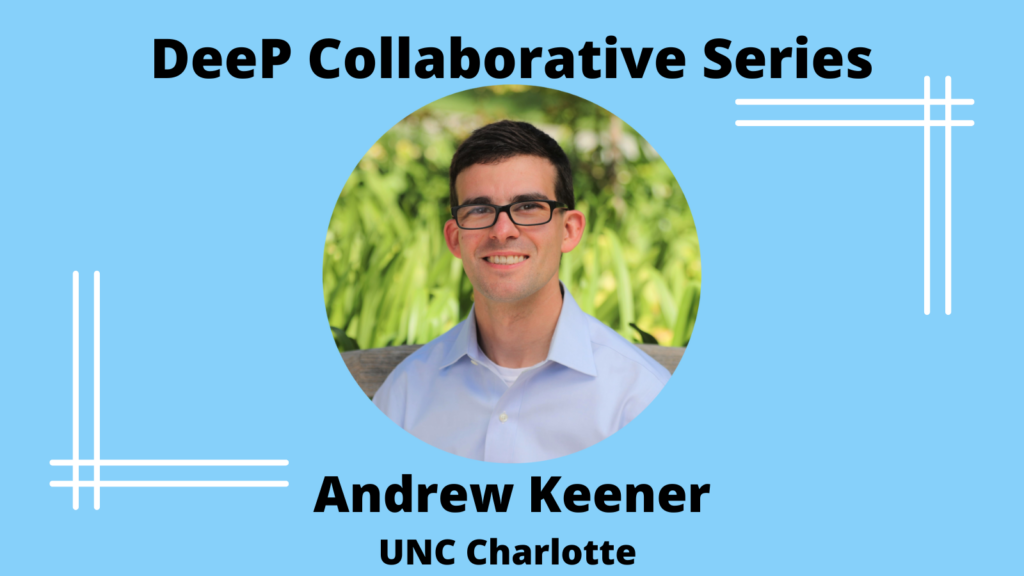
November 1, 2024 by Andrew Keener

One course I teach at UNC Charlotte is a lower-division general education course, “Critical Thinking and Communication,” specifically offered for students in the University Honors Program. The class size typically ranges between 15 and 20 students, and the variety of life experiences and racial, gendered, cultural, and religious identities in the room offer rich opportunities for students to engage and learn from each other across difference. Because I come from a humanities background (English literature), I have typically taught college writing seminars and critical thinking courses with a set of short, thought-provoking readings and other materials to stimulate new ways of thinking and writing. While I kept this practice for a part of the course this semester, I also incorporated an emphasis on the notion of public discourse and deliberation, with support from the DeeP Collaborative colleagues – particularly through our “G2” subgroup and discussions with my partner, Rebecca Alt. 

Although facilitating class discussion is something I have experience with, deliberation was a new topic to me as a teacher. While making that reality clear to my students, I also introduced them to the purposes and elements of deliberative engagement with readings, diagrams, and concepts I learned from and alongside the DeeP Collaborative. This material, which included essays such as Scott Aikin and Robert Talisse’s chapter on “Why We Argue,” and Martin Carcasson’s writings on “wicked problems,” offered a view of the stakes and techniques we were setting out to examine, and practice. My students were exposed to the Kaner model and deliberative dispositions; then, they began to connect their own prospective inquiry topics together as they assembled, midway through the course, into “D-Teams.” These D Teams are similar to but distinct from the Deliberative Citizenship Initiative’s D Teams, which are groups of students and non-students that meet outside of class to discuss different topics.  

Composed of four students apiece, the D-Teams in my class addressed the following thorny questions: What role should taxpayers have in municipal decisions about large-scale sports and entertainment events? How can public health be made more accessible? How can the government best represent the local people it serves? How can AI and other technological innovations be reconciled with environmental sustainability? And, what should 21st century parenting look like in the United States?  

Each of these questions emerged from four or more peers’ independently researched inquiry projects (a campus requirement for this general education course). What I noticed, and did not plan, was that the choice of a fruitful topic for deliberation itself was, in this context, a first occasion for deliberation. The Community Agreements collectively established by the class during the first week of the semester helped arrange some ground rules relevant to all of our deliberations, and my students also were able to watch a video of a practice deliberation.  

Here, I was grateful to have the chance to collaborate with four DeeP Collaborative colleagues: my fellow Honors College staff member Mindy Adnot, and three College of Education faculty: Danyeal Morrison, Michelle Stephan, and Nick Triplett. Our practice deliberation (on the subject of poverty and meritocracy) was not perfect by any means – in fact, we all agree that it left a lot of room for improvement. However, it provided a good chance for my students to observe a deliberation in action and offered a picture of several “moves” that students could employ in deliberations of their own making. 

As their deliberation dates approached, each D-Team assembled from their inquiry projects a set of relevant discussions that developed into their official Deliberation Guide. This three-purpose document provided a training ground for the D-Team, an overview of the stakes and relevant subtopics for the audience (the rest of the class), and an array of provocative questions for the facilitator.  

To permit me to evaluate deliberations as a more detached observer, I recruited and trained two bright students – who were not in the class – during a short session that featured Steve Kalisky’s video demonstration of facilitation styles, clips from the practice deliberation with my DeeP colleagues, and a set of recommended readings (Carcasson, etc.). When the time for deliberations took place, participants were evaluated on three areas: 1) their sustained support for a particular stance on the issue; 2) their respectful, concise, and relevant responses to peers’ comments; and 3) their recruitment of material in their group’s deliberation guide. A fourth area for evaluation consisted of a written reflection on the experience: opportunities, challenges, and take-aways. 

Altogether, the implementation of deliberative pedagogy in this honors course made good sense and gained traction among students through the readings, exercises, and ultimately the deliberative sessions themselves. I’ll be doing my own reflections and listening to and reading over my DeeP Collaborative peers’ experiences to inform some fine-tuning ahead of the next time I teach the course, and as I share my own experience with colleagues across campus. 

Filed Under: Blog Posts, Faculty Posts

Respect Matters: Why Being Right Isn’t Enough

October 16, 2024 by Grace Zagoria

“Harvard is the best university in the United States.”

“Derek Jeter was a great baseball player.”

These words echoed through the Davidson College Philanthropic Hall while a crowd of DCI Fellows adjusted their chairs and focused their attention on their guest speaker of the day: Associate Professor of Philosophy Dan Layman. 

As part of the Fellows’ weekly meeting, we typically dive into topics related to public discourse and deliberative citizenship. This week Dr. Layman introduced two key types of respect for us to consider: appraisal respect and recognition respect.

So, what are these concepts, and what do they have to do with Harvard University and a former shortstop for the New York Yankees?

First, let’s talk about appraisal respect, which is rooted in admiration for someone’s prowess and ability. We’ll take the case of Derek Jeter, and the quote from above. Saying Jeter was a great baseball player is a form of appraisal respect: the speaker is taking the shortstop’s accomplishments – 5 World Series Titles, 14 All-Star Selections, 5 Gold Gloves, and the list goes on – and assessing them based on their apparent value. For this speaker, Jeter’s accomplishments are impressive enough to designate him as a ‘great’ player. The speaker, then, judges the skills and abilities Jeter has demonstrated on the field as things worth celebrating. 

The same thought process applies to the Harvard case. The speaker – after some thought, we’d presume – comes to the conclusion that Harvard is the best university in the U.S. Their exact reasoning here we may not know – it could have something to do with the University having the biggest endowment in the world, its having produced 8 U.S. presidents, or its close association with more than 160 Nobel laureates – but, regardless, the speaker is affording the same type of high regard for the University’s achievements as the previous one did with respect to Derek Jeter. 

Both of these examples are forms of appraisal respect if the speaker is basing them on specific reasons or criteria that justify their appraisal. Such claims do not have to be about institutions or professional athletes; they could also be about ordinary people. One could say “Martina is a good person” and that could also qualify as appraisal respect. If someone asked the speaker to explain their reasoning, they could explain their statement with a response like, “Well, Martina carried my groceries up the stairs for me last week, and then she lent Oskars a textbook for math class, so she meets my criteria for being a good person.” The underlying point is that, especially in deliberative contexts, a speaker should be able to formulate grounds for their appraisals and be ready to share those with others when prompted. 

Here’s the caveat, though. 

What if the speaker were to instead say “Martina is a horrible person. Truly, the absolute worst?”

In that case, it would be pretty clear that the speaker doesn’t have a huge amount of appraisal respect for Martina. But that doesn’t mean they have zero respect for Martina.

That’s where recognition respect – or the notion of respecting another being because, like us, they are another being – comes into play. 

Recognition respect suggests that even if the speaker thinks Martina is a horrible person, they shouldn’t go around and treat her disrespectfully. This is because we recognize Martina as a fellow human being and must afford her a decent amount of consideration, despite whatever failings she may have.

Let’s say Martina is walking down the hall with a slew of books in her arms. There’s a heavy door about to slam in her face, and instead of assisting her, you let it close on her. In the process, she drops all of her things to the floor. 

If she’s gathering her books from the ground and says, “Hey! Why did you let that door slam on me?” and in response you shrug and tell her it is because she hasn’t yet earned your respect, then you’d come out of the situation looking like a complete jerk. Why? Because you haven’t shown the proper degree of recognition respect to Martina. 

Martina actually didn’t need to earn your respect in order for you to hold the door open for her: your recognition that Martina, like you, is another being who deserves consideration –  regardless of how you assess her words or her actions – should be sufficient for you to do so. 

Simple enough, right?

So, what does this have to do with DCI?

Here’s what I’d say: given that D Teams are filled with participants and facilitators who don’t know each other, the idea of appraisal respect may be less relevant in this context. After all, can you truly appraise someone if you met them just minutes ago? Should we judge them on the few words they say as they introduce themselves and share their thoughts on the topic that they may or may not have had a lot of time to think about?

Nevertheless, even if we know nothing about someone’s character, or their achievements, or their background, we do know that this person – like ourselves – is a free and sentient being whose reasons and judgments merit our recognition and, consequently, our fair and careful consideration. 

And, in the context of DCI, such recognition respect is crucially important, and it is why egalitarianism is one of the key deliberative dispositions it encourages participants to adapt. In our meetings we explore some very sensitive subjects – topics that can range from immigration law to reproductive rights – and many participants have perspectives that differ vastly from their counterparts. Even still, the notion of approaching your fellow deliberators with respect and maintaining this consideration – including when the discussion gets heated – is a cornerstone of DCI, and it’s what helps keep difficult conversations going. 

Filed Under: Blog Posts, Fellow Posts

The Philosophy Classroom as Deliberative Classroom 

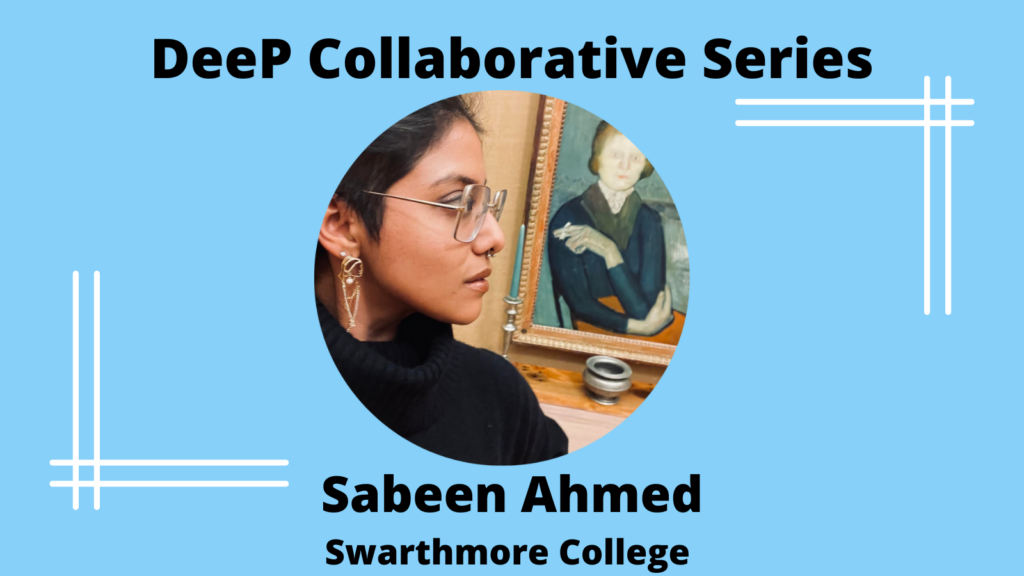
October 16, 2024 by Sabeen Ahmed

Though I did not always have the language to describe it as such, I have long relied on deliberative pedagogy as a framework both for modeling philosophical inquiry inside the classroom and for imparting the critical, interrogative, and evaluative skills required for responsible and reciprocal civic engagement. My approach to teaching has always been shaped by a commitment to foster a space of shared inquiry in which all perspectives and social positionalities are avenues rather than barriers to understanding. It is critical that my students recognize themselves as participants and co-creators of our collective learning experience, and that they approach the study of philosophy as an invitation into an ongoing dialogue of which we are all a part. 

To this end, I encourage my students to engage with philosophy deliberatively, as an always-unfinished, critical enterprise that is open to a constant questioning of the norms, assumptions, and premises of that which we have long taken for granted. By approaching philosophy this way, we are reminded that we are limited in our capacity to know, and that reciprocal engagement with others—and especially those whose lived experiences are far different from our own—is what enables us to see the blind spots in our thinking, brings to light questions that we may not have considered, and opens up avenues for new modes of knowing. This kind of critical, philosophical ethos is one that is genuinely self-reflective, governed by intellectual humility, and attentive to the historicity of the present. 

This approach to philosophy has served me and my students well in this last academic year. As a social and political philosopher, all of my courses—no matter the topic—engage with issues of power, and therefore with issues at the forefront of our concern as social and political beings. My responsibility, as I understand it, is to provide the tools and cultivate the space that enables my students to take on these issues with care. I do not set aside class days for formal, deliberative exercises, but incorporate them into every aspect of our classroom experience: we deliberate over the meaning of the text, giving reasons for why we interpret certain passages in certain ways; we deliberate over the tenability of arguments, both on their own terms and in relation to the lived present; we deliberate over how an author’s framework of analysis can help us make sense of the crises of our day, and where they cannot. The Deliberative Pedagogy Collaborative has enabled me to better articulate these dimensions of my pedagogy.

By way of example, one new strategy that I employed for the first time this semester was to include specific “discussion questions” in my syllabus as a means of guiding students as they did the readings for our class. In my freshman-level course entitled “Aesthetics and Political Resistance,” which met once a week for three hours, I devised a series of inquiries under each set of readings that were intended to give students specific themes to focus on and which they would be expected to deliberate about during our meetings. Inevitably, however, students would take our conversations beyond those I imagined us to have, and I understood my responsibility in those moments to explore how our readings could shed light on their concerns. As the semester progressed, some of my students connected our themes—which included the aesthetic reproduction of the status quo, the role of aesthetic feelings in destabilizing social norms, and so forth—to the events unfolding around us, both abroad as well as on our campus. 

Given the extremely polarized nature of these events, disagreements were unavoidable—and for this reason, several of my colleagues preferred to shut down such conversations entirely. Yet in an era where the rhetoric of “civility” is increasingly deployed to censor critical speech, these moments of disagreement are perhaps the most significant for us as pedagogues. They have reminded me that responsible deliberative pedagogy demands that we understand where our students are coming from, so that we can better put competing viewpoints into constructive dialogue and translate disagreements into learning opportunities. In other words, it requires that we cultivate a critical ethos in ourselves just as much as we try to cultivate it in our students. I am grateful to the Deliberative Pedagogy Collaborative for giving me the space to deeply reflect on this responsibility.

Filed Under: Blog Posts, Faculty Posts

The Value of Choosing a Deliberation-Oriented College 

October 2, 2024 by Charlotte Juge

Like many high schoolers, I faced the daunting task of choosing a college to spend my next four years at just sixteen. The COVID-19 pandemic gave me time to fully dive into the process, starting with a spreadsheet of 160 schools and attending numerous virtual calls. While I don’t remember many specifics from those calls, I realized that I wanted a college where open, honest conversation and the exchange of challenging ideas could thrive.

As I narrowed down my list, I began to focus more on the importance of campus dialogue—something that wasn’t often discussed on tours. Caught up in the allure of prestige, majors, and quirky traditions, I nearly lost sight of what truly mattered to me: the freedom of open discourse.

When deciding between two schools for early decision, I asked both their representatives the same question: “How open is this campus to discussion?” The first responded dismissively, almost shocked by the question, revealing a closed mindset that became evident during my campus visit.

The second school’s representative, however, paused and thoughtfully explained how the campus encourages diverse thought processes, ideas, backgrounds, and life experiences in order to provoke deeper discussions and challenge each student’s preconceived notions. After that conversation, I knew without hesitation that Davidson College was my first choice.

In October 2022, I reached out to the Faculty Director of Davidson’s Deliberative Citizenship Initiative (DCI) and received a reply from Professor Graham Bullock. He wrote, “This is very much the focus of Davidson’s DCI, which is committed to creating spaces for students, faculty, staff, alums, and the broader community to engage with the difficult issues facing our society and community.” Little did I know that two years later, I would become part of this initiative, fully committed to its mission.

My first year at Davidson came with challenges. As an 18-year-old entering a new environment with people from vastly different backgrounds, I had to navigate new perspectives. Growing up in debate, I was used to open conversations, but class discussions required a balance between sharing ideas and being comfortable doing so. Although I was used to challenging my thoughts and perspectives, I sometimes felt that there was only one narrative allowed in discussions. While I understand we often have strongly-held views about particular issues that come up in the classroom, in my opinion, class discussions should not be a form of debate in which there are winners and losers; in fact, that mentality makes us all losers. Instead, there should be an openness to listen, disagree, agree, or potentially change your mind; however, if we go into a space closed off to being challenged, it creates a divisive classroom setting.  

During the 2023-2024 school year, Davidson faced key issues like campus protests, police violence, and free speech. One moment stood out: in the midst of the Middle East conflict, a professor paused the scheduled lesson to create space for discussion. For that class of 30 students, the opportunity to reflect and challenge assumptions solidified what I believe college should be—a place to learn, engage, and grow together. 

When I shared this experience with friends at other schools, they were shocked we had space for such a discussion. Some didn’t even know what was happening on their own campuses and, when they tried to find space to process, faced hostility. Their frustration made me question what a college education should offer and what students should consider when choosing a school.

Reflecting on my time at Davidson, I’m incredibly grateful for the unique opportunity to engage in meaningful deliberation, both through the DCI and in the classroom. Being here is about more than just academic learning; it’s about personal discovery—understanding what I truly value and believe. College should provide a space where we can challenge, reinforce, and reshape our beliefs, and that kind of growth is essential not just for our minds, but for our souls.

As a tour guide, I always end my tours by explaining why I chose Davidson: its commitment to deliberation and its respect for diverse perspectives. This is what sets Davidson apart for me—an institution that fosters learning through dialogue while creating safe spaces for growth.

To current and future students, faculty, and staff, I urge you to embrace this commitment to deliberation. Having difficult conversations isn’t easy, but it’s a vital part of growth. The ability to articulate our thoughts, engage with others, and remain open to change is a lifelong skill that I believe we should all strive to nurture.

Filed Under: Blog Posts, Fellow Posts

  • « Go to Previous Page
  • Page 1
  • Interim pages omitted …
  • Page 4
  • Page 5
  • Page 6
  • Page 7
  • Page 8
  • Interim pages omitted …
  • Page 38
  • Go to Next Page »

Footer

Blog Post Categories

  • Announcements
  • Blog Posts
  • DCI Posts
  • Events
  • Faculty Posts
  • Fellow Posts
Image of a compass superimposed by the text "Deliberative Citizenship Initiative" and "Davidson College." Clicking on this image leads to the Initiative page.

Recent DCI Blog Posts

  • We Tried to Fix Jubilee’s “Middle Ground” – Here’s How It Went
  • A Case for Deliberation in the Natural Sciences
  • Welcoming New Staff to the DCI and DCN
  • Facebook
  • Twitter
  • Instagram
  • LinkedIn


Copyright © 2026 · Infinity Pro on Genesis Framework · WordPress · Log in