If you are ready to register to attend the Expert Roundtable either in-person or online, click here. If you’d like to learn more first, read on below.
Founding Commitments:
“…endowed by their Creator with certain unalienable Rights, that among these are Life, Liberty and the pursuit of Happiness…” (Declaration of Independence)
“…promote the general Welfare, and secure the Blessings of Liberty…” (Preamble)
A thriving democratic society must balance protection of individual liberty with policies aimed at collective welfare and prosperity. Ensuring broad-based societal flourishing may require significant governmental intervention, yet expansive government action risks encroaching upon individual freedoms and economic autonomy. Such government action may both reduce disparities in the general welfare of a nation’s citizens and promote economic growth that benefits all citizens while simultaneously limiting their liberties through higher taxes, stronger regulations, and other policies.
There has long been an inherent tension within American society between the individual and the group. The Declaration of Independence is often recognized as the ideological foundation on which America was founded, and no phrase is perhaps as recognizable as the one that states that all men are “endowed…with certain unalienable Rights, that among these are Life, Liberty, and the pursuit of Happiness.”
The Preamble of the Constitution builds on the foundation laid by the Declaration, laying out six essential objectives of our nation, including both securing “the Blessings of Liberty” and promoting “the general Welfare.” General welfare in this sense has both symbolic and substantive significance. It both encourages us to be mindful of the less unfortunate around us while also reminding us that the health and vitality of American society is the responsibility of every citizen. General welfare is further reflected in several core American aspirations, including public safety, public health, economic security, public infrastructure, and safety net programs designed to help out people who are most in need.
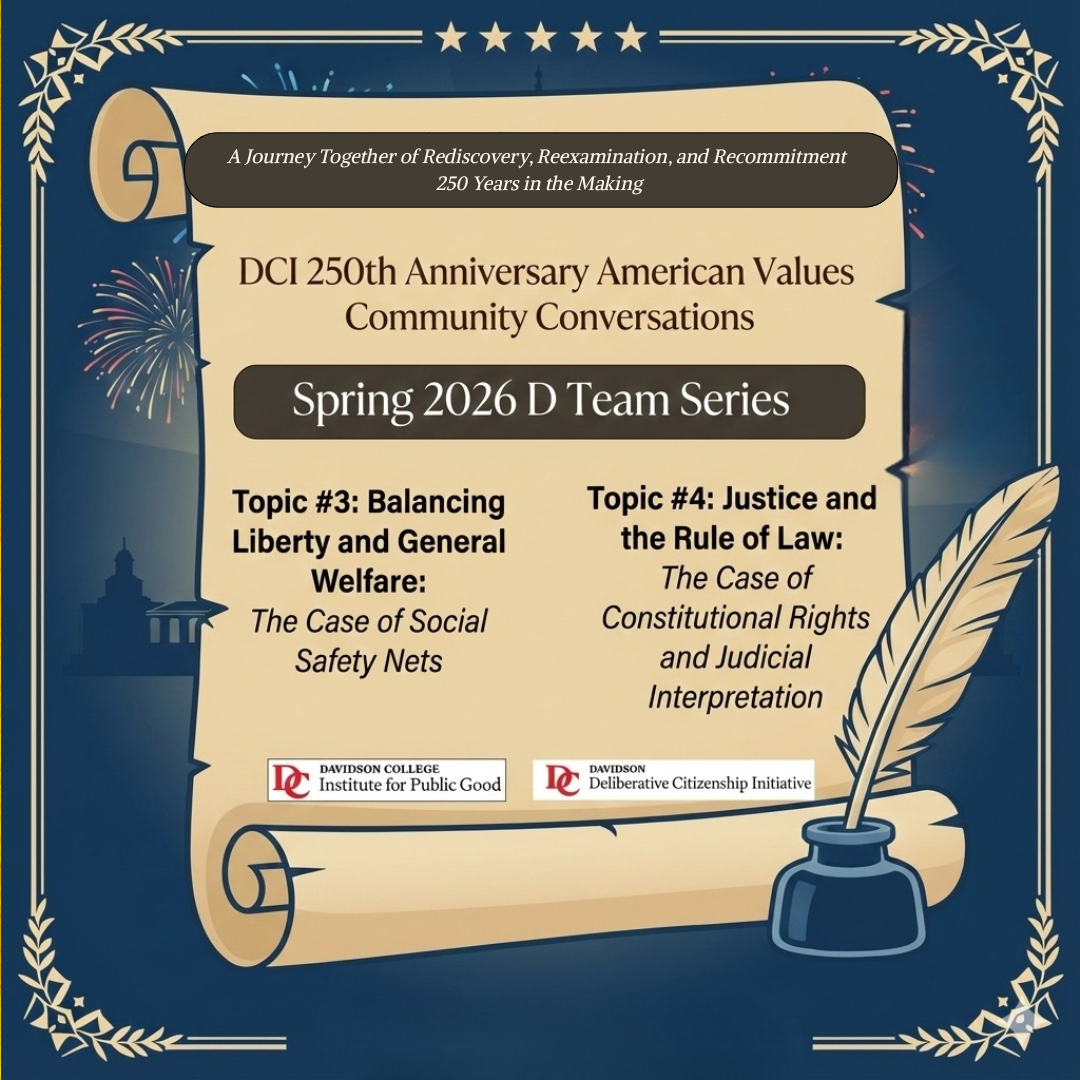
As part of the American Values Deliberative Forum Series it is co-hosting with Duke University and UNC Chapel Hill, Davidson College’s Deliberative Citizenship Initiative is hosting an Expert Roundtable that will explore these dynamics both conceptually and historically. This roundtable will be held on February 11 from 7 to 8:30 pm in the 900 Room on the Davidson College campus, and it will also be broadcast live online. Register here to reserve a ticket today (in-person seats are limited).
The Expert Roundtable is designed to stimulate conversations about the substantive compatibility of liberty and general welfare as well as the tensions that inevitably arise when two fundamental American values are relevant to an issue of public concern. It explores different ways to understand these two values, their relationship to each other, and how they have interacted over the history of the United States. It brings all this together through a focus on public policy debates about existing social safety net programs like Medicaid, Medicare, and Social Security. While focused on the American context, these discussions are broadly relevant to similar questions being asked about liberty and general welfare in countries around the world.
The roundtable will include the scholars listed below, each of whom brings a unique set of expertise and knowledge to the conversation, both on the general questions related to liberty and general welfare and on the specific topic of social safety nets. Specifically, they will address the question, “Are the ideals of liberty and the general welfare compatible in American society, and what role should social safety nets play in balancing them?”
Expert Roundtable Panelist Bios
Romina Boccia is the Director of Budget and Entitlement Policy at the Cato Institute. She is a fiscal and economic expert specializing in federal spending, entitlement reform, and the long-term sustainability of major social programs such as Social Security and Medicare. Ms. Boccia publishes Debt Dispatch, a widely read fiscal newsletter for policymakers, and is the co-author of Reimagining Social Security: Global Lessons for Retirement Policy Changes (2025). She has also written about SNAP loopholes and accountability and is the principal author of the Heritage Foundation’s flagship budget plan, Blueprint for Balance. Ms. Boccia holds both her B.S. and M.A. in Economics from George Mason University.
Christopher Freiman is Professor of General Business at the John Chambers College of Business and Economics and Director of Outreach for the Kendrick Center for an Ethical Economy at West Virginia University. Dr. Freiman is a philosopher whose work engages with questions of distributive justice, liberty, and democratic engagement. He is the author of the book, Unequivocal Justice, and articles on “Wealth Without Limits: In Defense of Billionaires,” “Welfare,” “If You’re An Egalitarian, You Shouldn’t Be So Rich,” and “Equal Political Liberties,” among others. Dr. Freiman earned his Ph.D. in Philosophy from the University of Arizona after receiving his B.A. from Duke University.
Lisa Gennetian is the Pritzker Professor of Early Learning Policy Studies at Duke University’s Sanford School of Public Policy. Dr. Gennetian is an applied economist whose research focuses on child development, behavioral economics, and the effects of poverty and social policy on children and families. Her work combines economics, psychology, and public policy methods, including randomized controlled trials, to understand how socioeconomic conditions and programs influence long-term outcomes. She is a co-PI on Baby’s First Years, a multi-site study examining the causal impact of unconditional cash transfers to low-income mothers and their children. Dr. Gennetian earned her B.A. from Wellesley College and her Ph.D. in Economics from Cornell University.
Joshua Preiss is Teaching Associate Professor of Public Policy and Core Faculty in Philosophy, Politics, and Economics (PPE) at the University of North Carolina at Chapel Hill. Dr. Preiss is a philosopher and public policy scholar whose work spans political economy, ethics, freedom and markets, and justice in modern societies. His 2021 book, Just Work for All: The American Dream in the 21st Century, argues for re-centering justice in debates about work, opportunity, and economic policy. He has also authored articles on “Freedom, Autonomy, and Harm in Global Supply Chains,” “Libertarian Personal Responsibility,” and “Did We Trade Freedom for Credit?” Dr. Preiss holds a Ph.D. in Philosophy from the University of Chicago.
Dan Layman, Associate Professor of Philosophy at Davidson College, will serve as the moderator of the roundtable discussion. Dr. Layman’s research and teaching focuses on political philosophy and the character of political liberty, and he is the author of the book, Locke among the Radicals: Liberty and Property in the Nineteenth Century (Oxford University Press) and articles on “Robust Deliberative Democracy,” “The Fair Value of Economic Liberty,” and “Locke on Basic Income,” among others.
In the two weeks after the Roundtable, the DCI will be hosting a series of Deliberative “D” Team meetings that will build on the scholars’ deliberations. These two-hour deliberative discussions of 6-10 people will be moderated by trained facilitators. To learn more about these opportunities and reserve a spot at a time that works for you, click here (the deadline to do so is January 30). Duke, UNC, and potentially other institutions will be hosting similar conversations for their communities. If you are interested in hosting a conversation yourself at your organization, click here to watch a webinar on how both individuals and institutions can get involved — and how the DCI can help you with doing so.
For those unable to join a D Team, we will also be hosting a Community Conversation on the same topic on February 25 at 7 pm in the 900 Room. This will be an opportunity for students, faculty, staff, and community members to discuss the issues covered by the Expert Roundtable, guided by DCI facilitators. You can register to attend this conversation here.
The Expert Roundtable and Community Conversation are both part of the Deliberative Forum Series on American Values that Davidson College, Duke University, and the University of North Carolina, Chapel Hill are co-hosting in the lead-up to the 250th anniversary of the Declaration of Independence and the nation’s founding. Approaching this milestone in an era marked by historical amnesia and selective memory, the series aims to foster a more complete understanding of our nation’s past and present. To learn more about and register for the other forums and community conversations that are a part of this series, visit this webpage for more information and updates.
Inviting participants to reflect on the foundational ideals that have shaped our republic, each of the four forums in the series will draw from both the Declaration and the Constitution’s Preamble to explore a pair of core American values that often complement each other but also have been – and remain – at the heart of deep tensions, particularly during moments of national change. Through dialogue grounded in history, informed by philosophical inquiry, and connected to current policy challenges, this series and this guide is designed to encourage thoughtful deliberation on how best to uphold and balance these enduring commitments in an ever-changing democracy.
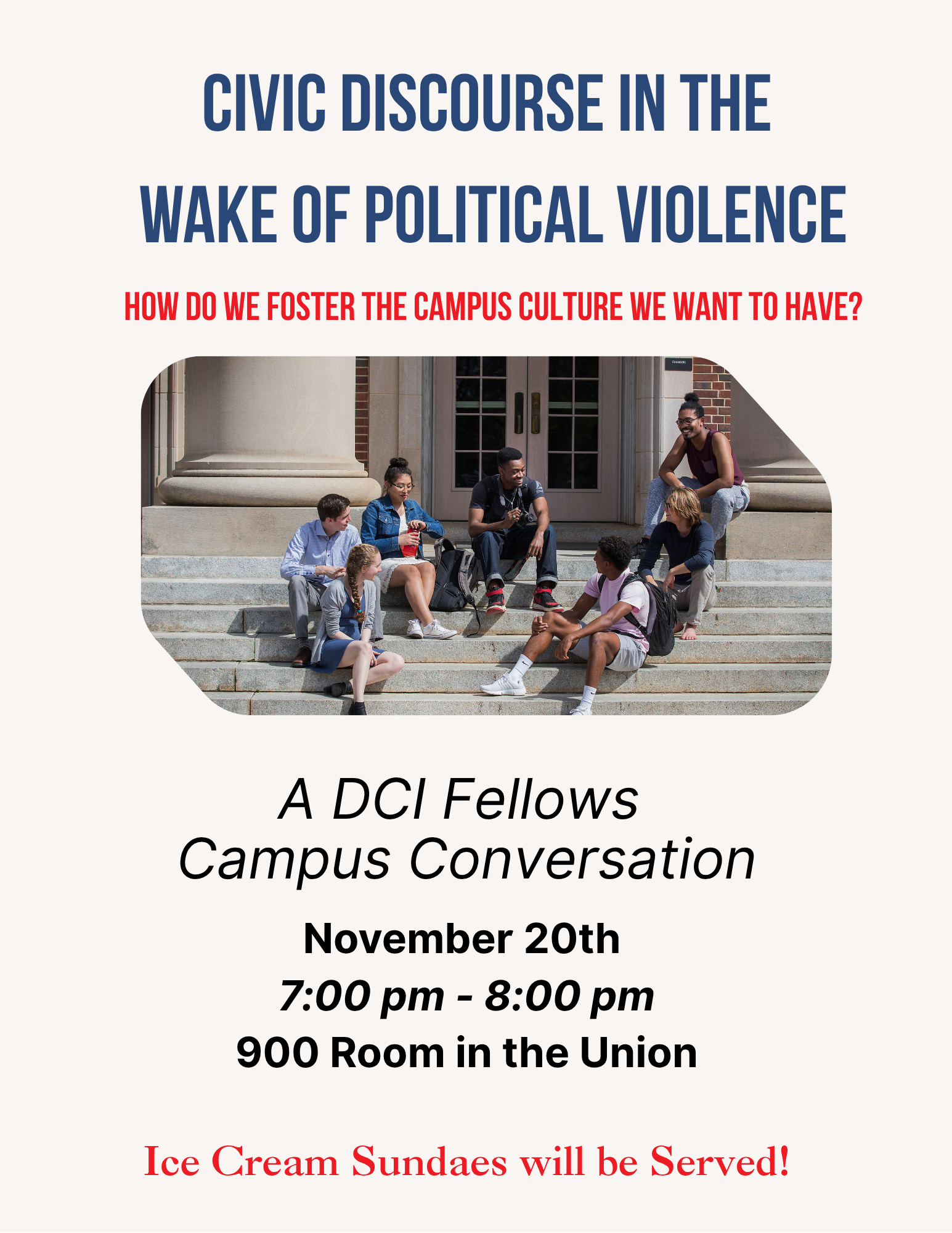
Liberty-General-Welfare-and-Social-Safety-Nets-Forum-Poster