• Skip to main content
  • Skip to footer

Deliberative Citizenship Initiative

Building Democracy One Conversation at a Time

  • The Initiative
    • Programs
      • Deliberation Across the Curriculum
      • Deliberation on Campus
      • Deliberation in the Community
      • Research on Deliberation
    • Motivations
      • Why Deliberative Citizenship?
      • Why Davidson? Why Now?
    • Who’s Involved?
      • DCI Fellows Cohorts
        • 2025-2026 Fellows
        • 2024-2025 Fellows
        • 2023-2024 Fellows
        • 2022-2023 Fellows
        • 2021-2022 Fellows
        • 2020-2021 Fellows
      • DeeP Collaborative Cohorts
        • 2024-2025 DeeP Collaborative Faculty
        • 2023-2024 DeeP Collaborative Faculty
      • Advisory Council
    • History
      • What Sparked the Initiative?
    • Key Deliberative Dispositions
    • Frequently Asked Questions (FAQ)
    • Annual Report
  • Get Involved!
    • Participate in a Forum
    • Join a D Team
    • Become a Fellow
    • Take Courses
    • Get Training
    • Come to Guest Lectures
  • Events
    • Upcoming Events
      • 250th Anniversary Deliberative Forum Series on American Values
    • Past Events
  • Connections
    • The Deliberative Citizen: The DCI’s Monthly Newsletter
    • Efforts on Campus
    • Efforts in the Community
    • Efforts Elsewhere
    • Readings and Resources
      • DCI-Published Guides
      • DCI Guide to One-on-One Conversations
      • How to Disagree
      • Demonstration of Facilitation Styles
      • Deliberative Pedagogy Mini-Course
    • How We Can Help: DCI’s LET’S DELIBERATE! Partnership Opportunities
    • DCI in the News
  • DCI Blog Posts
    • Recent Blog Posts
    • All Blog Posts

DCI Posts

Thanksgiving With a Side of Politics

November 22, 2023 by Sara Copic

Pumpkins and squashes at harvest time

By Sara Copic, DCI Assistant Director

It’s a commonplace saying in American culture that we shouldn’t talk about politics at family gatherings. And though American political polarization is nothing new, recent Israeli military raids in Gaza in response to the October 7th Hamas attack in Israel have the potential to deepen our political divides and leave us feeling more emotionally reactive, more prone to blaming one another, and potentially less willing to spend time together at Thanksgiving. Recent landmark Supreme Court rulings, former President Donald Trump’s ongoing trials, and an upcoming presidential election make the political stakes feel even higher.

What practices or intentions might help us have a Thanksgiving that connects us with our families, communities, and friends—and what should we leave at the door? One thing we have control over and that can help us connect is the practice of approaching a disagreement with genuine curiosity.

All too often, when we get into a discussion about a social or political problem, we fall into a debate—you have your reasons, I have mine, now let’s figure out who’s right and who’s wrong. But if we’re gathering to connect, as we hope to do at Thanksgiving, debate is likely not the right tool for the occasion. Instead, asking how someone came to hold their beliefs and why those beliefs are so important to them with openness and curiosity can better aid connection.

There’s a fine line between asking “why do you think that?” in the spirit of debate and in the spirit of curiosity. But asking questions that aim toward understanding rather than adversarial debate can show someone you really care, rather than that you’re looking for a fight. One way to show genuine curiosity is not to follow up on those questions right away with opposing positions and arguments, but to sit with where the other person is coming from. Making space for their beliefs without arguing against them can be a way of showing acceptance for someone as a person, even if you ultimately disagree with her worldview.

An objector might ask, “But what if I find my family members’ views morally problematic? What if what they advocate is, in my opinion, unjust?” The idea here may be that we must—perhaps for reasons of moral integrity, or for the sake of doing the right thing—disabuse our family and friends of the problematic views they hold. Indeed, we shouldn’t simply let a disagreement lie indefinitely or condone a serious injustice where we see it. But might it be possible and even preferable to leave the business of moral and political argumentation aside in some contexts so that we may foster a mutual care for each other, and lay the foundation for more productive disagreements in the future? By approaching our deep disagreements with curiosity first, we may be able to build the trust needed in order to have the hard conversations we would like to have together.

If this approach resonates with you, or you would like to learn more about it, check out some of our programming from this semester in which Christy Vines explains the idea of empathic intelligence and how to harness it to connect across our lines of difference.

Want more Thanksgiving inspiration? Check out posts by Carla Cole and Dalton Landon for more perspectives about how to approach holiday connection and conversation.

Filed Under: Blog Posts, DCI Posts, Faculty Posts

“Let’s Deliberate!” The DCI’s Partnership Program

November 13, 2023 by Graham Bullock

weaving

Is there a difficult or contentious issue of public concern that your organization, program, department, office, or business would like to have a conversation about, but you are hesitant because you don’t know how it would go? Do you see the value of such a discussion but are not sure how to organize it effectively?

If so, the Deliberative Citizenship Initiative (DCI) may be able to help through its Deliberation Partnership Program, Let’s Deliberate! Every year, the DCI’s Fellows organize their own deliberation projects on topics that are of interest to them and others in our community. They could assist you in designing and facilitating a conversation on a topic that members of your group are interested in discussing. These Fellows are Davidson students who have gone through intensive deliberation facilitation training and have served as facilitators of the DCI’s Deliberative “D” Teams and Deliberative Forums.

If you are interested in exploring this option with one of our Fellows or other collaboration opportunities, please email dci@davidson.edu with your ideas. You are welcome to share some information about your group or organization and what topic of public concern that you would like to discuss. While we cannot guarantee that we will be able to match you with one of our Fellows, we will make our best efforts to do so.

To learn more about the DCI’s LET’S DELIBERATE Deliberative Citizenship Partnership opportunities, check out this page.

Filed Under: Announcements, DCI Posts

DCI in the News: Notre Dame’s Good Work Series

August 1, 2023 by Sara Copic

Good Work: examining institutions cover image.

By Sara Copic, DCI Assistant Director

Virtues and Vocations: Higher Education for Human Flourishing is a magazine of the Virtues and Vocations initiative at the University of Notre Dame’s Center for Social Concerns. This year, the DCI was featured as part of the magazine’s Good Work series. To read the original article, click here: https://socialconcerns.nd.edu/virtues/newsletter-post/davidson-college-deliberative-citizenship-initiative/ 

The article does a nice job of summarizing the work of the DCI and its core mission programs. 

The DCI was founded in 2020 with the goal of combating unproductive, polarized political and social discourse by replacing it with deliberative citizenship. Dr. Graham Bullock, Associate Professor of Political Science and Faculty Director of the DCI at Davidson College, was one of the founding co-conveners of the DCI. In the Virtues and Vocations article, Dr. Bullock elaborates on the notion of citizenship that is at the heart of the DCI:

“Citizenship has become equated with what passport you hold, a kind of national identity, but this is not the only way to think about citizenship. We’ve tried to think about a broader sense of citizenship as the work that we do together to engage the problems we face in society.”

And he elaborates on what deliberation is:

“Deliberation is sort of an antidote to the very harsh, toxic public discourse that we experience in the mainstream and social media contexts – talking past each other, not really engaging with one another’s reasons, sometimes not even providing reasons for why we hold the positions we do. We see deliberation as a form of discourse that is in good faith, trying to understand one another and then come up with new ideas that might often transcend where we started from.”

The article goes on to explain the history of the DCI and its early events, which started at the beginning of the COVID-19 pandemic. Rather than allowing COVID to block their progress, its leadership saw the pandemic as an opportunity to host virtual events that could draw not only a local and regional but also a national audience to the DCI. As a result, we have been able to host many kinds of deliberative discussions, both online and in-person. 

The DCI’s programming includes small-scale discussions between members of deliberative groups, or D Teams, and larger scale events like our speaker series and public forums. All of our deliberations are facilitated by the DCI Fellows, who are Davidson students trained in best practices for leading productive and meaningful deliberations between people from all walks of life and from many ideological backgrounds. 

As we look ahead to the coming academic year, we hope to see you at our speaker series and public forums, to meet you in one of our D Teams or during one of our deliberation facilitator training workshops. Become a member below to keep up with our activity, and follow us on your favorite social media site. 

Filed Under: Announcements, Blog Posts, DCI Posts

The DCI Has a New Assistant Director!  

July 10, 2023 by Graham Bullock

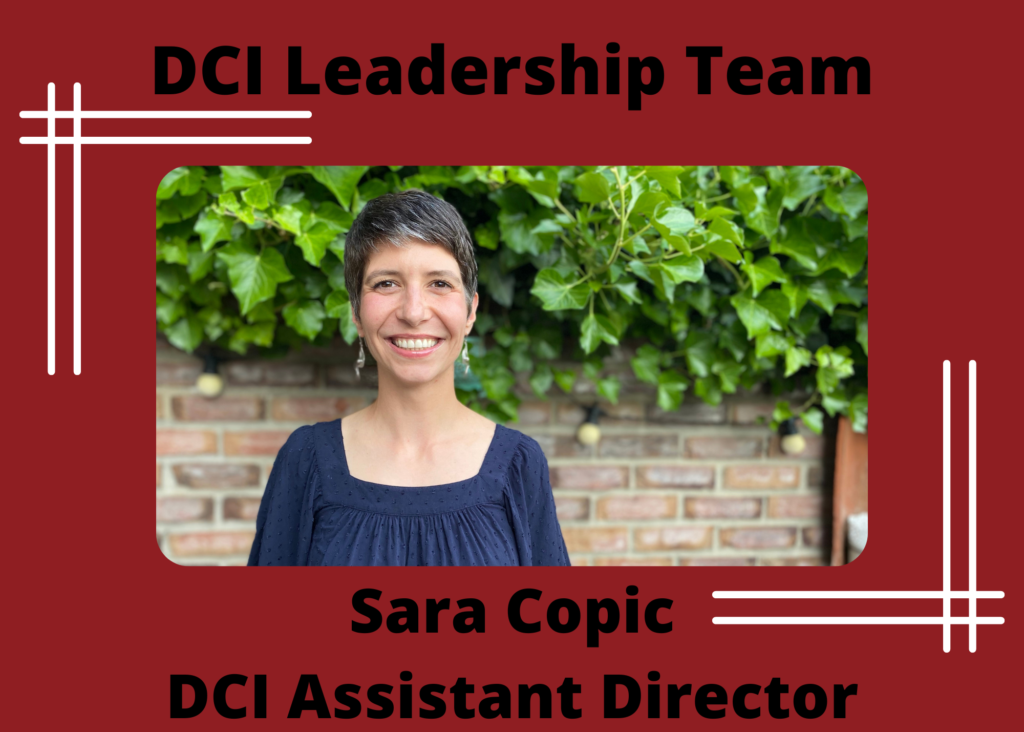
The DCI welcomes Sara Copic as our new Assistant Director! Dr. Copic will be responsible for assisting with the development, implementation, and assessment of the DCI’s programs and operations. Dr. Copic’s experience at both the University of North Carolina at Chapel Hill and the University of Notre Dame prepares her exceedingly well to help lead the DCI’s efforts to create opportunities for productive dialogue and deliberation in diverse classroom settings, outside of the classroom, and in the community.

Dr. Copic received her PhD in philosophy from UNC-Chapel Hill, where she recently served as Visiting Teaching Assistant Professor of Philosophy and taught courses in practical ethics, bioethics, the ethics of peace, war, and defense, language and communication, and more. In her research, Dr. Copic specializes in the philosophy of language. She writes about the relationship our ordinary discourse has to truth and social cooperation, and how these goals determine different types of linguistic meaning. Her teaching and research thus directly relate to some of the themes that the DCI engages with on a regular basis.

Dr. Copic has also worked as Design Project Manager in the Office of Digital Learning at the University of Notre Dame, where she led over 12 different digital education projects to successful completion, including the University’s digital resiliency initiative during the Covid-19 pandemic and projects on tech and innovation ethics, poverty, and interfaith dialogue. Dr. Copic’s experience leading complex education projects will be another asset to the DCI, where she will help design and implement programs in all of its focus areas.

In this work, Dr. Copic will apply lessons she has learned as a scholar-teacher who focuses on utilizing active learning strategies that foster an inclusive classroom environment and bridge achievement gaps between students from different backgrounds. In her teaching, she has also focused on helping students practice reflection and critical thinking not only on their own but also in community with one another.

In addition to her duties as the DCI’s Assistant Director, Sara looks forward to teaching a course at Davidson on the nature and significance of artificial intelligence in the College Writing Program in Spring 2024. Dr. Copic is an affiliate of the AI Project at UNC Chapel Hill and also writes about what lessons we can learn about meanings by studying large language models. AI is a hot topic ripe for deliberation, and Dr. Copic’s course will enable students to grapple with both its challenges and opportunities and connect with any programming the DCI organizes around this important issue. 

All to say, we are excited that Dr. Copic has joined the DCI’s leadership team! Watch out for blog posts and emails from Dr. Copic, and say hi to her if you see her on campus or in the community.

Filed Under: Announcements, DCI Posts

2023-24 D Team and Forum Topics Survey Now Open!

June 21, 2023 by Graham Bullock

Voting box with sign "Vote Here" displayed on the front.

We are working on identifying and prioritizing topics for the DCI’s 2023-24 Deliberative Forums and D Teams, and would love your feedback on the ideas we are considering in the brief survey below. Thank you to those of you who have submitted ideas – we received a lot of great suggestions and have tried to incorporate them into the options listed. If you’d like to provide your input on the options we are considering, please complete the survey below by June 30. Thanks!

DCI 2023-24 Topics Survey

Pages: Page 1 Page 2

Filed Under: DCI Posts, Events

  • « Go to Previous Page
  • Page 1
  • Interim pages omitted …
  • Page 8
  • Page 9
  • Page 10
  • Page 11
  • Page 12
  • Go to Next Page »

Footer

Blog Post Categories

  • Announcements
  • Blog Posts
  • DCI Posts
  • Events
  • Faculty Posts
  • Fellow Posts
Image of a compass superimposed by the text "Deliberative Citizenship Initiative" and "Davidson College." Clicking on this image leads to the Initiative page.

Recent DCI Blog Posts

  • Making Conversation: A First Step to Understanding
  • The Costs of Changing Your Mind, and How to Overcome Them
  • ​Middle Schoolers: The Ones Who Taught Me the Most About Facilitation
  • Facebook
  • Twitter
  • Instagram
  • LinkedIn


Copyright © 2026 · Infinity Pro on Genesis Framework · WordPress · Log in