• Skip to main content
  • Skip to footer

Deliberative Citizenship Initiative

Building Democracy One Conversation at a Time

  • The Initiative
    • Programs
      • Deliberation Across the Curriculum
      • Deliberation on Campus
      • Deliberation in the Community
      • Research on Deliberation
    • Motivations
      • Why Deliberative Citizenship?
      • Why Davidson? Why Now?
    • Who’s Involved?
      • DCI Fellows Cohorts
        • 2025-2026 Fellows
        • 2024-2025 Fellows
        • 2023-2024 Fellows
        • 2022-2023 Fellows
        • 2021-2022 Fellows
        • 2020-2021 Fellows
      • DeeP Collaborative Cohorts
        • 2024-2025 DeeP Collaborative Faculty
        • 2023-2024 DeeP Collaborative Faculty
      • Advisory Council
    • History
      • What Sparked the Initiative?
    • Key Deliberative Dispositions
    • Frequently Asked Questions (FAQ)
    • Annual Report
  • Get Involved!
    • Participate in a Forum
    • Join a D Team
    • Become a Fellow
    • Take Courses
    • Get Training
    • Come to Guest Lectures
  • Events
    • Upcoming Events
      • 250th Anniversary Deliberative Forum Series on American Values
    • Past Events
  • Connections
    • The Deliberative Citizen: The DCI’s Monthly Newsletter
    • Efforts on Campus
    • Efforts in the Community
    • Efforts Elsewhere
    • Readings and Resources
      • DCI-Published Guides
      • DCI Guide to One-on-One Conversations
      • How to Disagree
      • Demonstration of Facilitation Styles
      • Deliberative Pedagogy Mini-Course
    • How We Can Help: DCI’s LET’S DELIBERATE! Partnership Opportunities
    • DCI in the News
  • DCI Blog Posts
    • Recent Blog Posts
    • All Blog Posts

Blog Posts

Deliberating About Ethics with Gen Z

July 20, 2023 by Erik Anderson

DeeP Collaborative Series Introductory Image for Erik A. Anderson.

By Erik A. Anderson (Chair and Associate Professor of Philosophy, Furman University, DeeP Collaborative Member)

The Deliberative Pedagogy (DeeP) Faculty Collaborative consists of 20+ faculty from Davidson College and five other Associated Colleges of the South institutions who are committed to learning and implementing new ways to improve and deepen the quality of their class discussions. These faculty come from a wide array of disciplines and backgrounds. They come together to study and discuss different deliberative pedagogy methods, share their ideas and questions with one another, and work to embed deliberation in their classrooms. In this special blog series, members of the Collaborative describe and reflect on their experiences developing and teaching their deliberation-involved courses.

This semester at Furman University, I incorporated deliberative pedagogy into my ethics course. We hear much about how polarized Americans are about moral issues, and there is a widespread impression that Gen Z students are too busy “cancelling” each other to discuss controversial questions. I wanted to investigate to what extent these assumptions were true of my students. I also wanted to do what I could to open them up to having difficult conversations and to help them develop the skills they need to do so effectively.

My course was organized around contemporary moral issues. We covered five broad topics: freedom of speech, animal rights, racism and sexism, environmental ethics, and abortion. My plan was to hold “deliberation days” on each of these topics in which students would reason together about competing policies. The students were told that on these days, we would pretend the class was a legislature and that our job was to debate and then vote on which policies to adopt. I described deliberative pedagogy on the syllabus as aiming “to improve our abilities as citizens to engage in democratic deliberation about pressing moral and political issues. […] The specific aim of the course in relation to deliberation is that you develop the ability to engage in respectful discussion with others who disagree with you about moral questions that matter deeply to you.” In order to introduce deliberation to the students, I assigned readings by Amy Gutmann and Dennis Thompson, Diana Hess and Paula McAvoy, and Scott Aikin and Robert Talisse. However, students primarily learned about deliberation by doing it.

Before the first deliberation day, I created “ten commandments,” in consultation with the class, that would govern our deliberations:

    (i) Judge ideas, not people.

    (ii) Be honest and respectful.

    (iii) Vegas rules: don’t post criticisms of your fellow students on social media.

    (iv) Commit to empathetic listening. Don’t listen just to find weaknesses in opposing views.

    (v) Try to understand competing perspectives and be fair to them.

    (vi) Disagree with curiosity, not hostility.

    (vii) Give other students the benefit of the doubt.

    (viii) Be brief so that everyone has the chance to participate.

    (ix) Monitor your body language: avoid eye rolls and other expressions of disdain.

    (x) Seek consensus, not victory.

In commenting on and explaining these rules, I connected them with some of the “deliberative virtues” developed in the literature as well as with the “deliberative dispositions” promoted by the Deliberative Citizenship Initiative. While it was largely up to the students to enforce the rules, there were, to my knowledge, no incidents in which students violated them.

I faced some practical challenges in organizing the deliberation days. Foremost among them was the lack of time (the class was only 50 minutes long) and the large size of the group (25 students). To make sure each student got to participate, I divided the class into groups of three and four students. I assigned students to the groups randomly and varied their membership each time in order to prevent students from only deliberating with friends or people they were likely to agree with. I also had the deliberation proceed through distinct stages. For each topic, I focused our attention on two competing policy proposals. In the first stage, students were instructed to present to their small group what they took to be the strongest arguments and the most serious objections to each of the competing proposals. The point was for students to articulate arguments for and against different policies without yet defending a position of their own. I hoped this would encourage them to be even-handed. Only after they laid out considerations for and against each proposal did I ask them, in the second stage, to state what position they supported and why. At this stage, they engaged in deliberation proper. They sought to persuade the members of their small group that their favored proposal was the better one. I circulated around the room so I could get a sense of how things were going, but I remained hands-off because I didn’t want to inhibit or influence their conversations.

After about 25 minutes in their small groups, we moved to a third stage in which each small group reported to the whole class about how their deliberations had gone. Was there any consensus about the best proposal? Was one of the proposals more widely accepted than the other? What were the reasons for and against each proposal articulated in the deliberation? Then, in a fourth stage, I posed the question again for the whole class to consider: which of the two proposals should we, as a class, adopt? My thinking was that individuals who offered arguments addressed to the whole class would have had their understanding of the issue and their arguments refined through their small group deliberations. In the whole group deliberation, students explained why they found the arguments favoring one of the proposals to be more compelling than those supporting the alternative. When one person defended a particular view, I would ask for rebuttals from the other side. While it was very tempting for me give my own input, I tried to stay in a facilitative role and to leave the deliberation up to the students themselves.

In a final stage, after about 15 minutes of whole-group deliberation, we took a vote. Students voted anonymously on Zoom, which instantly tallied the results. As the vote happened right at the end of our 50-minute class, I had to wait for the following class to debrief the exercise. Students had to write a “deliberation report” in which they summarized the arguments for and against the two proposals, defended their own view, reflected on the process of deliberation (for example, I asked them whether at any point they had changed their minds), and had the opportunity to devise their own alternative proposals.

One thing I didn’t anticipate was how difficult it was to come up with proposals for the students to discuss that were clearly distinct and yet both had initial plausibility. On free speech, for example, I decided to focus on the limits on what kinds of controversial materials professors could teach in class. There was consensus that professors and students shouldn’t use hate speech (e.g. slurs, verbal attacks) and that it was permissible for professors to assign materials that contained examples of hate speech as long as there were legitimate academic reasons for doing so. But students disagreed about material containing academic arguments in support of (what they took to be) racist, sexist, homophobic, or transphobic conclusions. I wanted the class to deliberate about a proposal that was relatively permissive — giving professors more leeway to assign controversial materials — and one that was more restrictive. But the more plausible I tried to make the two proposals, the more qualified and nuanced they became, the more they started to blur into one another. On the other hand, the more distinct I tried to make them, the more “extreme” they became, which threatened to make them nonstarters for the students. The proposals I ended up with were somewhat vague and ambiguous, saying things like “professors may assign materials that present sexist, racist, or other objectionable ideas as long as doing so serves a legitimate academic purpose” and “professors should not assign materials that marginalize, exclude, or denigrate students on the basis of their race, sex, gender identity, etc.” Students interpreted a number of the key phrases in these proposals differently, which meant that they weren’t always assigning the same meanings to the competing alternatives.

Despite this (unresolved) problem, students reported that they enjoyed the activity of deliberation and found it useful. There were no heated conflicts and it didn’t seem to me that students felt the need to censor themselves (though it’s hard to know for sure — in hindsight, I should have asked them about self-censorship on their deliberation reports). I do have to mention one caveat, however. The whole semester we were building toward a deliberation day on the most controversial issue by far, abortion. Unfortunately, I came down with COVID after spring break and had to cancel a number of classes. As a result, we were not able to have a final deliberation on abortion. That issue would have been an important test case for how proficient the students had become at deliberation. I can say, though, that the discussions we had on the readings about abortion were civil and productive even when we discussed pro-life views, which conflicted with the views held by most students. One student who said early in the semester that “men are not entitled to have an opinion about abortion” had by the end of the term come around to seeing the importance of listening to diverse perspectives on the issue.

As a first-time experiment, my attempt to teach ethics deliberatively wasn’t entirely successful, but it was successful enough to be worth working on and improving in the future. I was especially impressed by how seriously the students took our deliberation days — as if the members of Gen Z were hungry for the kinds of respectful moral and political conversations that are so lacking in America today.

Filed Under: Blog Posts, Faculty Posts

The Explorer Mindset: Can It Be a Possibility?

July 17, 2023 by Divin Dushimimana

Image of the painting Wanderer of the Sea Fog

Divin Dushimimana ‘26 (DCI Fellow)

We’re in a world with many polarizing ideas. At some point it feels like it’s one idea against all other ideas and their owners do everything in their capacity to transmit their ideas. Without going too far from where our present location, let’s start with the US and the country’s political systems. We mostly have Republicans vs Democrats. These political ideologies differ in many ways, starting with their perspective on taxes to minimum wage to healthcare policy to the military and to many other things in the country. Statistics show that the number of Americans in each party with a negative view of the other party has doubled since 19941https://www.pewresearch.org/politics/2014/06/12/political-polarization-in-the-american-public/. It’s as if members of one political party wants to convert people in the other party to their beliefs.

By zooming out, we can see that the western political and economic ideology of democracy and capitalism has been fighting head-to-head with the political and economic ideologies of socialism and communism for a long time. Having been present in a conversation between an American and a Chinese that encapsulated this conflict, it’s hard for me to envision a situation where an explorer-mindset as a deliberative disposition can be applicable in a normal conversation. In this conversation about capitalism and communism that I witnessed, it was about one person proving why one of the systems is better than the other.  Now that I think about it, neither were looking for a common ground in the debate, and I feel like this is how many conversations are in this world.

When looking back to my primary school memories, I reminisce about debates we used to have like fire vs water, food vs water, or even who is better between mother and father. As I remember, none of us in these conversations were ready to apply the explorer-mindset to understand where other people’s opinions originate. As we grow up, this character trait – a stubborn commitment to our currently held beliefs, right or wrong – gets ingrained in us and we become resistant to accepting and learning from other people’s perspectives. When I look back, I think polarization is a concept that we were taught since we were young and we grow up to apply it in our daily lives.

That’s why the explorer mindset is a concept I had never seen applied by anyone before reading and learning about the Deliberative Citizenship Initiative. My conversations were so debate-focused before joining DCI. Ever since I learned about this concept, I’ve been trying to put it into practice because I realized it’s a way to practice intellectual humility by understanding that there could be multiple truths to a certain topic. Conversations should shift from being focused on persuading another person of your perspective or opinion to finding common ground and actually learning why people think the way they think. This is because people’s backgrounds and experiences do really influence their opinions on certain topics.

However, with little exposure to this concept, it’s unlikely that people are going to put it into practice or that the number of people willing to practice intellectual humility will increase. Instead, we see the number of people without intellectual humility increase day by the day and this is a concerning trend. Unless DCI and other similar initiatives become accessible to more students, people, and institutions around the world, the explorer-mindset is unlikely to spread widely, despite our desperate need for it amidst today’s hyper-polarization. For this reason, I hope that more of us will join the DCI and participate in its activities, so we can all explore different perspectives together, in our search of solutions to our common problems.  

Filed Under: Blog Posts, Fellow Posts

From Imperialism to Civil Rights: Debating and Discussing American History in HIS 142

June 27, 2023 by Dan Aldridge

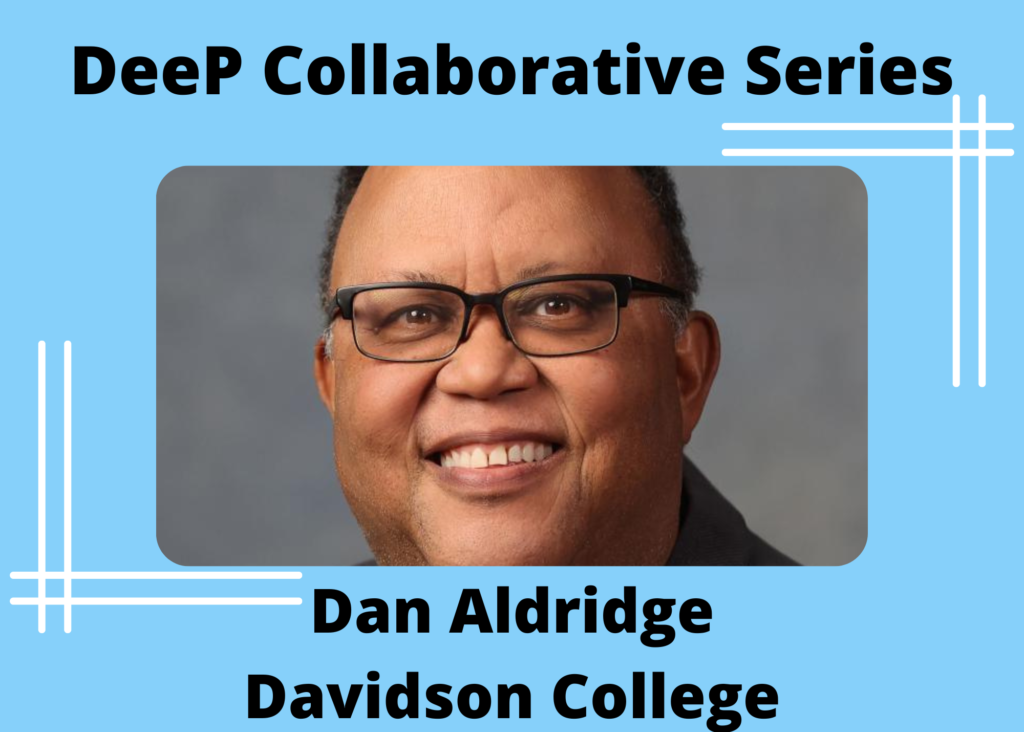
Photo of Dan Aldridge, Chair & Professor of Africana Studies, Professor of History, DeeP Collaborative Member

By Dan Aldridge (Chair & Professor of Africana Studies, Professor of History, DeeP Collaborative Member)

The Deliberative Pedagogy (DeeP) Faculty Collaborative consists of 20+ faculty from Davidson College and five other Associated Colleges of the South institutions who are committed to learning and implementing new ways to improve and deepen the quality of their class discussions. These faculty come from a wide array of disciplines and backgrounds. They come together to study and discuss different deliberative pedagogy methods, share their ideas and questions with one another, and work to embed deliberation in their classrooms. In this special blog series, members of the Collaborative describe and reflect on their experiences developing and teaching their deliberation-involved courses.

I agreed to participate in the Deliberative Pedagogy (DeeP) Collaborative because I wanted to improve the quality of student engagement with major issues in American history without fear of facing and expressing a wide range of points of view and to encourage their development as citizens who will be engaged in public issues in the decades to come.  I teach a course that is an introduction to 20th century US History aimed primarily and 1st and 2nd year students.  I focused the course on four broad “issues”: The United States’ emergence as an imperial power and future world power at the beginning of the 20th century; the life and career of Margaret Sanger as a way of exploring issues involving feminism, birth control, eugenics and related issues; varying interpretations of the meanings of the civil rights movement of the 1960s; and the different views of liberals and conservatives about the direction of American life since the 1960s.

After we finished readings, lectures, and discussions about each issue I would assign groups of students to hold a debate about the issues raised.  For example, I asked one group of four students to support the United States’ becoming an imperial and global power in the early 20th century while another group of four argued the anti-imperialist position.  After each side made its presentation the remaining students in the course would ask questions of the two debate teams.  Finally, the class as a whole would discuss the issues raised.  I have found from in-class observation, student comments, and student evaluations that they greatly enjoyed the debates and found them to be pedagogically valuable.  The debate/discussion format seems to enable students to take historical issues that seemingly belong in the “past” come alive and become more relevant to them and their contemporary lives.

Students also reacted well to reading a wide variety of points of view about historical issues including perspectives from the Right, Left, and Center.  Students read strongly pro-imperialist and somewhat racialist arguments for imperialism by authors such as Theodore Roosevelt; they read scathing critiques for US foreign policy from the Left by Noam Chomsky; they watched African American conservative intellectual Thomas Sowell critique much of the conventional wisdom about race and rights held by liberals and progressives; and they read Jeanne Theoharis argue that our understanding of civil right activism of the 1960s understates its radicalism.  They also read Catholic writers who strongly critiqued birth control, abortion and feminism as well as feminist authors who strongly supported those things.

I found that students were not angered or intimidated by being exposed to a wide variety of viewpoints, including many that would not be currently deemed to be “correct” or “polite.”  Indeed, a number commented on how they liked that the course was open to a wide variety of opinions and not committed to promoting a particular ideology or point of view.  I plan to incorporate more elements in deliberative discussion in other courses I teach where needed and appropriate.

Filed Under: Blog Posts, Faculty Posts

Catalyzing Pollution Solutions: Deliberation in a Polymer Chemistry Course

June 27, 2023 by Bassil El-Zaatari

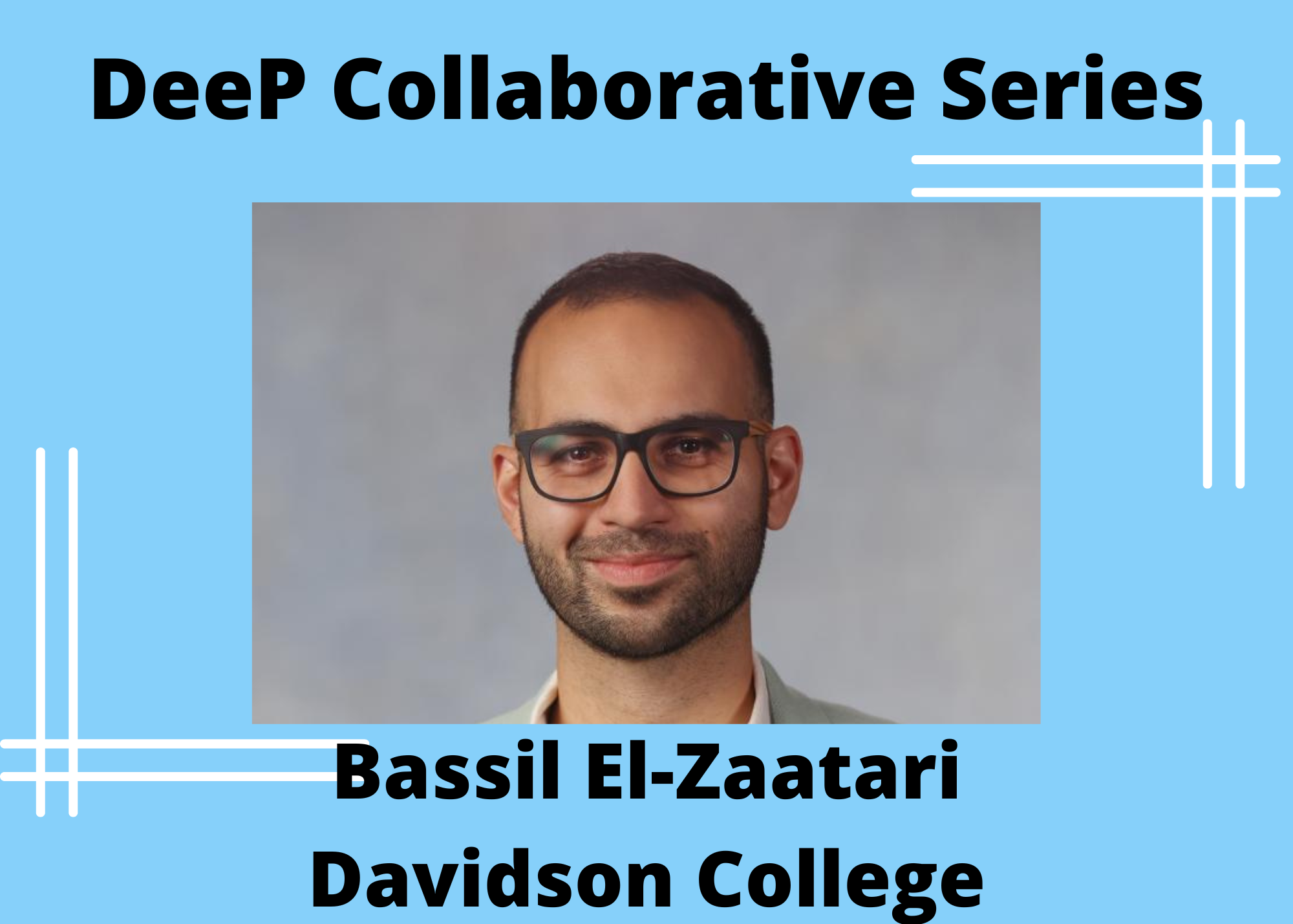
DeeP Collaborative Series with guest Bassil El-Zaatari.

The Deliberative Pedagogy (DeeP) Faculty Collaborative consists of 20+ faculty from Davidson College and five other Associated Colleges of the South institutions who are committed to learning and implementing new ways to improve and deepen the quality of their class discussions. These faculty come from a wide array of disciplines and backgrounds. They come together to study and discuss different deliberative pedagogy methods, share their ideas and questions with one another, and work to embed deliberation in their classrooms. In this special blog series, members of the Collaborative describe and reflect on their experiences developing and teaching their deliberation-involved courses.

By Bassil El-Zaatari (Assistant Professor of Chemistry, DeeP Collaborative Member)

Plastic pollution remains one of the largest challenges facing us in today’s world. Met with an ever-growing population, the use of plastic materials continues to flourish with limited ability to recycle and reprocess these materials. In fact, projections now show that by the year 2050, there may be more plastic in the ocean than fish. As I embarked on teaching polymer chemistry for the first time this semester at Davidson College, I knew I had to balance what I was teaching from a scientific perspective with thoughtful understandings of the socioeconomic, political, and historical implications of the synthesized materials discussed in class. Through the Deliberative Pedagogy (DeeP) Collaborative, I set up a framework of discussions and readings throughout the semester that culminated in a final “debate” activity during the last week of class.

On the first day of class, I explained to my students that it is critical for us, as current and future scientists, to address STEM-related controversial modern issues including stem cell research, climate change, energy policy, and pollution levels. I made sure they understood that while the ubiquity of polymers and plastics in everyday life has been critical to human advancement, the waste generated from plastic waste has been detrimental to ecosystems, especially aquatic life, and its landfill and incineration has been linked to worsening climate change.

Throughout the semester, I tried to link topics that we were learning about to broader issues and local events. One example that comes to mind was after the train derailment in East Palestine, Ohio that was carrying vinyl chloride, a precursor to synthesize polyvinyl chloride (PVC), a widely utilized plastic material. We chatted about the environmental implications of this polymer precursor from the spillage as well as methods that could have prevented it. We discussed what type of socioeconomic impacts that this derailment will have on the area for years to come and whether the need to synthesize PVC outweighed its potential hazards during manufacturing and post synthesis.

As the semester was coming to an end, the final debate tasked the students to come up with the best approach to the following prompt:

“You and your team have been appointed to solve the plastic pollution problem by world leaders from all over the world. You will have to come up with a plan of action using your polymer chemistry knowledge. You will have to decide where to start from in tackling this problem and present your findings to the class.”

This prompt was supplemented by several articles, both from scientific journals and periodicals, that the students had to read prior to the start of the activity, as well as a special topic lecture that discussed current methods of plastic recycling and reprocessing. While debating this topic, the students were prompted to keep the following questions in mind:

(1) How can we balance the importance of polymers and plastics with the waste generated from not being able to recycle, reprocess and reuse most of them?
(2) Can we reach a world in which plastic waste is a thing of the past?
(3) Does plastic free actually mean pollution free?

The activity was split into two 75-minute class periods. During the first session of the debate, the students were separated into four small groups (consisting of three or four students each) and were prompted to arrive at an evidence-supported position on this topic while weighing pertinent scientific, socioeconomic, and political implications. I walked around the different groups, listened to their conversations, and helped facilitate discussions. The students felt passionate about their positions and worked hard to convince their groupmates of the best approach to this problem, while keeping an open mind and listening to others.

Towards the end of the class period most groups had agreed on a plan of action to present during the next session. In the second session, the groups presented their findings to their classmates. Each presentation was up to ten minutes long and was followed by 5 to 10 minutes of questions from the rest of the class. I was impressed by the elegance in the solutions the classmates produced and the intensity of the Q&A session that followed.

Overall, I would say that the activity was a success and the students left the semester with a sense of scientific intersectionality that they may have not encountered in previous STEM classes. The students seemed to enjoy the activity and were passionate about their positions and defending them to others. The use of deliberation in future chemistry classes is something I intend to implement and improve on.

Filed Under: Blog Posts, Faculty Posts

Emotional Readiness vs. Community Relevance? The Difficulty of Selecting Topics for Deliberation

June 21, 2023 by Laegan Smith

two heads with questions and ideas.

By Laegan Smith ’24 (DCI Fellow)

When I completed the training to become a facilitator for deliberation, one of the first things we discussed was how to select topics for deliberation. That seemed easy enough to me at first—surely you can just choose any topic and talk about it—but I soon found that there are a lot of questions that must first be asked to determine if a topic will make for a productive conversation.

For example, what issues are people interested in talking about? Will participants have enough background knowledge to deliberate about the issue? Is it possible to gather people with diverse viewpoints and opinions to deliberate? Can participants have disagreements about the issue? Are participants emotionally ready to deliberate about the issue? All these questions are used to determine whether a topic can be considered timely and “ripe” for discussion for a group.

These questions have come up again and again as the DCI has organized and hosted deliberations throughout this year. During our initial training, we were tasked with coming up with some possible deliberation topics for Davidson College and my fellow trainees and I disagreed on whether some topics could be considered “ripe” for discussion or not. I felt like the topic one of my peers suggested was too sensitive and emotionally charged to deliberate given the recent events surrounding it in the news, while my peer argued that that was the exact reason it would be a good topic for deliberation. While I was more focused on the question of emotional readiness, he was focused on the question of community interest. I realized then how subjective choosing a “ripe” topic is.

These questions came up for me again at the deliberative forum on Schools and Parents: Who Should Teach our Kids about Race, Gender, and Sexuality? that the DCI hosted last semester. After the event, I spoke to some of my peers who disagreed that the event should have been held to gauge why they didn’t want to participate. The overwhelming answer that I received was, “I refuse to deliberate about something so personal to me.” That resonated with me: though I did not feel the same way about that particular event, I felt that that was absolutely a valid reason not to partake in a deliberation. The other feedback I received was that the deliberation shouldn’t have even been held—that it was too personal and sensitive of a topic to deliberate at all.

The next week, another one of the DCI Fellows and I shared our thoughts on this issue during our weekly Commons Conversations. We and some other students discussed not only what topics we felt were timely for deliberation, but also what topics we felt should and shouldn’t be deliberated given the feedback from the forum. It was difficult to draw the line between uncomfortable topics that might hit too close to home for some people and topics that are inherently unsuitable for deliberation due to their sensitivity.

My initial reaction was that there definitely are topics that are too sensitive to be deliberated. However, the conversation raised some important questions: if topics that are too sensitive aren’t deliberated, how will we ever understand other perspectives on those topics? How will we be able to explain our point of view to someone who disagrees? How can we as a society move forward on the most personal of topics if we do not discuss them?

I don’t know the answers to these questions and I’m still not sure where the line should be drawn—it’s incredibly subjective. I’ve learned from these experiences how difficult it is to select a topic for deliberation and how impossible it is to please everyone when doing so. Ultimately, I think it’s up to the organizer of a deliberation to gauge the emotional readiness of the community it serves and up to the participant to decide whether they personally are emotionally ready to attend, and it’s okay if the answer is no.

Filed Under: Blog Posts, Fellow Posts

  • « Go to Previous Page
  • Page 1
  • Interim pages omitted …
  • Page 18
  • Page 19
  • Page 20
  • Page 21
  • Page 22
  • Interim pages omitted …
  • Page 38
  • Go to Next Page »

Footer

Blog Post Categories

  • Announcements
  • Blog Posts
  • DCI Posts
  • Events
  • Faculty Posts
  • Fellow Posts
Image of a compass superimposed by the text "Deliberative Citizenship Initiative" and "Davidson College." Clicking on this image leads to the Initiative page.

Recent DCI Blog Posts

  • We Tried to Fix Jubilee’s “Middle Ground” – Here’s How It Went
  • A Case for Deliberation in the Natural Sciences
  • Welcoming New Staff to the DCI and DCN
  • Facebook
  • Twitter
  • Instagram
  • LinkedIn


Copyright © 2026 · Infinity Pro on Genesis Framework · WordPress · Log in