• Skip to main content
  • Skip to footer

Deliberative Citizenship Initiative

Building Democracy One Conversation at a Time

  • The Initiative
    • Programs
      • Deliberation Across the Curriculum
      • Deliberation on Campus
      • Deliberation in the Community
      • Research on Deliberation
    • Motivations
      • Why Deliberative Citizenship?
      • Why Davidson? Why Now?
    • Who’s Involved?
      • DCI Fellows Cohorts
        • 2025-2026 Fellows
        • 2024-2025 Fellows
        • 2023-2024 Fellows
        • 2022-2023 Fellows
        • 2021-2022 Fellows
        • 2020-2021 Fellows
      • DeeP Collaborative Cohorts
        • 2024-2025 DeeP Collaborative Faculty
        • 2023-2024 DeeP Collaborative Faculty
      • Advisory Council
    • History
      • What Sparked the Initiative?
    • Key Deliberative Dispositions
    • Frequently Asked Questions (FAQ)
    • Annual Report
  • Get Involved!
    • Participate in a Forum
    • Join a D Team
    • Become a Fellow
    • Take Courses
    • Get Training
    • Come to Guest Lectures
  • Events
    • Upcoming Events
      • 250th Anniversary Deliberative Forum Series on American Values
    • Past Events
  • Connections
    • The Deliberative Citizen: The DCI’s Monthly Newsletter
    • Efforts on Campus
    • Efforts in the Community
    • Efforts Elsewhere
    • Readings and Resources
      • DCI-Published Guides
      • DCI Guide to One-on-One Conversations
      • How to Disagree
      • Demonstration of Facilitation Styles
      • Deliberative Pedagogy Mini-Course
    • How We Can Help: DCI’s LET’S DELIBERATE! Partnership Opportunities
    • DCI in the News
  • DCI Blog Posts
    • Recent Blog Posts
    • All Blog Posts

Blog Posts

Introducing Our Fall 2023 D Teams

August 9, 2023 by Sara Copic

D-Teams-2023-Flyer-1-2

The DCI is hosting its fourth year of D Teams starting this fall, and we are excited to share this fall’s theme and topics with you. This year, we also invite you to participate in our new Invite a Friend Program, which will help us increase the range of perspectives represented in D Team discussions.

The DCI’s D Teams provide the opportunity for groups of 6-10 people to meet three times per semester and to discuss a series of contentious topics of public concern together. D Teams present a unique opportunity because they can get you into meaningful conversation with people socially, generationally, or ideologically different from you. They build community among participants empower them to have more productive conversations about topics that typically are difficult to talk about.

When we conducted our Topics Survey earlier this summer—where we gathered responses from previous D Team participants, Davidson students, and community members via our social media channels—and when we considered the suggestions for topics from our 2022-2023 cohort of DCI Fellows, we found that there was significant interest in topics that seemed to touch on the value of autonomy. These topics were: (i) speech, harm, and offense, (ii) abortion, and (iii) book censorship.

Our goal this year is to pay attention to the different problems presented by each topic while also investigating different ways of balancing our autonomy rights with one another’s so that everyone’s autonomy can be properly respected. We will also explore how our commitment to autonomy should be weighed when it comes into conflict with other values. To learn more about our topics for this year and our theme, see our Fall 2023 D Teams webpage. You can also read more about the purpose and structure of our D Teams here.

Since D Teams are about building community and building democracy, we very much would like you to participate in our Invite a Friend Program. This program allows you to indicate a preference to be on a D Team with someone you know when you register. They could be a friend, family member, colleague, neighbor, or someone you know from another context. You may want to invite someone who is ideologically different from you, in order to increase our D Teams’ ability to engage with different perspectives. Or, in case you are feeling hesitant about joining a team, you may want to invite someone with whom you share something in common. In either case, we welcome you and a friend (or multiple friends!) to join us this year as we deliberate about the problems we find both pressing and challenging for us to solve today.

Sign up for a D Team – and invite a friend – by September 7, 2023.

Filed Under: Announcements, Blog Posts, Events

How Do We Deliberate in the Arts?

August 2, 2023 by Robert Vander Poppen Leave a Comment

Robert Vander Poppen, Rollins College

By Robert Vander Poppen (Associate Professor of Classical Art & Archaeology at Rollins College, DeeP Collaborative Member)

The Deliberative Pedagogy (DeeP) Faculty Collaborative consists of 20+ faculty from Davidson College and five other Associated Colleges of the South institutions who are committed to learning and implementing new ways to improve and deepen the quality of their class discussions. These faculty come from a wide array of disciplines and backgrounds. They come together to study and discuss different deliberative pedagogy methods, share their ideas and questions with one another, and work to embed deliberation in their classrooms. In this special blog series, members of the Collaborative describe and reflect on their experiences developing and teaching their deliberation-involved courses.

In Spring 2023, 25 students at Rollins College in Winter Park, FL walked into ARH 215 – Art and Archaeology of the Greek World. Few of them were expecting the class to be anchored in the pedagogy of deliberation. Art History, on its surface, doesn’t seem to be a field that would lend itself to the kind of debates that easily arise in other disciplines. After all, what is there to debate about art and artifacts that are 2,500 years old? 

In truth, the deliberative process is at the heart of what we as Archaeologists and Art Historians do in our scholarship. Archaeological and Art Historical research is aimed at deciphering meaning from visual objects based on their internal formal characteristics (what they look like and what is depicted on them) and interpreting them by analyzing them in their cultural, historical, and physical contexts. Not surprisingly, it is rare, especially with regard to ancient art, to be able to construct such context in its entirety. Much relevant information that would aid in the interpretation of images and objects is unknown, and much Art Historical and Archaeological scholarship is an exercise in the explanation of incomplete data. 

This phenomenon of missing context is especially prevalent when one moves beyond the cannon of well-known masterpieces and into attempting to understand the decisions that went into creating (and using) more mundane sites and artifacts such as the dinner dishes, or a private house, or a craftsman’s workshop. As a result, Archaeologists and Art Historians constantly engage in the exercise of deliberation and reason giving based on visual evidence.

The reason-giving found in Art History and Archaeology classes may look a bit different than that found in other deliberation-involved courses. Whereas in a Philosophy or Ethics class students might be developing their arguments based on the rules of formal logic, the system of argument in Art History and Archaeology is predicated on the logic of visual analysis. Students in ARH 215 spent the semester honing their skills in this specialized type of argumentation that they then used to inform their deliberations. Students worked in small deliberation groups to determine where an artifact fits in a stylistic sequence, what constitute the salient features of a typology, and which amongst a suite of possible readings of an artifact or interpretations of an archaeological site should be preferred.

All of these skills are important to the discipline as a whole, but there is also a second area of focused deliberation within the fields of Art History and Archaeology. Although artists create meaning when they produce an artifact and contemporary viewers add a second layer through the use of the object in its original context, a final layer of meaning is imparted to an object through its display. That is to say that the modern deposition of objects in museum collections is a function of a series of political, cultural, and historical trends that often lead to ethical debates. Museums are not neutral. They are active participants in the creation of narrative surrounding the artifacts that they display and the choice of text, as well as the very ownership of objects have contemporary political implications.

One of the primary concerns surrounding artifacts from antiquity is the question of ownership. Starting in the 1970s museums, universities, and cultural institutions began to wrestle with legacies of colonialism that underpinned the system of foreign excavations and the movement of objects away from their places of excavation via the art market. Since the UNESCO Convention on Cultural Heritage was adopted, the entities mentioned above have had to wrestle with the implications of possessing the physical and material culture of someone else’s past. Within ARH 215, students engaged in debates surrounding issues of repatriation and exportation of cultural patrimony. Such issues are rarely clear-cut. Often several competing claims on objects exist and what is right is not always determined strictly by the law. In other words, just because it might be legal for an institution to keep an object or artifact, it doesn’t mean that it is ethical. Throughout the course, students familiarized themselves with international cultural heritage law, the codes of ethics of relevant professional organizations, as well as key scholars including museum professionals as they attempt to frame such debates. 

The cornerstone of the course was a series of class-long debates on several controversial issues related to ancient Greek Art. Students placed themselves in the role of a museum curator and decided whether they would buy the Getty Kouros. They adopted the role of trustees of the British Museum and members of the Greek Government and decided what to do with the Parthenon Marbles. 

The debate surrounding the disposition of the Parthenon Marbles was the most intense and the most productive. Students were asked to consider the problem through a variety of lenses. At first, students researched the historical context of the removal of the marbles and the current state of museum infrastructure in both Greece and the United Kingdom. Based on recent solutions to other cultural property disputes, the students developed several practical and workable proposals for moving the controversy forward and building trust between the institutions involved. As a second phase of the deliberations, students were asked to familiarize themselves with the legal implications of the major treaties on cultural property, as well as the state of British law with regard to the marbles. After this research, many of the students were surprised to note that many of the solutions that they had proposed for moving the discussion surrounding the Parthenon marbles forward in an equitable way could not be accomplished due to the current legal framework.

Their observations were that a group of reasonable people willing to commit to a genuine deliberation could solve the controversy in a satisfactory way, but the current political and legal framework was operating to prevent these conversations from happening in a meaningful way.

Filed Under: Blog Posts, Faculty Posts

DCI in the News: Notre Dame’s Good Work Series

August 1, 2023 by Sara Copic

Good Work: examining institutions cover image.

By Sara Copic, DCI Assistant Director

Virtues and Vocations: Higher Education for Human Flourishing is a magazine of the Virtues and Vocations initiative at the University of Notre Dame’s Center for Social Concerns. This year, the DCI was featured as part of the magazine’s Good Work series. To read the original article, click here: https://socialconcerns.nd.edu/virtues/newsletter-post/davidson-college-deliberative-citizenship-initiative/ 

The article does a nice job of summarizing the work of the DCI and its core mission programs. 

The DCI was founded in 2020 with the goal of combating unproductive, polarized political and social discourse by replacing it with deliberative citizenship. Dr. Graham Bullock, Associate Professor of Political Science and Faculty Director of the DCI at Davidson College, was one of the founding co-conveners of the DCI. In the Virtues and Vocations article, Dr. Bullock elaborates on the notion of citizenship that is at the heart of the DCI:

“Citizenship has become equated with what passport you hold, a kind of national identity, but this is not the only way to think about citizenship. We’ve tried to think about a broader sense of citizenship as the work that we do together to engage the problems we face in society.”

And he elaborates on what deliberation is:

“Deliberation is sort of an antidote to the very harsh, toxic public discourse that we experience in the mainstream and social media contexts – talking past each other, not really engaging with one another’s reasons, sometimes not even providing reasons for why we hold the positions we do. We see deliberation as a form of discourse that is in good faith, trying to understand one another and then come up with new ideas that might often transcend where we started from.”

The article goes on to explain the history of the DCI and its early events, which started at the beginning of the COVID-19 pandemic. Rather than allowing COVID to block their progress, its leadership saw the pandemic as an opportunity to host virtual events that could draw not only a local and regional but also a national audience to the DCI. As a result, we have been able to host many kinds of deliberative discussions, both online and in-person. 

The DCI’s programming includes small-scale discussions between members of deliberative groups, or D Teams, and larger scale events like our speaker series and public forums. All of our deliberations are facilitated by the DCI Fellows, who are Davidson students trained in best practices for leading productive and meaningful deliberations between people from all walks of life and from many ideological backgrounds. 

As we look ahead to the coming academic year, we hope to see you at our speaker series and public forums, to meet you in one of our D Teams or during one of our deliberation facilitator training workshops. Become a member below to keep up with our activity, and follow us on your favorite social media site. 

Filed Under: Announcements, Blog Posts, DCI Posts

Talking Religion and Politics: How Deliberation Can Help Students Navigate Difficult Conversations

July 26, 2023 by Jason Blum

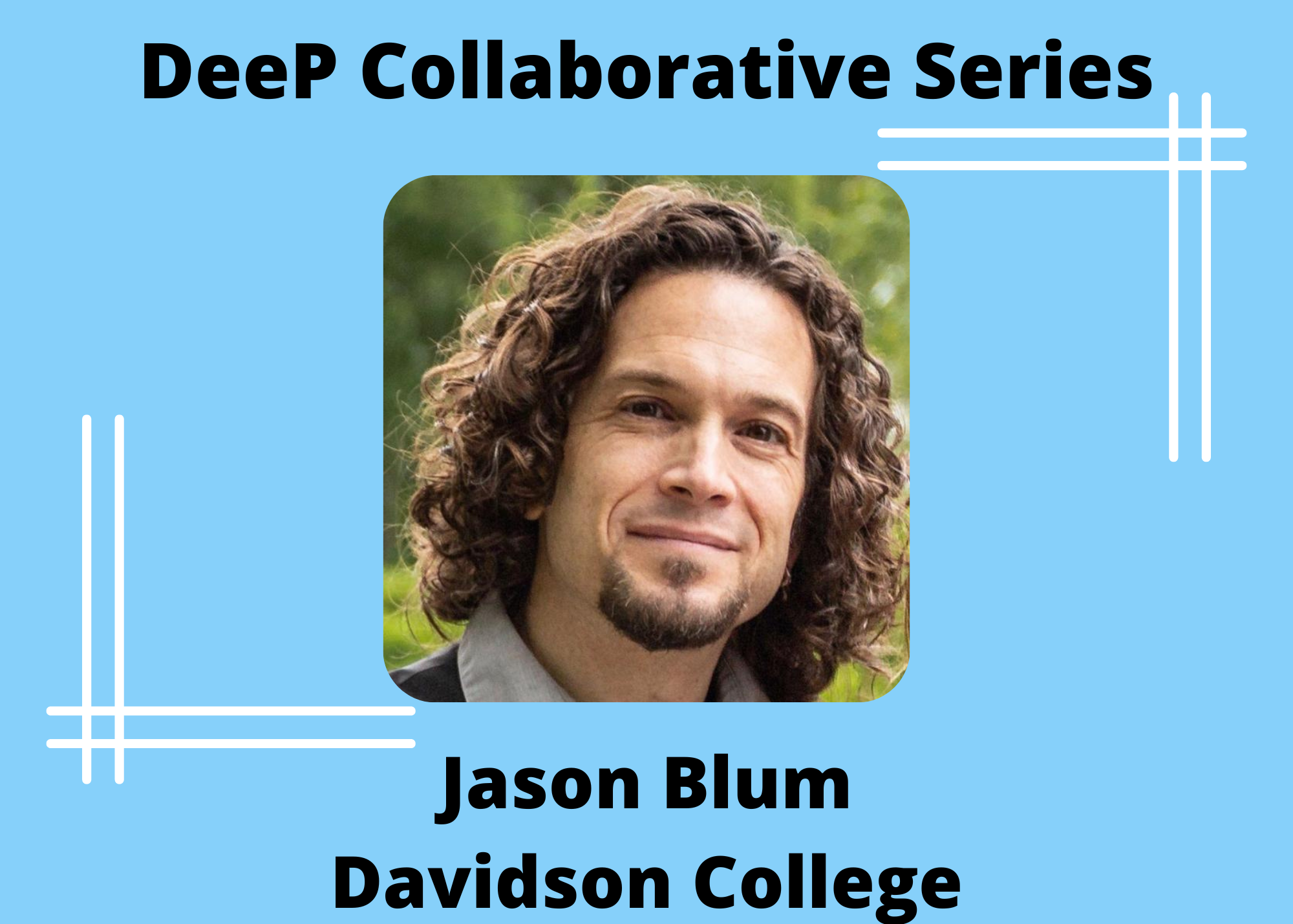
DeeP Collaborative Series Introductory Image for Jason Blum.

By Jason Blum (Assistant Professor of the Practice in Writing, Davidson College, DeeP Collaborative Member)

The Deliberative Pedagogy (DeeP) Faculty Collaborative consists of 20+ faculty from Davidson College and five other Associated Colleges of the South institutions who are committed to learning and implementing new ways to improve and deepen the quality of their class discussions. These faculty come from a wide array of disciplines and backgrounds. They come together to study and discuss different deliberative pedagogy methods, share their ideas and questions with one another, and work to embed deliberation in their classrooms. In this special blog series, members of the Collaborative describe and reflect on their experiences developing and teaching their deliberation-involved courses.

Please note that Professor Blum’s course was taught and the below blog post was written before the U.S. Supreme Court ruled in case of 303 Creative LLC et al. v. Elenis et al.

The case of 303 Creative LLC v. Elenis, which was argued before the Supreme Court in December of 2022,was a natural choice for the central deliberation exercise I staged in my course during the Spring 2023 semester. I incorporated it into my writing course, a seminar-style class designed specifically for first-year students. Although the primary goal of the course is to hone students’ writing skills, I fashion my writing courses around provocative and timely topics that challenge students to engage with other authors’ (often competing) perspectives and to produce arguments that explain and defend their own positions in response to those texts. This semester, the topic around which my writing course was built was religion in the public square. 

Much of the course centers on two texts, one of which argues for a more prominent role of religion in public life, and the other of which contends that religion is undeserving of the legal accommodations and special cultural status that it enjoys in the United States. The casewas well-suited to emphasize the deliberative skills and sensibilities that I sought to foster throughout the semester. It involves a Colorado-based web designer who plans to expand her business into creating websites for weddings. For religious reasons, she objects to same-sex marriage and intends to post a disclaimer stating that she will not design websites for same-sex weddings. Because Colorado law forbids discrimination against gay people, the disclaimer she wants to post would be illegal.

For our deliberation, students were organized in teams of three and provided with a brief New York Times article that describes the basic details of the case. I then asked each team to devise arguments supporting the plaintiff, and then to devise arguments supporting the defendant. After considering the case from each perspective, teams then attempted to reach consensus on how the case should be decided. I explicitly prompted students to draw on our course readings in approaching the exercise. Finally, the class reconvened as a whole to compare decisions and discuss the deliberations that led to their decisions.

I never opined on the case. My pedagogical strategy is to withhold my own positions to avoid the possibility of influencing my students and make them more comfortable expressing a range of opinions. I also explain to students why I do this, and many of them have commented that they appreciate this technique and my purpose in using it.

The case was appropriate for my course primarily because it concerns contrasting values that the majority of students would likely see as positive: on the one hand, religious liberty and freedom of speech, and on the other hand, antidiscrimination.[1] As one of our authors puts it, the case was therefore one in which “the clash is not of wrongs but of rights.”[2] Students were therefore tasked with making a difficult call. Reflecting the divergent texts that we read, there are viable and potentially compelling arguments to be made on both sides. It is the kind of complex and challenging question over which intelligent, well-meaning people can disagree – a “wicked problem,” in the lingo of deliberation – and therefore one that would force students to practice the kind of careful reflection that makes not only for good writing but for good thinking. 

This was perhaps the central intellectual sensibility that I sought to foster in my course: the ability to engage honestly and even generously with competing perspectives over an issue that is complex and unlikely to be easily or cleanly resolved. Tasking student teams with the responsibility of coming to a determination in the 303 Creative case was also beneficial in that it provided a concrete case in which these competing concerns were acutely crystallized. I scheduled the deliberation late in the semester, once students were familiar with the general outlines of the two primary texts we read. They were therefore well-positioned to apply the general principles they had learned in a way that was specific, and which clarified for them both the stakes involved and the sometimes abstract concepts we had discussed. By this point in the semester, the class had also developed a sufficient rapport with each other (and me) that we were able to discuss this controversial issue with an attitude of mutual trust and collaboration.

At least one student commented to me that the exercise forced her to change her thinking. The necessity of addressing a real-world instance seemed to provide a kind of intellectual traction that deepened her thinking on the relevant questions that forced reconsideration of her prior assumptions and values. Other students echoed the sentiment that applying course concepts to a real-world scenario was helpful, as well as “fun.” More than one student suggested that future iterations of the course could benefit from more exercises like this. Incorporating deliberation into my course underscored intellectual skills – such as honest attention to contrary perspectives, generosity of interpretation, acknowledgement of complexity, and willingness to reconsider one’s own positions – that are also central to effective writing and good thinking.


[1] The Supreme Court has stipulated that it will limit its review of the case to the question of whether the Colorado law violates First Amendment protections of freedom of speech. For our deliberation, I instructed students to proceed as though the question of free exercise of religion was still on the table, since that was an essential dimension of the course. 

[2] Stephen Carter, The Culture of Disbelief (New York: Anchor Books, 1993), 154.

Filed Under: Blog Posts, Faculty Posts

The Fusion of Nuclear Technologies and Policy in a First-Year Writing Course

July 25, 2023 by Anthony Kuchera

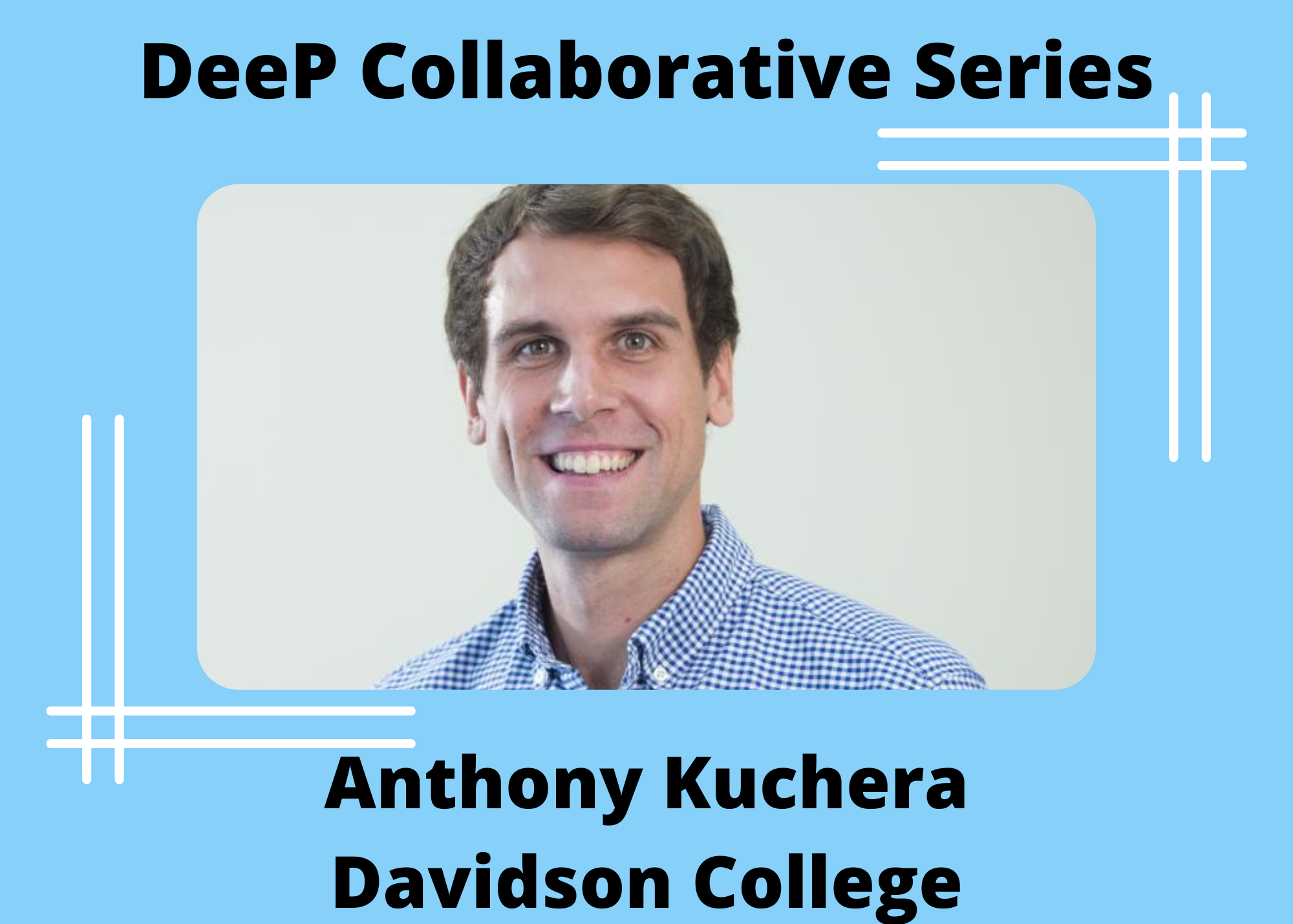
DeeP Collaborative Series Introductory Image for Anthony Kuchera.

By Anthony Kuchera (Assistant Professor of Physics at Davidson College, DeeP Collaborative Member)

The Deliberative Pedagogy (DeeP) Faculty Collaborative consists of 20+ faculty from Davidson College and five other Associated Colleges of the South institutions who are committed to learning and implementing new ways to improve and deepen the quality of their class discussions. These faculty come from a wide array of disciplines and backgrounds. They come together to study and discuss different deliberative pedagogy methods, share their ideas and questions with one another, and work to embed deliberation in their classrooms. In this special blog series, members of the Collaborative describe and reflect on their experiences developing and teaching their deliberation-involved courses.

As a nuclear physicist who primarily teaches upper-level physics courses, I was initially intimidated to teach a Writing 101 course at Davidson College. This is a required course for all first-year students that can be taught by faculty members across the college. With help and guidance from the former director of the Davidson College Writing Center, I gained confidence that the theme of my course, the intersections of nuclear science, technology, and policy, was worthy for a writing course and of interest to the Davidson students. In May 2023 I completed teaching the course for the third time. As a result of my participation in the Deliberative Citizenship Initiation (DCI) Deliberative Pedagogy (DeeP) Faculty Collaborative during the 2022-2023 academic year, I feel that it was the strongest yet. By participating in the readings, trainings, and interactions with other students and faculty, I found a significantly better way to approach discussions on difficult topics in the classroom.

In many physics courses, there is a focus on the scientific concepts, mathematical framework, and problem solving. Typically, there is not much discussion on contentious issues. In the WRI 101 course I teach, the idea is flipped. There is very little focus on the scientific details (but enough for students to understand generally what is going on) and a primary emphasis on analyzing the ways in which nuclear science and its applications are understood, perceived, regulated, and implemented to solve societal needs. I regularly emphasize to the students that the nucleus of the atom holds incredible potential for applications in energy, medicine, and other industries, but it comes with (often significant) risks. Because of this risk-reward situation, there is a broad spectrum of ideas on how nuclear technologies can and should be used.

In the first two iterations of this course, I found the in-class discussions to generally be less than satisfying with only a few eager students willing to engage and mostly responding just to me and not the other members of the class. I take the blame for this as I didn’t have a great strategy to facilitate these discussions. This lack of preparedness is what motived me to join the DCI DeeP Faculty Collaborative.

In Spring 2023, I updated my WRI 101 course to incorporate deliberations into my curriculum. The course is structured with four major topics: radiation and the public, development of nuclear weapons, nuclear power, and current political situations with nuclear technologies. Each topic has a major writing assignment. The deliberations were held about one week before the due date of the writing assignments. This was intentional, and gave students sufficient time to consider other perspectives to issue and the argument(s) they are making. In each writing assignment it was expected that students respond to viewpoints other than their own and the deliberation gives an opportunity to hear what those are and why others might have those perspectives. Each deliberation took place for about 35 minutes in class with 10 minutes at the end for the students to write a reflection on their experiences.

I was pleasantly surprised by the reactions and feedback from the twelve students in the class. They all seemed to thoroughly enjoy the deliberations. The deliberations provided a way for students to interact with each other and not just respond to me. I was fascinated to see students take initiative to ask fellow students questions about their perspectives. I also was grateful to see students engage respectfully when disagreeing with each other. Ultimately, this is what I wanted to see happen. I hoped students would discover what they believe and find out what leads to others having different perspectives. In holding these deliberations, I found a solution. Future iterations of this course will certainly continue to have deliberations and I am now trying to find ways to include some in other courses I teach.

Filed Under: Blog Posts, Faculty Posts

  • « Go to Previous Page
  • Page 1
  • Interim pages omitted …
  • Page 17
  • Page 18
  • Page 19
  • Page 20
  • Page 21
  • Interim pages omitted …
  • Page 38
  • Go to Next Page »

Footer

Blog Post Categories

  • Announcements
  • Blog Posts
  • DCI Posts
  • Events
  • Faculty Posts
  • Fellow Posts
Image of a compass superimposed by the text "Deliberative Citizenship Initiative" and "Davidson College." Clicking on this image leads to the Initiative page.

Recent DCI Blog Posts

  • We Tried to Fix Jubilee’s “Middle Ground” – Here’s How It Went
  • A Case for Deliberation in the Natural Sciences
  • Welcoming New Staff to the DCI and DCN
  • Facebook
  • Twitter
  • Instagram
  • LinkedIn


Copyright © 2026 · Infinity Pro on Genesis Framework · WordPress · Log in