
• Skip to main content
  • Skip to footer

Deliberative Citizenship Initiative

Building Democracy One Conversation at a Time

  • The Initiative
    • Programs
      • Deliberation Across the Curriculum
      • Deliberation on Campus
      • Deliberation in the Community
      • Research on Deliberation
    • Motivations
      • Why Deliberative Citizenship?
      • Why Davidson? Why Now?
    • Who’s Involved?
      • DCI Fellows Cohorts
        • 2025-2026 Fellows
        • 2024-2025 Fellows
        • 2023-2024 Fellows
        • 2022-2023 Fellows
        • 2021-2022 Fellows
        • 2020-2021 Fellows
      • DeeP Collaborative Cohorts
        • 2024-2025 DeeP Collaborative Faculty
        • 2023-2024 DeeP Collaborative Faculty
      • Advisory Council
    • History
      • What Sparked the Initiative?
    • Key Deliberative Dispositions
    • Frequently Asked Questions (FAQ)
    • Annual Report
  • Get Involved!
    • Participate in a Forum
    • Join a D Team
    • Become a Fellow
    • Take Courses
    • Get Training
    • Come to Guest Lectures
  • Events
    • Upcoming Events
      • 250th Anniversary Deliberative Forum Series on American Values
    • Past Events
  • Connections
    • The Deliberative Citizen: The DCI’s Monthly Newsletter
    • Efforts on Campus
    • Efforts in the Community
    • Efforts Elsewhere
    • Readings and Resources
      • DCI-Published Guides
      • DCI Guide to One-on-One Conversations
      • How to Disagree
      • Demonstration of Facilitation Styles
      • Deliberative Pedagogy Mini-Course
    • How We Can Help: DCI’s LET’S DELIBERATE! Partnership Opportunities
    • DCI in the News
  • DCI Blog Posts
    • Recent Blog Posts
    • All Blog Posts

Laegan Smith

Emotional Readiness vs. Community Relevance? The Difficulty of Selecting Topics for Deliberation

June 21, 2023 by Laegan Smith

two heads with questions and ideas.

By Laegan Smith ’24 (DCI Fellow)

When I completed the training to become a facilitator for deliberation, one of the first things we discussed was how to select topics for deliberation. That seemed easy enough to me at first—surely you can just choose any topic and talk about it—but I soon found that there are a lot of questions that must first be asked to determine if a topic will make for a productive conversation.

For example, what issues are people interested in talking about? Will participants have enough background knowledge to deliberate about the issue? Is it possible to gather people with diverse viewpoints and opinions to deliberate? Can participants have disagreements about the issue? Are participants emotionally ready to deliberate about the issue? All these questions are used to determine whether a topic can be considered timely and “ripe” for discussion for a group.

These questions have come up again and again as the DCI has organized and hosted deliberations throughout this year. During our initial training, we were tasked with coming up with some possible deliberation topics for Davidson College and my fellow trainees and I disagreed on whether some topics could be considered “ripe” for discussion or not. I felt like the topic one of my peers suggested was too sensitive and emotionally charged to deliberate given the recent events surrounding it in the news, while my peer argued that that was the exact reason it would be a good topic for deliberation. While I was more focused on the question of emotional readiness, he was focused on the question of community interest. I realized then how subjective choosing a “ripe” topic is.

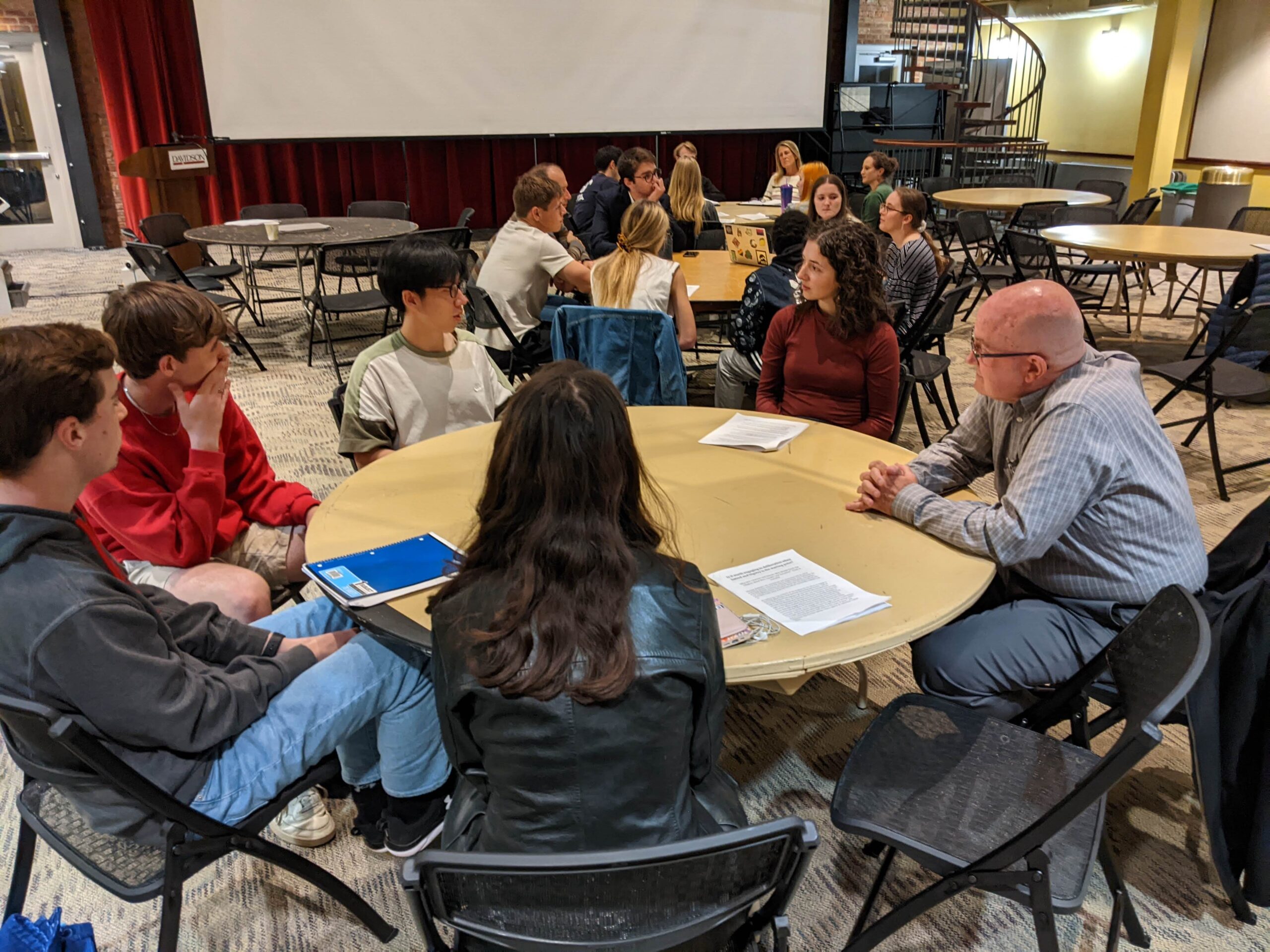
These questions came up for me again at the deliberative forum on Schools and Parents: Who Should Teach our Kids about Race, Gender, and Sexuality? that the DCI hosted last semester. After the event, I spoke to some of my peers who disagreed that the event should have been held to gauge why they didn’t want to participate. The overwhelming answer that I received was, “I refuse to deliberate about something so personal to me.” That resonated with me: though I did not feel the same way about that particular event, I felt that that was absolutely a valid reason not to partake in a deliberation. The other feedback I received was that the deliberation shouldn’t have even been held—that it was too personal and sensitive of a topic to deliberate at all.

The next week, another one of the DCI Fellows and I shared our thoughts on this issue during our weekly Commons Conversations. We and some other students discussed not only what topics we felt were timely for deliberation, but also what topics we felt should and shouldn’t be deliberated given the feedback from the forum. It was difficult to draw the line between uncomfortable topics that might hit too close to home for some people and topics that are inherently unsuitable for deliberation due to their sensitivity.

My initial reaction was that there definitely are topics that are too sensitive to be deliberated. However, the conversation raised some important questions: if topics that are too sensitive aren’t deliberated, how will we ever understand other perspectives on those topics? How will we be able to explain our point of view to someone who disagrees? How can we as a society move forward on the most personal of topics if we do not discuss them?

I don’t know the answers to these questions and I’m still not sure where the line should be drawn—it’s incredibly subjective. I’ve learned from these experiences how difficult it is to select a topic for deliberation and how impossible it is to please everyone when doing so. Ultimately, I think it’s up to the organizer of a deliberation to gauge the emotional readiness of the community it serves and up to the participant to decide whether they personally are emotionally ready to attend, and it’s okay if the answer is no.

Filed Under: Blog Posts, Fellow Posts

Deliberation vs. Debate: Fostering Understanding and Respect

November 28, 2022 by Laegan Smith

deliberators at the Davidson College 900 room.

By Laegan Smith ’24 (DCI Fellow)

Before coming to Davidson and joining the Deliberative Citizenship Initiative, my experience with deliberation was very limited. Like many people, I was hesitant to assert my beliefs for fear of discomfort, conflict, or judgment and careful to avoid conversation around politics or controversial issues with those who I knew disagreed with me. In my prior experience, those interactions often turned to debate in which the goal was not to listen and learn but to play attack and defense with the goal of being “right.” They nearly always ended in someone feeling hurt or disrespected. Though I thoroughly enjoy engaging in conversation about complex topics, I had no interest in doing so in such a hostile and unwelcoming environment.

As I became involved in the DCI, I learned about what distinguishes deliberation from debate. The goal is not to win or be right, but to come away with a greater understanding of both the complexities of the topic and of alternative perspectives. It is meant to be a welcoming and respectful space in which people can express their views without fear of dismissal or ridicule.

While this seems straightforward in theory, my first DCI event tested how well I could maintain such a space as a facilitator. The topic at hand was very personal to me and I was reluctant to listen to a speaker with whom I disagreed so strongly. Prior to the forum, I was quick to dismiss her views as bigotry. But as she explained the intricacies of her perspective, I gained a new lens through which to look at the issue. Though I did not agree with her foundational beliefs, her discussion of her perspective helped me to understand the reasoning behind why she thought that way. I gained empathy for her point of view that I did not have before. I realized that my immediate dismissal of her was due to my assumption about what I thought she would say rather than based on her actual words, and that I had not previously offered her perspective the same respect as my own.

Before my experience with deliberation, I had not realized how much I subconsciously dismissed views different from mine. I had not realized how much I assumed what people’s views were instead of actively listening to what they had to say. It has since opened my eyes to the extraordinary amount of nuance that is present in every issue. There are not solely two sides in any given issue, and the sides are not inherently in opposition. Someone’s view on one particular issue should not lead us to make assumptions about their other views or about their character.

With the current state of rapidly increasing polarization and gridlock, deliberation is especially important. We cannot continue to debate to win, nor can we continue to leave controversial topics out of the conversation. In order to make progress, we must work towards bridging the political divide by engaging in openminded, respectful conversation that fosters mutual understanding and empathy.

Filed Under: Blog Posts, Fellow Posts

Footer

Blog Post Categories

  • Announcements
  • Blog Posts
  • DCI Posts
  • Events
  • Faculty Posts
  • Fellow Posts
Image of a compass superimposed by the text "Deliberative Citizenship Initiative" and "Davidson College." Clicking on this image leads to the Initiative page.

Recent DCI Blog Posts

  • We Tried to Fix Jubilee’s “Middle Ground” – Here’s How It Went
  • A Case for Deliberation in the Natural Sciences
  • Welcoming New Staff to the DCI and DCN
  • Facebook
  • Twitter
  • Instagram
  • LinkedIn


Copyright © 2026 · Infinity Pro on Genesis Framework · WordPress · Log in