• Skip to main content
  • Skip to footer

Deliberative Citizenship Initiative

Building Democracy One Conversation at a Time

  • The Initiative
    • Programs
      • Deliberation Across the Curriculum
      • Deliberation on Campus
      • Deliberation in the Community
      • Research on Deliberation
    • Motivations
      • Why Deliberative Citizenship?
      • Why Davidson? Why Now?
    • Who’s Involved?
      • DCI Fellows Cohorts
        • 2025-2026 Fellows
        • 2024-2025 Fellows
        • 2023-2024 Fellows
        • 2022-2023 Fellows
        • 2021-2022 Fellows
        • 2020-2021 Fellows
      • DeeP Collaborative Cohorts
        • 2024-2025 DeeP Collaborative Faculty
        • 2023-2024 DeeP Collaborative Faculty
      • Advisory Council
    • History
      • What Sparked the Initiative?
    • Key Deliberative Dispositions
    • Frequently Asked Questions (FAQ)
    • Annual Report
  • Get Involved!
    • Participate in a Forum
    • Join a D Team
    • Become a Fellow
    • Take Courses
    • Get Training
    • Come to Guest Lectures
  • Events
    • Upcoming Events
      • 250th Anniversary Deliberative Forum Series on American Values
    • Past Events
  • Connections
    • The Deliberative Citizen: The DCI’s Monthly Newsletter
    • Efforts on Campus
    • Efforts in the Community
    • Efforts Elsewhere
    • Readings and Resources
      • DCI-Published Guides
      • DCI Guide to One-on-One Conversations
      • How to Disagree
      • Demonstration of Facilitation Styles
      • Deliberative Pedagogy Mini-Course
    • How We Can Help: DCI’s LET’S DELIBERATE! Partnership Opportunities
    • DCI in the News
  • DCI Blog Posts
    • Recent Blog Posts
    • All Blog Posts

Emre Guvenilir

The Complementary Roles of Deliberation and Disruptive Communication in Political Discourse

May 31, 2024 by Emre Guvenilir

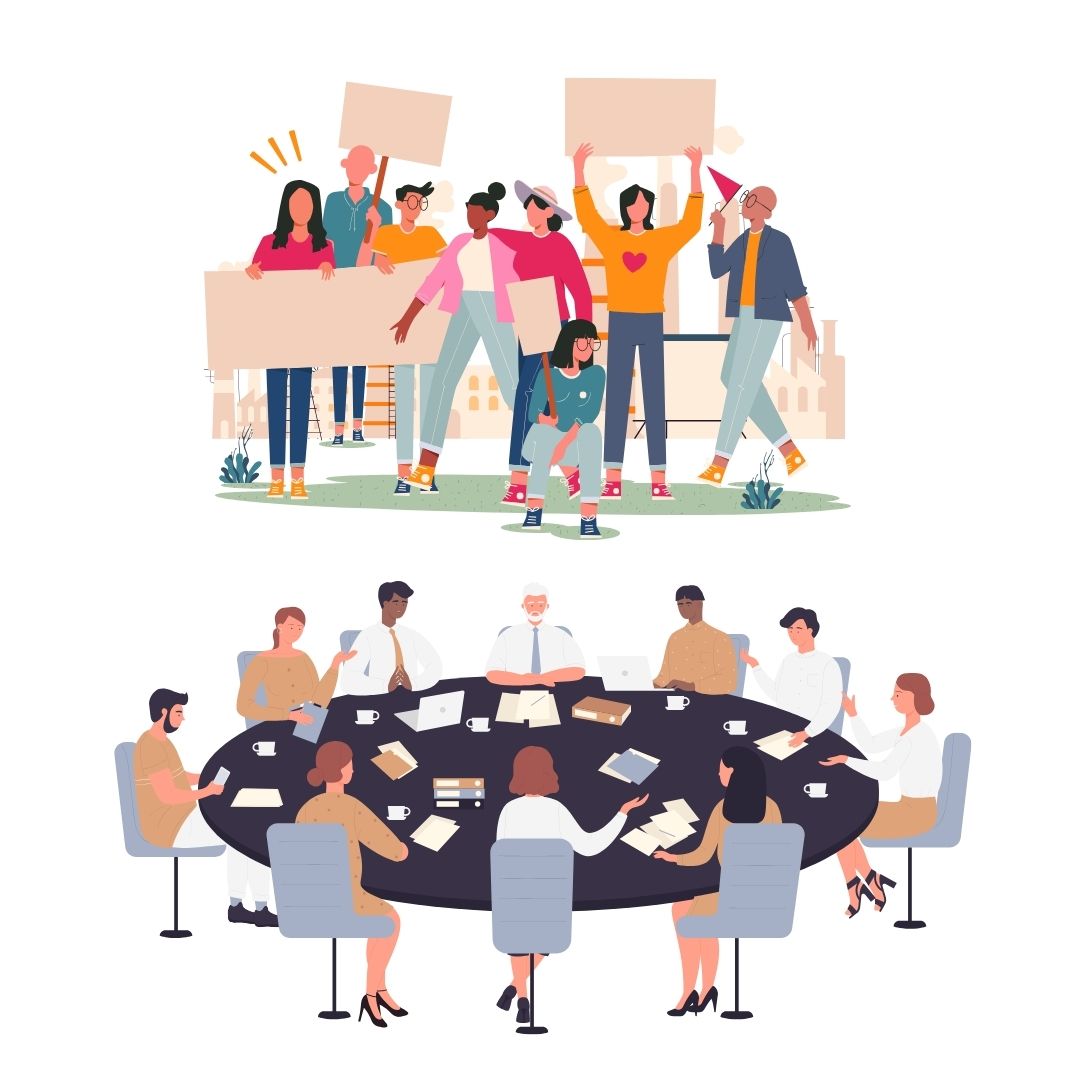
Graphics showing protestors and people deliberating around a table

By Emre Guvenilir ’25

In my view, deliberation is a tool that can help facilitate healthy conversation. When done correctly, it can bring together those who hold opposing views to find common values or goals, which can in turn orient policy solutions in less extreme directions. This is critical in a free democracy, where everyone is given a voice and empowered to advocate for different policy solutions and points of view in a respectful manner. A good deliberation is a peaceful, reasonable discussion that involves individuals with different perspectives, a clear shift from what is often portrayed on national television between politicians and the most outspoken advocates.

It is important to recognize that political discourse comes in many forms, including protest and other forms of citizen activism. A few weeks ago, the DCI Fellows had an opportunity to read a paper titled “Deliberation and Non-Deliberative Communication” by Edana Beauvais at Harvard University. The article develops a typology of communication that distinguishes between communication that is collectively-oriented and communication that is reason-giving. This raises the question concerning how deliberative communication fits into the wider political discourse, and if viewed within the context of a deliberative framework, whether more disruptive political communication can be considered part of a healthy deliberative democracy.

To address the first question, we must identify who engages and does not engage in political communication. In my view, political engagement in rallies, protests, and other events typically involves the most partisan among us. Then, there are those who may be loosely engaged with politics by reading and watching news stories, or through social media. Finally, there are those who are turned off from the nature of political discourse, so do not engage. However, it is important to recognize that all these people still have values that are important to them.

The hardest group to engage are those disconnected from politics. However, we can make deliberation more attractive to this group if it is focused through a lens of values, rather than concrete political issues. This means focusing on larger scale topics such as family, individualism, equality, and other core values. Those who are already engaged in partisan politics might be inclined to participate in a deliberation. However, when they engage for the first time with those who hold directly opposing views, even for this group, deliberation should also focus on values rather than specific issues. This will help everyone find common ground or at least better understand how they are emphasizing different values.

To answer the second question of how more disruptive political communication fits in to our broader political discourse, it is important to recognize that acts like protests aim to publicize a particular perspective and influence government and public opinion. Generally speaking, the aim of protesting is not to understand the other side. In my view, this differs from the goal of deliberation, and therefore deliberative theorists do not need to classify those forms of political communication as forms of deliberation.

However, deliberation can fail. To me, deliberation fails if deliberators fail to uphold the conversation agreements. This could happen for any number of reasons; for example, some involved in the deliberation feel they cannot express their thoughts because of a power imbalance that exists, deliberators fail to respect each others’ values, or any number of reasons. If deliberation fails, deliberative theorists should recognize that more disruptive acts can give a platform for stakeholders to come back to the table. As Edana Beauvais explains, “disruptive communication…is an effective tool for calling people to arms, to capture their interest, focus their energies, draw them tightly together.”

If deliberative communication fails partly because of a perceived power imbalance, protest can aid in bringing a voice to those who feel they do not have one and get the attention of those who are perceived to hold power. When individuals turn to disruptive forms of political communication, deliberation may appear to be the antithesis of what is needed. Protesters do not usually demand compromise; they demand the entirety of what they are fighting for. This leaves those in power resistant to any change since it seems to be an “all or nothing” deal. When that point is reached, I believe deliberation is a tool that should be used to better understand the differences of the parties involved and find common ground where possible.

So, to bring it back to the bigger question: where does deliberation fit into the larger political discourse? As Edana Beauvais concludes, different types of communication play different roles in public discourse. It is important for deliberative theorists to understand that deliberation has its limits, and only works when individuals are willing to recognize that others may be focusing on different values than they are. If individuals are willing to take this step and acknowledge that their own views may be wrong (or at least limited), deliberation can indeed be used as a tool that helps us move beyond competing slogans and sound bites, and empower us to create a more inclusive, functional, and dynamic democracy.


 [BG1]Can you say more about what you mean here?

Filed Under: Blog Posts, Fellow Posts

When Deliberation Fails

February 29, 2024 by Emre Guvenilir

Game paws collected on one side with one outlier

Emre Guvenilir ’25 (DCI Fellow)

As a trained deliberation facilitator, my role is often central to the success or detriment of a deliberation. The skills I employ as well as the framework set up by the Deliberative Citizenship Initiative (DCI) allow deliberators to navigate the difficult topics chosen. Two of these frameworks are the conversation agreements and deliberative dispositions, which set the expectations for those who enter in a deliberation to adhere to. These standards allow all participants and the facilitator to feel comfortable and welcome in the environment.

Our deliberative dispositions include ideas like egalitarianism, which is a commitment to the involvement of each participant. They also include the empathy, which asks deliberators to “treat remarks made by others with openness and compassion, and approach disagreements with generosity and good will.” But do these frameworks always ensure that a deliberation goes well? While at a glance these seem obvious, it can be difficult to adhere to every disposition when someone feels that a vital part of their identity is at stake in the conversation.

For a deliberation to be successful, both deliberators and the facilitator must feel welcome and engaged. Such success does not always mean that ideas have been transcended and the participants have found a new way to view an issue. Rather, success could mean that the facilitator has enabled the deliberators to carefully listen to another perspective that challenged their views, even if these views did not change.

Sometimes we do not achieve such success in our deliberations, and the challenge is to figure out how we can do better next time. I recently facilitated a deliberation where the topic was important to all the deliberators, yet at the end I felt I had failed as a facilitator because, from my view, we had not been able to maintain our deliberative dispositions or our conversation agreements. Surprisingly, it wasn’t because the conversation was rife with immense disagreement. A consensus had formed in the group, and I pointed it out to the deliberators. Part of the facilitator’s job is to introduce views that have not been expressed in the conversation, and to do so in a way that makes clear those views are not necessarily their own, but views that many hold just as closely as the participants hold their views.

This is where I believe the deliberation failed. I did not succeed in enabling the deliberators to productively engage with perspectives different from their own. When addressing these views that were not represented in the group, the deliberators oriented their responses towards me rather than amongst themselves. Because they believed those views were at odds with their fundamental beliefs, the deliberation became agitated and a clear tension arose in the conversation.

What could I have done differently? Looking back on this experience now, I would have paused the deliberation and created a “half time” where everyone can get up and move around, get some water, and detach from the tension rather than attempting to power through it when we were no longer holding ourselves to the conversation agreements.

Although it can be difficult to do so in the moment, taking a break can allow each participant and the facilitator to reflect and come back with a new start. Returning from a break, I could have asked more questions about the why. What makes these issues so important to you, personally? I believe that if I had done a better job at asking questions and guiding the conversation, the deliberation might have turned a corner. The pessimistic part of me wants to say, “No, that deliberation was never going to succeed in the environment it was in.” But if I am going to become a better facilitator, and become more open-minded myself, I cannot listen to the pessimist. To walk away from a deliberation without reflecting and trying to improve undermines the exact reason we deliberate in the first place: to reflect on our own stances and ways, and to refine those skills, those beliefs, and all the things that can help make us more complete and better human beings.

Filed Under: Blog Posts, Fellow Posts Tagged With: deliberation, democracy, discourse, facilitation

Footer

Blog Post Categories

  • Announcements
  • Blog Posts
  • DCI Posts
  • Events
  • Faculty Posts
  • Fellow Posts
Image of a compass superimposed by the text "Deliberative Citizenship Initiative" and "Davidson College." Clicking on this image leads to the Initiative page.

Recent DCI Blog Posts

  • We Tried to Fix Jubilee’s “Middle Ground” – Here’s How It Went
  • A Case for Deliberation in the Natural Sciences
  • Welcoming New Staff to the DCI and DCN
  • Facebook
  • Twitter
  • Instagram
  • LinkedIn


Copyright © 2026 · Infinity Pro on Genesis Framework · WordPress · Log in