• Skip to main content
  • Skip to footer

Deliberative Citizenship Initiative

Building Democracy One Conversation at a Time

  • The Initiative
    • Programs
      • Deliberation Across the Curriculum
      • Deliberation on Campus
      • Deliberation in the Community
      • Research on Deliberation
    • Motivations
      • Why Deliberative Citizenship?
      • Why Davidson? Why Now?
    • Who’s Involved?
      • DCI Fellows Cohorts
        • 2025-2026 Fellows
        • 2024-2025 Fellows
        • 2023-2024 Fellows
        • 2022-2023 Fellows
        • 2021-2022 Fellows
        • 2020-2021 Fellows
      • DeeP Collaborative Cohorts
        • 2024-2025 DeeP Collaborative Faculty
        • 2023-2024 DeeP Collaborative Faculty
      • Advisory Council
    • History
      • What Sparked the Initiative?
    • Key Deliberative Dispositions
    • Frequently Asked Questions (FAQ)
    • Annual Report
  • Get Involved!
    • Participate in a Forum
    • Join a D Team
    • Become a Fellow
    • Take Courses
    • Get Training
    • Come to Guest Lectures
  • Events
    • Upcoming Events
      • 250th Anniversary Deliberative Forum Series on American Values
    • Past Events
  • Connections
    • The Deliberative Citizen: The DCI’s Monthly Newsletter
    • Efforts on Campus
    • Efforts in the Community
    • Efforts Elsewhere
    • Readings and Resources
      • DCI-Published Guides
      • DCI Guide to One-on-One Conversations
      • How to Disagree
      • Demonstration of Facilitation Styles
      • Deliberative Pedagogy Mini-Course
    • How We Can Help: DCI’s LET’S DELIBERATE! Partnership Opportunities
    • DCI in the News
  • DCI Blog Posts
    • Recent Blog Posts
    • All Blog Posts

Graham Bullock

Thanksgiving after the Election

November 26, 2024 by Graham Bullock

Thanksgiving images with people talking and Donkey and Elephant in their thoughts, with the word Connect between them.

Every year around Thanksgiving you can find a stream of advice about how to engage with family with different political viewpoints across the dinner table (and the DCI has contributed our fair share). The supply of these missives likely peaks in presidential election years, and the demand for them may be at its highest after our most recent election. Indeed, many Americans feel a deep sense of disconnection from, disillusionment with, and even disgust for those who voted for the candidate they most despise.

These feelings build on a normal and natural desire to step from politics after an election and return to focusing on other important spheres of our lives. Even when elections are not as fraught as they currently are, it is not surprising that we want to escape from the political and re-discover our other passions – whether that be on Netflix, in books, on hikes, or elsewhere.

Whether our candidate won or lost, such escape may be healthy and even critical for us at this point. It can enable us to step back, get perspective, and restore ourselves. It can help us re-focus our energies and return to our interest in politics with a fresh perspective. Because at some point, we must return to it; if we care about our collective life together, if we care about one another and the directions our society follows, then we owe it to ourselves and each other to re-engage in some form or another.

Okay, fine, you say, but do I have to do it at Thanksgiving? Can’t I wait until at least the New Year, or maybe 2026? Perhaps, and everyone must make their own decision on when and how best to re-enter the political conversation. But family gatherings, perhaps ironically, offer a special opportunity for trying out new approaches and different modes of engagement after consequential political events.

How so? By enabling us, first within the space of our closest relations, to re-commit to following the Golden Rule of “loving your neighbor as yourself.” We can ask ourselves, if your candidate had lost (when in fact they won), how would you want those whose candidate had won to treat you at those gatherings? Certainly not by making snide, sarcastic, or acerbically triumphant remarks, but probably also not by just ignoring you or the subject.

Instead, how meaningful would it be to you, if that sister whose candidate won, authentically, earnestly, and sincerely asked you, in a quiet moment after dinner perhaps, “You know, I know we voted differently, and I know how upset you must feel about the outcome. I’m concerned about you – how are you doing?” What if they were truly open to hearing your concerns and just listening – and responding as patiently and respectfully as possible, when asked, “How could you vote for that person?”

And likewise, if your candidate had won (when in fact they lost), how would you like those whose candidate had lost to treat you? Also probably not with biting criticism, doomsday rhetoric, or willful silence. But what if instead, that brother whose candidate lost, said to you, honestly and directly, “You know, I know we voted differently, and I know how happy you must feel about the outcome. But frankly, I’m really struggling with understanding it; maybe you can help me. Why do you think so many people voted the way they did?” What if they were truly open to hearing your analysis and just listening – and asking as respectfully as possible, “And why did you vote for that person?”

There is some asymmetry here – a basic ethic of care and compassion suggests that the victor has a little more moral responsibility to reach out to the vanquished.  But the vanquished also have a duty to treat the victor as a human being as well. Humility, generosity, and curiosity are all important virtues – and deliberative dispositions – to cultivate in these moments.

I was recently invited by a group at Davidson College Presbyterian Church to speak about “Civil Discourse after the Election: Pitfalls and Pathways Moving Forward.” In my talk, I referenced some biblical passages that provide some guidance on why and how to adopt these dispositions. To those who have been victorious, Proverbs 24:17 suggests, “Do not gloat when your enemy falls; when they stumble, do not let your heart rejoice.” To those who have been defeated and feel (or fear) persecution, Matthew 5:43-44 encourages, “You have heard that it was said, ‘Love your neighbor and hate your enemy.’ But I tell you, love your enemies and pray for those who persecute you.”

Similar advice is offered by many different faith and secular traditions, and they all suggest we should avoid the vices of both conceit and contempt – the habit of thinking ourselves better than others and believing those others to be unequivocally worthless. Instead, we should aim to be both humble and courageous – humble enough to recognize we might be wrong and brave enough to discover when others might be right.

Sounds great in theory, perhaps, but how do we enact these principles in practice? The DCI has developed a Guide to One-on-One Conversations, which maps out a process that you can follow before, during, and after a discussion with someone who you disagree with. Establishing expectations, setting the tone, asking good questions, listening actively, sharing respectfully; these are just a few of the suggestions it includes that may be helpful.

But perhaps the most important thing to remember, as you pass the Thanksgiving sides across the table, is the goal. Given the deep pain, frustration, and division that many of us are feeling, our objective at this point should probably not be to win an argument or persuade one another of the rightness of our side. Instead, we should first focus on re-discovering our common humanity, our common joys and concerns, our love for one another. First seek to heal and to understand; as Sara Copic wrote in her Thanksgiving blog post last year, “By approaching our deep disagreements with curiosity first, we may be able to build the trust needed in order to have the hard conversations we would like to have together.”

Have a restful and restorative Thanksgiving that has its share of escape, rediscovery, and perhaps a small bit of empathetic conversation across our family and political divides.
Filed Under: DCI Posts, Faculty Posts

Innovation within Tradition: Eu-Phi Debate Includes DCI-Supported Audience Deliberations 

November 26, 2024 by Graham Bullock

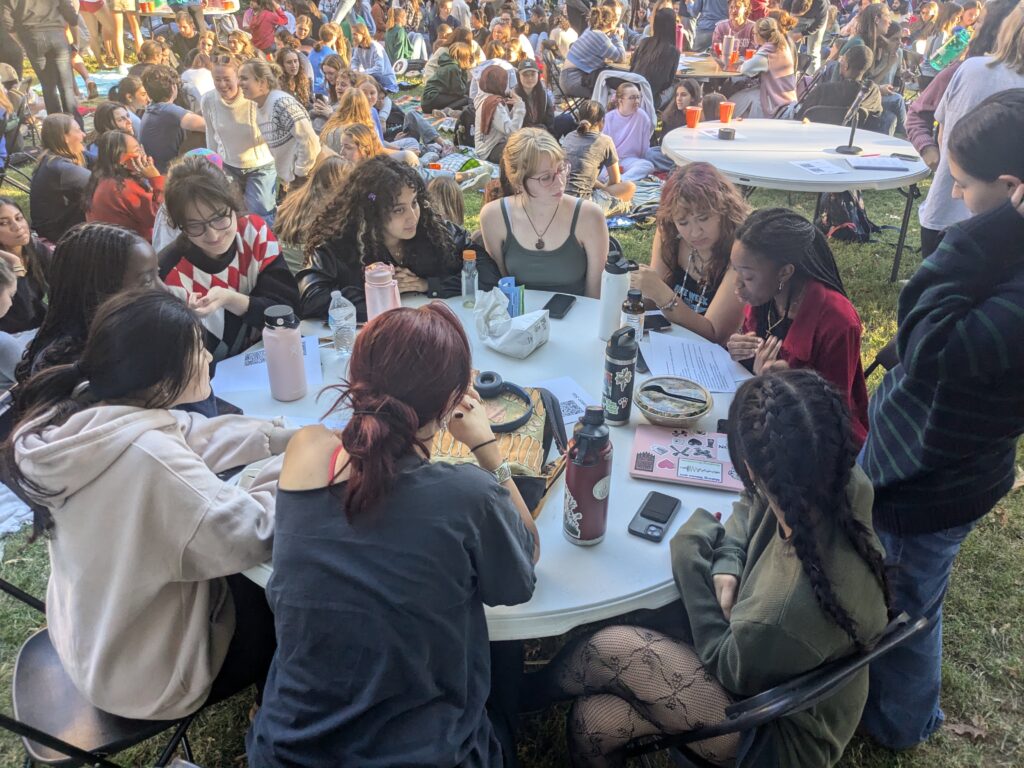
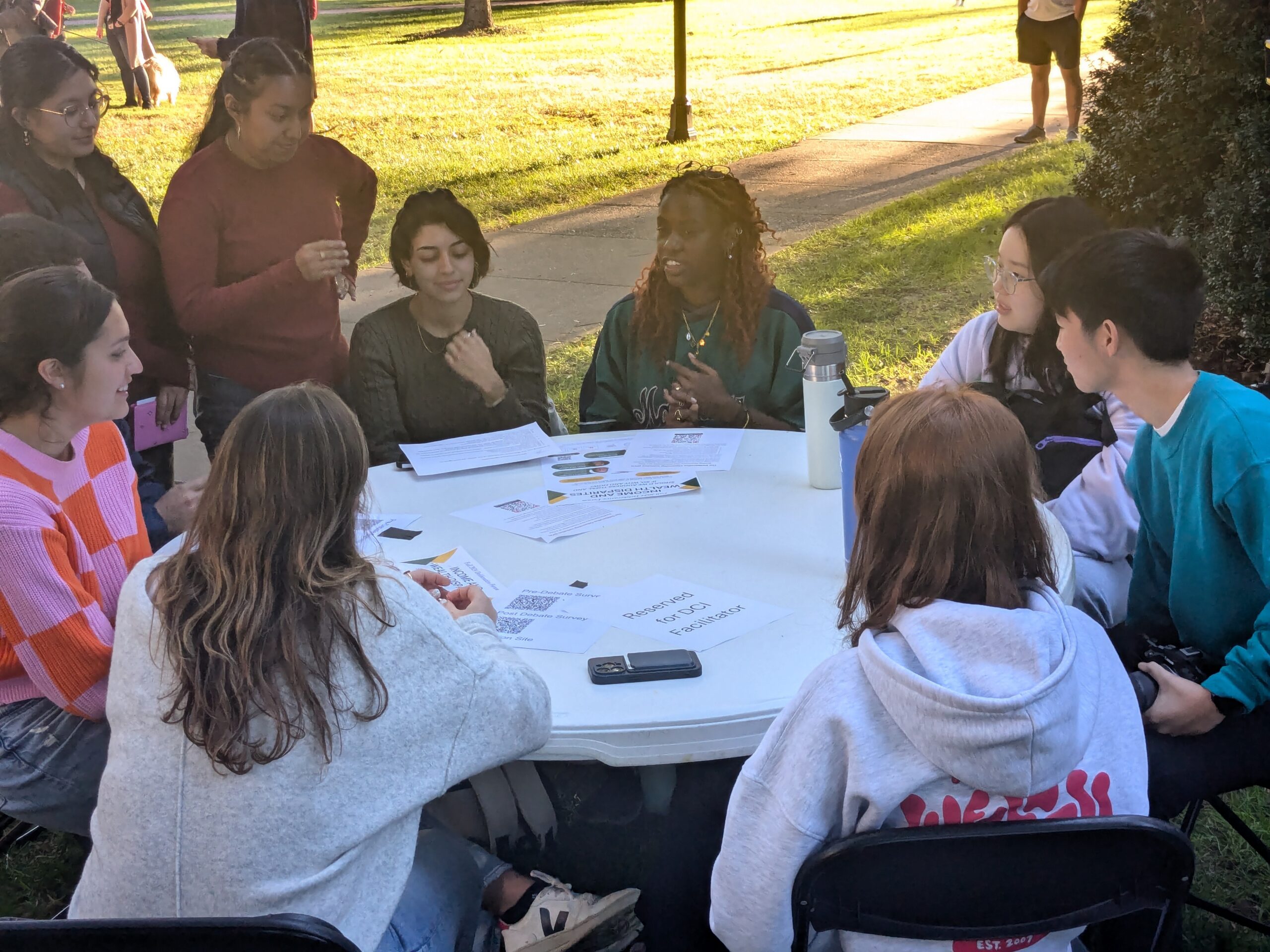
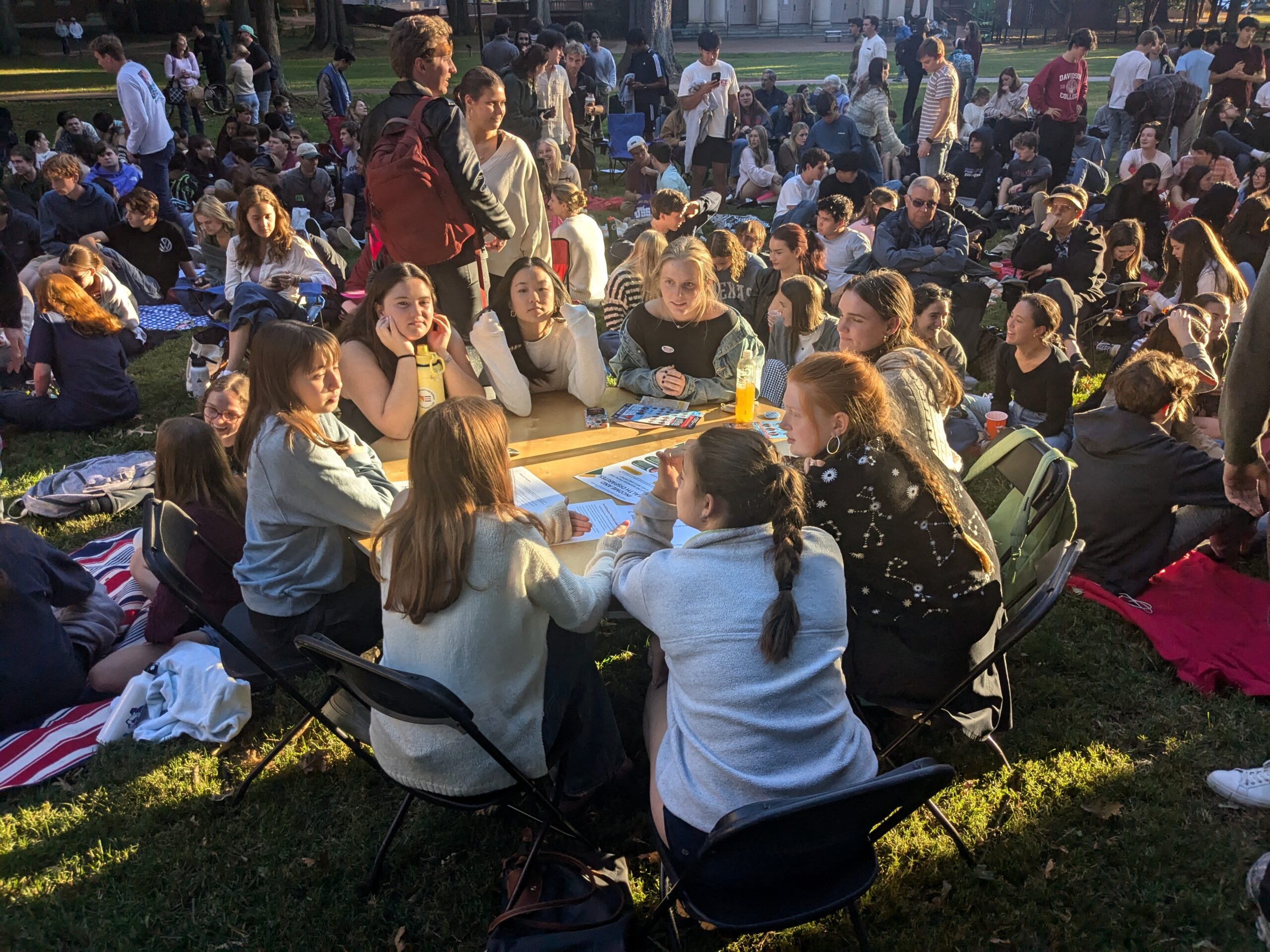
Group of students sitting around a table discussing

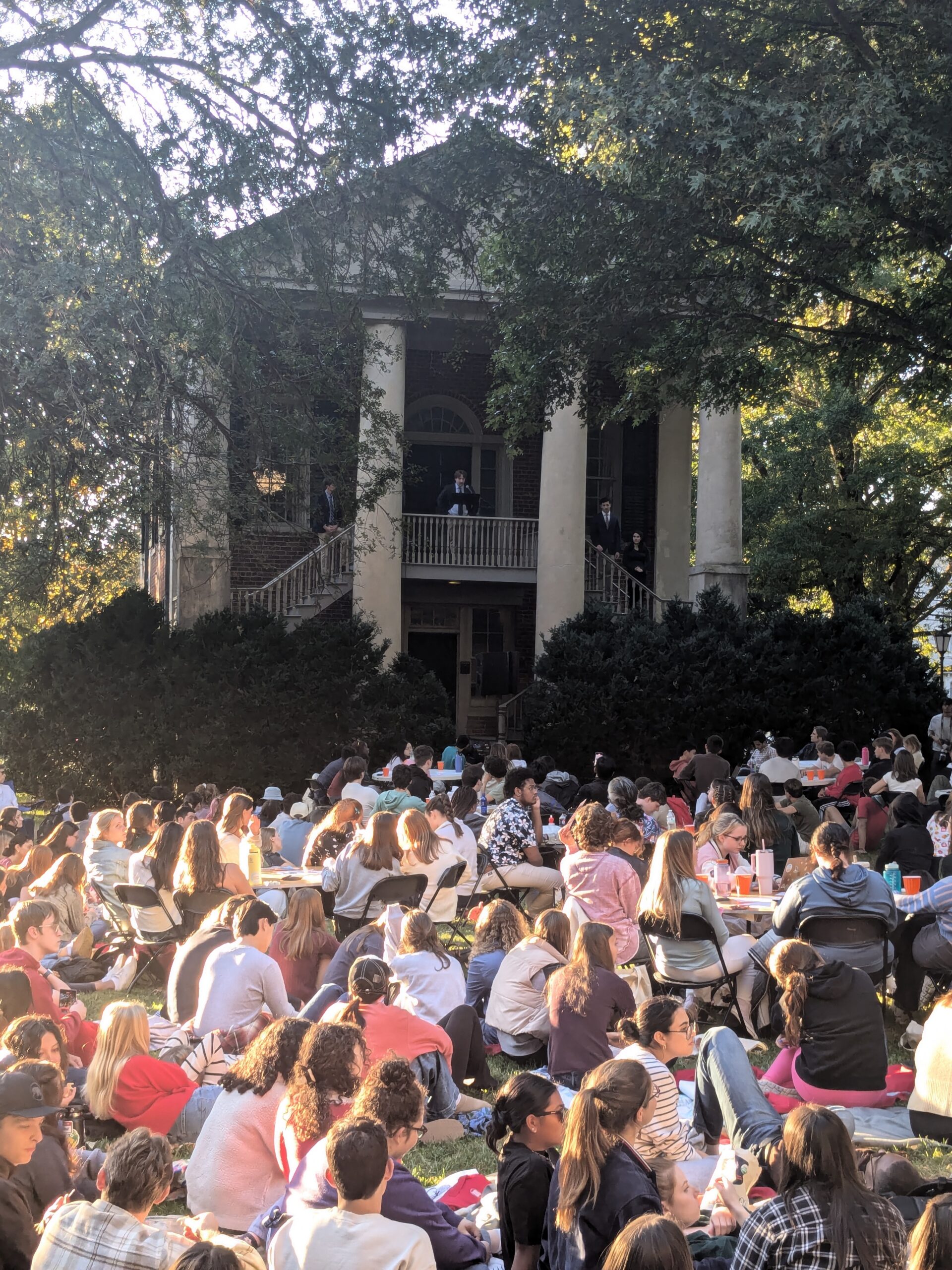
Every four years since at least 2000, the Davidson College Democrats and Republicans have held debates focused on key issues in the presidential election. They have been held between Eu and Phi Halls, two of the oldest buildings on campus, and have built on an even older tradition of debates between the Davidson’s two literary societies, Eumanean Society and Philanthropic Society, that date back to the college’s founding in 1837.

This fall, the College Democrats and College Republicans collaborated with the Deliberative Citizenship Initiative (DCI) to add a new element to the debate experience. In the past, the audience at these debates were generally passive spectators, listening to the arguments made but not having any meaningful way to engage themselves. 

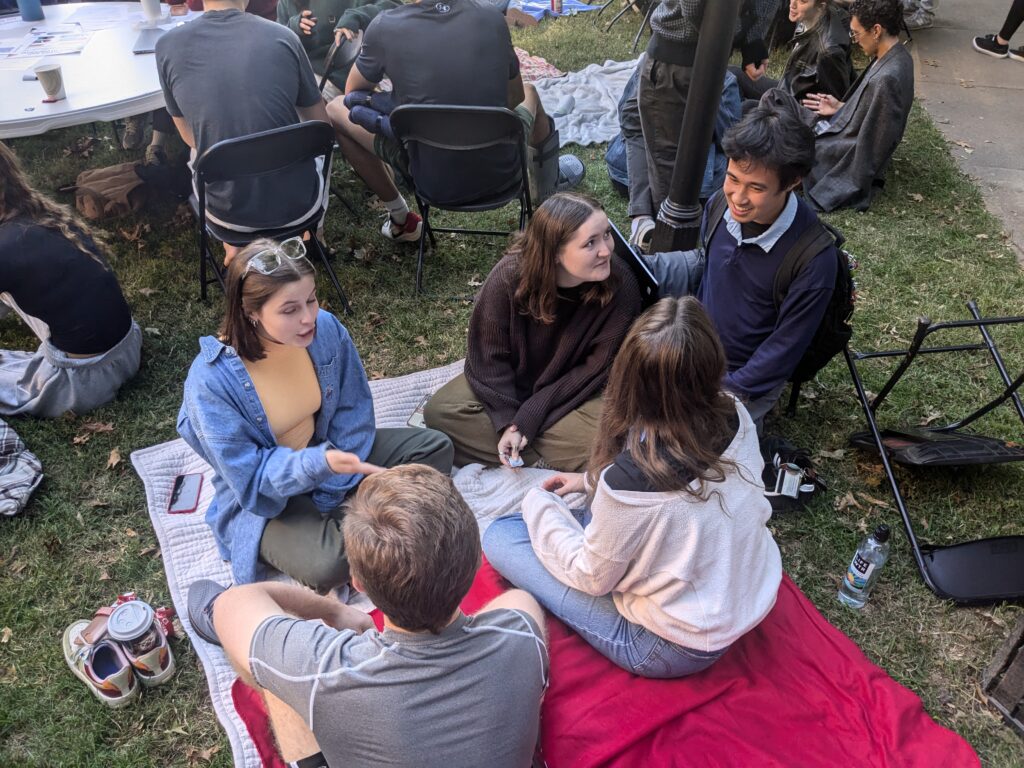
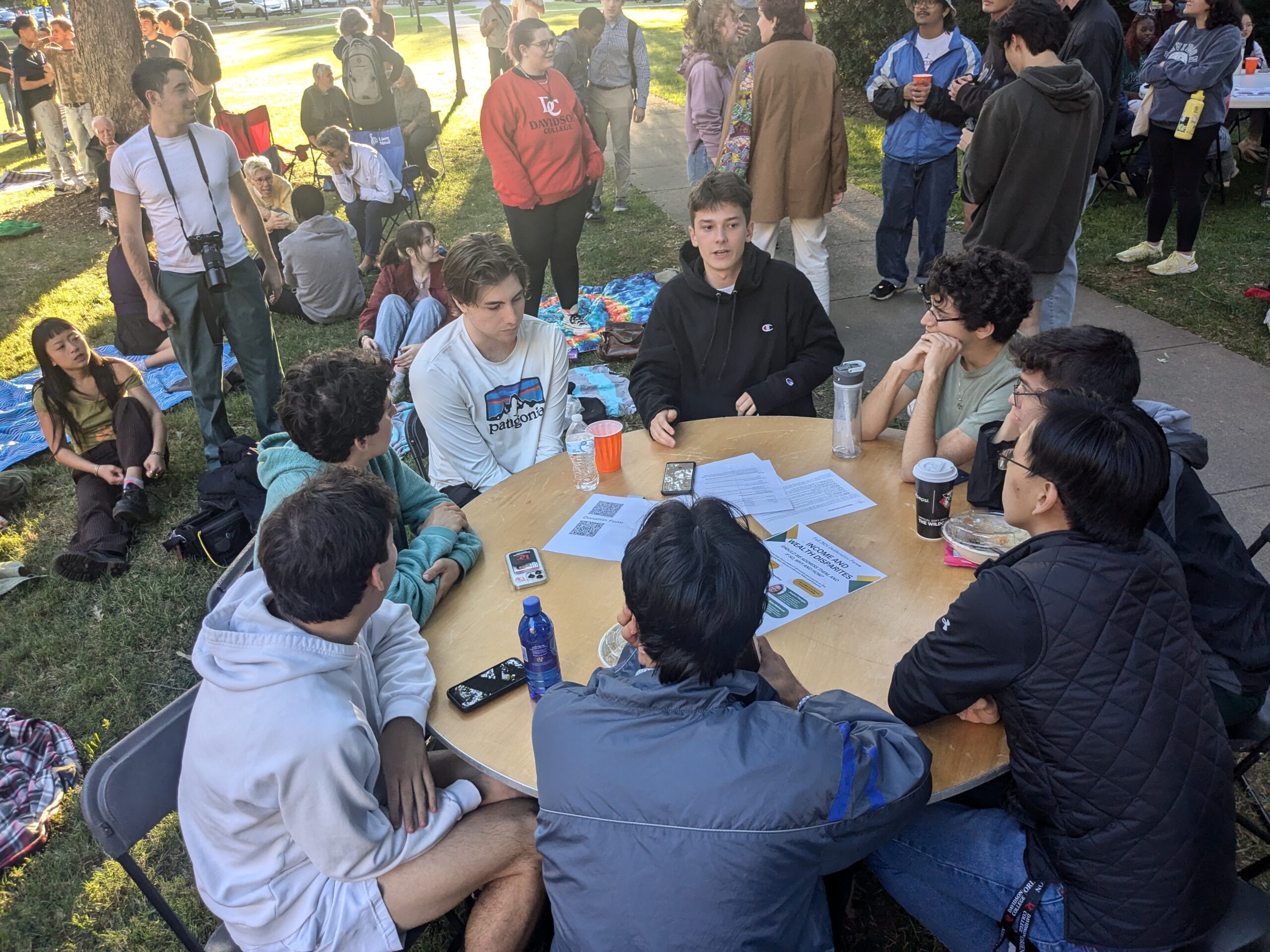
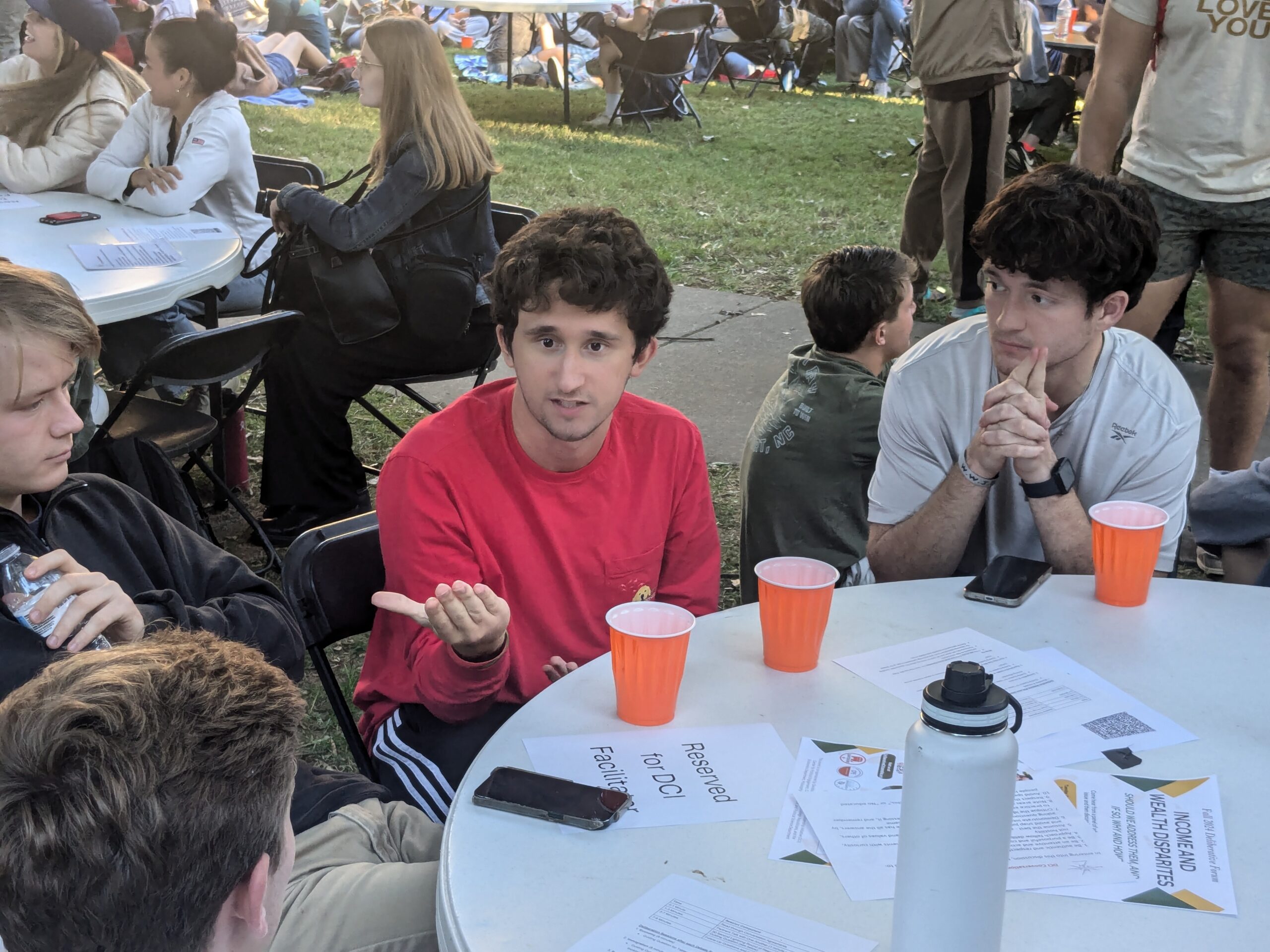
In 2024, however, audience members were given an opportunity to deliberate together about the topics that the debaters covered. In short “deliberative interludes” between each round of debate, DCI-trained facilitators guided conversations at round tables positioned between Eu and Phi Hall, introducing a set of conversation agreements, inviting participants to first share their thoughts with someone sitting next to them, and then to share with the larger group. 

They explored questions like, What insights did you gain from today’s discussion or debate? What arguments or experiences shared today have you thinking differently? What aspects of the conversation would you like to explore further? Which part of the discussion or debate surprised you the most? These lightly-structured conversations provided participants with entry points into the conversation that they could respond to, build on, and explore together. 

Given the hundreds of people who attended the debate (the turnout was incredible!), not everyone was able to join these conversations, and many just chatted informally with their friends during these breaks in the debate. But these interludes allowed everyone – whether they were at a table or not – to consider and discuss the arguments made by the debaters before moving onto the next topic. 

There are certainly tradeoffs associated with this innovation; for example, it took away time from the debaters and for other topics to be debated. But it also made the event more social and broke up the intensity and tension that inevitably comes from discussing challenging topics. Sitting for two hours listening to opposing viewpoints on some of society’s most contentious issues without an opportunity to constructively chime in can be challenging and draining, even for the most committed of us. 

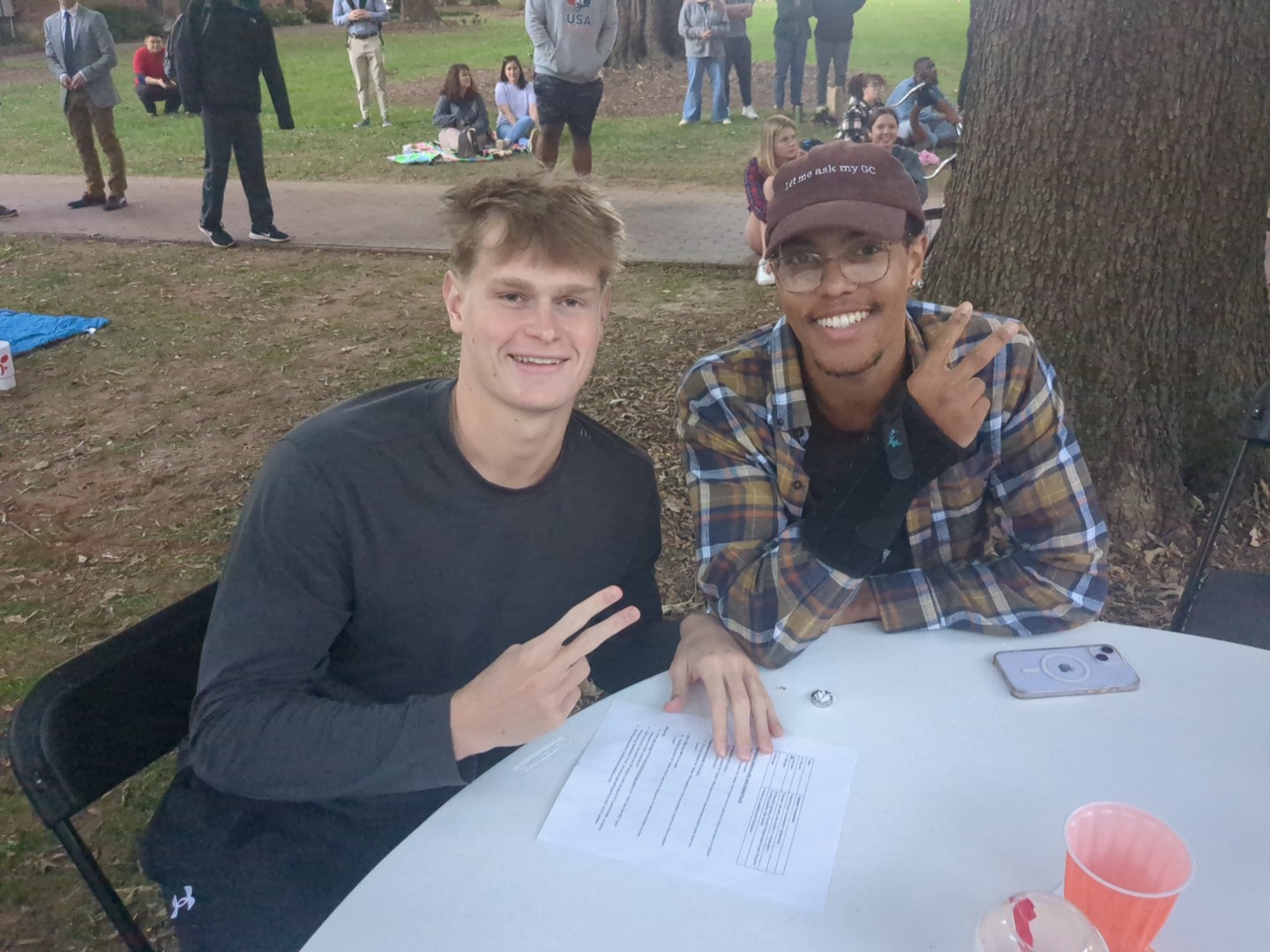
Group of students talking around a table.

The time allotted to the breaks was also limited – only about 10 minutes each – and did not allow for extensive and in-depth exploration of the issues at hand. But they did enable participants to share their initial reflections and connect with one another in ways that they might not do otherwise. As many student participants in the DCI’s programs have reported, they don’t often talk with their classmates about political issues given how sensitive and difficult they are. These breaks provided everyone in attendance a space to engage with one another on these issues, even if it was for a short time, and hopefully increased their interest, capacity, and confidence in diving into deeper conversations in the future, either through the DCI or in other contexts. 

There is still a lot of work to be done to create a more deliberative culture at Davidson and in our larger society, and no one event will accomplish this task. But this debate did advance us towards that goal. It enabled a substantive exchange of ideas through the debate itself and modeled a process by which ordinary people can engage with one another as well. Perhaps just as importantly, it brought together students from across the political spectrum to organize the event together. It was a truly collaborative project between students in the Center for Political Engagement, College Democrats, College Republicans, and the DCI that they all worked hard on to pull off and make successful. 

Students sitting around a  table talking.

It will take lots of these types of opportunities (“one conversation at a time”), but taken together, they can help us figure out how to engage with one another more humbly, more courageously, and more constructively. 

To learn more about the event, check out this article published on Davidson’s article. 

Filed Under: DCI Posts

DCI Publishes its Fourth Annual Report!

September 19, 2024 by Graham Bullock Leave a Comment

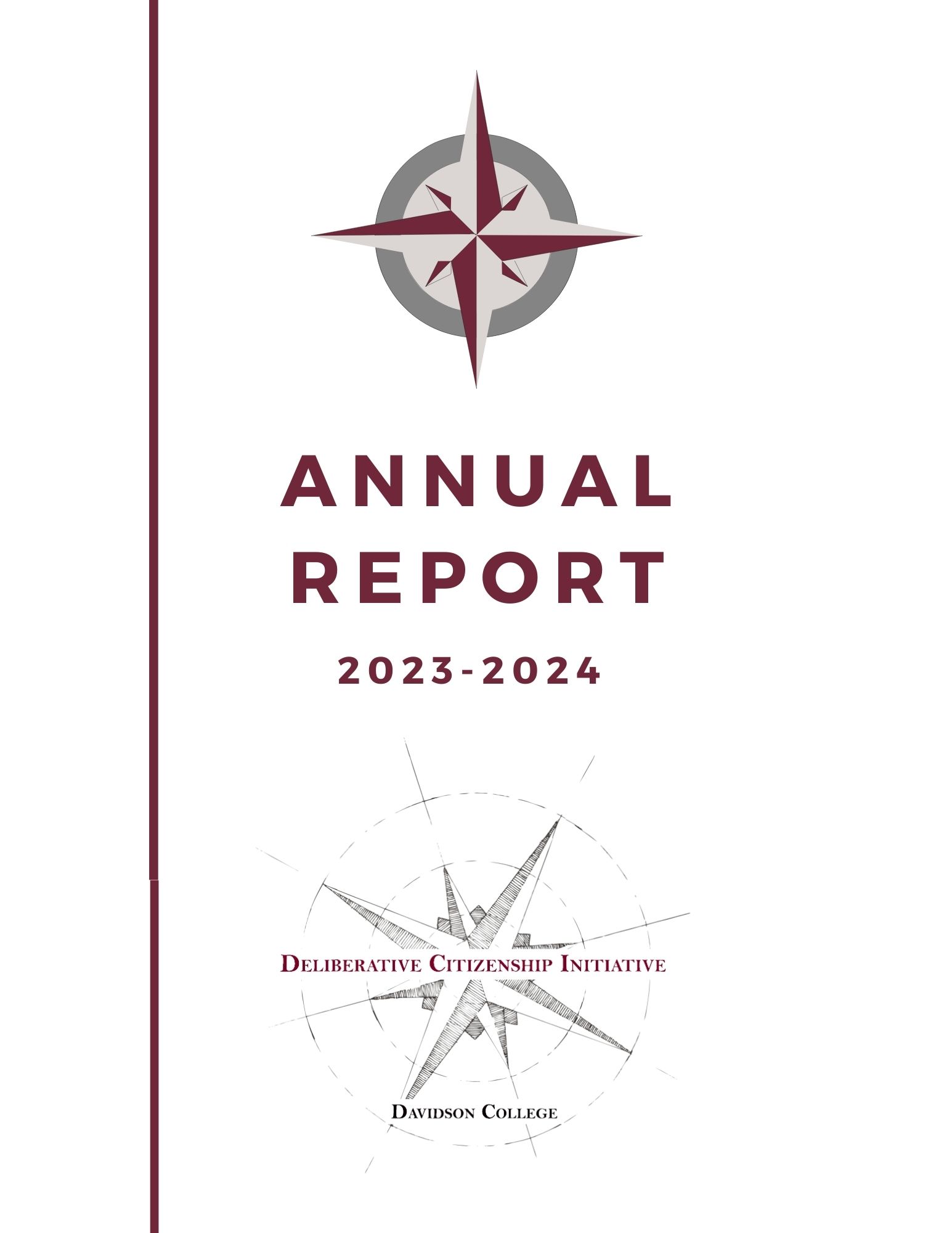
Cover page of DCI Annual Report.

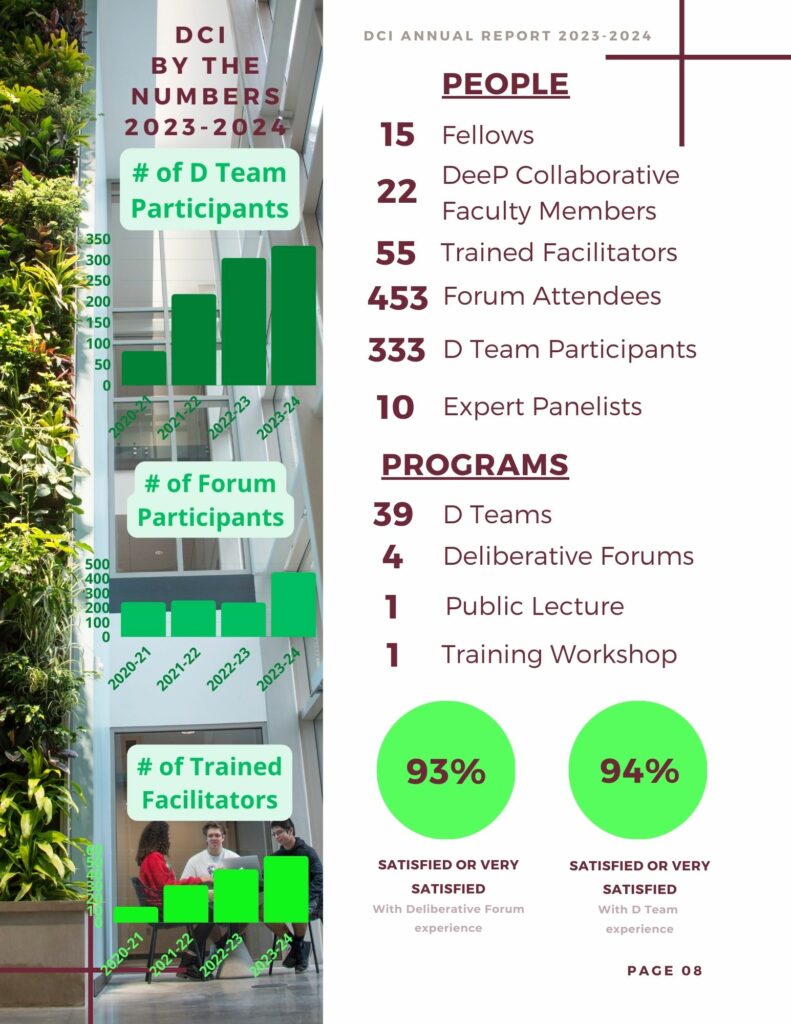
Four Deliberative Forums, 10 expert panelists, 15 Student Fellows, 22 Deliberative Pedagogy Collaborative Faculty Fellows, 39 D Teams, and over 1000 Davidson students, faculty, staff, alumni, and community members who participated in facilitated deliberations on challenging and contentious issues facing our society…2023-24 was a busy year for the DCI! The range and depth of this work is captured in the DCI’s fourth Annual Report that was just published on its website. We’d like to share a few highlights from the report and encourage you to check it out yourself as well. We hope that it will inspire you to join the new and continuing programs that the DCI is planning for the coming year.

Page of data from Annual Report.

The year began with our second annual Fall Semester Kickoff Party and our fifth Deliberation Facilitator Training Program, which trained over 50 people in how to moderate challenging conversations on difficult topics. They included our fourth cohort of DCI Student Fellows and our third cohort of DeeP Faculty Fellows, who came from 13 different colleges and universities from across the country. The student fellows went on to host our Deliberative Forums, D Teams, Commons Conversations, Deliberating GOATs event, and their own personal deliberation projects, while the Faculty Fellows developed and taught courses that systematically incorporated more deliberation about contentious topics into them.

The DCI hosted Christy Vines, CEO and President of the Ideos Institute, for a series of public lectures, workshops, class visits, and small group discussions with students. Vines focuses on empathic intelligence in her work, and her public lecture was titled, Faith, Race, and Politics: Can empathy help bridge our divides in a polarized world? Her visit helped the DCI and the Davidson community grapple with challenging questions related to identity, public discourse, and the pursuit of justice in a pluralistic society.

The DCI’s newly re-imagined Commons Conversations series featured Davidson faculty and staff who hosted discussions on topics related to their expertise. One of the DCI’s forums also highlighted the expertise of Davidson faculty on challenges facing democracy around the world, from Europe to Asia to Africa. The DCI continued to collaborate with academic departments, co-curricular programs, and community partners throughout the year. For example, its final forum of the year on Guns in America was co-sponsored with the Davidson College Democrats, Davidson College Republicans, Davidson College Libertarians, Center for Political Engagement, and the Political Science Department.

The work of the DCI also extended last year beyond Davidson, as it co-organized the first North Carolina Campus Discourse Leaders Conference with colleagues from UNC Chapel Hill, UNC Charlotte, Elon University, and North Carolina Campus Engagement. Hosted on the Chapel Hill campus, the conference brought together over 40 faculty and staff from public and private institutions of higher education from across the state of North Carolina to connect, share, and learn about how to best foster more productive discourse about difficult political and social issues in the classroom, on campus, and with the community.

Suffice to say, it was a rich and rewarding year, and provides a solid foundation for the exciting opportunities that the DCI will be pursuing in the year ahead. Check out the annual report at the link below, stay tuned for more info about our upcoming programs that are coming soon!

Filed Under: Announcements, Blog Posts, DCI Posts

Freshman Deliberation Challenge – Build the Best Democracy!

August 26, 2024 by Graham Bullock Leave a Comment

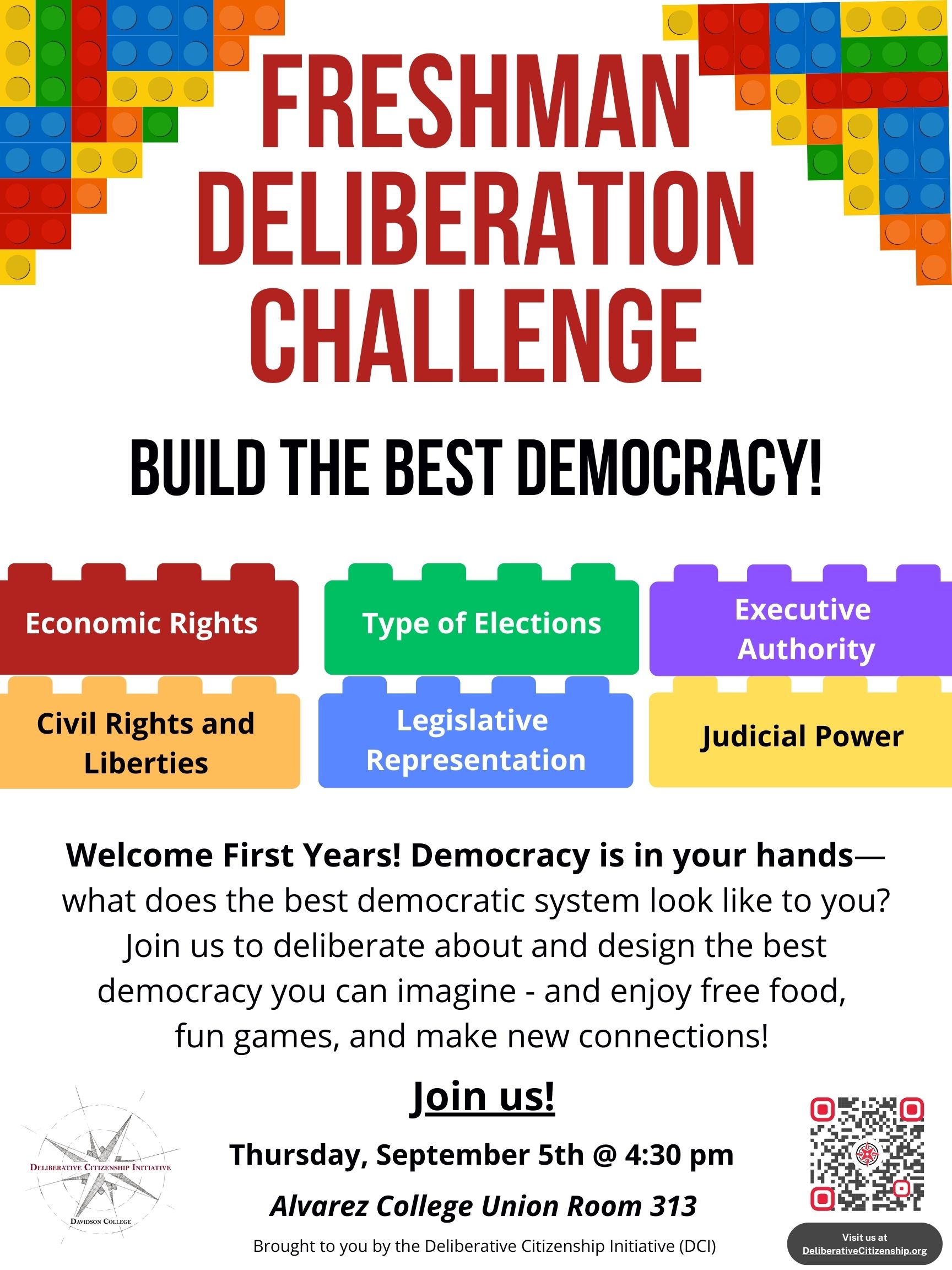
This innovative Open House is designed for all first-year students learn about the DCI and deliberate about the key features of a democracy in an engaging series of deliberative conversations with one another. We’ll be in the Arthur Vining Davis Room (Alvarez College Union Room 313) on Sept. 5 @ 4:30 pm: Come enjoy free food, fun games, and new connections!

Filed Under: Announcements

Come Join our DCI Fall Semester Kickoff Party!

August 19, 2024 by Graham Bullock 3 Comments

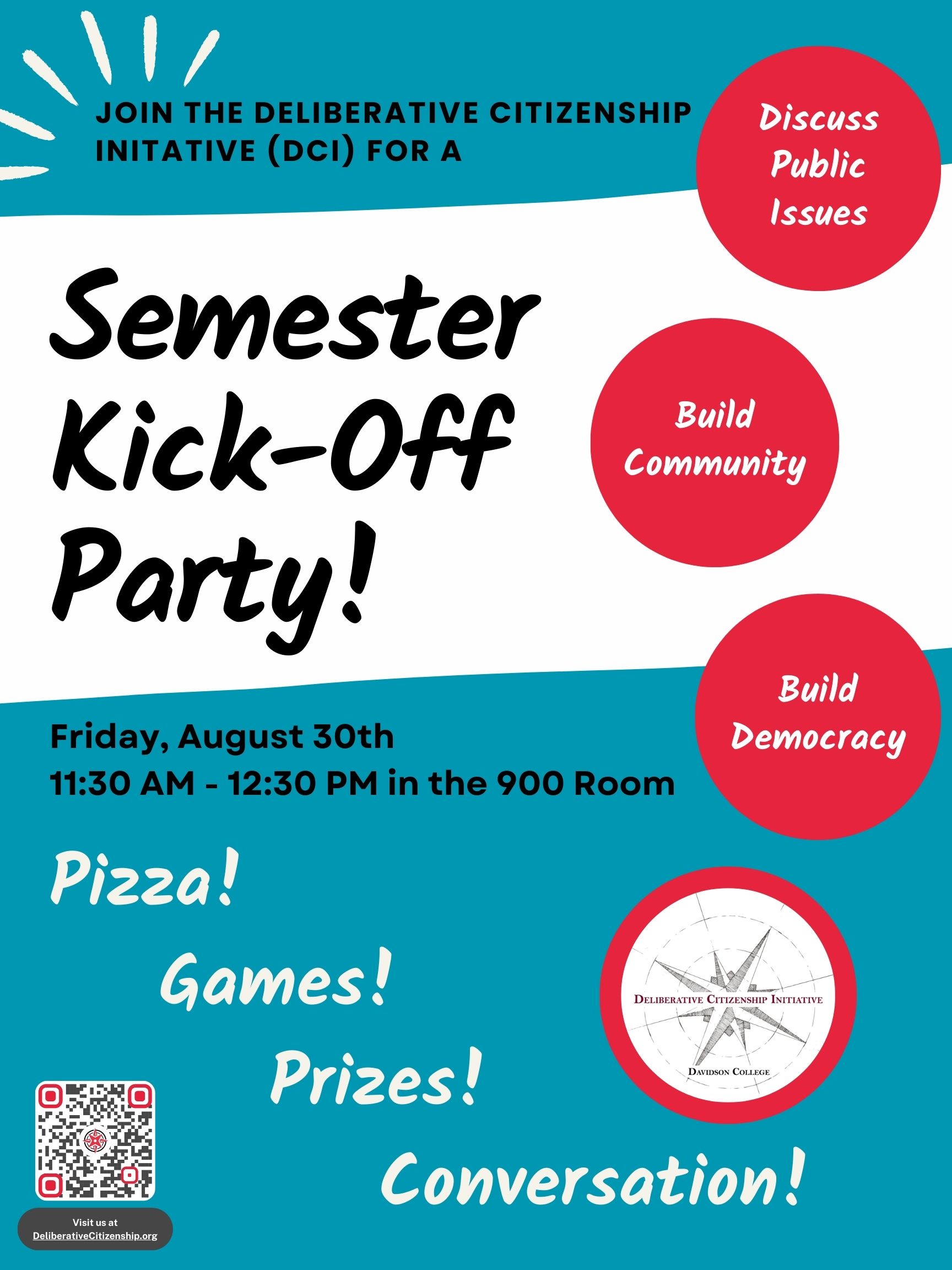
Flyer for Fall Kickoff Party

On Friday, August 30, as part of Davidson’s back-to-school Welcome Week, the DCI is hosting a Semester Kickoff Party in the 900 Room at the Alvarez Student Union from 11:30 AM to 12:30 PM. We welcome all Davidson students, faculty and staff to join us for pizza, deliberation about some hot topics, and even a few prizes…No need to RSVP—bring your friends and drop in any time!

Our Kickoff Party is a place to learn how you can get involved in deliberation about contentious topics of public interest on campus and beyond, and to meet others interested in deliberation on campus. You will also get a chance to meet current DCI Fellows, Senior Fellows, and some members of the DCI leadership team along the way. You’ll also be able to talk with us about our upcoming programs and to find your own way to get involved—whether that means joining a D Team, becoming a Fellow, attending a Deliberative Forum, and/or attending our Deliberative Citizenship Speaker Series.

You will also have a chance to practice your deliberative skills as we talk about some engaging topics and play some deliberative games over free pizza courtesy of the DCI. We hope you’ll join us for a fun event that will help us get energized for the coming year.

Filed Under: Announcements

  • « Go to Previous Page
  • Page 1
  • Interim pages omitted …
  • Page 11
  • Page 12
  • Page 13
  • Page 14
  • Page 15
  • Interim pages omitted …
  • Page 22
  • Go to Next Page »

Footer

Blog Post Categories

  • Announcements
  • Blog Posts
  • DCI Posts
  • Events
  • Faculty Posts
  • Fellow Posts
Image of a compass superimposed by the text "Deliberative Citizenship Initiative" and "Davidson College." Clicking on this image leads to the Initiative page.

Recent DCI Blog Posts

  • We Tried to Fix Jubilee’s “Middle Ground” – Here’s How It Went
  • A Case for Deliberation in the Natural Sciences
  • Welcoming New Staff to the DCI and DCN
  • Facebook
  • Twitter
  • Instagram
  • LinkedIn


Copyright © 2026 · Infinity Pro on Genesis Framework · WordPress · Log in