• Skip to main content
  • Skip to footer

Deliberative Citizenship Initiative

Building Democracy One Conversation at a Time

  • The Initiative
    • Programs
      • Deliberation Across the Curriculum
      • Deliberation on Campus
      • Deliberation in the Community
      • Research on Deliberation
    • Motivations
      • Why Deliberative Citizenship?
      • Why Davidson? Why Now?
    • Who’s Involved?
      • DCI Fellows Cohorts
        • 2025-2026 Fellows
        • 2024-2025 Fellows
        • 2023-2024 Fellows
        • 2022-2023 Fellows
        • 2021-2022 Fellows
        • 2020-2021 Fellows
      • DeeP Collaborative Cohorts
        • 2024-2025 DeeP Collaborative Faculty
        • 2023-2024 DeeP Collaborative Faculty
      • Advisory Council
    • History
      • What Sparked the Initiative?
    • Key Deliberative Dispositions
    • Frequently Asked Questions (FAQ)
    • Annual Report
  • Get Involved!
    • Participate in a Forum
    • Join a D Team
    • Become a Fellow
    • Take Courses
    • Get Training
    • Come to Guest Lectures
  • Events
    • Upcoming Events
      • 250th Anniversary Deliberative Forum Series on American Values
    • Past Events
  • Connections
    • The Deliberative Citizen: The DCI’s Monthly Newsletter
    • Efforts on Campus
    • Efforts in the Community
    • Efforts Elsewhere
    • Readings and Resources
      • DCI-Published Guides
      • DCI Guide to One-on-One Conversations
      • How to Disagree
      • Demonstration of Facilitation Styles
      • Deliberative Pedagogy Mini-Course
    • How We Can Help: DCI’s LET’S DELIBERATE! Partnership Opportunities
    • DCI in the News
  • DCI Blog Posts
    • Recent Blog Posts
    • All Blog Posts

Deliberative Forums

Our Housing Future: Needs, Goals, and Solutions

Forum Slide for Our Housing Future.

On Tuesday, March 30, 2021, the Davidson College Deliberative Citizenship Initiative and Center for Civic Engagement, in partnership with the North Mecklenburg Economic Mobility Collaborative, hosted a deliberative forum and expert panel on pressing issues in housing.

Communities across the United States and in Charlotte and the Mecklenburg County region face significant challenges related to issues in housing and affordable housing. The changing housing landscape and needs of different stakeholders are driving increased attention to pressing problems such as cost and availability of housing, housing education and literacy, development and gentrification, evictions, segregation, and more. Many of these problems intersect with one another and other challenges related to education, economic mobility, and community development, and there are a multitude of perspectives and ideas about how to address these problems to create a brighter housing future for all.

Members of the Davidson College campus and the wider public were invited to engage with these ideas by hearing from a panel of local stakeholders and experts and joining facilitated small groups in breakout rooms to deliberate on which goals and solutions were most important.

Our Housing Future: Deliberating with Realism and Idealism

By Kyle Broxton, DCI Fellow

On Tuesday, March 30, the Davidson College Deliberative Citizenship Initiative, in partnership with the Center for Civic Engagement and North Mecklenburg Economic Mobility Collaborative, hosted an expert panel and deliberative forum on pressing issues related to housing in the Charlotte-Mecklenburg region. Members from Davidson College and the broader community were invited to first hear from a panel of five stakeholders and experts on a variety of challenges to housing, including affordability, gentrification, and segregation. Following the panel, participants engaged in small-group deliberations during which they shared their own ideas about addressing the housing challenges facing the community.

The panelists included the Town of Davidson’s Housing and Equity Director, Eugene Bradley, CEO of A Roof Above, Liz Clasen-Kelly, Associate Professor of Geography at UNC Charlotte, Elizabeth Delmelle, Affordable Housing and Community Development Professional, Willie Jones, and Senior Analyst in Regulatory Studies and Research Editor at John Lock Foundation, Jon Sanders. Each of these panelists brought a unique perspective to best contextualize the issues related to housing throughout the first hour of the event.

The expert panel was immediately followed by a deliberative forum in which participants were divided up into small groups and tasked to deliberate on the issue themselves. Having been given some background by the expert panel on a wide array of issues that relate to housing, the groups were prepared to engage in deliberations of their own. Similar to the panel of stakeholders and experts from the first hour, my group was composed of participants with a diverse range of perspectives on the issue. They each brought meaningful insights to the conversation.

My group adopted an open-minded approach in identifying the needs and goals of housing. While favorable to the idea of increasing the supply of housing, we all remained aware of the costs that result from achieving this supply. Furthermore, we acknowledged the drawbacks that would ultimately manifest with each goal that was posited. By the time we were considering solutions to accomplish the goals of housing we had discussed, my sense was that a negative and pessimistic view of the topic had been adopted by most of the participants of my group.

At that point, one of the participants asked a question that I believe made for an excellent way to close out the latter half of the event. Instead of suggesting a solution to address the housing challenges, the participant simply asked if there were any housing victories the group had seen in the Charlotte-Mecklenburg region in recent years. Initially, the other participants denied any victories existed. However, after a brief pause, one participant corrected herself, recalling an instance when her community convinced a developer to construct affordable living spaces where more luxurious housing was originally planned. Following her, another participant expressed her appreciation for the recent work of one of the panelists, Willie Jones. Another noted the benefits that would result from bringing more voices to the development phase of housing through development dividends. In that moment, I recognized the significant effect that the question had on our small group.

Simply asking the group what housing victories they had seen in recent years seemed to motivate the participants to adopt a slightly more positive and optimistic view of the topic. By noting what has worked in the past, the participants were far more motivated to suggest what we should do for the future. While the drawbacks and challenges related to housing were still acknowledged by the group, we closed out feeling more motivated than we were before the forum.

This experience revealed to me the value of striking a balance between realism and idealism in deliberative contexts. Too much of the former can be discouraging and depressing, while too much of the latter can be ungrounded and misleading. In my group’s context, having looked at what has succeeded to better gauge what can succeed (considering the many challenges we had already identified), I believe we struck a healthy balance between realism and idealism by the end of our deliberation. Ultimately, not only did our group take on a more hopeful view of that evening’s topic, but of deliberative democracy itself.

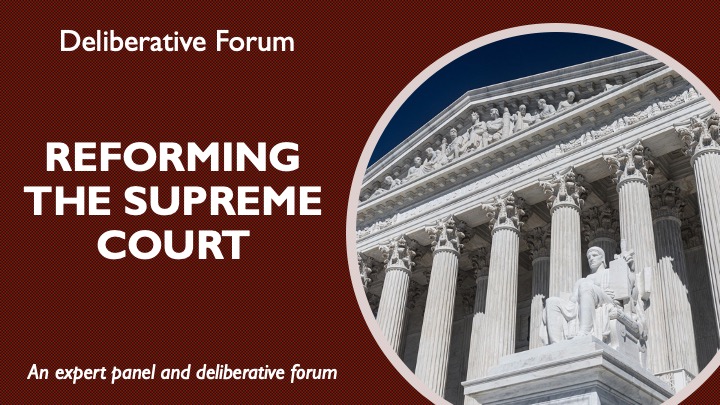
Reforming the Supreme Court

Forum Slide for SCOTUS

On Thursday, February 12, 2021, the Deliberative Citizenship Initiative and Department of Political Science at Davidson College hosted an online expert panel and deliberative forum on reforming the Supreme Court. Four Supreme Court experts weighed in on reform ideas ranging from expanding the number of justices to instituting term limits on their time in office to reducing the court’s power as an institution. Then, attendees listened to the perspectives of others and shared their own ideas about reforming the Supreme Court in breakout rooms facilitated by trained DCI Fellows.

Reforming-the-Supreme-Court_Poster

Judith Resnik, the Arthur Liman Professor of Law at Yale Law School, introduced the broader context and dynamics of judicial reform by exploring the historical development of our modern day Supreme Court. Professor Resnik then moderated her fellow panelists’ comments about different reform ideas.

Ryan Doerfler, Professor of Law at the University of Chicago Law School, suggested that strategies to “disempower” the court, such as jurisdiction stripping and supermajority requirements, would not only be feasible but would also increase the perceived legitimacy of the court. Kent Greenfield, Professor of Law and Dean’s Distinguished Scholar at Boston College Law School, responded with his proposal for a new Constitutional Court which would shift the most contentious constitutional legal questions, including such topics as abortion, travel bans, and immigration policies, away from the Supreme Court to a new court made up of judges from other federal courts. Finally, James Lindgren, Professor of Law at Northwestern School of Law, explored the parameters and benefits of his proposal to institute 18-year or 24-year terms limits for Supreme Court justices.

The event was moderated by the DCI’s Faculty Director, Professor Graham Bullock, and Professor Andrew O’Geen, Chair of Political Science at Davidson College. You can watch the panelists’ full remarks in the video below.

  • « Go to Previous Page
  • Page 1
  • Page 2
  • Page 3
  • Page 4

Footer

Blog Post Categories

  • Announcements
  • Blog Posts
  • DCI Posts
  • Events
  • Faculty Posts
  • Fellow Posts
Image of a compass superimposed by the text "Deliberative Citizenship Initiative" and "Davidson College." Clicking on this image leads to the Initiative page.

Recent DCI Blog Posts

  • We Tried to Fix Jubilee’s “Middle Ground” – Here’s How It Went
  • A Case for Deliberation in the Natural Sciences
  • Welcoming New Staff to the DCI and DCN
  • Facebook
  • Twitter
  • Instagram
  • LinkedIn


Copyright © 2026 · Infinity Pro on Genesis Framework · WordPress · Log in