• Skip to main content
  • Skip to footer

Deliberative Citizenship Initiative

Building Democracy One Conversation at a Time

  • The Initiative
    • Programs
      • Deliberation Across the Curriculum
      • Deliberation on Campus
      • Deliberation in the Community
      • Research on Deliberation
    • Motivations
      • Why Deliberative Citizenship?
      • Why Davidson? Why Now?
    • Who’s Involved?
      • DCI Fellows Cohorts
        • 2025-2026 Fellows
        • 2024-2025 Fellows
        • 2023-2024 Fellows
        • 2022-2023 Fellows
        • 2021-2022 Fellows
        • 2020-2021 Fellows
      • DeeP Collaborative Cohorts
        • 2024-2025 DeeP Collaborative Faculty
        • 2023-2024 DeeP Collaborative Faculty
      • Advisory Council
    • History
      • What Sparked the Initiative?
    • Key Deliberative Dispositions
    • Frequently Asked Questions (FAQ)
    • Annual Report
  • Get Involved!
    • Participate in a Forum
    • Join a D Team
    • Become a Fellow
    • Take Courses
    • Get Training
    • Come to Guest Lectures
  • Events
    • Upcoming Events
      • 250th Anniversary Deliberative Forum Series on American Values
    • Past Events
  • Connections
    • The Deliberative Citizen: The DCI’s Monthly Newsletter
    • Efforts on Campus
    • Efforts in the Community
    • Efforts Elsewhere
    • Readings and Resources
      • DCI-Published Guides
      • DCI Guide to One-on-One Conversations
      • How to Disagree
      • Demonstration of Facilitation Styles
      • Deliberative Pedagogy Mini-Course
    • How We Can Help: DCI’s LET’S DELIBERATE! Partnership Opportunities
    • DCI in the News
  • DCI Blog Posts
    • Recent Blog Posts
    • All Blog Posts

deliberation

The Power of Deliberation: Embracing New Ideas

November 2, 2023 by Florian Moser

DCI Fellow Florian Moser facilitating a deliberation

Florian Moser ’26 (DCI Fellow)

My initial interest in the Deliberative Citizenship Initiative was sparked last year in a conversation at the DCI kickoff party in the College Union. My group and our facilitator argued about a geopolitical topic on which I held a strong opinion. Therefore, I was trying to defend my point of view and counterargue opposing opinions. At that point, our facilitator interrupted me to ensure everybody could speak, forcing me to listen to other ideas. At that moment, I started to understand the difference between deliberation and debate. I want to compare these two approaches since, in today’s society, debate is the more prominent approach to conversation.

Confrontational vs. Collaborative: Debates and Deliberation

Debates are typically confrontational, with participants firmly entrenched in their positions, aiming to prove their viewpoint’s superiority. In contrast, deliberation is a more open and cooperative process focused on understanding different perspectives, reaching common ground, and appreciating diverse ideas. The key distinction lies in how people react to opposing views. In debates, individuals often defensively cling to their positions, sometimes at the expense of genuinely listening to others. Deliberation, however, encourages active listening and open-mindedness, fostering a collaborative environment that values constructive dialogue and the exploration of different viewpoints.

Since we are so used to debating, it is common for participants of DCI events to recognize the significant difference between deliberation and debate for the first time. In my first mock deliberation, during a DCI facilitator training, my facilitator ensured that every participant expressed their ideas in every round of the deliberation. This strong emphasis on equal-length speech contributions from all deliberations lets people formulate their ideas who might not be used to getting the chance to speak up. 

Instead of getting stuck in a debate about two specific viewpoints, participants gain many ideas they might not have considered before. The exchange of ideas and the practice of leaning into a different perspective holds two advantages. First, it is more valuable for the deliberators to gain new ideas, improving their worldview in the long run, than just winning an argument. Second, deliberations help to foster soft skills, strongly contributing to respectful and productive conversations. These soft skills help create a respectful and constructive environment in the long run, whether in debates or deliberations.

Here, I want to list some critical soft skills:

  1. Active Listening: In deliberation, listening isn’t passive; it’s an active effort to understand and appreciate the viewpoints of others.
  2. Open-Mindedness: Participants should be open to changing their views based on new information or insights.
  3. Respectful Communication: Encourage respectful and civil discourse, where participants can express themselves without fear of personal attacks.
  4. Seek Common Ground: Look for shared values and common objectives as a starting point for finding solutions.
  5. Value Diverse Perspectives: Recognize that diversity of thought leads to more creative and effective solutions.

The Benefits of Deliberation

Deliberation offers several advantages over debate. It promotes collaboration, reduces polarization, and fosters a sense of unity among participants. Moreover, drawing on broader ideas and perspectives can lead to better decision-making. In today’s complex and interconnected world, where many of the challenges we face require innovative solutions, deliberation is a practice that should be embraced and celebrated. It allows us to move beyond the limitations of our own perspectives and tap into the collective intelligence of diverse groups.

Conclusion

While debate has its place and can be a valuable tool for exploring differences, deliberation shines as a means to appreciate and harness new ideas. In deliberation, we see the true power of open-mindedness, empathy, and collaboration, and these qualities can help us navigate the complexities of our rapidly changing world. So, let us strive to embrace deliberation, for in doing so, we unlock the potential for collective growth, understanding, and progress.


Filed Under: Blog Posts, Events, Fellow Posts Tagged With: DCI, debate, deliberation, facilitation

Why Argue?

November 1, 2023 by Monty Krakovitz

DCI Fellow Monty Krakovitz facilitating a deliberation

Monty Krakovitz ’25 (DCI Fellow)

As part of the deliberative training for the DCI Fellows, we were asked to read a section from the book written by Scott Akin and Robert Talisse titled “Why We Argue (And How We Should).” The book shows the importance of political deliberation from the perspective of Aristotle . The authors present the view of Aristotle that “man is a political animal” and that what we believe or do in the privacy of our own home affects society at large.

When Aristotle makes this claim, he doesn’t necessarily mean politics in terms of voting. He conceives of politics as how individuals relate to one another to form communities. From the moment that each of us are brought into this world, we are defined by our relationships to others. The newborn is not an isolated individual, but is someone’s son or daughter who relies on his or her mother and father for support. Likewise, the new mother is also not an isolated individual, but has obligations to her child. The term “political animal” means nearly everyone has duties and relationships with others, who also have relationships with others, connecting everyone together to form the society at large.

The authors also give an example of private beliefs affecting others as well. For example, a person, let’s call her Nancy, schedules a picnic at the park with the false view that the weather is sunny when it is clearly raining, and proceeds to invite her family from out of town to the picnic. The family does not know that it is raining at the park because they are coming from a distance. After being falsely told that the weather is perfect, they all drive in to find out that the weather is not, in fact, perfect but is pouring rain. The family has now wasted their day because the person who scheduled the picnic held the false belief that the weather is nice. Nancy’s false belief about the weather led her to act on that belief, which in turn inconvenienced her family in a large way.

This example displays a relatively low-cost error considering that no one was harmed, but the same principle can be applied to  other circumstances where the consequence of holding false beliefs is much higher. The truth is that ideas have consequences. When a man holds a false belief, he is likely to act in accordance with that false belief, leading to bad behavior that affects others in his community.

This semester, one of the D Team deliberations will be on abortion which is a topic ripe for discussion. The D Team will get down to the root of people’s beliefs in order to discover why citizens hold the views that they do. It is clear that a person’s views on this moral, political, and ultimately religious issue affects their actions. From the Pro-Life perspective, holding a false moral view on abortion directly affects the unborn child whose life is now endangered by the mother’s false view on the sanctity of life. From the Pro-Choice perspective, the false view that abortion is a moral evil leads citizen to vote in a way that infringes on the mother’s bodily autonomy.

This is why deliberation is vital: our private views do matter, and they matter deeply. In some cases, a false opinion can lead to minor inconveniences. In others, a false opinion can lead to the death of an unborn child or the loss of a women’s bodily autonomy. That is why it is important to argue: it helps avoid the high cost of error and aids in answering the big questions facing our society today.

Filed Under: Blog Posts, Events, Fellow Posts Tagged With: D Teams, deliberation, discourse, facilitation

DCI’s Fall 2023 Deliberative Forum Recap & Recording: The Challenge for Democracy

October 26, 2023 by Sara Copic

On Thursday, October 19, the DCI hosted its 9th public Deliberative Forum, The Challenge for Democracy: To What Extent Should the U.S. and Other Democratic Nations Defend and Promote Democracy Around the World?  For this event, we partnered with Davidson’s own Political Science Department and featured speakers with different global areas of specialization. Professors Bes Ceka, Shelley Rigger, and Ken Menkhaus presented their own views about democracy promotion and defense and focused on Europe, Asia, and Africa (respectively). We invite you to watch the recording of our panel below!

The Challenge for Democracy: To What Extent Should the U.S. and Other Democratic Nations Defend and Promote Democracy

panel

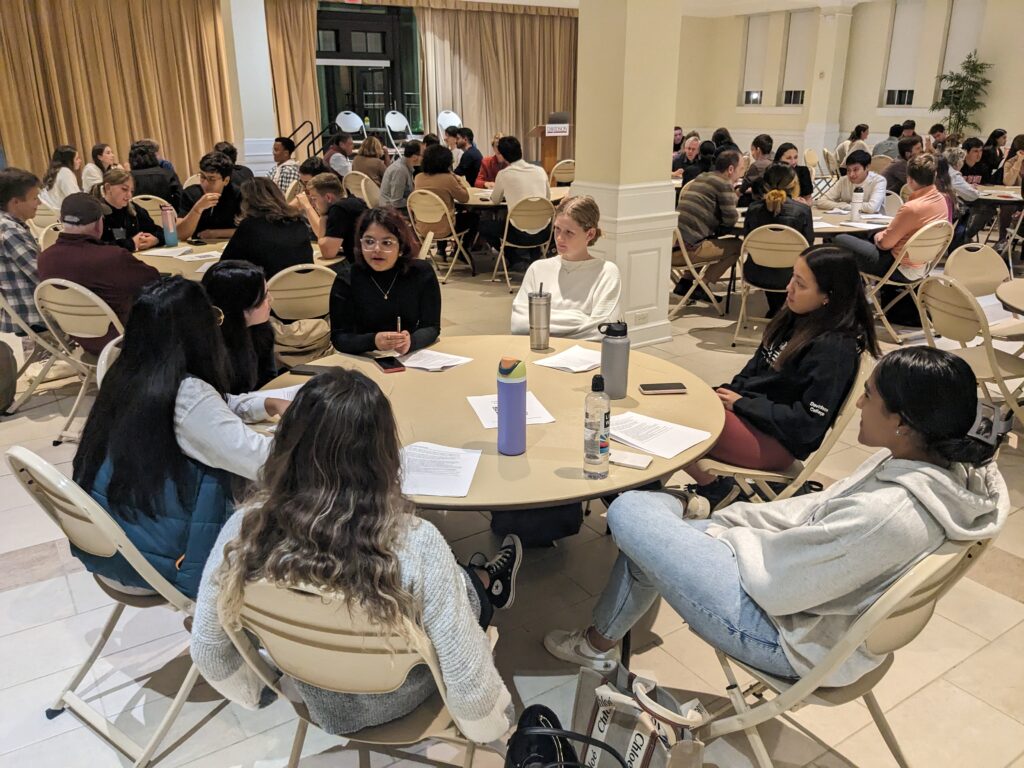
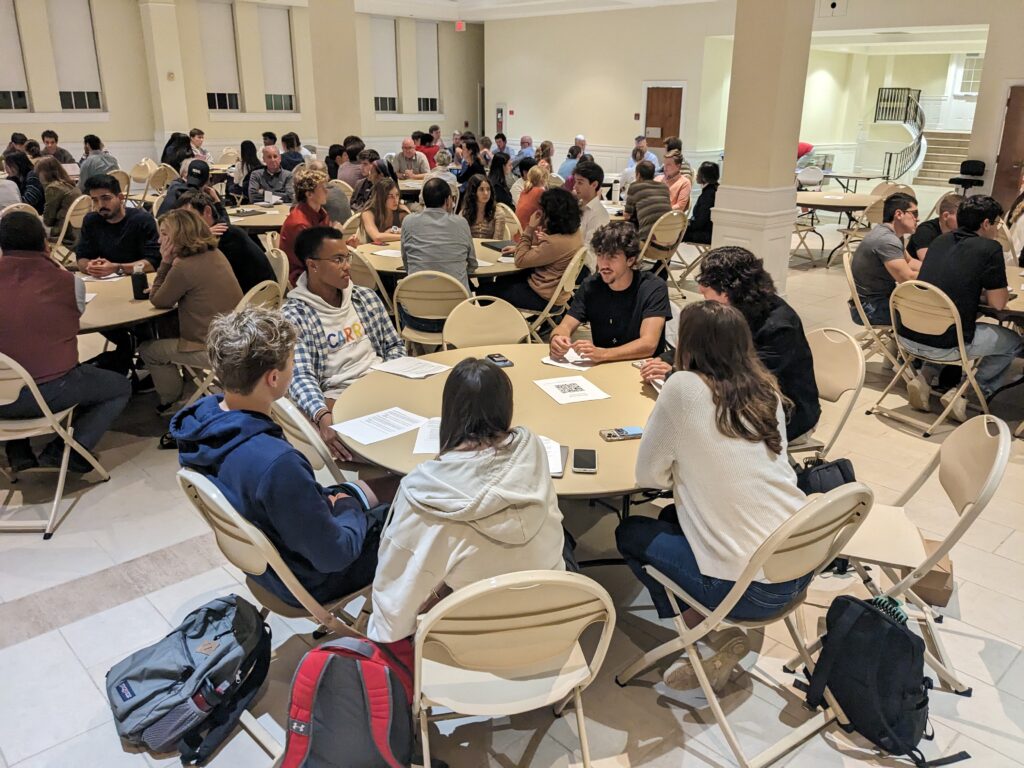
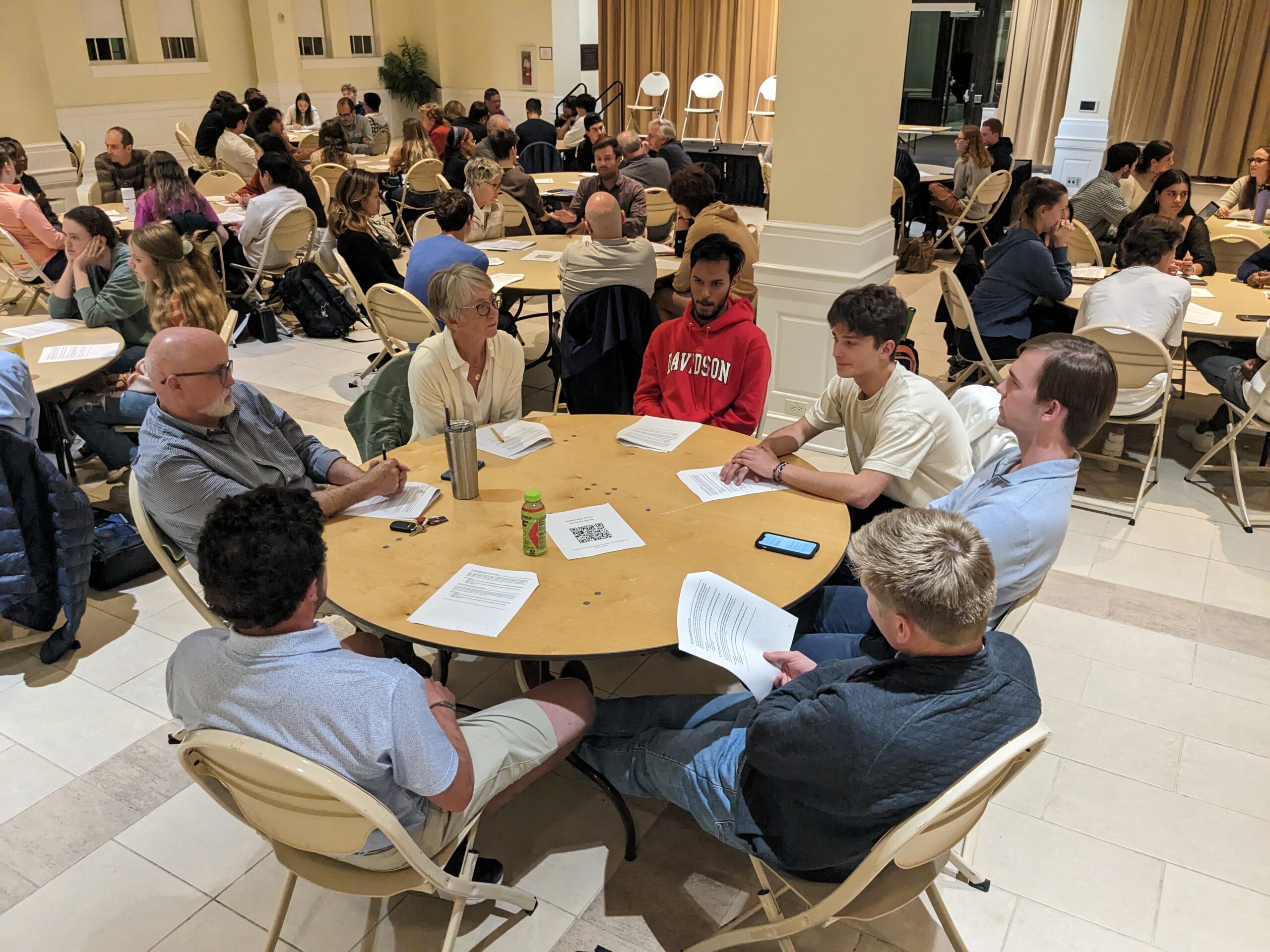
Our Deliberative Forum didn’t end with the panel. After the panel discussion, 96 participants engaged with one another in small-group deliberations facilitated by the DCI’s Fellows, Senior Fellows, and others who have gone through our Deliberation Facilitator Training Program, including a few Davidson faculty members. We had a total of 18 small groups deliberating about the topic both online and in-person, drawing on our Deliberation Guide written for the event and engaging with one another on the forum’s central question.

Check out some photos and the short video of these discussions below.

Want to make sure you don’t miss our next forum? Follow us on your favorite social media site and subscribe below for DCI updates!

Panel at DCI Forum
The Deliberative Citizenship Initiative (DCI) and Political Science Department Event – The Challenge for Democracy

Filed Under: Announcements, Events, Fellow Posts Tagged With: deliberation, democracy, facilitation

Deliberation and the Holidays: Deck the Halls Not Your Uncle

December 3, 2020 by Dalton Langdon Leave a Comment

Holiday wreath on door

By Dalton Langdon, DCI Fellow

The holidays are a time for gathering and spending time with loved ones. For many, the process of going home around the holidays is not always seen as a joyous occasion, but one of contention and argument – especially during an election year. If you are anything like me, you’ve probably thought long and hard about what you might say to your family this year about the current political atmosphere. You may have even practiced what you are going to say, fact checked yourself, or geared yourself up like you’re going to take the stage for debate. I am here to say there is an alternative approach to discussing politics with family…the path of deliberative conversation.

Through the Deliberative Citizenship Initiative, I have learned a few different skills I would like to share with you now to help ease you through the holiday season. However, before we lean into these skills, I want to first dissuade you of the notion that swearing off politics altogether is the key to a quiet, stress-free holiday break. While many think avoiding the topic of politics is the smartest move to avoid conflict, I respectfully disagree. By avoiding these difficult conversations, we allow feelings of resentment to fester and grow, until finally they are unleashed in a whirlwind of barbarous insults. Instead of playing the proverbial ostrich with our heads in the sand, I instead suggest we all consider using the following framework when having our next contentious political conversation: 1) set the stage and expectations, 2) listen with strength, 3) ask probing questions, 4) find common ground, and 5) show grace.

Set the Stage and Expectations

Before engaging with a relative this holiday season on a controversial topic, first ask yourself “what do I hope to gain from this conversation and what is my intent?” The objective of having an informal and unstructured conversation should not be to change the other person’s mind or win the conversation, but to gain perspective. Set this expectation early and make your intention well known. Disagreement will happen, that is natural; productive deliberations depend on how you react and your willingness to understand the other person’s point of view.

Listen with Strength

Listening with strength is all about active listening without judgement. While this sounds like an easy process – it does not come as intuitively as one may think. Typically speaking, we give a person about a quarter of our attention while devoting the rest of our attention to formulating a response. Active listening means giving the person your undivided attention and listening to understand them. This takes practice and can be accomplished by rephrasing what your conversation partner said previously – this way they know you are in fact hearing them.

Ask Probing Questions

Asking probing questions is just as important as actively listening. Asking follow-up or clarifying questions can showcase you are invested in learning more about the person’s perspective. To get at this deeper level of understanding, try asking the five Ws:

  • Who in your life had the most impact on the way you think about this issue?
  • What life experiences might have led you to develop this view?
  • Where do you see this issue playing out in your life?
  • When do you think your view applies? Are there any exceptions?
  • Why is this issue so important to you?

Find Common Ground

After asking probing questions, try to find connections or areas of agreement with the person. You can identify common ground by noting words or phrases your conversation partner said and trace them back to values like liberty, equality, or kindness. By finding a shared common value, you further validate the person and become aware of the perspective from which they view an issue (e.g., “it sounds like the right to choose is really important to you in this context”). Generally speaking, when it comes to politics and values there is no one objectively correct perspective, but by hearing the person out and finding common ground you can see where they are coming from and hopefully learn from their perspective.

Show Grace

Lastly and possibly most importantly, give the other person the benefit of the doubt. If we go into a conversation with a negative mindset, chances are high that we have put on our blinders and will bulldoze through the conversation. Thus, the conversation will become a self-fulfilling prediction; the conversation is going to go horribly, and we shouldn’t even try to avoid that outcome. However, if you show a bit of grace, avoid snap judgements, and assume the best about the other person, chances are you might just have a productive conversation.

I submit this framework to you not lightly, but with high hopes that we can all unbury our heads from our respective sandboxes and take the first steps toward meaningful and deliberative conversations. Happy holidays!

For more on how to have productive dialogues with friends and family, check out the DCI’s “Guide to One-On-One Conversations” and “How to Disagree.”

Filed Under: Blog Posts, Fellow Posts Tagged With: deliberation

Deliberation vs. Debate: What Kind of Society (and Discourse) Do We Want?

October 15, 2020 by Sandro Chumashvili 1 Comment

two women sitting at a table by a window talking

By Sandro Chumashvili, DCI Fellow

Since the age of thirteen, I have actively participated in competitive debates. I started with “world school style” and then found the most significant success in the “British Parliament Style.” By success, I mean becoming the champion of my country (Georgia) and achieving high results on an international level. After the world championship in 2019, at the age of just 17, I retired from debates. I moved to adjudicating and teaching new generations.

After joining the Davidson College community, I searched for ways to further develop the skills that I gained while debating, but in a less confrontational and understanding manner, and I found the Deliberative Citizenship Initiative (DCI). It focuses on deliberation and has the primary goal of depolarizing society, which sounded very appealing. With the other DCI Fellows, I went through the weeks of training and now facilitate political discussions and deliberations. Today I would like to point out some of the main differences between deliberations and debates on the different scales and levels. I will leave it up to you to decide which is better for the growth of an individual and society.

On the personal development level, both deliberations and debates help one to train specific skills. Debates are more focused upon critical thinking in limited time. It encourages you to protect your side at any cost, but the beauty of debates shows through when you do not know which position you will have to support before the preparation starts. For example, you may have to defend a position in the simulation that is totally opposite to the one that you have in real life. I remember that I had to defend communistic measures in the Estonian championship, despite considering myself libertarian; other times, I had to stand on the side of atheism while I identify myself as Christian. These clashes help you dig deep into the other side of an idea, which naturally forces you to think differently from how we would in real life; it internally forces us to question our beliefs and opinions.

Deliberations influence an individual differently. Here, you do not put up a wall between you and your companions, but to the contrary, you are open to changing your mind and accepting others’ opinions. Deliberations substitute the word “protect” in debates with “express,” meaning that you shall express and explain your idea, but at the same time, closely engage with other’s points. This way, the conversation tends to be less self-centered and touches upon the deeper parts of one’s ideas. People seldom totally agree or disagree with each other; therefore, deliberation is a more natural way to interact. It takes away the artificial “reject everything they say” point and nudges the participants toward a more interactive discussion.

Are both of those useful on all levels of society? To answer this question, let’s consider two crucial aspects: the stakes and the goal. If participants’ purpose is to show their dominance over another person, they become resistant to accepting the other person’s opinions, and deliberation is no more productive. The same can be said for when the stakes are high. For example, substituting presidential debates with deliberation would not be useful, since it is not in the candidates’ interests to find their spots of intersection. They always try to show their dominance in the areas they disagree with.

On the other hand, and on a smaller scale, wherever the main goal is to find a solution to a problem, and especially if compromise may be necessary, deliberation is a better solution since it does not disregard anyone’s opinion. The output reflects everyone’s input.

Personally, as time has passed and I have matured, I have moved away from debates. The main reason for this shift is how emotionally demanding they are and how high the stakes are. Debates are a perfect way to shape your opinion through clashes. Still, deliberations are more useful once you are more confident in your values and beliefs and are open to being challenged. What is more helpful depends on your values, what kind of society you want to see in the future, and how you perceive others’ ideas. Still, we shall remember that like everywhere, the answer is never black or white; both deliberation and debate are helpful on different scales and in different situations.

Filed Under: Blog Posts, Fellow Posts Tagged With: debate, deliberation, discourse

  • « Go to Previous Page
  • Page 1
  • Interim pages omitted …
  • Page 3
  • Page 4
  • Page 5
  • Page 6
  • Go to Next Page »

Footer

Blog Post Categories

  • Announcements
  • Blog Posts
  • DCI Posts
  • Events
  • Faculty Posts
  • Fellow Posts
Image of a compass superimposed by the text "Deliberative Citizenship Initiative" and "Davidson College." Clicking on this image leads to the Initiative page.

Recent DCI Blog Posts

  • We Tried to Fix Jubilee’s “Middle Ground” – Here’s How It Went
  • A Case for Deliberation in the Natural Sciences
  • Welcoming New Staff to the DCI and DCN
  • Facebook
  • Twitter
  • Instagram
  • LinkedIn


Copyright © 2026 · Infinity Pro on Genesis Framework · WordPress · Log in