• Skip to main content
  • Skip to footer

Deliberative Citizenship Initiative

Building Democracy One Conversation at a Time

  • The Initiative
    • Programs
      • Deliberation Across the Curriculum
      • Deliberation on Campus
      • Deliberation in the Community
      • Research on Deliberation
    • Motivations
      • Why Deliberative Citizenship?
      • Why Davidson? Why Now?
    • Who’s Involved?
      • DCI Fellows Cohorts
        • 2025-2026 Fellows
        • 2024-2025 Fellows
        • 2023-2024 Fellows
        • 2022-2023 Fellows
        • 2021-2022 Fellows
        • 2020-2021 Fellows
      • DeeP Collaborative Cohorts
        • 2024-2025 DeeP Collaborative Faculty
        • 2023-2024 DeeP Collaborative Faculty
      • Advisory Council
    • History
      • What Sparked the Initiative?
    • Key Deliberative Dispositions
    • Frequently Asked Questions (FAQ)
    • Annual Report
  • Get Involved!
    • Participate in a Forum
    • Join a D Team
    • Become a Fellow
    • Take Courses
    • Get Training
    • Come to Guest Lectures
  • Events
    • Upcoming Events
      • 250th Anniversary Deliberative Forum Series on American Values
    • Past Events
  • Connections
    • The Deliberative Citizen: The DCI’s Monthly Newsletter
    • Efforts on Campus
    • Efforts in the Community
    • Efforts Elsewhere
    • Readings and Resources
      • DCI-Published Guides
      • DCI Guide to One-on-One Conversations
      • How to Disagree
      • Demonstration of Facilitation Styles
      • Deliberative Pedagogy Mini-Course
    • How We Can Help: DCI’s LET’S DELIBERATE! Partnership Opportunities
    • DCI in the News
  • DCI Blog Posts
    • Recent Blog Posts
    • All Blog Posts

debate

Bridging Divides and Overcoming Polarization: The Power of Deliberative Practice

March 14, 2024 by Florian Moser

People of different races holding hands in a circle

Flo Moser ’26 (DCI Fellow)

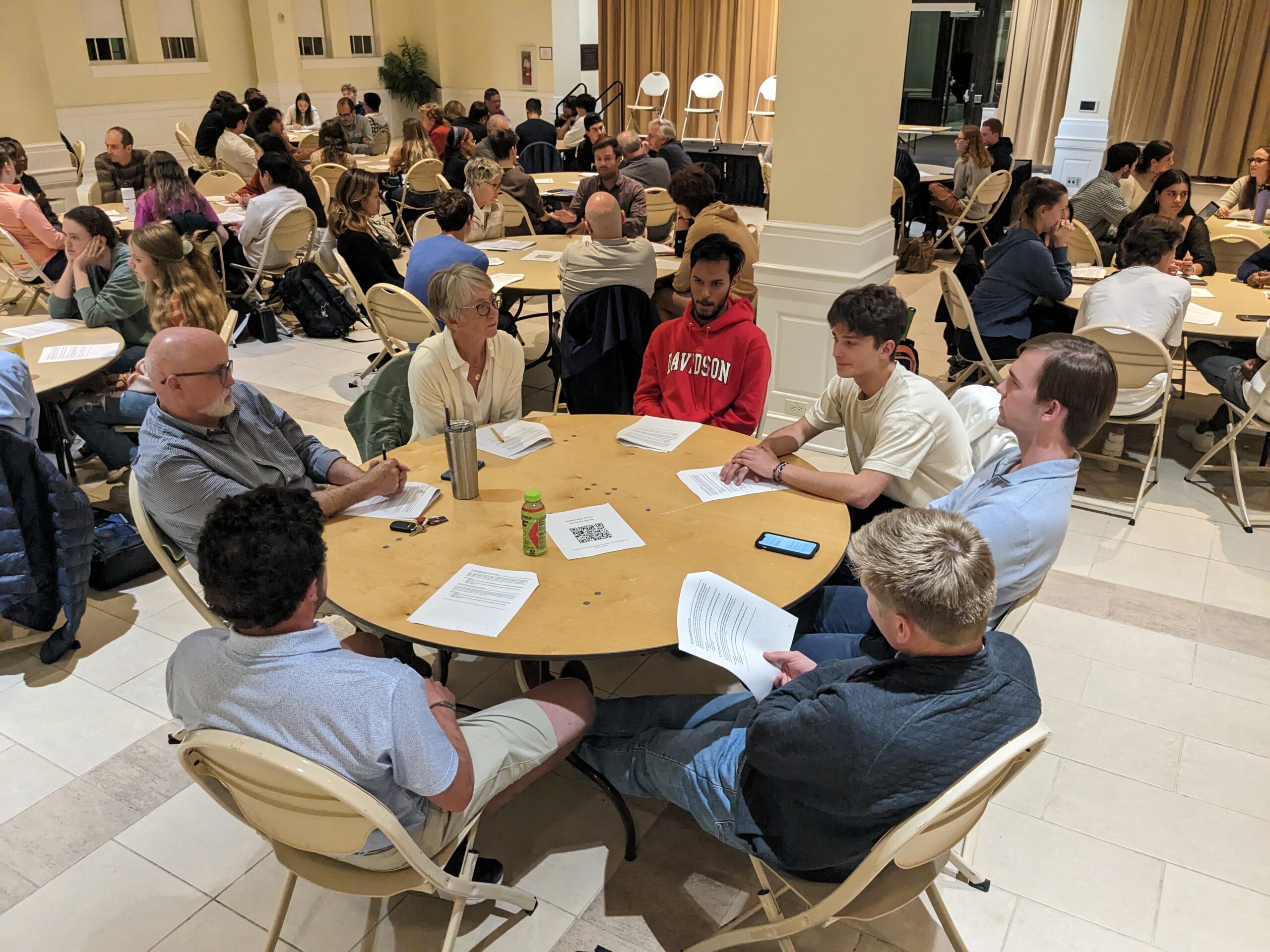
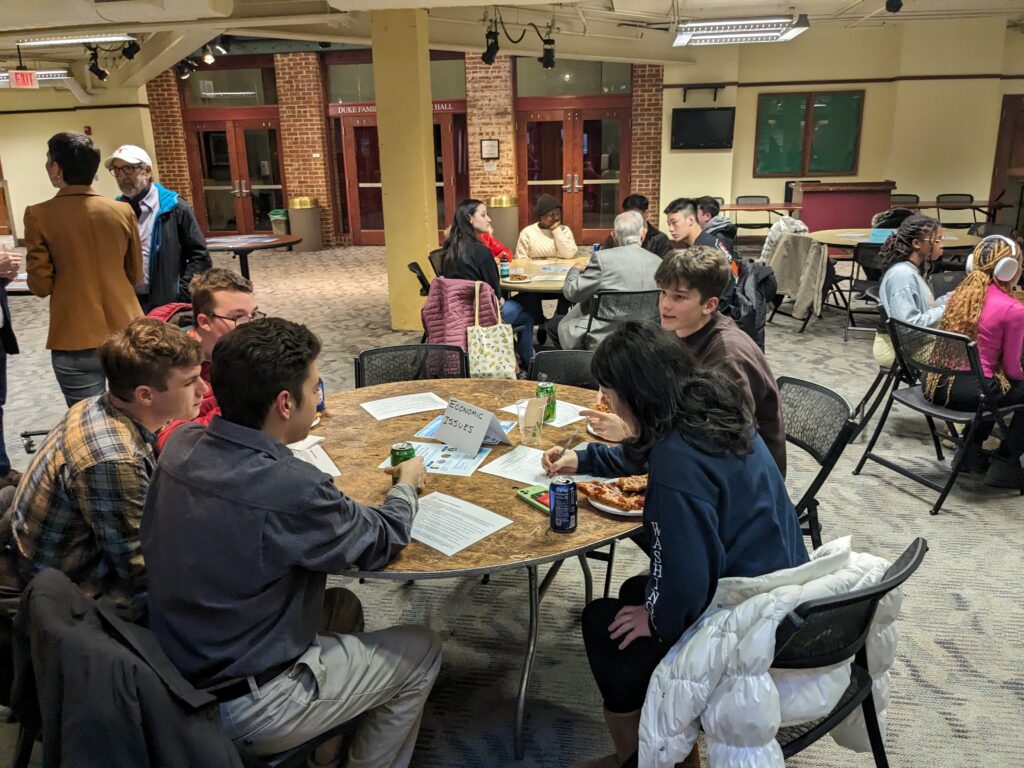
On Friday, January 19, the Deliberative Citizenship organized a Semester Kickoff Party to start the semester by engaging in deliberative practice. In addition to the table with the pizzas and drinks, many tables were assigned to different subject areas. For example, there were tables on international topics, economics, American politics, technology, etc. On each table, there were cards with conversation topics, which were then discussed by the participants under the guidance of the deliberative facilitators. For instance, one card from the economics table asked whether the minimum wage should be lower or higher. Usually, topics like this are said to polarize and divide society. On this day, however, they brought people together.
In today’s increasingly polarized society, finding common ground and fostering understanding between opposing viewpoints has become a formidable challenge. The social media echo chambers and the divisive rhetoric in public discourse often lead to a widening gap between individuals and groups. However, there is a powerful tool that has the potential to mend these fractures and build bridges of understanding: deliberative practice.

Polarization in society arises from the deepening divisions between individuals with differing opinions, values, and beliefs. This phenomenon is fueled by a need for more meaningful communication and a growing unwillingness to engage with perspectives that differ from our own. In such an environment, breaking down these barriers and creating spaces for constructive dialogue is crucial.

Deliberative practice involves intentionally and thoughtfully discussing issues among individuals with diverse perspectives. It goes beyond mere debate, emphasizing active listening, respectful engagement, and a commitment to finding common ground. This process encourages participants to examine their beliefs and critically understand the nuances of opposing viewpoints.

One of the critical elements of deliberative practice is the art of listening. In a society where people are often quick to express their opinions without truly hearing others, fostering a culture of active listening is transformative. When individuals are willing to listen, they open themselves to understanding the motivations, fears, and aspirations underlying diverse perspectives. This empathetic approach is a cornerstone of overcoming polarization.

Deliberation practice taps into a fundamental human desire—the urge to be part of the solution. Many people are growing weary of the toxic environment created by polarization and yearn for constructive ways to contribute to positive change. Deliberation provides an avenue for individuals to actively engage in shaping solutions rather than perpetuating the cycle of division.

One of the main drivers of polarization is confirmation bias—the tendency to seek out information that confirms our pre-existing beliefs. Deliberative practices encourage participants to confront and challenge their biases by exposing them to alternative viewpoints. This process helps individuals move beyond their comfort zones and fosters a more comprehensive understanding of complex issues.

In a world marked by polarization, deliberation emerges as a powerful antidote. By promoting active listening, a commitment to understanding diverse perspectives, and a shared sense of responsibility for solutions, deliberation can bridge divides and cultivate a culture of unity. As the many participants at the DCI Kickoff Party showed, people are willing to listen to others’ opinions, even on the most polarized topics, because they strive to be part of the solution. This urge we have to be part of the solution, combined with a willingness to engage in respectful dialogue, can create a more harmonious and inclusive society. As we embrace deliberation, we take a significant step towards healing the fractures in our communities and building a future grounded in understanding and collaboration.


DCI Spring Semester Kickoff Party

Filed Under: Blog Posts, Fellow Posts Tagged With: DCI, debate, deliberation, democracy, discourse, politics

A Deliberative Forum on Guns in America

March 13, 2024 by Graham Bullock

Join us for an opportunity to learn about and discuss one of the most challenging topics in American politics

Gun-Forum-Final-11×17-1

Can we talk about one of the most contentious and challenging topics in American politics? One that touches on some of our most basic concerns and aspirations about life in a free society? The Deliberative Citizenship Initiative, Center for Political Engagement, and Political Science Department believe we can and we must at least try to do so, with as much compassion, curiosity, and courage as possible, and in the hope that we will come to a greater understanding and create the foundation for sustained progress on this issue.

We therefore cordially invite you to join us for a Deliberative Forum on Guns in America: How Should We Balance Concerns about Gun Rights and Gun Risks? It is being held on Tuesday, April 2 from 7 pm to 9 pm in the Lilly Gallery and online. Sign up to attend the forum through this link — we have extended the deadline from March 28 to March 31. Virtual and in-person registration options are available. We hope you can join us!

  • The Forum will begin with a panel of advocates and experts with different views on this topic who will explore their areas of agreement and disagreement about the costs and benefits of different approaches to gun rights, gun regulations, and gun violence. 
  • Panelists include Shannon Klug (Former Air Force Colonel with Moms Demand Action, Be SMART, and Everytown Veterans Advisory Council), Philip Smith (President of the National African Americans Gun Association), Ray Nothstine (Future of Freedom Fellow and Senior Editor at a non-profit focusing on state level policy and former Second Amendment Research Fellow at the John Locke Foundation), and Dominic Erdozain (Research Fellow at Emory University and author of One Nation Under Guns: How Gun Culture Distorts our History and Threatens our Democracy). Learn more about them in their bios below.
  • The panel will be moderated by Dan Aldridge, Professor of History, Chair of Africana Studies, and a former DCI Deliberative Pedagogy (DeeP) Faculty Fellow. 
  • Following the panel discussion, both online and in-person forum attendees will have the opportunity to deliberate about the topic among themselves, guided by the DCI’s trained facilitators.

Panelist Bios

Shannon Klug works with Moms Demand Action, a part of Everytown for Gun Safety, and is the Charlotte Co-Lead for Be SMART, an organization that advocates for secure gun storage to save children’s lives. She is also a gun owner and retired Air Force Colonel, and she is a member of the Everytown Veterans Advisory Council. Klug has written numerous op-eds in the Charlotte Observer, Stars and Stripes, and elsewhere about the importance of reducing gun violence and improving gun safety.

Philip Smith, a graduate of the University of California at Davis, is the president and founder of the National African American Gun Association (NAAGA). The National African American Gun Association is an organization that promotes gun ownership rights among African Americans in the United States. Founded in 2015, it has over 34,000 members (60% of whom are African American women), more than 75 chapters in the United States, and has grown significantly in reaction to black deaths. 

Ray Nothstine is a Future of Freedom Fellow and senior editor and writer for a non-profit focusing on state-level policy. He previously worked as opinion editor at Carolina Journal and as a Second Amendment research fellow at the John Locke Foundation. Nothstine served for over seven years as managing editor of Religion & Liberty, a publication of the Acton Institute. He has written numerous articles advocating for gun rights and fewer gun regulations in The Carolina Journal, Salisbury Post, The Anson Record, and elsewhere. 

Dominic Erdozain is a writer and historian with a passion for bringing the past into dialogue with the present. A graduate of Oxford and Cambridge, he is currently a Research Fellow at Emory University. In his book, One Nation Under Guns: How Gun Culture Distorts our History and Threatens our Democracy, published by Random House in 2024, Erdozain places America’s gun problem in a broader philosophical and historical context and argues that we have wrongly ceded the big-picture argument on guns.

Moderator Bio

Dr. Dan Aldridge will serve as the moderator of the panel. Dr. Aldridge is Professor of History and Chair of Africana Studies at Davidson College. He has also participated as a Faculty Fellow in the DCI’s Deliberative Pedagogy (DeeP) Collaborative. Dr. Aldridge has served as a public defender in Los Angeles and written extensively about the history of the African American civil rights movement. He received his PhD from Emory University, his JD from Northwestern University, and his BA from Michigan State University.

Register Here by March 28

Filed Under: Announcements, Events Tagged With: debate, deliberation, democracy, discourse, politics

How We Can Use Arguments to Learn From One Another

January 3, 2024 by Stephen Walker

People discussing at a round table

Stephen Walker ’26 (DCI Fellow)

Arguments are difficult. Whether stemming from our own personal attachments to ideas or a fear of criticism and negative social outcomes, people often tend to stigmatize arguments as impolite, irrational drains on our emotional well-being that only serve to produce tension and animosity between the parties involved. In my own experience, I have faced such feelings of hopelessness, of innately distressing conversations bound to go nowhere. Contentious arguments can give one the feeling they are fighting for the sake of fighting and nothing more. But this does not have to be so. Argument can be one of the most meaningful forms of positive interaction individuals can engage in with one another.

The DCI’s deliberative framework and the constructive norms our Fellows cohort has been exposed to have reconfigured my entire perception of how one ought to engage in argument and what they should hope to get out of it. One of our required readings for the program, Why We Argue (And How We Should) by Scott Aikin and Robert Talisse, details two sweeping norms for augment that I have relied on through my work to improve my relational and facilitator abilities: argumentative earnestness and argumentative responsibility.

Argumentative earnestness and responsibility have allowed me and other practitioners who utilize them to guide arguments away from zero sum competitions aimed at forcing one person to concede entirely to the other side through manipulation and distractions toward a positive, holistic exploration of issues at large and an informative pursuit of truth.

Aikin and Talisse describe argumentative earnestness as our duties to pay close attention to evaluating the reasons placed before us to justify a position or a view. By blocking out the noise–pressures to win, manipulative rhetoric, bias, and distractions–and evaluating arguments based on the reasons and logic behind them, the merit of a point can be more clearly established and progress can be made in what would otherwise be a contentious, stagnant process.

Argumentative earnestness takes what Aikin and Talisse label “intellectual courage,” or the courage to not just focus on the truth when others try to pressure you away from it but to also realize you may be biased and misleading others. It takes intellectual courage to admit that, much like the other side, you too can use flawed arguments in pursuit of winning rather than the truth. Going beyond holding the other side in arguments to such scrutiny by holding yourself to equally high, if not higher standards, can ensure you are constantly improving the quality of the arguments you produce.

Argumentative earnestness on its own is not enough to ensure a successful argument. Looking at the variety of reasons that may go into one side or another regarding a particular topic will round out your arguments to a fuller extent. Looking beyond what may be the widely preferred or most obvious reasons for holding a belief, we find out that there can be many reasons for taking a specific stance on a specific issue.

When we try to empathize with those who might take these different positions, regardless of whether we agree with them or not, it allows us to engage with the other side to the fullest extent possible. When we engage with the full, honest perception we have of the other side’s stance we can either learn and change our own perspectives on an issue or develop more robust responses than we would otherwise be capable of when engaging with simplified reasons. In this way, argumentative responsibility inspires learning and is essential to productive argument.

In my work as a deliberation facilitator, I am sometimes tasked with playing devil’s advocate by taking on the role of the other side when everyone in a deliberation agrees on an issue and the conversation reaches a stand-still. Without engaging in argumentative earnestness and responsibility, it could be very hard to be the sole advocate for another perspective that one sometimes may not even agree with themselves. Embodying these principles in my attempts at being a better devil’s advocate has allowed me to focus on the reasons behind competing stances, encouraging people to examine their views in ways that would not be possible without such a focus on reason over confrontation.

Playing devil’s advocate to urge members of my deliberation groups to consider opposing arguments has been a truly fruitful exercise to watch play out. People not only willingly consider the full scope of reasons behind views they may have otherwise immediately rejected, but they learn how to better respond to such reasons and enhance their reasoning processes. This can allow deliberators to examine their views, thus enhancing their ability to reason through and properly weigh the merit of counterarguments they may face for the stances they take on various issues. It also allows them to build up the courage to admit when they may be wrong or faced with superior reasoning.

In my experience, when we try to exercise argumentative earnestness and responsibility in our efforts to deliberate, we tend to learn more, have better arguments, and have a better chance of unlocking the truth. This allows us to not only be aware of the flaws in the stances we take but to make clear to others in a constructive, rather than hostile way, the problems in the reasoning that they present. Better arguments make better-informed citizens and by leaning into not just argumentation but constructive norms, we learn and grow in ways that would not otherwise be possible. We learn and grow as a community of citizens unified by our pursuit of truth.

Filed Under: Blog Posts, Fellow Posts Tagged With: debate, deliberation, discourse, facilitation

The Power of Deliberation: Embracing New Ideas

November 2, 2023 by Florian Moser

DCI Fellow Florian Moser facilitating a deliberation

Florian Moser ’26 (DCI Fellow)

My initial interest in the Deliberative Citizenship Initiative was sparked last year in a conversation at the DCI kickoff party in the College Union. My group and our facilitator argued about a geopolitical topic on which I held a strong opinion. Therefore, I was trying to defend my point of view and counterargue opposing opinions. At that point, our facilitator interrupted me to ensure everybody could speak, forcing me to listen to other ideas. At that moment, I started to understand the difference between deliberation and debate. I want to compare these two approaches since, in today’s society, debate is the more prominent approach to conversation.

Confrontational vs. Collaborative: Debates and Deliberation

Debates are typically confrontational, with participants firmly entrenched in their positions, aiming to prove their viewpoint’s superiority. In contrast, deliberation is a more open and cooperative process focused on understanding different perspectives, reaching common ground, and appreciating diverse ideas. The key distinction lies in how people react to opposing views. In debates, individuals often defensively cling to their positions, sometimes at the expense of genuinely listening to others. Deliberation, however, encourages active listening and open-mindedness, fostering a collaborative environment that values constructive dialogue and the exploration of different viewpoints.

Since we are so used to debating, it is common for participants of DCI events to recognize the significant difference between deliberation and debate for the first time. In my first mock deliberation, during a DCI facilitator training, my facilitator ensured that every participant expressed their ideas in every round of the deliberation. This strong emphasis on equal-length speech contributions from all deliberations lets people formulate their ideas who might not be used to getting the chance to speak up. 

Instead of getting stuck in a debate about two specific viewpoints, participants gain many ideas they might not have considered before. The exchange of ideas and the practice of leaning into a different perspective holds two advantages. First, it is more valuable for the deliberators to gain new ideas, improving their worldview in the long run, than just winning an argument. Second, deliberations help to foster soft skills, strongly contributing to respectful and productive conversations. These soft skills help create a respectful and constructive environment in the long run, whether in debates or deliberations.

Here, I want to list some critical soft skills:

  1. Active Listening: In deliberation, listening isn’t passive; it’s an active effort to understand and appreciate the viewpoints of others.
  2. Open-Mindedness: Participants should be open to changing their views based on new information or insights.
  3. Respectful Communication: Encourage respectful and civil discourse, where participants can express themselves without fear of personal attacks.
  4. Seek Common Ground: Look for shared values and common objectives as a starting point for finding solutions.
  5. Value Diverse Perspectives: Recognize that diversity of thought leads to more creative and effective solutions.

The Benefits of Deliberation

Deliberation offers several advantages over debate. It promotes collaboration, reduces polarization, and fosters a sense of unity among participants. Moreover, drawing on broader ideas and perspectives can lead to better decision-making. In today’s complex and interconnected world, where many of the challenges we face require innovative solutions, deliberation is a practice that should be embraced and celebrated. It allows us to move beyond the limitations of our own perspectives and tap into the collective intelligence of diverse groups.

Conclusion

While debate has its place and can be a valuable tool for exploring differences, deliberation shines as a means to appreciate and harness new ideas. In deliberation, we see the true power of open-mindedness, empathy, and collaboration, and these qualities can help us navigate the complexities of our rapidly changing world. So, let us strive to embrace deliberation, for in doing so, we unlock the potential for collective growth, understanding, and progress.

Filed Under: Blog Posts, Events, Fellow Posts Tagged With: DCI, debate, deliberation, facilitation

Deliberation vs. Debate: What Kind of Society (and Discourse) Do We Want?

October 15, 2020 by Sandro Chumashvili 1 Comment

two women sitting at a table by a window talking

By Sandro Chumashvili, DCI Fellow

Since the age of thirteen, I have actively participated in competitive debates. I started with “world school style” and then found the most significant success in the “British Parliament Style.” By success, I mean becoming the champion of my country (Georgia) and achieving high results on an international level. After the world championship in 2019, at the age of just 17, I retired from debates. I moved to adjudicating and teaching new generations.

After joining the Davidson College community, I searched for ways to further develop the skills that I gained while debating, but in a less confrontational and understanding manner, and I found the Deliberative Citizenship Initiative (DCI). It focuses on deliberation and has the primary goal of depolarizing society, which sounded very appealing. With the other DCI Fellows, I went through the weeks of training and now facilitate political discussions and deliberations. Today I would like to point out some of the main differences between deliberations and debates on the different scales and levels. I will leave it up to you to decide which is better for the growth of an individual and society.

On the personal development level, both deliberations and debates help one to train specific skills. Debates are more focused upon critical thinking in limited time. It encourages you to protect your side at any cost, but the beauty of debates shows through when you do not know which position you will have to support before the preparation starts. For example, you may have to defend a position in the simulation that is totally opposite to the one that you have in real life. I remember that I had to defend communistic measures in the Estonian championship, despite considering myself libertarian; other times, I had to stand on the side of atheism while I identify myself as Christian. These clashes help you dig deep into the other side of an idea, which naturally forces you to think differently from how we would in real life; it internally forces us to question our beliefs and opinions.

Deliberations influence an individual differently. Here, you do not put up a wall between you and your companions, but to the contrary, you are open to changing your mind and accepting others’ opinions. Deliberations substitute the word “protect” in debates with “express,” meaning that you shall express and explain your idea, but at the same time, closely engage with other’s points. This way, the conversation tends to be less self-centered and touches upon the deeper parts of one’s ideas. People seldom totally agree or disagree with each other; therefore, deliberation is a more natural way to interact. It takes away the artificial “reject everything they say” point and nudges the participants toward a more interactive discussion.

Are both of those useful on all levels of society? To answer this question, let’s consider two crucial aspects: the stakes and the goal. If participants’ purpose is to show their dominance over another person, they become resistant to accepting the other person’s opinions, and deliberation is no more productive. The same can be said for when the stakes are high. For example, substituting presidential debates with deliberation would not be useful, since it is not in the candidates’ interests to find their spots of intersection. They always try to show their dominance in the areas they disagree with.

On the other hand, and on a smaller scale, wherever the main goal is to find a solution to a problem, and especially if compromise may be necessary, deliberation is a better solution since it does not disregard anyone’s opinion. The output reflects everyone’s input.

Personally, as time has passed and I have matured, I have moved away from debates. The main reason for this shift is how emotionally demanding they are and how high the stakes are. Debates are a perfect way to shape your opinion through clashes. Still, deliberations are more useful once you are more confident in your values and beliefs and are open to being challenged. What is more helpful depends on your values, what kind of society you want to see in the future, and how you perceive others’ ideas. Still, we shall remember that like everywhere, the answer is never black or white; both deliberation and debate are helpful on different scales and in different situations.

Filed Under: Blog Posts, Fellow Posts Tagged With: debate, deliberation, discourse

  • Page 1
  • Page 2
  • Go to Next Page »

Footer

Blog Post Categories

  • Announcements
  • Blog Posts
  • DCI Posts
  • Events
  • Faculty Posts
  • Fellow Posts
Image of a compass superimposed by the text "Deliberative Citizenship Initiative" and "Davidson College." Clicking on this image leads to the Initiative page.

Recent DCI Blog Posts

  • We Tried to Fix Jubilee’s “Middle Ground” – Here’s How It Went
  • A Case for Deliberation in the Natural Sciences
  • Welcoming New Staff to the DCI and DCN
  • Facebook
  • Twitter
  • Instagram
  • LinkedIn


Copyright © 2026 · Infinity Pro on Genesis Framework · WordPress · Log in