• Skip to main content
  • Skip to footer

Deliberative Citizenship Initiative

Building Democracy One Conversation at a Time

  • The Initiative
    • Programs
      • Deliberation Across the Curriculum
      • Deliberation on Campus
      • Deliberation in the Community
      • Research on Deliberation
    • Motivations
      • Why Deliberative Citizenship?
      • Why Davidson? Why Now?
    • Who’s Involved?
      • DCI Fellows Cohorts
        • 2025-2026 Fellows
        • 2024-2025 Fellows
        • 2023-2024 Fellows
        • 2022-2023 Fellows
        • 2021-2022 Fellows
        • 2020-2021 Fellows
      • DeeP Collaborative Cohorts
        • 2024-2025 DeeP Collaborative Faculty
        • 2023-2024 DeeP Collaborative Faculty
      • Advisory Council
    • History
      • What Sparked the Initiative?
    • Key Deliberative Dispositions
    • Frequently Asked Questions (FAQ)
    • Annual Report
  • Get Involved!
    • Participate in a Forum
    • Join a D Team
    • Become a Fellow
    • Take Courses
    • Get Training
    • Come to Guest Lectures
  • Events
    • Upcoming Events
      • 250th Anniversary Deliberative Forum Series on American Values
    • Past Events
  • Connections
    • The Deliberative Citizen: The DCI’s Monthly Newsletter
    • Efforts on Campus
    • Efforts in the Community
    • Efforts Elsewhere
    • Readings and Resources
      • DCI-Published Guides
      • DCI Guide to One-on-One Conversations
      • How to Disagree
      • Demonstration of Facilitation Styles
      • Deliberative Pedagogy Mini-Course
    • How We Can Help: DCI’s LET’S DELIBERATE! Partnership Opportunities
    • DCI in the News
  • DCI Blog Posts
    • Recent Blog Posts
    • All Blog Posts

2023-2024

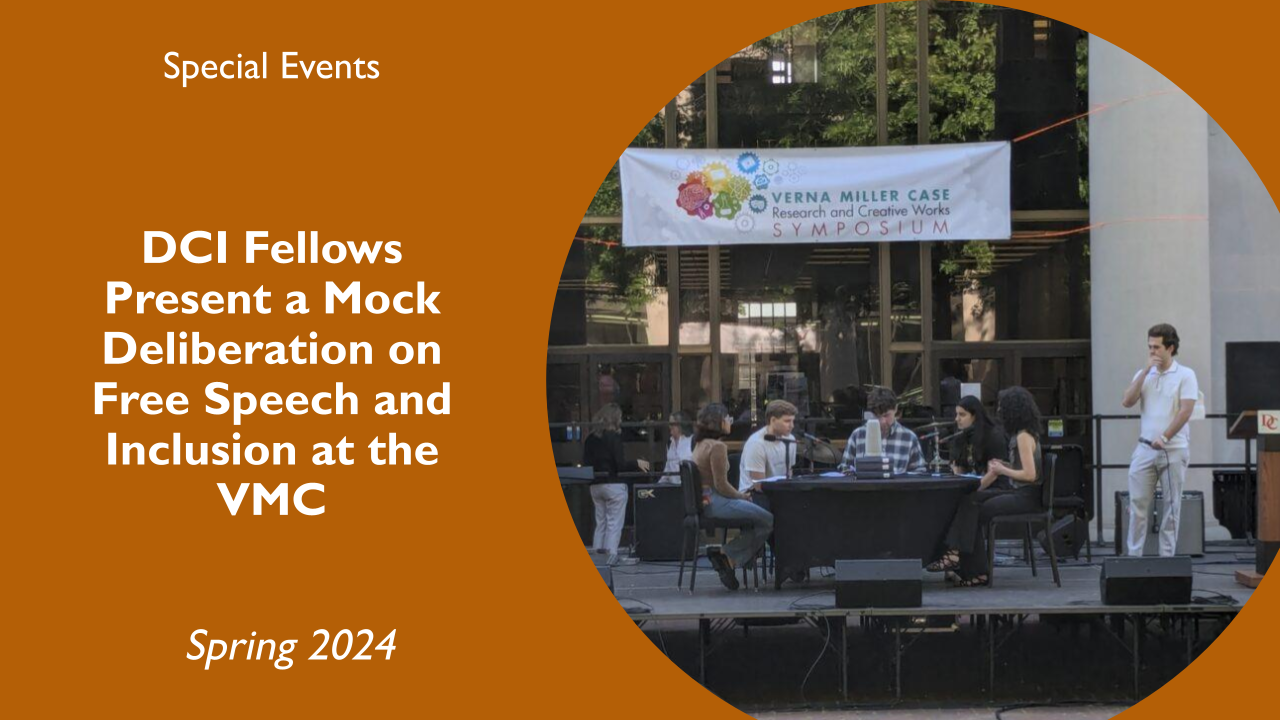
DCI Fellows Present a Mock Deliberation on Free Speech and Inclusion at the VMC

Since its inception, the DCI has participated in Davidson’s daylong celebration of student intellectual achievement called the Verna Miller Case (VMC) Symposium. DCI Fellows have presented posters and given presentations on the work of the DCI, and it has been a great opportunity for them to share their work with the Davidson community.

This year we wanted to do something a little more dynamic and interactive to capture the spirit and ethos of the DCI. And so a team of Fellows got together and designed an hour-long event that actively demonstrated the DCI’s key features and contributions to creating a more deliberative culture on and off campus.
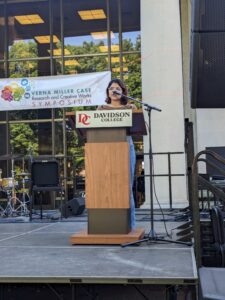
Photo of Mishti Mookherjee standing behind a Davidson College podium, speaking to the public.

It included a mock deliberation on the relationship between free speech and inclusion that highlighted moves that both deliberators and facilitators can make to foster more productive deliberations. The mock deliberation did not shy away from engaging with some of the most contentious aspects of the issue at hand, but tried to demonstrate how we can engage constructively and respectfully with them.

The event also included short summaries by the Fellows about their deliberation projects that they designed on issues important to them personally. It concluded with an opportunity for audience members to deliberate among themselves on a range of different topics.

The event wonderfully displayed the range and depth of deliberation that the Fellows engaged in and the set of skills they learned over the course of the 2023-24 academic year. It nicely complemented the other types of amazing work highlighted by the Symposium that Davidson students engage in on campus, from research in the social sciences, natural sciences, and humanities to achievements in the performing and visual arts to collaborations with local communities and organizations on pressing social challenges.
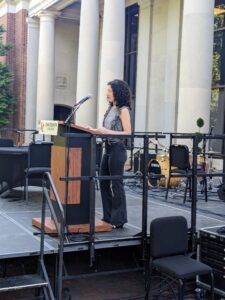
Laegan Smith speaking.

In many ways, the DCI brings together these different threads of the liberal arts – rigorous research, creative work, and civic engagement – and applies them to the critical project of fostering constructive conversations across differences on issues that matter deeply to our society.

Check out the video highlights of the DCI’s symposium event below. It features an introduction to the Deliberative Citizenship Initiative by DCI Senior Fellow and Co-Convener Laegan Smith ’24 followed by a mock deliberation featuring Laegan, Stephen Walker ’26, Emre Guvenilir ’25, Auden White ’26, Mishti Mookherjee ’27, and Arshi Hussain ’26. These and other DCI Fellows then introduce their personal deliberation projects. Check it out – it’s a great way to learn about the incredible work that Davidson students are doing as part of the DCI.

Commons Conversation with Chris Clunie: Sports Betting, what are the issues?

By Graham Bullock, Stephen Walker ’26, and Emre Guvenilir ’25

The DCI’s final Commons Conversation of the spring semester was hosted by Chris Clunie, Athletics Director and Vice President for Athletics. The topic was “Sports Betting: What are the Issues,” and Mr. Clunie started the conversation by explaining the College’s current rules related to sports betting. In short, employees and students are not allowed to 1) engage in any form of betting on sports competitions in which Davidson College athletes are competing, 2) share nonpublic information about Davidson College athletes that is relevant to sports betting, or 3) attempt to influence the outcome of a sporting event that includes Davidson College athletes.

He also discussed how sports betting can erode the sense of community and trust within the campus community if students place bets on their fellow Davidson student-athletes. Doing so can also ruin relationships between those individuals. When the performance of a team or individual can materially affect a classmate or staff members financial well-being, that places enormous pressure on both the athletes and how they connect with others on campus.

After Mr. Clunie concluded his introduction to the topic, the Commons Conversation’s participants weighed in with their perspectives and questions. Some were in favor of sports betting and not regulating it too rigidly, while others were more skeptical and concerned about its recent rapid growth. Everyone weighed the effects of betting on student-athletes on those specific-athletes themselves, and they benefited from insights from two track team members taking part in the discussion. They considered how the practice might harm them personally, especially considering the fact that they are Division I athletes at a school as small as Davidson. 

The participants also considered the benefits for people engaged in betting markets, including generating revenue and pure fun, and the limits of those benefits. Some highlighted how enjoyable sports betting is for a lot of people. Others suggested that betting is largely only experienced by groups of a higher socioeconomic status and emphasized that it can be highly addictive and harmful. They talked about how gambling is different from many other types of addictions in that its effects are less visible and that treatment and recovery resources are generally less available.

Mr. Clunie’s contributions to the conversation gave everyone insight into the rationale of different stakeholders considered by the athletics department as it works to develop betting rules for the college community to abide by that ensure they protect athletes and support the Honor Code. In discussing these rules, the participants emphasized the limits of the ability of the College to regulate the practice and the importance of the ethos of the honor code in ensuring sports betting does not adversely affect athletes, students, and teams. 

The participants discussed the honor code more generally and expressed a shared sense of declining reverence for the guidelines in the post-COVID era. They then explored possible solutions to this problem and deliberated about what the administration can and should do to address it. One participant argued that grade inflation is contributing to less concern about the Honor Code, while another stated that they came to Davidson because of it. Circling back to the issue of sports betting, especially on student athletes, participants emphasized that students must point out to one another what is and is not acceptable.

The conversation concluded with some discussion about the practice of sports betting more generally, and how people across the ideological spectrum may take issue with it. We highlighted the ways cultural shifts in society at large can impact college campuses in unpredictable and important ways. 

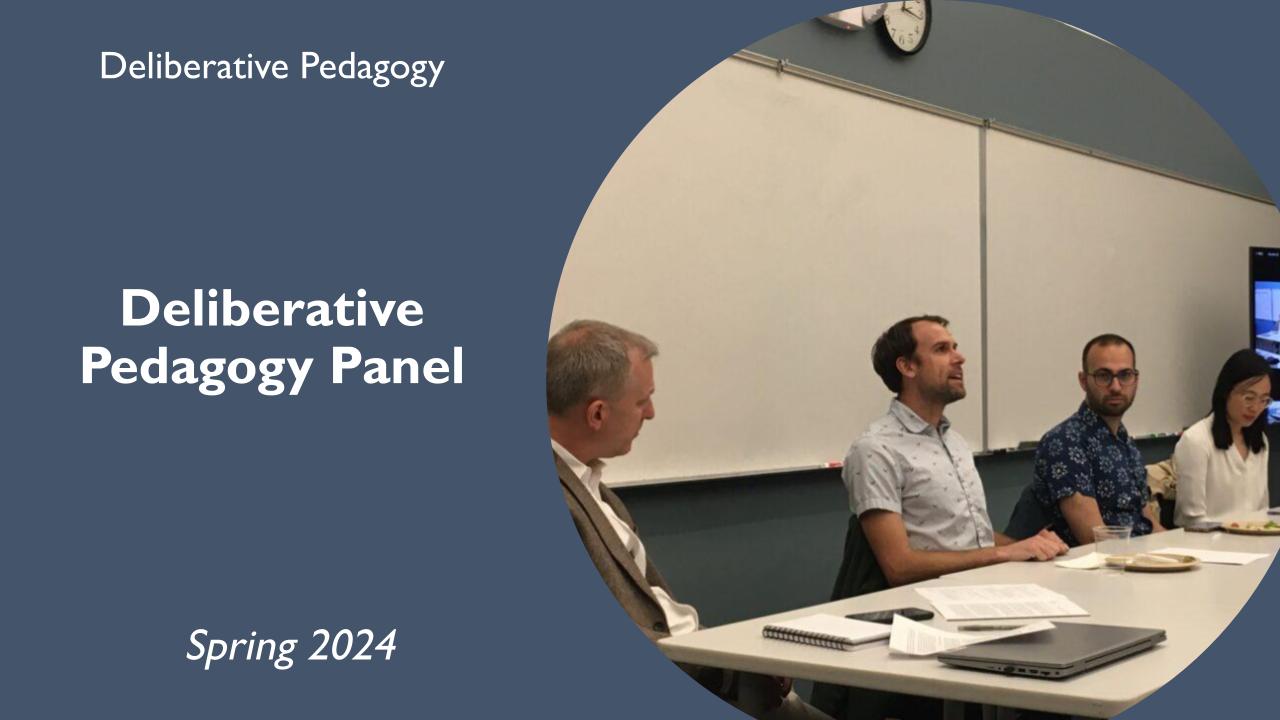
Deliberative Pedagogy Panel (Spring 2024)

On Friday, March 15th, faculty from Davidson and beyond gathered to learn from Professors Emily Sydnor (Political Science, Southwestern University), Rachel Pang (Religious Studies, Davidson College), Bassil El-Zaatari (Chemistry, Davidson College), and Anthony Kuchera (Physics, Davidson College) about how to integrate deliberative practices into their classrooms over lunch. The panelists spoke about best practices for hosting deliberations in the classroom, facilitating deliberation, providing feedback, and the improved learning outcomes they found in the courses where they had started to practice deliberative pedagogy.

For example, Professor El-Zaatari encouraged STEM faculty not to shy away from deliberative pedagogy in their courses. And Professor Pang spoke about increased student engagement and how students felt an increased sense of ownership over the course in her deliberative religious studies course. All in all, participants walked away with new knowledge about how to update their teaching practice with deliberative practices.

The event highlighted the work that all four professors did as members of the DCI’s Deliberative Pedagogy (DeeP) Collaborative, which is a year-long, paid fellowship program that helps faculty embed deliberation about contentious topics into their courses related to their content. Attendees of the panel and lunch learned about how professors from very different disciplines can update their teaching practice with deliberative practices.

Graham Bullock, Faculty Director of the DCI, moderated the panel and announced that the applications to join the 2024-25 cohort of the Deliberative Pedagogy (DeeP) Collaborative are now being accepted. Review of applications will begin on April 22 and will continue until all positions are filled. If participating in the Collaborative sounds intriguing to you, learn more and apply to be a Faculty Fellow in next year’s Deliberative Pedagogy (DeeP) Collaborative here.

You can learn more about the Collaborative and hear what the panelists had to say yourself by checking out our recording of the panel discussion below…

Deliberative Forum on Artificial Intelligence

AI slide

In February 2024, the DCI hosted a Deliberative Forum on Artificial Intelligence in partnership with Davidson’s Computer Science Department, Digital Studies Department, and Office for Technology and Innovation. Together, we connected Davidson students, faculty, staff, alums, and members of the wider community to discuss how we should think about and interact with the advanced AI systems have been dominating our public discourse about tech since the public release of ChatGPT in November 2022.

DCI-AI-Forum-Poster_Feb-5

Three panelists with very different kinds of AI expertise discussed how we should aim to relate to AI now and in the future. You can watch the whole panel discussion below. All in all, over 130 people participated in the forum, sharing their hopes and fears about the technology’s impact and deliberating together about the role of humans in a world that will be potentially fundamentally transformed by generative AI.

Damien Williams, Assistant Professor of Philosophy and Data Science at UNC Charlotte spoke about how awareness of what biases, especially social biases, can arise in AI algorithm training impact the degree to which the outputs of these systems align with just goals and values. Lauren Kahn, Senior Research Analyst at Georgetown University’s Center for Security and Emerging Technology discussed ways that AI applications can positively impact national security and state interests, the risks associated with them, and how to develop them with responsible speed. Richard Boyd, CEO of Ultism, talked about AI’s impacts on the private sector. All panelists touched on the importance of working on aligning AI systems with our values and interests, as well as the challenges associated with this task. The panel was moderated by Sara Copic, DCI Assistant Director and affiliate researcher of the UNC Chapel Hill AI Project.

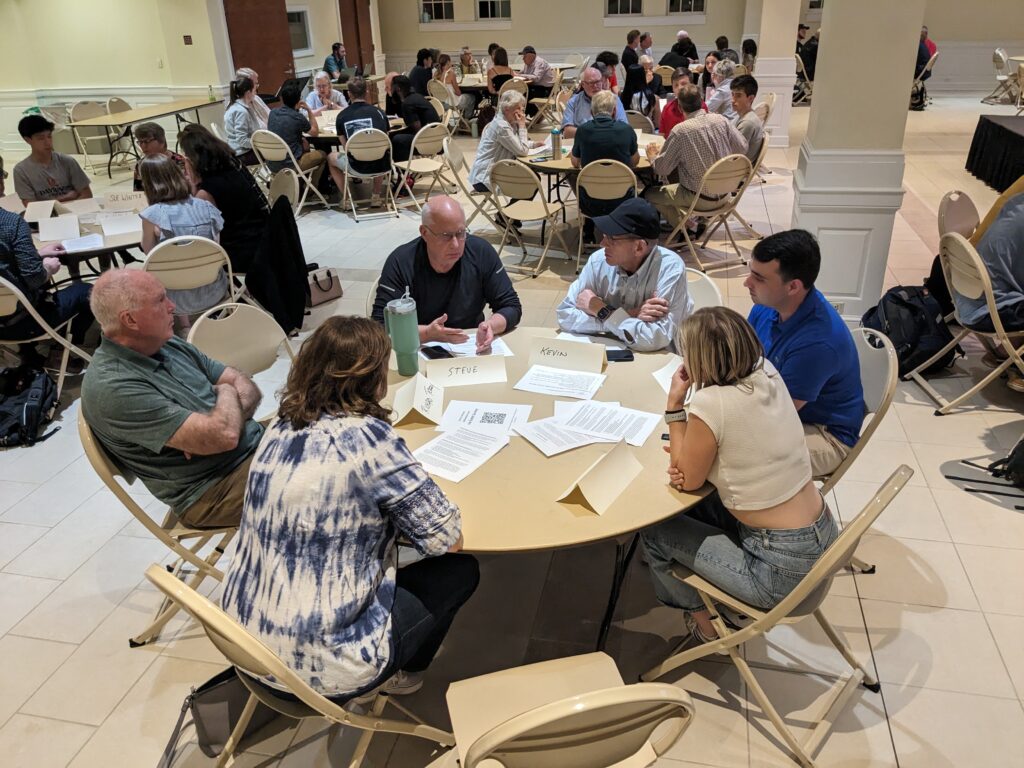
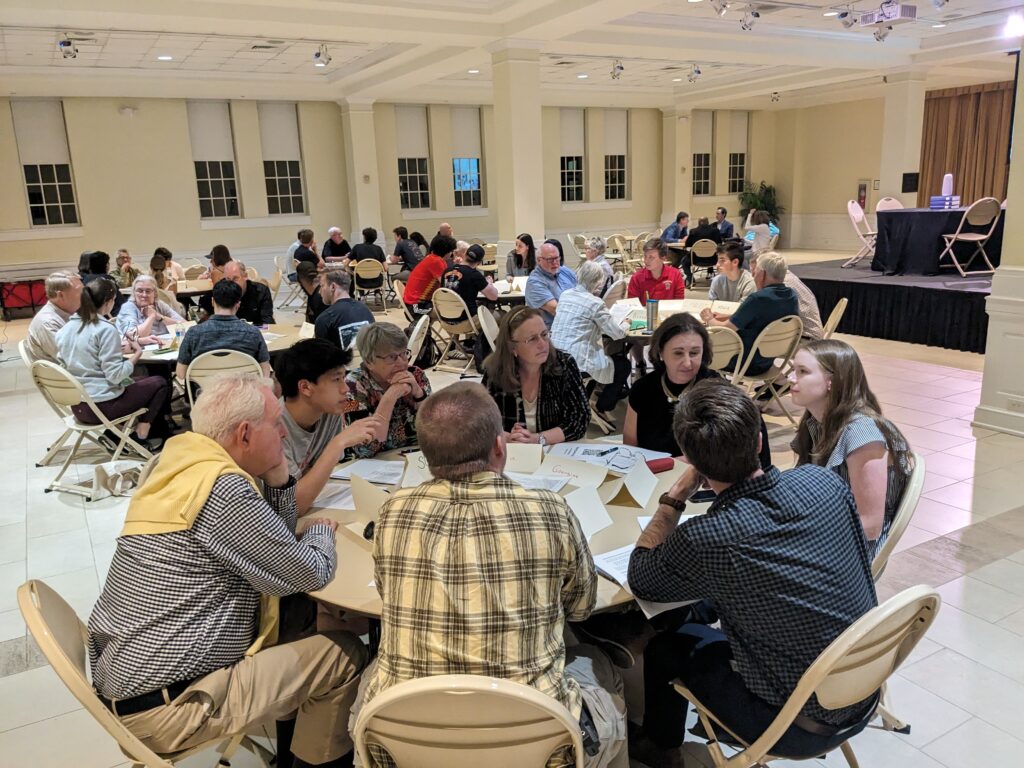
Following the panel discussion, participants deliberated about AI ethics, standards, and policy. These discussion groups were guided by the DCI’s trained facilitators and included a mix of students, faculty, staff, alumni, and community members who were able to share their questions and thoughts about this new technology.

Forum participants deliberate at round tables

You can check out a short video of the small group discussions that participants engaged in the video below (less than one minute long). We used Canva’s AI Assistant to help generate the video, and we couldn’t resist leaving in the last two captions that it generated — watch until the end and we bet you’ll get a kick of out of it.

Participation in every DCI program includes access to a Deliberation Guide, a document that provides some background information and practical examples that enable people of all backgrounds to engage with the topics of our programs. Below, you can access our Deliberation Guide that we distributed as part of our Forum on Artificial Intelligence. Although our guides are intended to be used with the help of a trained facilitator, we hope that this document will spark interest for those looking for ways to deepen their understanding of how generative AI works and the special ethical and policy tradeoffs and challenges associated with this technology. If you missed this event, we also hope it will inspire you to participate in our future deliberative forums — we have one coming up on April 2 on Guns in America. More info coming soon…

DCI-Deliberation-Guide_Artificial-Intelligence-1

Deliberative Forum on Guns in America

Slide of Guns in America forum.

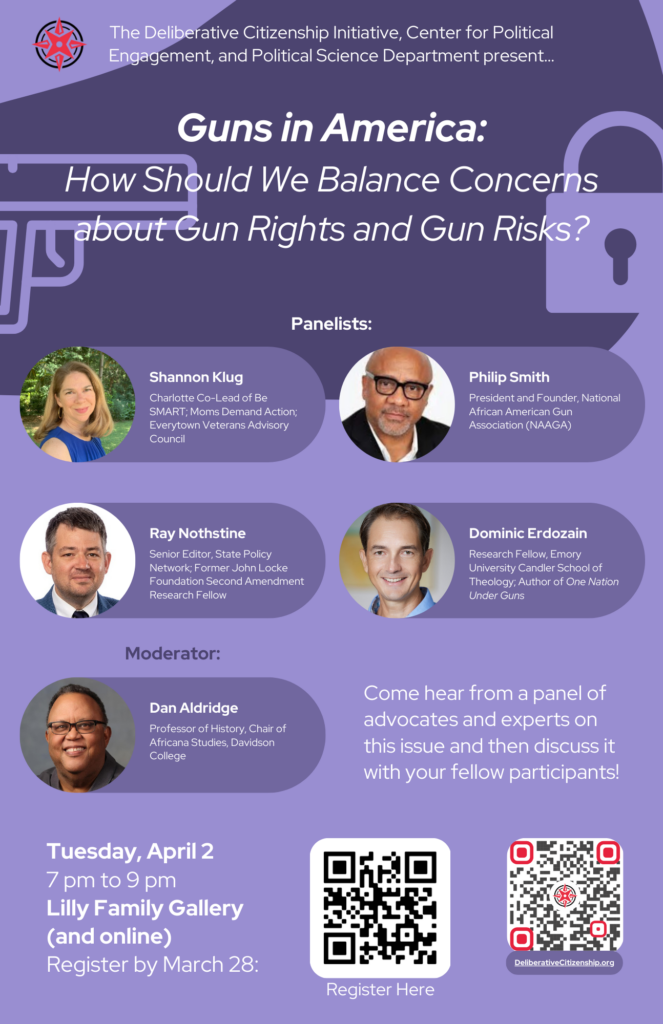
The Deliberative Citizenship Initiative, Center for Political Engagement, College Democrats, College Libertarians, College Republicans, and Political Science Department recently co-hosted a Deliberative Forum on Guns in America: How Should We Balance Concerns about Gun Rights and Gun Risks? Below is the flyer, more information about the event and panelists, recordings of the panel discussion and small group deliberations, and the deliberation guide for the forum.

gun forum flyer

“I’m so very grateful for Davidson’s DCI initiative that provides a thoughtful, meaningful, and challenging (in all the good ways a functioning democracy requires that) opportunity to engage with fellow citizens.“

DCI Guns in America Deliberative Forum Participant

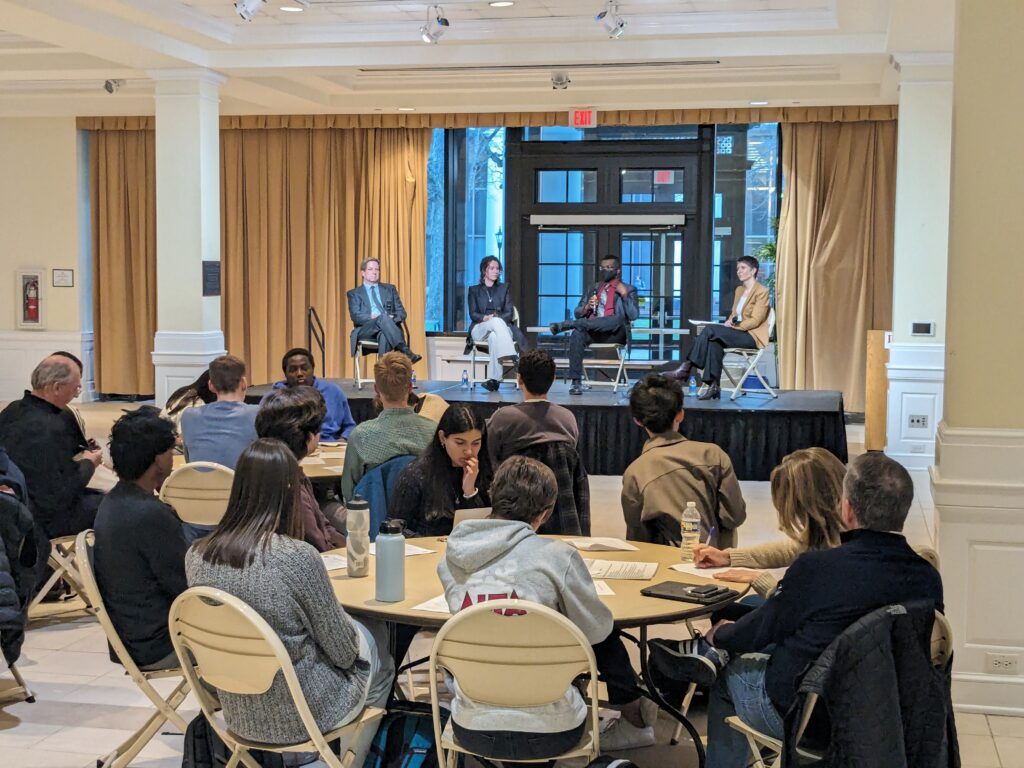
On Tuesday, April 2, 2024, nearly 170 people – 94 online on Zoom and 69 in-person at Davidson College’s Lilly Family Gallery (a record number for a DCI Forum) – gathered to deliberate about one of the most contentious and challenging topics in American politics, and they did so authentically, respectfully, and thoughtfully. The topic – Guns in America: How Should We Balance Concerns about Gun Rights and Gun Risks? – was first discussed by a panel of experts and advocates who came from a wide range of backgrounds and expressed a wide range of perspectives.

They included Shannon Klug, a Former Air Force Colonel who has worked with Moms Demand Action, Be SMART, and Everytown’s Veterans Advisory Council), Philip Smith, the President of the National African Americans Gun Association, Ray Nothstine, a former Second Amendment Research Fellow at the John Locke Foundation, and Dominic Erdozain, a Research Fellow at Emory University and author of One Nation Under Guns: How Gun Culture Distorts our History and Threatens our Democracy. Their discussion was moderated by Dan Aldridge, Professor of History, Chair of Africana Studies, and a former DCI Deliberative Pedagogy (DeeP) Faculty Fellow, while Graham Bullock, Faculty Director of the DCI and Associate Professor of Political Science, served as the event’s MC.

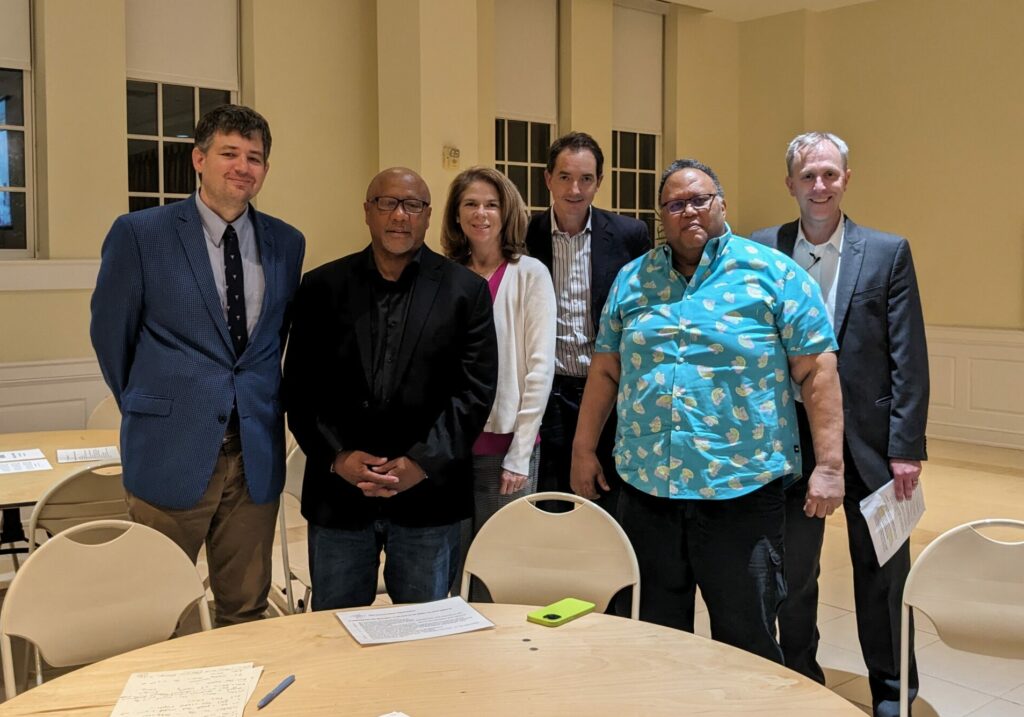
Photo of panelists and organizers standing together.
From Left: Ray Nothstine, Philip Smith, Shannon Klug, Dominic Erdozain, Dan Aldridge, and Graham Bullock

 The event was co-sponsored by Davidson College’s Deliberative Citizenship Initiative, Center for Political Engagement, College Democrats, College Libertarians, College Republicans, and Political Science Department. Representatives from each of the student political organizations asked questions of the panelists during the event, building on Dr. Aldridge’s facilitation of the discussion.

Instead of being lined up in a row of chairs, the panelists were seated around a roundtable on a stage, which enabled them to talk to each other more easily. A 360 degree video camera (a “Meeting Owl”) was placed in the center of the table, which enabled the conversation to be streamed live to participants who joined over Zoom. The video stream, which is available to view below, was also projected on a screen behind the panelists so people attending in-person could see who was speaking in case their direct view was blocked. This was the first time the DCI used this format, and it was widely praised as a helpful and engaging innovation.

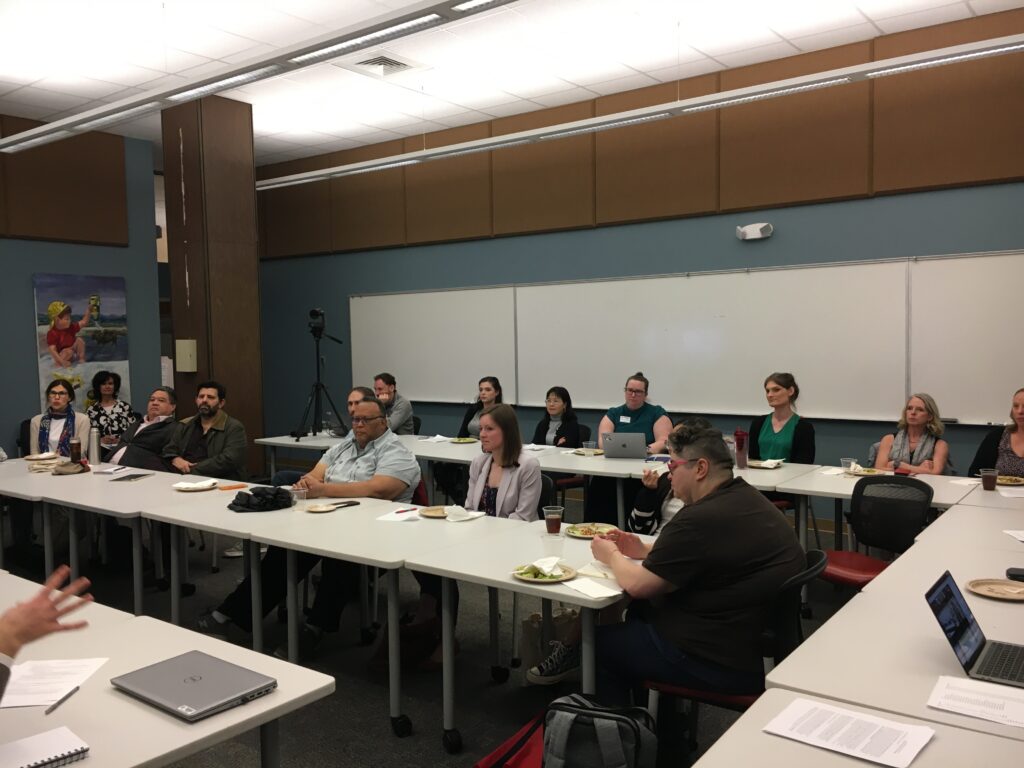
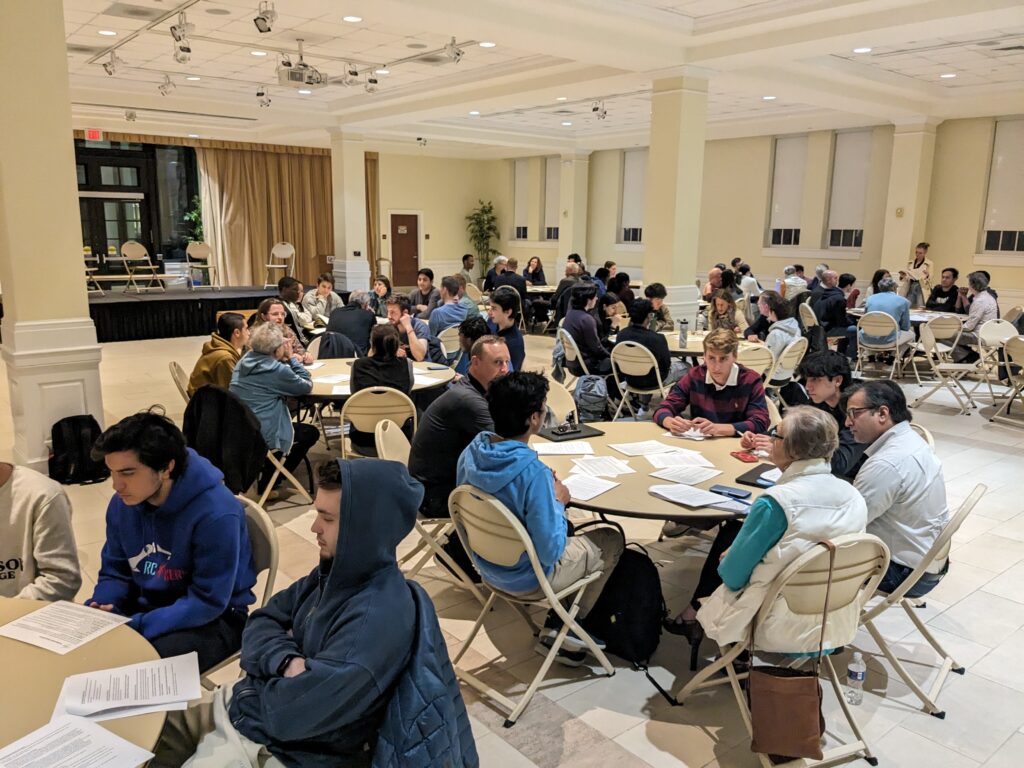
The panel discussion set the stage for an in-depth hour-long opportunity for audience members to explore the issues associated with guns in America among themselves. They broke up into small groups of 6-8 people who included Davidson students, faculty, staff, community members, and alums. Each discussion was facilitated by a trained DCI facilitator, most of whom were DCI student fellows but also included several faculty and community members. They introduced a series of discussion questions shared in a Deliberation Guide that was distributed to participants both before and at the event. The guide, included below, also provided some background information and a summary of different viewpoints on the topic so everyone had access to a baseline of knowledge going into the discussion.

The short video below provides some short clips of these discussions as well as a window into how the panelists’ roundtable deliberation was setup in the room.

These were not easy discussions and participants explored both their areas of disagreement and agreement. But they did so with kindness, curiosity, and courage, and were generally very satisfied with the experience; 82% were either satisfied or very satisfied with their small group discussion, and 98% reported they are likely or highly likely to participate in another Deliberative Forum in the future. Check out some of their comments about the event below:

  • “We live in such angry times, where every controversial topic becomes a zero sum game that is impossible to win. I’m so very grateful for Davidson’s DCI initiative that provides a thoughtful, meaningful, and challenging (in all the good ways a functioning democracy requires that) opportunity to engage with fellow citizens. It is empowering to know you have a lot to contribute to the greater understanding of critical issues, and crucially important to be reminded that you also have a lot to learn from others.”
  • “We can all learn and open our minds to others in this type of format. The guided breakout sessions gave me reason to look at my own views and rethink some of my positions. In addition, the Deliberation Guide given out is most helpful in discerning my thoughts on this topic and learning of other resources. I encourage anyone who has even made up their mind about gun laws to attend the next forum. What we do together makes a difference.”
  • “I wanted to attend the DCI forum on guns to hear from experts and fellow citizens on how we can all work together to address gun safety in America. It was refreshing to be in a room full of people who all seemed to be there for the right reasons and were all open-minded to hearing different perspectives. The work being done by the DCI is important and I believe all citizens should challenge themselves to participate in these types of programs.”
  • “Far exceeded my expectations to hear a wide variety of opinions in a balanced and logical way.”
  • “The range of views (rather than simply two opposite views) on the panel was fabulous.”
  • “This was fantastic – THANK YOU to everyone who worked so hard to provide a balanced, informative space. [Our facilitator] did an excellent job in facilitating our discussion. Loved connecting with all the other alums in my group. And am very appreciative of the well sourced materials that I may revisit more deeply on my own time.”

Our hope is that events like this forum contribute to greater understanding of different perspectives on the issues that divide us and create the foundation for sustained progress on them in the future.

Deliberation on Guide in Guns in America

DCI-Deliberation-Guide_Guns-in-America-2024

Panelist Bios

Shannon Klug works with Moms Demand Action, a part of Everytown for Gun Safety, and is the Charlotte Co-Lead for Be SMART, an organization that advocates for secure gun storage to save children’s lives. She is also a gun owner and retired Air Force Colonel, and she is a member of the Everytown Veterans Advisory Council. Klug has written numerous op-eds in the Charlotte Observer, Stars and Stripes, and elsewhere about the importance of reducing gun violence and improving gun safety.

Philip Smith, a graduate of the University of California at Davis, is the president and founder of the National African American Gun Association (NAAGA). The National African American Gun Association is an organization that promotes gun ownership rights among African Americans in the United States. Founded in 2015, it has over 34,000 members (60% of whom are African American women), more than 75 chapters in the United States, and has grown significantly in reaction to black deaths. 

Ray Nothstine is a Future of Freedom Fellow and senior editor and writer for a non-profit focusing on state-level policy. He previously worked as opinion editor at Carolina Journal and as a Second Amendment research fellow at the John Locke Foundation. Nothstine served for over seven years as managing editor of Religion & Liberty, a publication of the Acton Institute. He has written numerous articles advocating for gun rights and fewer gun regulations in The Carolina Journal, Salisbury Post, The Anson Record, and elsewhere. 

Dominic Erdozain is a writer and historian with a passion for bringing the past into dialogue with the present. A graduate of Oxford and Cambridge, he is currently a Research Fellow at Emory University. In his book, One Nation Under Guns: How Gun Culture Distorts our History and Threatens our Democracy, published by Random House in 2024, Erdozain places America’s gun problem in a broader philosophical and historical context and argues that we have wrongly ceded the big-picture argument on guns.

Moderator Bio

Dr. Dan Aldridge will serve as the moderator of the panel. Dr. Aldridge is Professor of History and Chair of Africana Studies at Davidson College. He has also participated as a Faculty Fellow in the DCI’s Deliberative Pedagogy (DeeP) Collaborative. Dr. Aldridge has served as a public defender in Los Angeles and written extensively about the history of the African American civil rights movement. He received his PhD from Emory University, his JD from Northwestern University, and his BA from Michigan State University.

  • Page 1
  • Page 2
  • Page 3
  • Go to Next Page »

Footer

Blog Post Categories

  • Announcements
  • Blog Posts
  • DCI Posts
  • Events
  • Faculty Posts
  • Fellow Posts
Image of a compass superimposed by the text "Deliberative Citizenship Initiative" and "Davidson College." Clicking on this image leads to the Initiative page.

Recent DCI Blog Posts

  • We Tried to Fix Jubilee’s “Middle Ground” – Here’s How It Went
  • A Case for Deliberation in the Natural Sciences
  • Welcoming New Staff to the DCI and DCN
  • Facebook
  • Twitter
  • Instagram
  • LinkedIn


Copyright © 2026 · Infinity Pro on Genesis Framework · WordPress · Log in