• Skip to main content
  • Skip to footer

Deliberative Citizenship Initiative

Building Democracy One Conversation at a Time

  • The Initiative
    • Programs
      • Deliberation Across the Curriculum
      • Deliberation on Campus
      • Deliberation in the Community
      • Research on Deliberation
    • Motivations
      • Why Deliberative Citizenship?
      • Why Davidson? Why Now?
    • Who’s Involved?
      • DCI Fellows Cohorts
        • 2025-2026 Fellows
        • 2024-2025 Fellows
        • 2023-2024 Fellows
        • 2022-2023 Fellows
        • 2021-2022 Fellows
        • 2020-2021 Fellows
      • DeeP Collaborative Cohorts
        • 2024-2025 DeeP Collaborative Faculty
        • 2023-2024 DeeP Collaborative Faculty
      • Advisory Council
    • History
      • What Sparked the Initiative?
    • Key Deliberative Dispositions
    • Frequently Asked Questions (FAQ)
    • Annual Report
  • Get Involved!
    • Participate in a Forum
    • Join a D Team
    • Become a Fellow
    • Take Courses
    • Get Training
    • Come to Guest Lectures
  • Events
    • Upcoming Events
      • 250th Anniversary Deliberative Forum Series on American Values
    • Past Events
  • Connections
    • The Deliberative Citizen: The DCI’s Monthly Newsletter
    • Efforts on Campus
    • Efforts in the Community
    • Efforts Elsewhere
    • Readings and Resources
      • DCI-Published Guides
      • DCI Guide to One-on-One Conversations
      • How to Disagree
      • Demonstration of Facilitation Styles
      • Deliberative Pedagogy Mini-Course
    • How We Can Help: DCI’s LET’S DELIBERATE! Partnership Opportunities
    • DCI in the News
  • DCI Blog Posts
    • Recent Blog Posts
    • All Blog Posts

Events

DCI Fellowship Application is Now Open!

June 1, 2023 by Graham Bullock

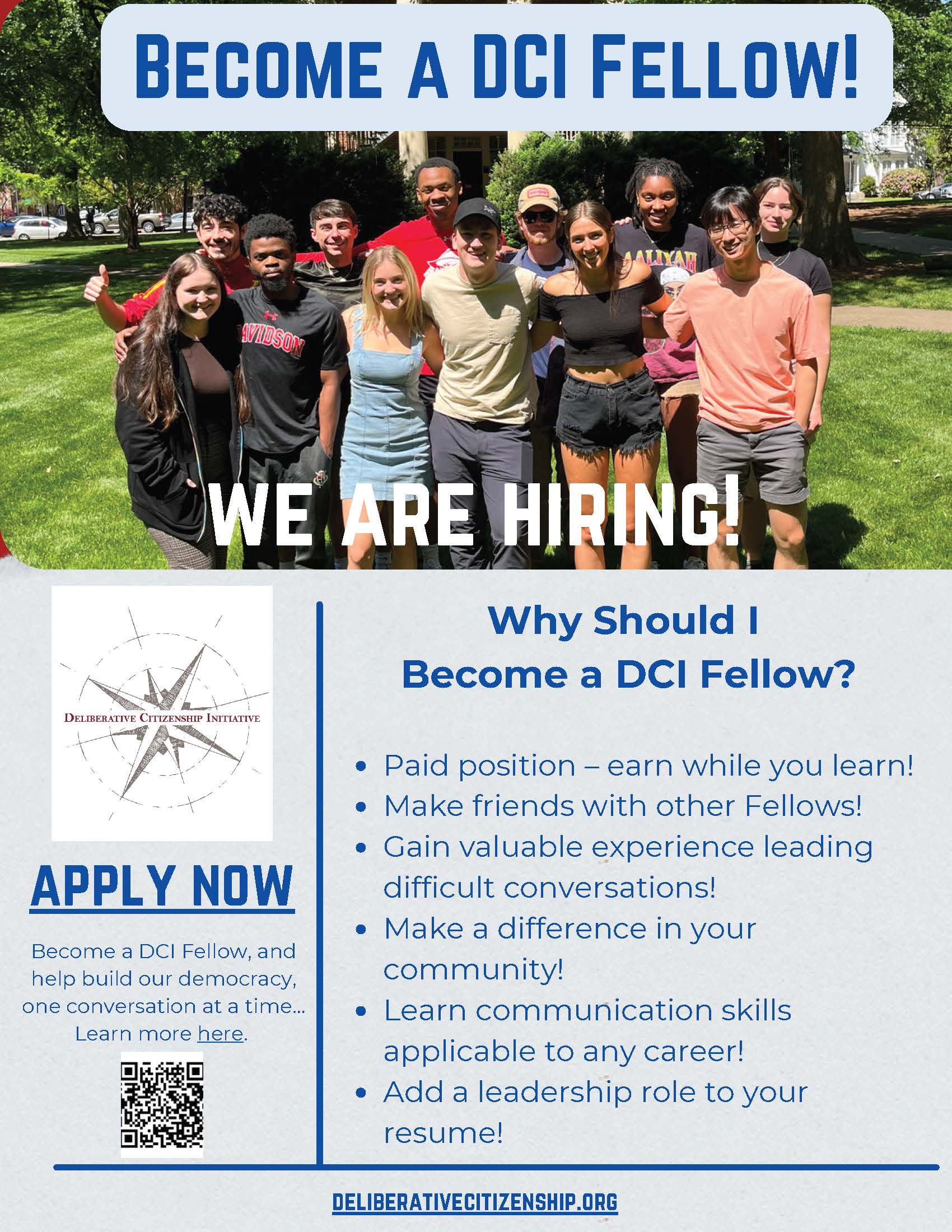
DCI Fellow Sign-Up Flyer.

Davidson students, the DCI is hiring! Apply to be a paid DCI Fellow for the 2023-24 academic year — earn while you learn, make friends with other Fellows, and gain valuable experience leading difficult conversations. You’ll also make a difference in your community, learn important communication skills applicable to any career, and be able to add a leadership role to your resume.

The purpose of the Deliberative Citizenship Initiative (DCI) is to create opportunities for Davidson students, faculty, staff, and members of the community to productively engage with one another on difficult and contentious issues facing our community and society. The Fellows Program offers interested Davidson students academic-year positions working with the DCI.

The DCI will select 12-15 students to work as Fellows for the 2023-2024 academic year. Fellows will meet weekly as a group with the DCI Faculty Director and Assistant Director to work towards achieving the DCI’s mission and goals – to teach deliberative skills, reinforce humane instincts, build meaningful community, catalyze creative solutions, and research deliberation. Fellows will also meet monthly with their Deliberative “D” Teams, small groups of 5-10 individuals who commit to engaging with one another on difficult issues.

Throughout the year, Fellows will immerse themselves in deliberative theory and methods by completing weekly curriculum assignments, deliberating among themselves, facilitating robust deliberations during D Team meetings and deliberative forums, learning from deliberative guest speakers, completing an individual deliberation project, and writing blog posts and reflections that document their experience. Fellows will also contribute to the planning of DCI programs by assisting with research, community engagement, and deliberation guide development. Fellows also play a leadership role in the DCI by serving as deliberative ambassadors demonstrating the skills of deliberation on campus and in the communities and organizations they are a part of.

In this age of intense feelings, rapid change, and hyper-polarization, Fellows will have the opportunity to contribute to the urgent and important work of bringing people together to explore how and why their perspectives are both similar and different – and begin building common solutions to our collective challenges. In the process, they will also enhance their ability to reason, engage in “good argument,” articulate their values, and help others do the same. These are life-long skills that will benefit fellows in their personal lives, in the classroom, and in their careers after Davidson. The ability to bring people together to tackle difficult challenges is in high demand across sectors, professions, and industries, and DCI Fellows will improve their capacity to do this critical work in a wide variety of settings.  

Program Components

The DCI Fellows program requires a commitment to learning about and doing deliberation. It empowers participants with new skills and knowledge to build community and promote more productive public discourse through deliberation. Key activities include:

  • Orientation – Fellows are required to complete an 8-hour deliberation facilitator training and orientation program in September.
  • Fellows Cohort Meetings – Fellows will meet as a group once a week during the Tuesday Common Hour to discuss deliberative topics covered in assigned readings, videos, and other materials, to debrief about their facilitation experiences, to plan DCI activities, and to deliberate as a group on important topics. Fellows will also serve on different committees focused on DCI goals and will provide committee updates and ideas during cohort meetings.
  • D Teams – Fellows will facilitate monthly Deliberative “D” Teams, which consist of 5-10 students, faculty, staff, alumni, and community members who are interested in engaging with one another over multiple sessions to discuss difficult issues. D Teams may meet both in-person or virtually.
  • Deliberative Forums and Other Events – Fellows will play key leadership roles in the DCI’s Deliberative Forums and other public events. These events enable one-time discussion and learning opportunities for students, faculty, staff, and community members and may be conducted in partnerships with other groups and organizations. The DCI hosts 1-2 deliberative events per semester.
  • Reflections and Blog Posts– Each Fellow will contribute one post per semester to the DCI Blog. Fellows will also be asked to reflect and write about their experiences throughout the year with the aim of informing the DCI about what worked well, what did not work well, and specific insights or takeaways, new ideas, and suggestions for program development.
  • Personal Deliberation Project– Fellows will organize, host, and facilitate a deliberative event that connects to their personal interests, exposes participants to the deliberation process, and builds Fellows’ capacity to conduct deliberative activities after they have completed the DCI Fellowship program.

Time Commitment and Compensation

Individuals can expect to commit approximately 5 hours every week to their work as a DCI Fellow. These hours may vary depending on the timing of scheduled events and activities. Fellows must be available for a 1-hour weekly cohort meeting during the Tuesday Common Hour and a 10-hour orientation and facilitation training at the start of the semester – 12:30 pm to 5:30 pm on September 10 and September 16 (including lunch both days). Per Davidson College’s Human Resources policies and guidance, Fellows will be compensated as follows: Fellows will be employed with the DCI as student workers to receive hourly compensation at a rate of $12.00 per hour, with maximum annual earnings of $1,800.

Eligibility

All students are eligible to apply on WildcatSync to become a 2023-2024 DCI Fellow. Approximately 12-15 students will be selected. Students in a work study program are eligible to apply their funding towards a job as a DCI Fellow. Davidson students who are part of scholarship and service programs such as the Bonner Scholars program may be able to apply their DCI Fellows experience towards program service hour requirements in lieu of compensation. Students should check with their respective program directors.

Deadline/How to Apply

To submit your application, please complete the ‘Deliberative Citizenship Initiative – Fellows Application’ form on WildcatSync. The priority application deadline is June 30. However, applications will remain open and new submissions accepted on a rolling basis until August 4th or once all positions have been filled by qualified candidates. Click here to access WildcatSync and complete your application. If you have any questions about your application, please email dci@davidson.edu.

Filed Under: Events Tagged With: facilitation

Registration for Upcoming Deliberative Forum on Social Media is Open!

March 15, 2023 by Graham Bullock

Image of Social Media: How should we engage and/or regulate it, if at all.

With Elon Musk’s recent acquisition of Twitter, the Supreme Court’s upcoming rulings on two cases (Gonzalez v. Google and Twitter v. Taameh) related to online content, and continuing concerns about the effects of online interactions on the mental health of teenagers in the news, questions about the role of social media in our lives have never been more salient. These questions exist at both the micro-level of personal decisions and interactions and the macro-level of society, politics, and democracy. Should we be on social media? Should we regulate it? If so, how and to what extent? Some argue that social media is generally positive for both individuals and society, while others assert that its harms far outweigh its benefits – at least as it currently operates.

To explore these questions, Davidson College’s Deliberative Citizenship Initiative, Digital Studies, Political Science, and Psychology Departments, and Jay Hurt Hub for Innovation and Entrepreneurship invite you to join us for a Deliberative Forum on “Social Media: How Should We Engage and/or Regulate it, If at All?” This Deliberative Forum will enable participants to actively engage with this important issue, first by hearing from an online panel of experts with diverse perspectives on the topic, and then by actively deliberating with one another in facilitated small group discussions (either in person or virtually) on how best to engage with and regulate social media (if at all). This is a fantastic opportunity to learn from experts, listen to the viewpoints of others, and share your own ideas about this challenging and complex topic.

The event is free but registration is required. We request that all registrants plan to attend both the panel and the small group discussions, which are designed to complement each other. Participants may join both in-person and online. Spaces are limited due to the number of trained DCI facilitators we have available to moderate the small group discussions. You may be placed on a waitlist if our capacity is reached; we will let you know if spaces open up. We will do our best to accommodate as many people as we can so please don’t hesitate to get on the waitlist. The Zoom link will be sent to online participants after they register.

Register on EventBrite
Social-Media-Forum-Poster_4.5.23

Panelist Bios:

Emily Dreyfuss is a journalist who covers the impacts of technology on society, with a focus on social media and information systems. She was a 2018 Nieman Berkman Klein fellow, a senior editor at WIRED and CNET, and a founding editor of the tech news website Protocol. Ms. Dreyfuss is currently Senior Editor and Research Fellow at the Harvard Kennedy School’s Technology and Social Change Project, where she co-leads the Harvard Shorenstein News Leaders Program and edits the Media Manipulation Casebook, a research platform that advances knowledge of misinformation and its threats to democracy, public health, and security. Ms. Dreyfuss is also a co-author of the 2022 book, Meme Wars: The Untold Story of the Online Battles Upending Democracy in America.

Melissa Hunt is the Associate Director of Clinical Training in the Department of Psychology at the University of Pennsylvania, where she also earned her PhD in psychology. Dr. Hunt conducts ongoing research on the cognitive and affective bases of depression, anxiety, and chronic gastrointestinal disorders, and has published two books on these topics for both patients and clinicians. In 2018, Dr. Hunt published the first experimental study on Facebook, Snapchat, and Instagram use, and found a causal link between time spent on these platforms and increased loneliness and depression. The study, “No More FOMO: Limiting Social Media Decreases Loneliness and Depression,” was published in the Journal of Social and Clinical Psychology and has been cited over 700 times.

Darius Kazemi is an internet artist and researcher who has been working on federated, decentralized social media since his Mozilla Open Web Fellowship in 2018. He maintains several federated social media software projects including Hometown, and published Run Your Own Social, a guide to hosting a small social media site for your friends. He is a Senior Software Engineer at Meedan where he works on Check, a software tool for content moderators and fact-checkers. He has been interviewed by The Wall Street Journal and The New York Times about the difficulty of identifying bot accounts on social media, and The Boston Globe has described him as “one of the most closely watched and pioneering figures at the intersection of technology, cultural commentary, and what feels to many like a new kind of Web-native art.”

Jacob Mchangama is CEO of the think tank Justitia and directs the organization´s Future of Free Speech Project. Jacob has written and commented extensively on free speech and human rights in international media outlets, including the Economist, L.A. Times, Washington Post, BBC, CBS News, NPR, CNN, Foreign Affairs, Foreign Policy, The Wall Street Journal, and Politico as well as top-tier academic and peer-reviewed journals. Jacob frequently appears on international TV and radio providing expert commentary on issues related to free speech, tech and human rights. Jacob is the producer and narrator of the podcast “Clear and Present” Danger: A History of Free Speech and author of the critically acclaimed book Free Speech: A History From Socrates to Social Media, published by Basic Books in 2022.

Mark Sample, Chair and Professor of Digital Studies at Davidson College, will serve as the moderator of the panel.

Filed Under: Events

Citizen University CEO Eric Liu Visits Davidson Monday – RSVP Today!

February 2, 2023 by Graham Bullock

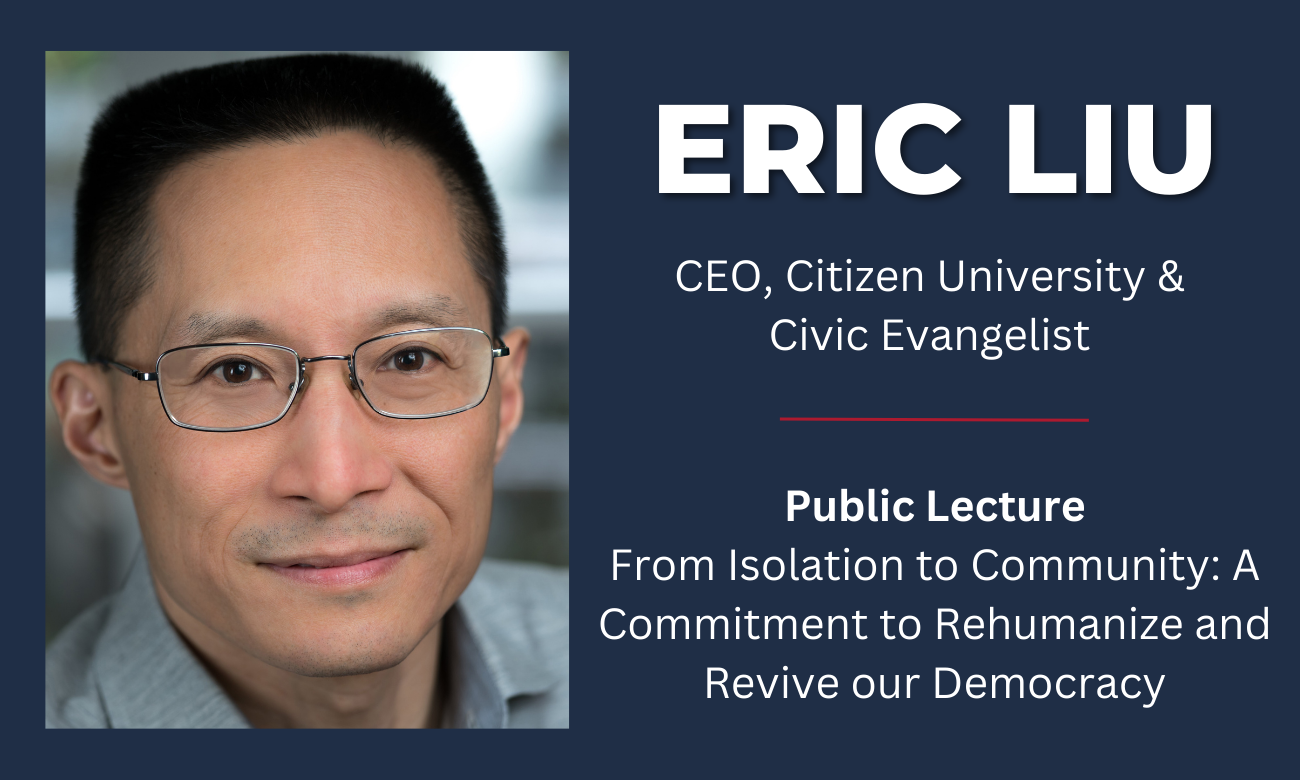
Introductory Slide for Eric Liu.

We are excited to share some information about two upcoming events co-sponsored by the Bonner Scholars Program and the Deliberative Citizenship Initiative featuring Citizen University CEO Eric Liu. The first is a public lecture by Mr. Liu this coming Monday evening (2/6) from 5 pm to 6:30 pm in the Lilly Gallery. The theme of his talk is “From Isolation to Community: A Commitment to Rehumanize and Revive our Democracy.” More information is below and attached; the event is free to attend in person but an RSVP is required on WildCatSync (there will also be a livestreaming option).

After his keynote address, Liu will lead a smaller interactive conversation exploring the key insights from the Better Arguments Project, a national civic initiative that he helped create to “bridge divides – not by papering over those divides but by helping people have better arguments.” Learn more below and RSVP on WildCatSync. The event is in-person and dinner is included for all participants, but seating is limited so RSVP as soon as possible if you are interested in joining.

Eric-Liu-Flyer-for-Email

PUBLIC LECTURE:

From Isolation to Community: A Commitment to Rehumanize and Revive our Democracy

Monday, February 6th, 5 pm to 6:30 pm

Is it possible to escape our culture of hyperindividualism, digital isolation, and status anxiety? What does it mean to be an engaged citizen in today’s divisive and divided political landscape? How can we come together to restore hope, find joy and purpose, revive democracy, and feel part of a connected community? Citizen University CEO Eric Liu confronts these questions, celebrates the shared values and beliefs that unite us, and provides an action plan for powerful citizenship. Drawing from his hit TED talk and the “Civic Saturdays” phenomenon his organization sparked, Liu will challenge us to rehumanize our politics and rekindle a spirit of love and responsibility in civic life. Not just for the good we will do for society, but for the powerful good that we will do for ourselves. To RSVP for this free event co-hosted by the Bonner Scholars Program and the Deliberative Citizenship Initiative, click here (in-person and streaming options available).

The Better Arguments Project:

AN INTERACTIVE CONVERSATION AND DINNER

Monday, February 6th, 7 pm to 8:30 pm

After his keynote address, Citizen University CEO Eric Liu will lead a smaller interactive conversation exploring the key insights from the Better Arguments Project, a national civic initiative that Liu helped create “to help bridge divides – not by papering over those divides but by helping people have better arguments.” Designed as a practical approach to enable individuals and groups with diverse perspectives to engage with one another (without rushing prematurely towards reconciliation), the Better Arguments Project focuses on incorporating historical context, emotional intelligence, and a recognition of power dynamics into these efforts. It is also based on five key principles for better arguments, which Liu will introduce and help participants actively consider how they can incorporate into their future conversations across differences. Dinner is included for all participants, but seating is limited so RSVP as soon as possible if you are interested in joining.           

Eric Liu, Citizen University CEO and Co-Founder

SPEAKER BACKGROUND

“Democracy works only when enough of us believe democracy works,” says Eric Liu. How do we rekindle that belief? How do we, as individuals, organizations, communities, corporations — even professions — reinvigorate the meaning and spirit of citizenship in America? These are the questions civic evangelist Eric Liu explores in his compelling, acclaimed talks – talks that celebrate our shared values and challenge Americans to live up to them. Liu is one of the country’s most sought-after speakers on citizen power, civic health, the future of democracy, and American identity. His inspirational 2019 main stage TED Talk, based on his work at Citizen University, received a standing ovation and more than topped one million views in less than a month. His two previous TED Talks, on power and on voting, have been viewed three million times. Recently, Liu has been elected to membership in the American Academy of the Arts and selected to be a 2020 Ashoka Fellow. In both cases he was recognized by colleagues and was championed by friends.

Liu, son of Chinese immigrants and former White House speechwriter, is the CEO of Citizen University, a nonprofit working to foster a culture of powerful, responsible citizenship. He also directs the Aspen Institute’s Citizenship & American Identity Program and is a correspondent at TheAtlantic.com. His eight books include You’re More Powerful Than You Think: A Citizen’s Guide to Making Change Happen, and the national best-sellers The Gardens of Democracy and True Patriot. His first book, The Accidental Asian, Notes of a Native Speaker was a New York Times Notable Book featured in the PBS documentary, “Matters of Race.” Liu’s latest book is Become America: Civic Sermons on Love, Responsibility and Democracy, which grows out of the Civic Saturday phenomenon that Liu and his team pioneered and has now spread nationwide. Liu served as a White House speechwriter for President Bill Clinton and later as the President’s deputy domestic policy adviser. He has also served as a board member of the Corporation for National and Community Service, the Washington State Board of Education and the Seattle Public Library and is co-founder of the Alliance for Gun Responsibility. He is a graduate of Yale College and Harvard Law School.

Reviewed as “phenomenal,” “amazing,” “motivating,” “moving” and “empowering” by audiences ranging from university leaders and K-12 educators to innovators in corporate citizenship, health care, and architecture, Liu’s talks are unforgettable experiences. With passion, magnetism, a grounding in history, and a sense of humor, Liu touches people from all walks of life and across the political spectrum. He ignites and unites. And he leaves his audiences inspired to take action, with a renewed spirit of common purpose and a deeper sense of civic responsibility.

Filed Under: Events

DCI Co-Hosts Deliberative Forum on Parents and Schools

October 4, 2022 by Graham Bullock

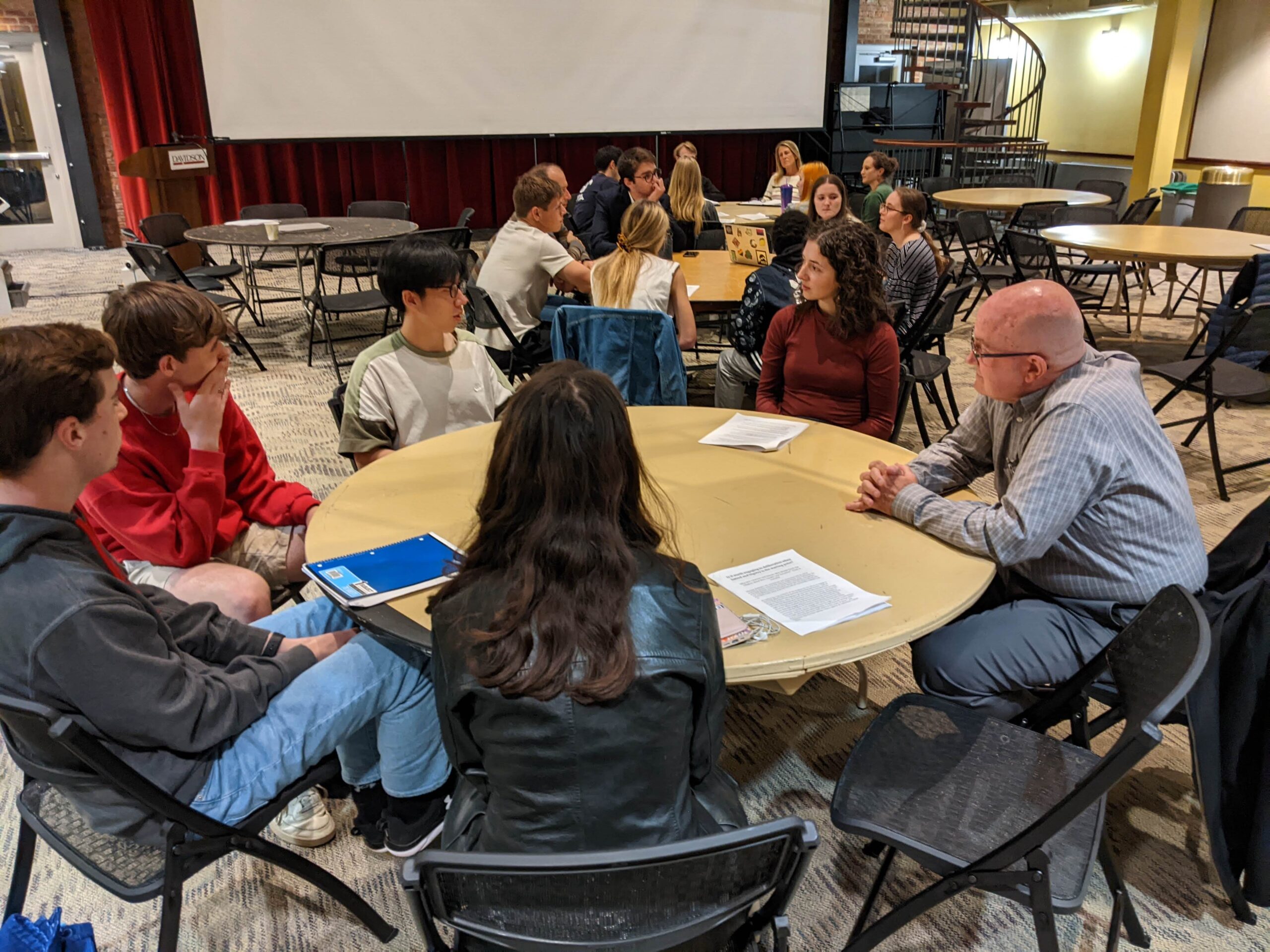
deliberators at the Davidson College 900 room.

On September 29, 2022, the Deliberative Citizenship Initiative, in partnership with Davidson College’s Educational Studies Department and Political Science Department, co-hosted a Deliberative Forum on “Parents and Schools: Who Should Teach our Children about Race, Gender, and Sexuality.” The event included both an expert panel discussion and small group deliberations on the topic.

The DCI selects both locally and nationally relevant topics for its forums that citizens – in the broadest sense of the word – have strongly-held, diverse, and conflicting views on and are highly salient to current and ongoing social and political debates. The topic of this forum certainly fits this description, and the strength of views on the topic were demonstrated by the student protests that were held outside the event. Protesters objected to the inclusion of Dr. Melissa Moschella, an associate professor of philosophy at Catholic University, on the panel due to her views on abortion, race, and transgender issues.

As background, the DCI invites panelists to its Deliberative Forums in order to introduce attendees to diverse perspectives on the topic at hand and provide an opportunity for them to witness good argument and a thoughtful, respectful exchange of reasons between people who may disagree deeply. The DCI does NOT endorse the views of any of the panelists it invites but selects them based on the depth and relevance of their expertise to the topic under discussion.

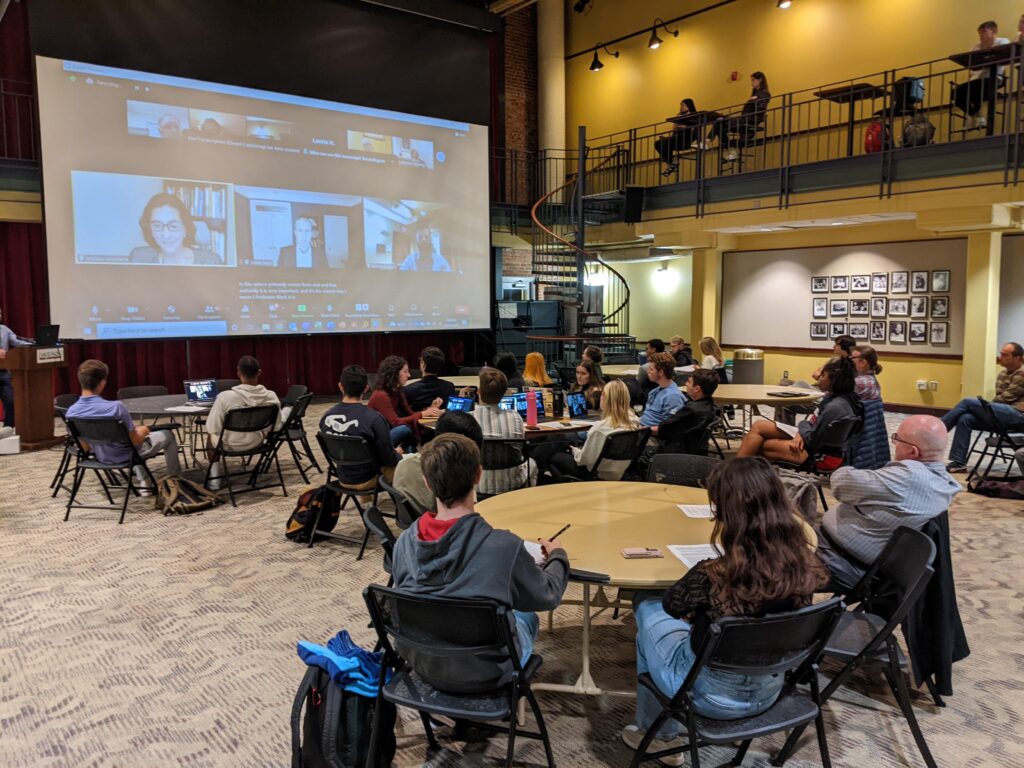
panelists

The DCI is committed to the idea that listening to speakers with whom we disagree does not imply agreement; it suggests a willingness to seek out the truth together and to better understand one another’s perspective as fellow citizens with equal status at the table. Melissa Moschella and Derek Black, the event’s other invited panelist, are two of the most highly-qualified and well-published scholars who can speak to the contentious questions surrounding the role of schools and parents in educating children about social issues.

Given their diverse viewpoints, panelists like Dr. Moschella and Dr. Black may hold views that some citizens reasonably find offensive. The DCI is committed to creating spaces for people to engage with, evaluate, and challenge these positions in a productive and civil manner.

More generally, the DCI is committed to catalyzing creative, broadly-supported solutions to the major social challenges facing our community and society – including racism, sexism, and other forms of injustice – through the process of deliberation across differences.

The video of the event is posted below, and we invite everyone to view the panel discussion, which was moderated by Professor Dan Layman, an associate professor of philosophy at Davidson and a co-convener of the DCI. Dr. Layman asked direct questions of each panelist while also allowing them to follow-up on each other’s points. Their discussion was followed by an hour-long opportunity for attendees to engage with one another on these topics in discussions facilitated by the DCI’s trained facilitators. Periods when we had some technical difficulties (this was our first hybrid in-person/virtual event) and when the discussion was temporarily disrupted by protesters have been edited from the video; all comments from the panelists are still included.

Filed Under: Events Tagged With: 2022-2023, Deliberative Forums

Upcoming Deliberative Forum on Parents and Schools: Who Should Teach Our Kids about Race, Gender, and Sexuality?

September 21, 2022 by Graham Bullock

The Davidson College Deliberative Citizenship Initiative, Educational Studies Department, and Political Science Department invite you to join us for a Deliberative Forum on “Parents and Schools: Who Should Teach our Kids about Race, Gender, and Sexuality?” Both in-person and online attendance options are available, but space is limited. The event will be held on Thursday, September 29 from 7 pm to 9 pm, and you may register to attend on EventBrite here.

Tensions surrounding responsibilities for teaching children about race, gender, and sexuality have become a prominent source of political debate. Some argue that it is the job of educators and schools to support students’ various identities, regardless of whether their parents are uncomfortable or anxious about such information. Others argue that parents ought to have control over what their children learn regarding complicated racial, sexuality, and gender matters.

This Deliberative Forum will enable participants to explore this important issue, first by hearing from a panel of experts on this issue, and then by actively deliberating with one another in facilitated small group discussions on how best to understand and engage with the tensions surrounding parents, schools, and childhood education about contentious social issues. This is a fantastic opportunity to learn from experts, listen to the perspectives of others, and share your own ideas about the roles of parents and schools in educating children about contentious social issues.

The event is free but registration is required. We request that all registrants plan to attend both the panel and the small group discussions, which are designed to complement each other. Spaces are limited due to the number of trained DCI facilitators we have available to moderate the small group discussions. You may be placed on a waitlist if our capacity is reached; we will let you know if spaces open up. We will do our best to accommodate as many people as we can so please don’t hesitate to get on the waitlist.

Panelist Bios:

Derek Black is Professor of Law and the Ernest F. Hollings Chair in Constitutional Law at the University of South Carolina’s School of Law. Professor Black’s work focuses on school funding and equality for disadvantaged students, and his books Education Law: Equality, Fairness and Reform and Schoolhouse Burning: Public Education and the Assault on American Democracy and articles on “The Fundamental Right to Education” and “Charter Schools, Vouchers, and the Public Good” are particularly relevant to the forum’s topic. Professor Black began his career litigating education cases at the Lawyers’ Committee for Civil Rights Under Law and teaching at Howard University School of Law, where he founded the Education Rights Center. He received his JD from the University of North Carolina, Chapel Hill and his BA in African American Studies, Philosophy, and Political Science from the University of Tennessee.

Melissa Moschella is an Associate Professor in the School of Philosophy at the Catholic University of America. Professor Moschella has written extensively on the rights of parents in education, including her dissertation on “Parental Rights in Education,” her 2016 Cambridge University Press book on To Whom Do Children Belong? Parental Rights, Civic Education, and Children’s Autonomy, and a recent paper in the Notre Dame Journal of Law, Ethics, and Public Policy on “Defending the Fundamental Rights of Parents: A Response to Recent Attacks.” Professor Moschella is also a McDonald Distinguished Fellow at the Emory University Center for the Study of Law and Religion, and has served as a Myser Fellow at the Notre Dame Center for Ethics and Culture. She received her PhD in political philosophy from Princeton University and her bachelor’s degree in Social Studies from Harvard University.

Daniel Layman, Associate Professor of Philosophy at Davidson College and a Co-Convener of the Deliberative Citizenship Initiative, will moderate the panel discussion.

Filed Under: Events

  • « Go to Previous Page
  • Page 1
  • Interim pages omitted …
  • Page 14
  • Page 15
  • Page 16
  • Page 17
  • Page 18
  • Page 19
  • Go to Next Page »

Footer

Blog Post Categories

  • Announcements
  • Blog Posts
  • DCI Posts
  • Events
  • Faculty Posts
  • Fellow Posts
Image of a compass superimposed by the text "Deliberative Citizenship Initiative" and "Davidson College." Clicking on this image leads to the Initiative page.

Recent DCI Blog Posts

  • We Tried to Fix Jubilee’s “Middle Ground” – Here’s How It Went
  • A Case for Deliberation in the Natural Sciences
  • Welcoming New Staff to the DCI and DCN
  • Facebook
  • Twitter
  • Instagram
  • LinkedIn


Copyright © 2026 · Infinity Pro on Genesis Framework · WordPress · Log in