• Skip to main content
  • Skip to footer

Deliberative Citizenship Initiative

Building Democracy One Conversation at a Time

  • The Initiative
    • Programs
      • Deliberation Across the Curriculum
      • Deliberation on Campus
      • Deliberation in the Community
      • Research on Deliberation
    • Motivations
      • Why Deliberative Citizenship?
      • Why Davidson? Why Now?
    • Who’s Involved?
      • DCI Fellows Cohorts
        • 2025-2026 Fellows
        • 2024-2025 Fellows
        • 2023-2024 Fellows
        • 2022-2023 Fellows
        • 2021-2022 Fellows
        • 2020-2021 Fellows
      • DeeP Collaborative Cohorts
        • 2024-2025 DeeP Collaborative Faculty
        • 2023-2024 DeeP Collaborative Faculty
      • Advisory Council
    • History
      • What Sparked the Initiative?
    • Key Deliberative Dispositions
    • Frequently Asked Questions (FAQ)
    • Annual Report
  • Get Involved!
    • Participate in a Forum
    • Join a D Team
    • Become a Fellow
    • Take Courses
    • Get Training
    • Come to Guest Lectures
  • Events
    • Upcoming Events
      • 250th Anniversary Deliberative Forum Series on American Values
    • Past Events
  • Connections
    • The Deliberative Citizen: The DCI’s Monthly Newsletter
    • Efforts on Campus
    • Efforts in the Community
    • Efforts Elsewhere
    • Readings and Resources
      • DCI-Published Guides
      • DCI Guide to One-on-One Conversations
      • How to Disagree
      • Demonstration of Facilitation Styles
      • Deliberative Pedagogy Mini-Course
    • How We Can Help: DCI’s LET’S DELIBERATE! Partnership Opportunities
    • DCI in the News
  • DCI Blog Posts
    • Recent Blog Posts
    • All Blog Posts

Announcements

A Deliberative History Forum: The Power of Historical Narratives and Contested Histories

April 4, 2025 by TBC Takougnadi

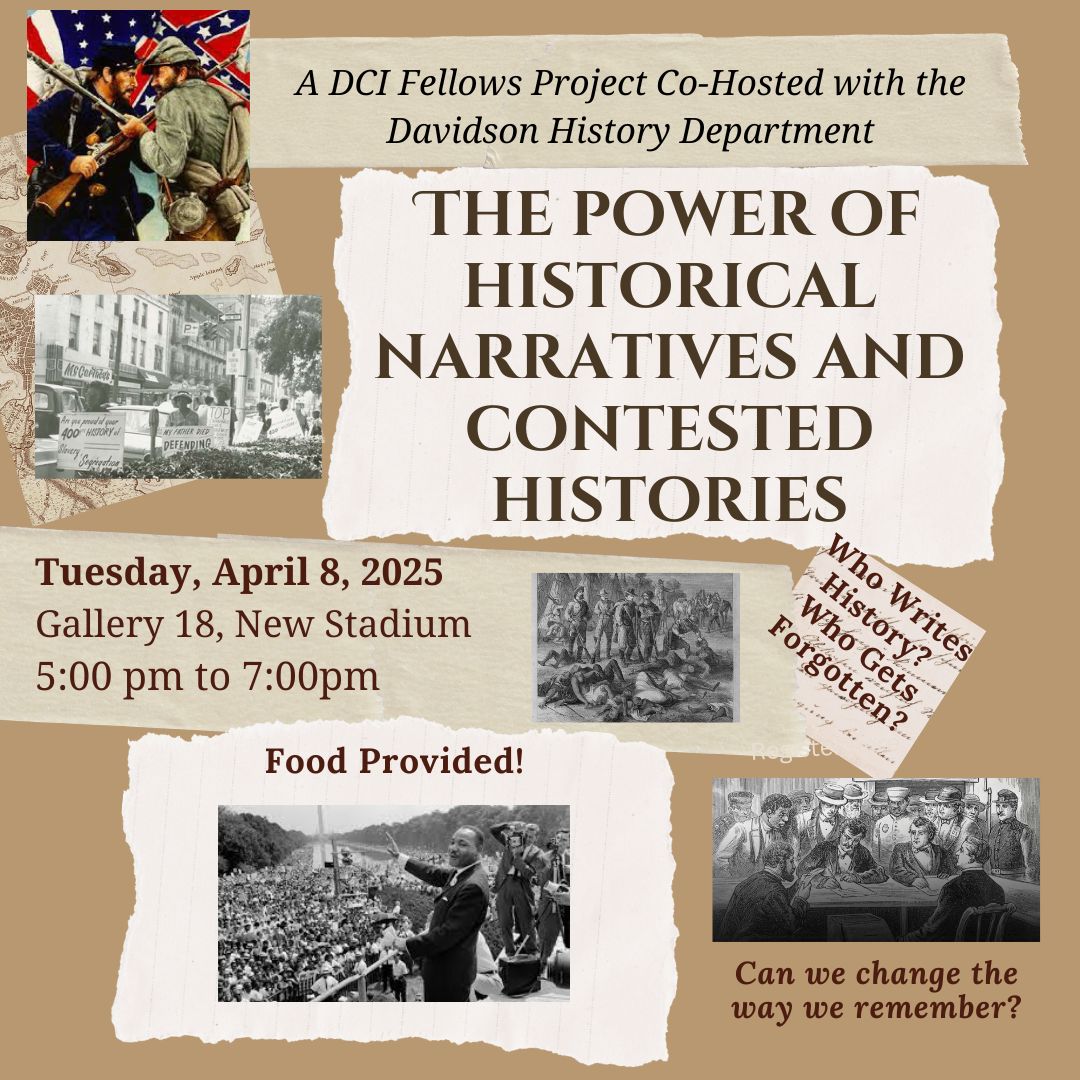
Poster for Deliberative History Forum

DCI Fellow Bosisso Charles Takougnadi ’27 (TBC)

History is not just a record of the past, it is a battleground of memory, identity, and power. The stories we tell about where we come from shape who we are, how we understand justice, and what kind of future we imagine. Yet history is rarely a singular, uncontested truth. Different communities, scholars, and political forces often clash over whose narratives are centered, whose voices are amplified, and whose experiences are erased. 

At Davidson College, we have a unique opportunity to engage in this vital conversation. On April 8, 2025 from 5 pm to 7 pm in the New Davidson Stadium’s Gallery 18, we invite students, faculty, and community members to join a critical discussion titled “The Power of Historical Narratives and Contested Histories.” This event is a deliberation project being organized by DCI Fellow Bosisso Charles Takougnadi ’27 (TBC) in collaboration with the History Department and the Deliberative Citizenship Initiative. It will feature insights from distinguished professors Jonathan Berkey, Jakub Kabala, Hilary Green, Dáša Mortensen, and John Wertheimer, who will explore how historical narratives are constructed, challenged, and reclaimed. You can register here.

 Why Does This Conversation Matter? 

 1. History Shapes Our Present and Our Future 

History is more than the past; it actively informs our laws, policies, and social structures. When certain narratives dominate while others are suppressed, the consequences are real. Consider: 

How do textbooks frame (or omit) slavery, colonialism, or Indigenous displacement? Why do some historical figures become national heroes while others are forgotten? What happens when marginalized communities reclaim their own histories? 

These questions matter because they determine whose struggles are acknowledged, whose grievances are legitimized, and whose futures are prioritized. 

 2. Contested Histories Reveal Power Dynamics 

As Professor John Wertheimer will discuss, the old saying that “history is written by the victors” is only partly true. While dominant groups often control official narratives, marginalized communities have always resisted, reinterpreted, and rewritten history. Professor Wertheimer will draw from U.S. legal history to show how contested narratives don’t just reflect power they can create it, shaping legal decisions, public memory, and even the outcomes of social movements. 

 3. Silenced Histories Can Be Reclaimed but Not Without Struggle 

One of the most powerful acts of resistance is the recovery of erased histories. Professor Hilary Green will examine how African American communities developed communal archival practices to counter the intentional silencing of their past. Even after the Civil Rights Movement, recovery efforts were faced and still face fierce opposition. Today, projects uncovering suppressed histories (from Tulsa’s Black Wall Street to Indigenous land dispossession) are met with political backlash, proving that historical narratives remain deeply contested. 

 4. Global Perspectives Enrich the Conversation 

This discussion is not limited to U.S. history. Professors Jonathan Berkey, Jakub Kabala, and Dáša Mortensen will bring transnational perspectives, exploring how historical narratives are constructed, weaponized, and reinterpreted across different cultures and eras. From colonial legacies to post-war memory politics, these comparisons remind us that the struggle over history is a global phenomenon. 

Why Should You Participate? 

This is not just an academic exercise. Whether you are a student, educator, or community member, history affects you. Here’s why your voice matters in this discussion: 

Students: You are inheriting a world shaped by these narratives. Engaging critically with history empowers you to question, challenge, and rewrite dominant stories. 

Educators: How we teach history influences the next generation’s understanding of justice and identity. 

Community Members: Local histories from Davidson’s own past (like slavery) to national debates are part of this conversation. Your perspective is essential. 

 Join Us 

We need diverse voices in this discussion. Come listen, learn, and contribute as we explore the following existential questions: 

How do historical narratives reinforce or challenge power? 

What does it mean to “reclaim” silenced histories? 

Why are some histories still so fiercely contested today? 

How do historical narratives of victimhood shape political legitimacy and moral authority in the Israel-Palestine conflict, and in what ways does the comparison to the Holocaust influence global perceptions and policy responses?

Event Details: 

📅 Date: April 8, 2025

📍 Location: Gallery 18, new football stadium.

🕒 Time: 5 pm to 7 pm

Food will be provided!

This is more than a lecture, it’s a dialogue. Let’s confront the past to better understand the present and shape a more just future. 

Help us with our planning by registering in advance at the link below. Once you register, we will send you a deliberation guide that will provide useful background for the discussion.

Deliberative History Forum Registration Link

And see the poster below for more information:
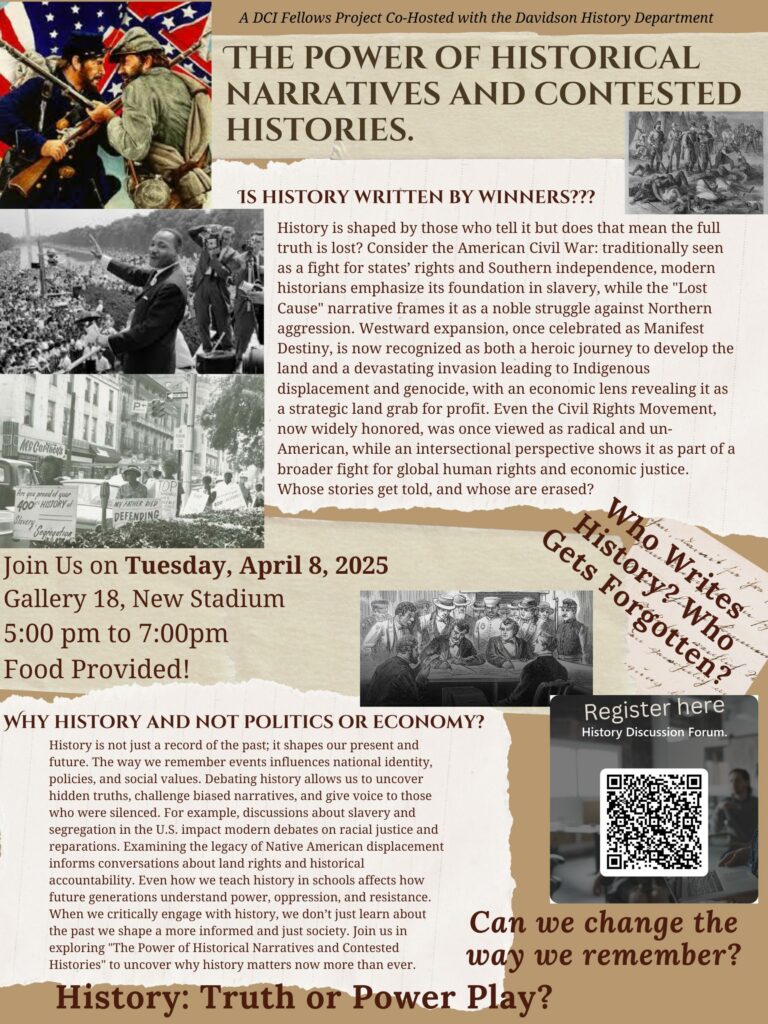
Full poster for History Forum

Filed Under: Announcements, Fellow Posts

A Campus Conversation about the Honor Code

March 1, 2025 by Graham Bullock

honor code conversation flyer.

Academic integrity is a core value at Davidson College, shaping our community’s commitment to honesty, trust, and responsibility in scholarship. But what does a robust culture of academic integrity truly look like? How do we define it, how well does it align with Davidson’s current academic culture, and what steps—if any—should we take to strengthen it?

Join the Deliberative Citizenship Initiative (DCI), Honor Council, Student Government Association (SGA), and the Office of the Vice President of Student Life for a Campus Conversation on Academic Integrity on Thursday, March 27 from 5:00 to 7:00 PM in the Lilly Gallery. This event will complement and build on the Celebration of Honor earlier in the month and offers an opportunity for students, faculty, and staff to come together in meaningful discussion about the role of academic integrity at Davidson.

The forum will begin with a brief update about Davidson’s honor code from the Honor Council, but the majority of the evening will be dedicated to roundtable discussions among students, faculty, and staff. Participants will consider:

  • What does academic integrity mean in practice?
  • What is Davidson’s current culture around academic integrity?
  • Should strengthening academic integrity be a priority, and if so, how?
  • How should we respond to challenges like cheating and plagiarism?

The conversation will be guided by a deliberation framework developed by DCI Senior Fellow and Co-Convener LJ Phillips ’25 and DCI Fellows Isabella Neri ’27 and Cavan Klein ’27, with support from DCI Faculty Director Graham Bullock. A deliberation guide will be shared with all participants in advance to provide background information and key discussion questions.

This forum is open only to Davidson students, faculty, and staff, and registration is required as dinner will be provided. Come be part of this important conversation and help shape the future of academic integrity at Davidson.

  • Register on WildCatSync by March 25 to reserve your spot!

Filed Under: Announcements, DCI Posts

Shape the Future of Transportation: Davidson Red Line Station Design Planning Session

February 20, 2025 by Graham Bullock

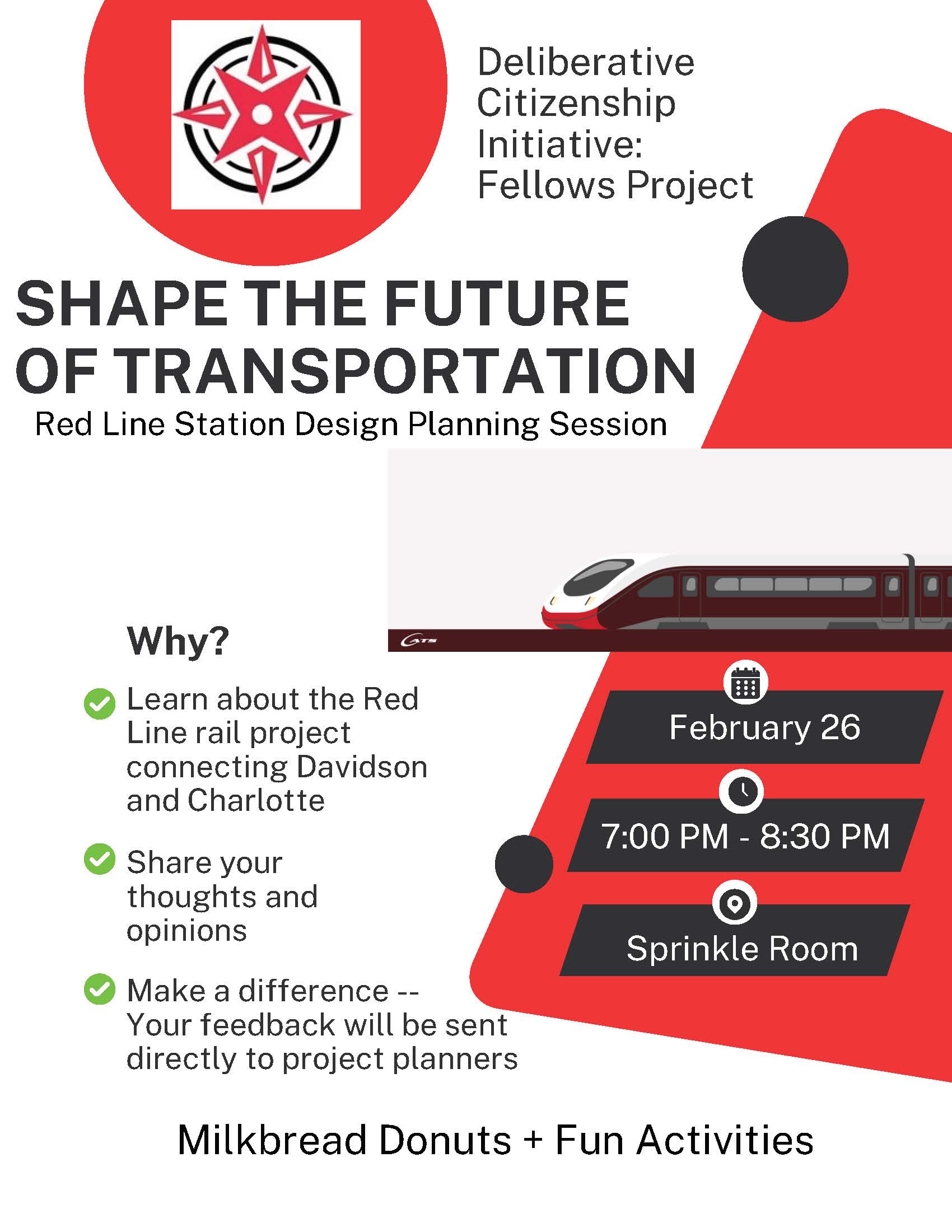
Flyer for Red Line Station Conversation.

Imagine stepping onto a train in Davidson and arriving in Uptown Charlotte—no traffic, no parking stress, just a smooth, direct ride. That’s the vision behind the Red Line Commuter Rail, a long-planned 25-mile transit project connecting Charlotte with Huntersville, Cornelius, Davidson, and Mooresville. This major infrastructure investment could transform regional transportation, opening new opportunities for Davidson residents and students alike.

As the project gains momentum, community voices are more important than ever. Hopes about the project may be tempered by questions and concerns about its effects on traffic, parking, and neighboring communities. The current phase of the project is focused on identifying the best site for the station in Davidson, and several options have been identified.

Join us on February 26 from 7:00 to 8:30 PM for a Community Conversation on the Red Line Station in Davidson, co-hosted by the Town of Davidson and the Deliberative Citizenship Initiative (DCI). The event is being designed and organized by two DCI Fellows, Garratt Rothberg ’27 and Zak Abdulahi ’27, with support from one of the DCI’s Senior Fellows and Co-Conveners, Emre Guvenilir ’25.

This event offers a unique chance to:
🚆 Hear from the Town of Davidson about the latest station design options and project updates.
💬 Engage in small-group discussions guided by trained facilitators, where participants can share their hopes, concerns, and ideas.
✨ Consider the impact of the Red Line on mobility, economic development and community life in Davidson, and connections to Charlotte and other towns on the Red Line.

This conversation is designed to complement the Town’s previous detailed information sessions by offering a space for dialogue and reflection—especially for Davidson College students, faculty, staff, and community members eager to explore the project’s implications.

Everyone is welcome—whether you’re excited, skeptical, or simply curious about what the Red Line could mean for Davidson’s future. Come join the conversation and help shape the vision for our town’s transit future!

📍 Date & Time: Wednesday, February 26 | 7:00 – 8:30 PM
📍 Location: Davidson College Union, Sprinkle Room, Fourth Floor (in person)

Registration is not required, but if you sign up we’ll send you a Deliberation Guide that will provide you with some useful background about the project. We’ll also have donuts from Milkbread to enjoy during the conversation. We look forward to seeing you there!

Filed Under: Announcements, Events

Ping Pong and Deliberation: Join us for our Semester Kickoff Party!

January 17, 2025 by Graham Bullock

flyer for spring kickoff party.

On Thursday, January 23rd from 5-7 pm, the DCI and the Davidson College Ping Pong Club are co-hosting a Spring 2025 Kickoff Party! We will be in the Alvarez-Brown Atrium at the Alvarez College Union, and we welcome you to join us for an evening of connection, deliberation, and fun! We’ll have pizza, prizes, and some engaging deliberative activities in which you’ll be able to engage with members of our Davidson community on both local and national topics of interest. It’s a great way to kick off the new year and connect with others who are interested in building community and improving our public discourse.

We will also have some ping pong tables setup so you can play a game in between interesting conversations – and watch others display their skills while you chat with new and old friends.

This event is intended to bring together those who have already been involved with the DCI in some way with people who may not have had an opportunity yet to engage in our programming or would like to learn more about us. If you completed our Deliberation Facilitator Training in the past, have taken part in any of our Deliberative Forums or D Teams, we would love for you to join us and help show others what the DCI is all about.

If you’ve never been to a DCI event or want to participate more but don’t know how to get involved, this is a perfect opportunity to learn more from the DCI community. Students, staff, faculty, community members, alums and family members are all welcome! We’ll share a bit about our plans for the upcoming semester – we’ve got some great events and activities on the calendar for 2025!

We hope you’ll decide to join us for our Kickoff Party! Feel free to drop in any time, bring a friend, and enjoy some free pizza! Registration is not required but an RSVP is appreciated for our planning purposes.

Filed Under: Announcements

Join our Winter Deliberative Forum on Religion in Public Life

January 11, 2025 by Graham Bullock

Religion in public life forum flyer.

Our Winter Deliberative Forum on Thursday, February 13 from 7 to 9 p.m. (both online and in the Lilly Gallery) will focus on Religion in Public Life: What role should religion play in the public square and government policies? Click here to register today!

Religion has been a powerful force shaping societies, values, and identities throughout history. In modern democracies, the intersection of religion and public life raises important questions: How do we balance freedom of religion with the principles of secular governance? To what extent should religious beliefs influence public policy? And how can diverse faiths and perspectives coexist harmoniously in a shared public square?

Davidson College’s Deliberative Citizenship Initiative, Chaplain’s Office, and Political Science Department invite you to explore these questions at this upcoming Winter Deliberative Forum, which will enable participants to actively engage with this important issue, first by hearing from a panel of experts and advocates with diverse perspectives on the topic. Then participants will actively deliberating with one another in facilitated small group discussions (either in person or virtually) about these questions. This is a fantastic opportunity to learn from experts, listen to the viewpoints of others, and share your own ideas about this challenging and complex topic.

Our panel features the following experts who hold a range of perspectives on the topic of the forum. They include: 

Photo of Robert Destro

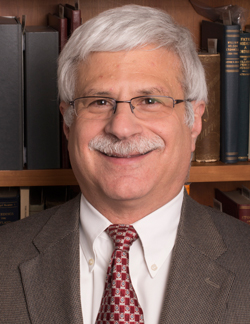
Robert Destro is Professor of Law at The Catholic University of America’s Columbus School of Law in Washington, D.C. He has served as the school’s Interim Dean and as Director of the University’s Institute for Policy Research and Catholic Studies. He is the co-author of Religious Liberty in a Pluralistic Society (Carolina Academic Press, 2002) and co-editor of Religion in Public Life (Vol. II): Religion and Political Structures: From Fundamentalism to Public Service (Council for Research in Values & Philosophy, 2005), and author of numerous other scholarly publications. Destro also served as the Assistant Secretary of State for Democracy, Human Rights, and Labor in the Trump Administration as well as a Commissioner on the United States Commission on Civil Rights in the Reagan Administration. His work included efforts to ensure that supply chains do not include goods or services produced by slave or forced labor. He also served as General Counsel to the Catholic League for Religious and Civil Rights, and he has been an advisor to religious organizations from a variety of religious traditions. Destro received his BA from Miami University in Oxford, Ohio, and his JD from the University of California, Berkeley. 

Photo of Bill McKenith

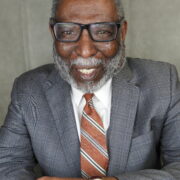
William McKenith is a pastor, educator, and author. He has served as the pastor of Reeves Temple African Methodist Episcopal Zion Church (A.M.E. Zion Church) in Davidson, NC, since June 2023. McKenith has pastored A.M.E. Zion churches for 28 years in both New Jersey and North Carolina, and the 48th Session of the General Conference of The A. M. E. Zion Church elected McKenith as a Justice of the Judicial Council.  He has also served as the A.M.E. Zion Church’s Archivist, Editor of its Quarterly Review, and Secretary of its Historical Society. McKenith has also served as Associate Dean of Students and Associate Professor of Ministerial Studies at Hood Theological Seminary, and recently co-authored the book, The Contemporary History of The African Methodist Episcopal Zion Church: The Freedom Church, 1972-2016 (A.M.E. Zion Publishing House, 2024), along with numerous other scholarly publications. McKenith has a BS degree in Business Administration from Norfolk State University; a Master of Divinity degree from New York Theological Seminary; and a Master of Philosophy degree and PhD from Casperson School of Graduate Studies at Drew University.

Photo of Hadia Mubarak

Hadia Mubarak is an Associate Professor of Religion at Queens University of Charlotte, and has previously served at Guilford College, New York University-Abu Dhabi, UNC-Charlotte, Davidson College, and Georgetown University. She is the author of Rebellious Wives, Neglectful Husbands: Controversies in Modern Qurʾanic Commentaries (Oxford University Press, 2022),“Crossroads,” I Speak for Myself: American Women on Being Muslim (White Cloud Press, 2011), and numerous articles on women and the Qur’an. She currently serves as a scholar-in-residence with the Muslim Community Center of Charlotte, a Board of Advisors member with the Carleton Center for the Study of Islam, and a scholar with the Institute for Social Policy and Understanding. Mubarak was the first female to be elected president of the national Muslim Students Association. As a field researcher, Mubarak has conducted on-site interviews and surveys with a range of Muslim scholars, government officials, activists, students, and journalists in Qatar, Jordan, Syria, Turkey, Pakistan and India. Mubarak received her master’s degree in Contemporary Arab Studies from Georgetown University, her BA in International Affairs and English from Florida State University, and her Ph.D. in Islamic Studies from Georgetown University.

photo of Nancy Petty

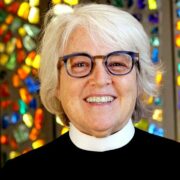
Nancy Petty has served as the senior pastor at Pullen Memorial Baptist Church in Raleigh, NC since 2002. Previously she served as Pullen’s Minister of Christian Education and Associate Pastor. In her role as Pullen’s senior pastor, Petty is a community faith leader who speaks out on issues of social justice, interreligious dialogue, and inclusion of the LGBTQIA+ community. She is chair of the Board for Repairers of the Breach, an organization started by the Reverend William Barber, and she has contributed to several books written on the North Carolina Moral Monday movement that she helped lead with Reverend Barber. She has received numerous awards for her work, including the 2014 North Carolina NAACP Minister of the Year Award; 2015 Human Relations Commission City of Raleigh Award; 2016 Champions for Children Award, and the 2018 Neighbor to Neighbor Award. In 2019, The Center for American Progress listed her as one of nine ministers to watch in our nation in 2019. Petty received her BA in religion/religious studies from Gardner-Webb University, her Masters of Divinity from Southeastern Baptist Theological Seminary, and her Doctorate of Ministry from McCormick Theological Seminary.

Photo of Brian Silva

Brian Silva is Vice President of Outreach at Americans United for Separation of Church and State. Founded in 1947, Americans United is a not-for-profit organization dedicated to ensuring that religion does not dictate public policy and that discrimination is not justified under the guise of religion. It is focused on protecting the American principle of freedom of religion — including the right to believe or not believe — for all. Silva spearheads efforts to organize AU members at the grassroots level to support church-state separation, including the Summit for Religious Freedom. Silva has almost three decades of organizing experience rooted in creating change through education and advocacy. After working as a high school history teacher and mentor, Brian has served as the Executive Director of Marriage Equality USA and as the Executive Director of the National Equality Action Team (NEAT), which he also founded. He also has a background in emergency management and disaster response, having worked at organizations such as the American Red Cross and Kenyon Worldwide Disaster Management. Silva earned his MPA from Metropolitan College of New York and his BA in Government from the University of Redlands.

Blum photo.

The panel will be moderated by Jason Blum, Associate Professor of the Practice of Writing at Davidson College. Jason completed his doctoral studies in Religious Studies at the University of Pennsylvania and has taught courses and is working on a book on religion in the public sphere. His research focuses on the intersections of religion, science, and ethics, and his work has appeared in The Journal of the American Academy of Religion, Method and Theory in the Study of Religion, and other scholarly publications.

The event is free but registration is required. Click here to register. We request that all registrants plan to attend both the panel and the small group discussions, which are designed to complement each other. Participants may join both in-person and online. Spaces are limited due to the number of trained DCI facilitators we have available to moderate the small group discussions. The Zoom link will be sent to online participants after they register.

Following the panel discussion, both online and in-person forum attendees will have the opportunity to deliberate about the topic among themselves, guided by the DCI’s trained facilitators.

Find out more about the event, learn about our panelists’ backgrounds and sign up to attend the forum by February 11 at this link. Virtual and in-person registration options are available. We hope you can join us!

Filed Under: Announcements, Events

  • « Go to Previous Page
  • Page 1
  • Interim pages omitted …
  • Page 4
  • Page 5
  • Page 6
  • Page 7
  • Page 8
  • Interim pages omitted …
  • Page 16
  • Go to Next Page »

Footer

Blog Post Categories

  • Announcements
  • Blog Posts
  • DCI Posts
  • Events
  • Faculty Posts
  • Fellow Posts
Image of a compass superimposed by the text "Deliberative Citizenship Initiative" and "Davidson College." Clicking on this image leads to the Initiative page.

Recent DCI Blog Posts

  • We Tried to Fix Jubilee’s “Middle Ground” – Here’s How It Went
  • A Case for Deliberation in the Natural Sciences
  • Welcoming New Staff to the DCI and DCN
  • Facebook
  • Twitter
  • Instagram
  • LinkedIn


Copyright © 2026 · Infinity Pro on Genesis Framework · WordPress · Log in