DCI Fellow Bosisso Charles Takougnadi ’27 (TBC)
History is not just a record of the past, it is a battleground of memory, identity, and power. The stories we tell about where we come from shape who we are, how we understand justice, and what kind of future we imagine. Yet history is rarely a singular, uncontested truth. Different communities, scholars, and political forces often clash over whose narratives are centered, whose voices are amplified, and whose experiences are erased.
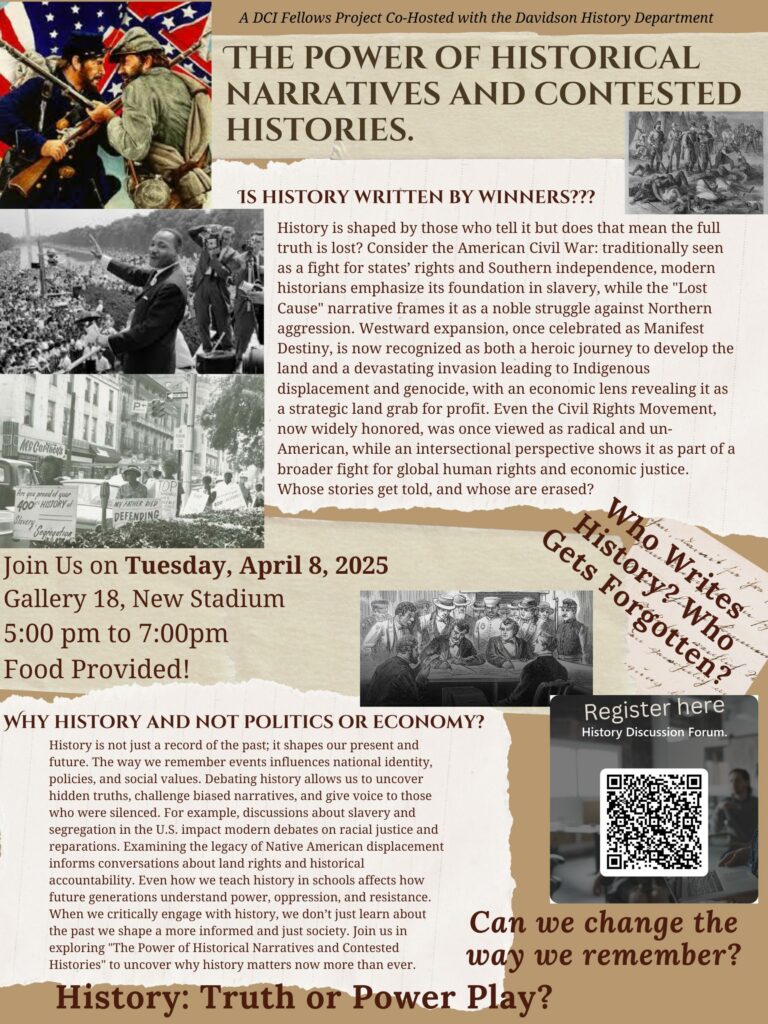
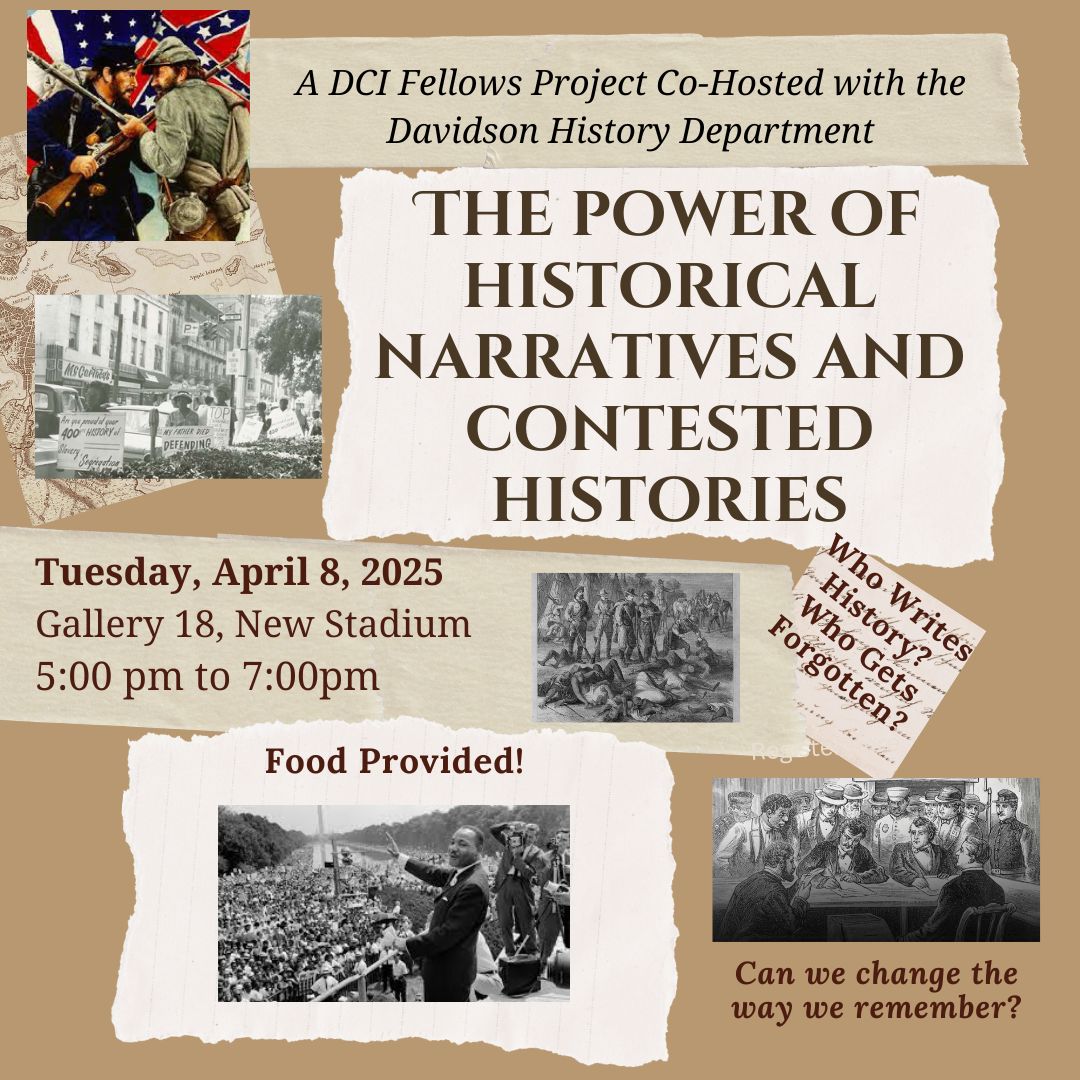
At Davidson College, we have a unique opportunity to engage in this vital conversation. On April 8, 2025 from 5 pm to 7 pm in the New Davidson Stadium’s Gallery 18, we invite students, faculty, and community members to join a critical discussion titled “The Power of Historical Narratives and Contested Histories.” This event is a deliberation project being organized by DCI Fellow Bosisso Charles Takougnadi ’27 (TBC) in collaboration with the History Department and the Deliberative Citizenship Initiative. It will feature insights from distinguished professors Jonathan Berkey, Jakub Kabala, Hilary Green, Dáša Mortensen, and John Wertheimer, who will explore how historical narratives are constructed, challenged, and reclaimed. You can register here.
Why Does This Conversation Matter?
1. History Shapes Our Present and Our Future
History is more than the past; it actively informs our laws, policies, and social structures. When certain narratives dominate while others are suppressed, the consequences are real. Consider:
How do textbooks frame (or omit) slavery, colonialism, or Indigenous displacement? Why do some historical figures become national heroes while others are forgotten? What happens when marginalized communities reclaim their own histories?
These questions matter because they determine whose struggles are acknowledged, whose grievances are legitimized, and whose futures are prioritized.
2. Contested Histories Reveal Power Dynamics
As Professor John Wertheimer will discuss, the old saying that “history is written by the victors” is only partly true. While dominant groups often control official narratives, marginalized communities have always resisted, reinterpreted, and rewritten history. Professor Wertheimer will draw from U.S. legal history to show how contested narratives don’t just reflect power they can create it, shaping legal decisions, public memory, and even the outcomes of social movements.
3. Silenced Histories Can Be Reclaimed but Not Without Struggle
One of the most powerful acts of resistance is the recovery of erased histories. Professor Hilary Green will examine how African American communities developed communal archival practices to counter the intentional silencing of their past. Even after the Civil Rights Movement, recovery efforts were faced and still face fierce opposition. Today, projects uncovering suppressed histories (from Tulsa’s Black Wall Street to Indigenous land dispossession) are met with political backlash, proving that historical narratives remain deeply contested.
4. Global Perspectives Enrich the Conversation
This discussion is not limited to U.S. history. Professors Jonathan Berkey, Jakub Kabala, and Dáša Mortensen will bring transnational perspectives, exploring how historical narratives are constructed, weaponized, and reinterpreted across different cultures and eras. From colonial legacies to post-war memory politics, these comparisons remind us that the struggle over history is a global phenomenon.
Why Should You Participate?
This is not just an academic exercise. Whether you are a student, educator, or community member, history affects you. Here’s why your voice matters in this discussion:
Students: You are inheriting a world shaped by these narratives. Engaging critically with history empowers you to question, challenge, and rewrite dominant stories.
Educators: How we teach history influences the next generation’s understanding of justice and identity.
Community Members: Local histories from Davidson’s own past (like slavery) to national debates are part of this conversation. Your perspective is essential.
Join Us
We need diverse voices in this discussion. Come listen, learn, and contribute as we explore the following existential questions:
How do historical narratives reinforce or challenge power?
What does it mean to “reclaim” silenced histories?
Why are some histories still so fiercely contested today?
How do historical narratives of victimhood shape political legitimacy and moral authority in the Israel-Palestine conflict, and in what ways does the comparison to the Holocaust influence global perceptions and policy responses?
Event Details:
📅 Date: April 8, 2025
📍 Location: Gallery 18, new football stadium.
🕒 Time: 5 pm to 7 pm
Food will be provided!
This is more than a lecture, it’s a dialogue. Let’s confront the past to better understand the present and shape a more just future.
Help us with our planning by registering in advance at the link below. Once you register, we will send you a deliberation guide that will provide useful background for the discussion.
Deliberative History Forum Registration Link
And see the poster below for more information: