• Skip to main content
  • Skip to footer

Deliberative Citizenship Initiative

Building Democracy One Conversation at a Time

  • The Initiative
    • Programs
      • Deliberation Across the Curriculum
      • Deliberation on Campus
      • Deliberation in the Community
      • Research on Deliberation
    • Motivations
      • Why Deliberative Citizenship?
      • Why Davidson? Why Now?
    • Who’s Involved?
      • DCI Fellows Cohorts
        • 2025-2026 Fellows
        • 2024-2025 Fellows
        • 2023-2024 Fellows
        • 2022-2023 Fellows
        • 2021-2022 Fellows
        • 2020-2021 Fellows
      • DeeP Collaborative Cohorts
        • 2024-2025 DeeP Collaborative Faculty
        • 2023-2024 DeeP Collaborative Faculty
      • Advisory Council
    • History
      • What Sparked the Initiative?
    • Key Deliberative Dispositions
    • Frequently Asked Questions (FAQ)
    • Annual Report
  • Get Involved!
    • Participate in a Forum
    • Join a D Team
    • Become a Fellow
    • Take Courses
    • Get Training
    • Come to Guest Lectures
  • Events
    • Upcoming Events
      • 250th Anniversary Deliberative Forum Series on American Values
    • Past Events
  • Connections
    • The Deliberative Citizen: The DCI’s Monthly Newsletter
    • Efforts on Campus
    • Efforts in the Community
    • Efforts Elsewhere
    • Readings and Resources
      • DCI-Published Guides
      • DCI Guide to One-on-One Conversations
      • How to Disagree
      • Demonstration of Facilitation Styles
      • Deliberative Pedagogy Mini-Course
    • How We Can Help: DCI’s LET’S DELIBERATE! Partnership Opportunities
    • DCI in the News
  • DCI Blog Posts
    • Recent Blog Posts
    • All Blog Posts

The DCI Blog

DCI Trains Over 230 Facilitators from Davidson and Across the Nation

September 28, 2026 by Anne-Marie Moehring

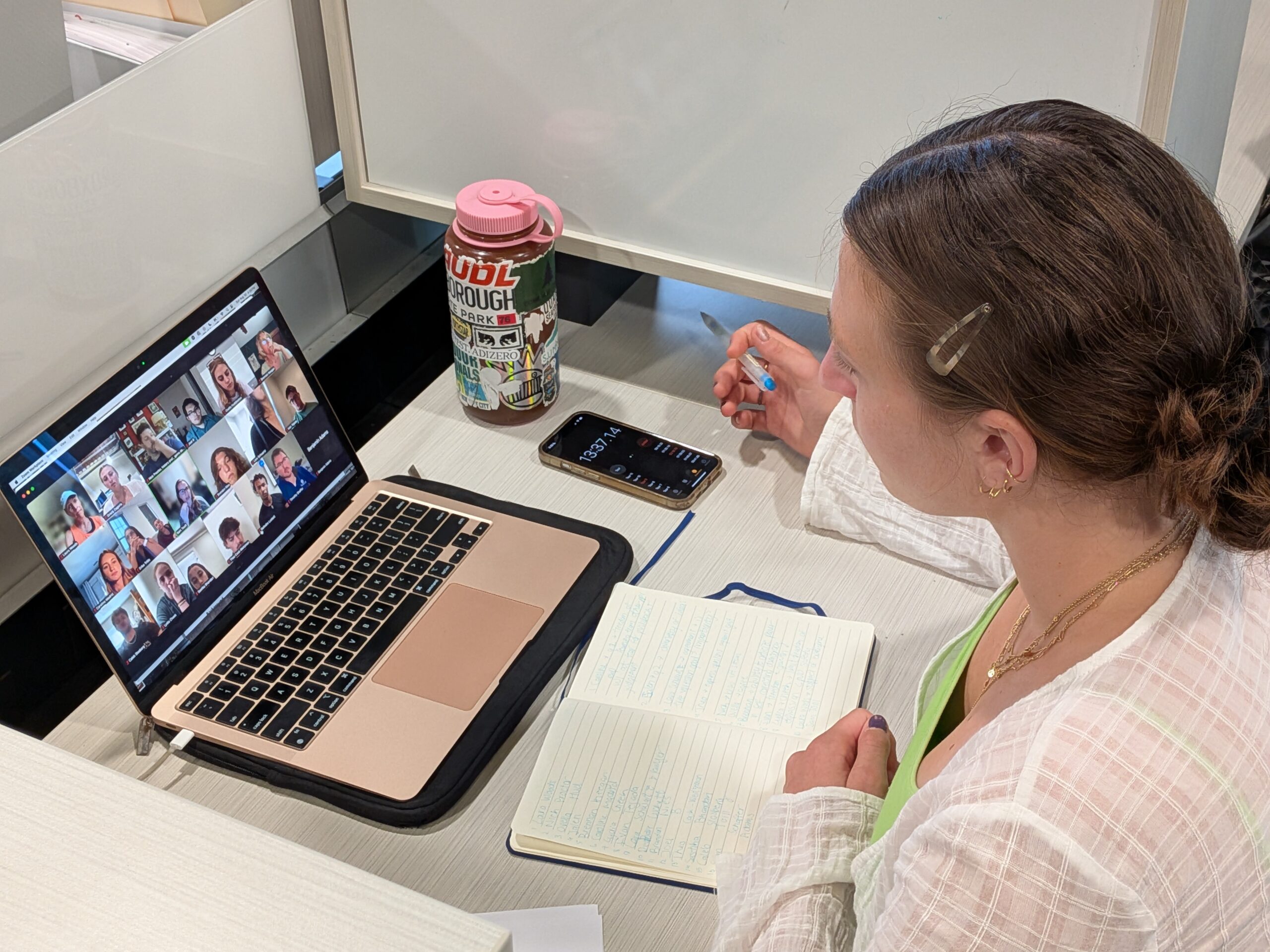
A person sitting at a desk participating in a virtual video meeting on a laptop while taking handwritten notes.

On Aug. 30 and Sept. 6, the DCI held its annual Deliberation Facilitator Training. While rooted at the Jay Hurt Hub for Innovation and Entrepreneurship at Davidson College, this year’s program marked a major milestone in scaling deliberative discourse, welcoming a record-breaking cohort of over 230 participants joining both in person and online.

These annual trainings, held since the spring of 2020, are designed to empower students, staff, faculty, and community members with essential skills to navigate and lead complex conversations. What made this year particularly celebratory was the sheer scale and reach of the audience: participants represented Davidson College alongside 24 partner institutions from the newly launched Deliberative Citizenship Network (DCN). This diverse nationwide blend created an energetic, inclusive setting that expanded the DCI’s community of practice across higher education.

Spread over two weekends, the 8-hour comprehensive training equips participants with practical frameworks to facilitate structured, respectful discussions on contentious social and political issues among people with varying perspectives. Upon completion of the two-day training, participants earn their DCI Facilitator Certification, preparing them to lead formal deliberative forums as well as informal dialogues in their home communities and campuses.

Session 1: Setting the Foundation
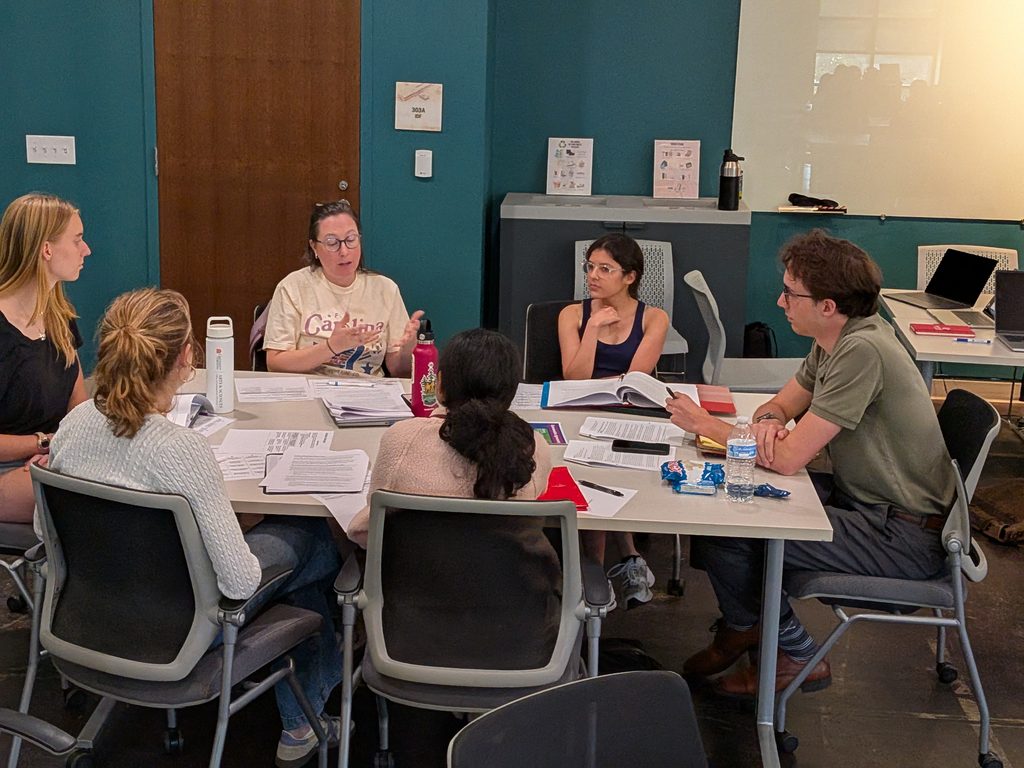
A group of five participants gathered around a table in a workshop room during a small-group deliberative dialogue session.

During the first day of training, Dr. Graham Bullock guided participants through the core principles of preparing for and structuring effective deliberations. Trainees learned how to establish inclusive ground rules, foster curiosity, and create a welcoming environment for public reasoning.

A central highlight of the opening weekend was a hands-on mock deliberation focused on Free Speech and Inclusion, facilitated by senior DCI Fellows and several Davidson community members. Stepping into the role of deliberators, participants shared personal views and observed firsthand how experienced facilitators guide challenging conversations. The interactive session underscored the critical role that empathy, respect, and active listening play when navigating contentious topics.

Session 2: Advanced Techniques and Hands-On Practice

The second session focused on equipping trainees with advanced tools to manage tense moments, diffuse polarization, and encourage deeper reflection. Participants engaged in an interactive, gamified learning module based on the Deliberation Facilitator’s Handbook, which brought key facilitation techniques to life.

To put theory into practice, trainees then assumed the role of facilitators during a second mock deliberation centered on the focus of the DCN Student Convention that will be hosted in Davidson, NC, in the Spring. Working through the DCI’s custom discussion guide, participants practiced asking probing questions, balancing airtime, and guiding peers across differing perspectives. This supportive practice environment allowed new facilitators to refine their instincts and build confidence in real time. The deliberation also created practical guidelines for the Student Convention, which many of those participating in the Facilitation Training will join.

Building a Broader Deliberative Community

The training concluded with an opportunity for in-person and online participants to reflect, celebrate, and connect with fellow advocates dedicated to strengthening civil discourse.

With the newly certified facilitators returning to Davidson and campuses across the DCN, the impact of this year’s training will extend far beyond the two-day workshop. We are deeply grateful to everyone who participated and look forward to seeing how these facilitators apply their skills to cultivate thoughtful civic engagement in their local communities.
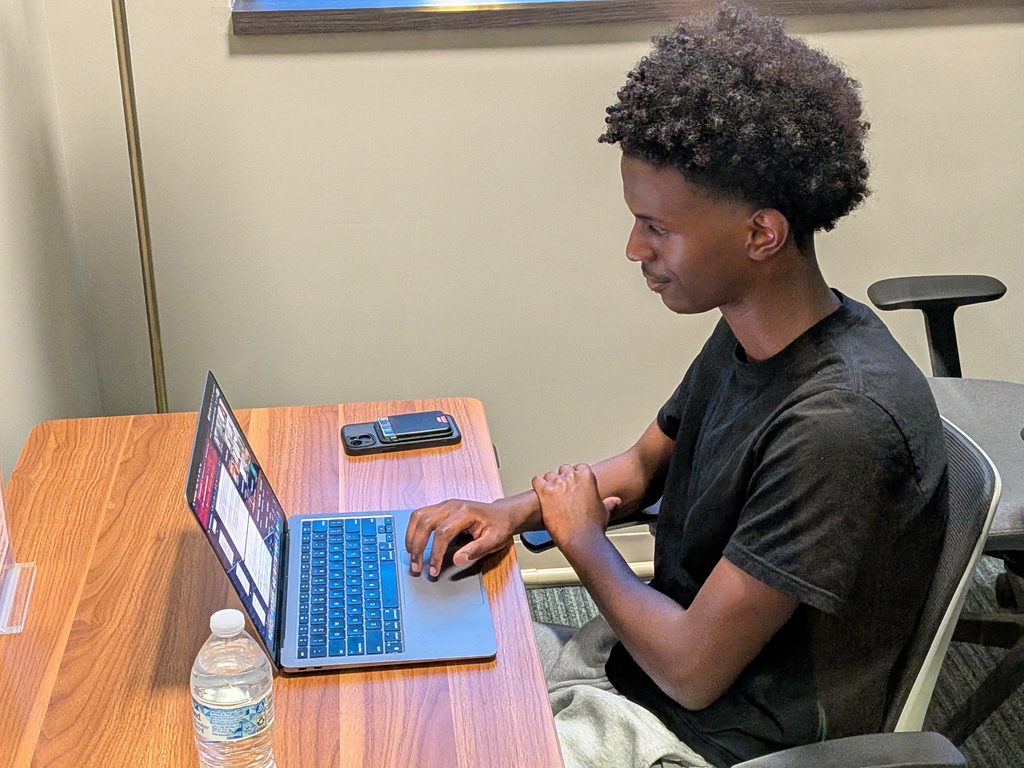
A student seated at a wooden desk participating in a virtual session or online deliberation on his laptop.

Interested in building a better democracy, one conversation at a time? Keep an eye out for upcoming DCI Deliberation Facilitator Trainings and join our growing community!
Filed Under: DCI Posts

Building the Best Democracy, One Lego Piece at a Time

September 28, 2026 by Anne-Marie Moehring

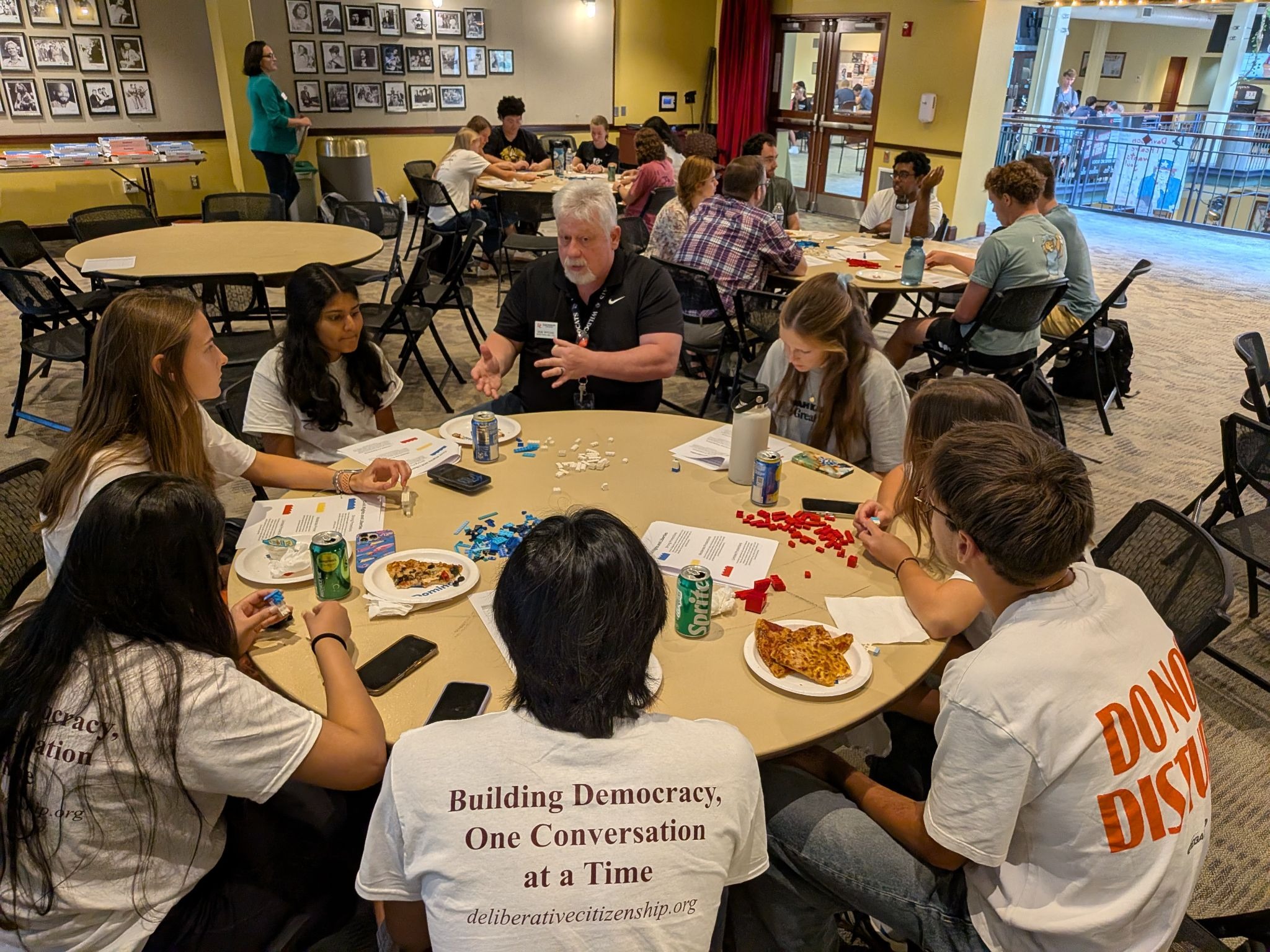
A photo of a workshop or group discussion where participants sit at round tables with red, blue and white Lego bricks.

Every fall, the Deliberative Citizenship Initiative (DCI) hosts its Semester Kickoff Party to welcome students back to campus and introduce them to the practice of constructive dialogue and deliberation. On Aug. 28, the DCI continued this tradition in the Alvarez Student Union’s 900 Room, bringing together Davidson students for active discussion, creative problem-solving, and pizza.

Designed as an engaging, low-stakes entry point for both newcomers and returning participants, the event offered attendees the chance to learn about upcoming DCI programming while putting deliberative principles directly into practice.

Deliberating about “The Best Democracy”

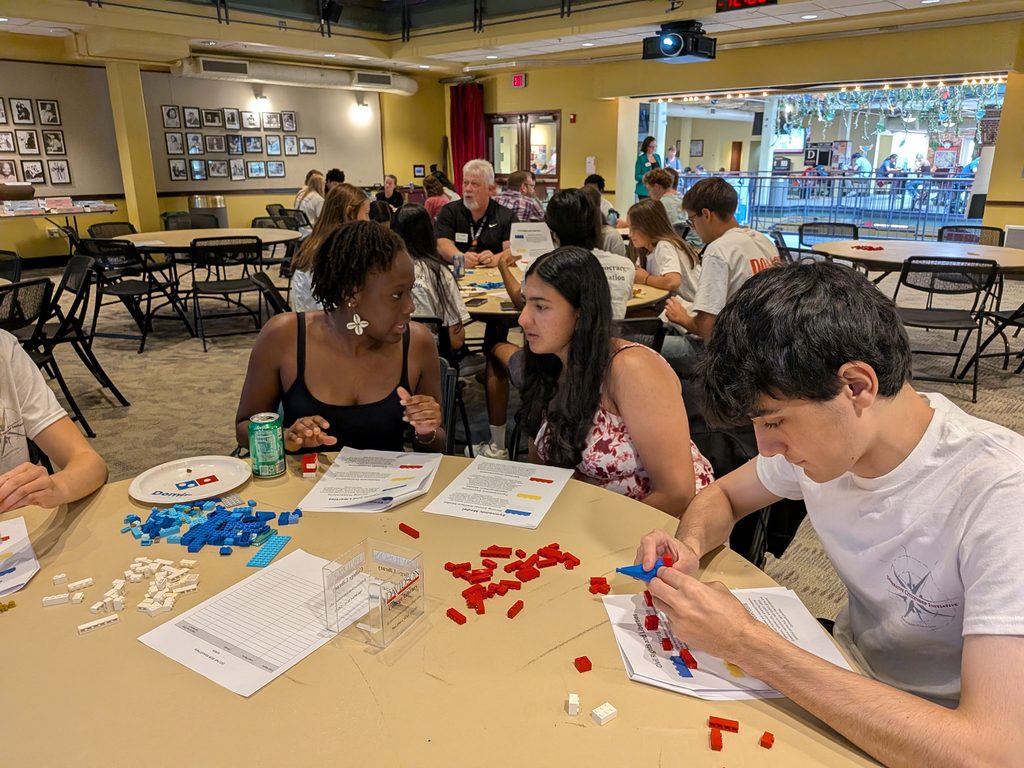
Students seated at a round table building with plastic bricks during a Deliberative Citizenship Initiative (DCI) interactive activity.

This year’s event featured the return of a hands-on activity: using Legos to “Build the Best Democracy”! Working in groups, students engaged in lively table discussions on the essential building blocks of a healthy democratic society. Groups debated how to prioritize key institutional elements of balancing executive authority, legislative representation, judicial power, economic rights, election models, and civil liberties, before translating those abstract concepts into physical Lego structures.

The resulting creations represented diverse, and creative,  models of governance, illustrating how different combinations of rights, responsibilities, and institutional checks make for a responsive, resilient democratic republic.

Democracy in Action

In true democratic fashion, participants ended the night by voting on the creations. After evaluating the models at their individual tables, attendees cast votes for the best overall representation of democracy. Winning teams took home grand prizes and honorable mention awards, capping off a fun and thought-provoking evening.

The Semester Kickoff Party served as an energetic start to the academic year, reinforcing the DCI’s commitment to fostering respectful dialogue and deep civic engagement across campus, one Lego piece at a time.

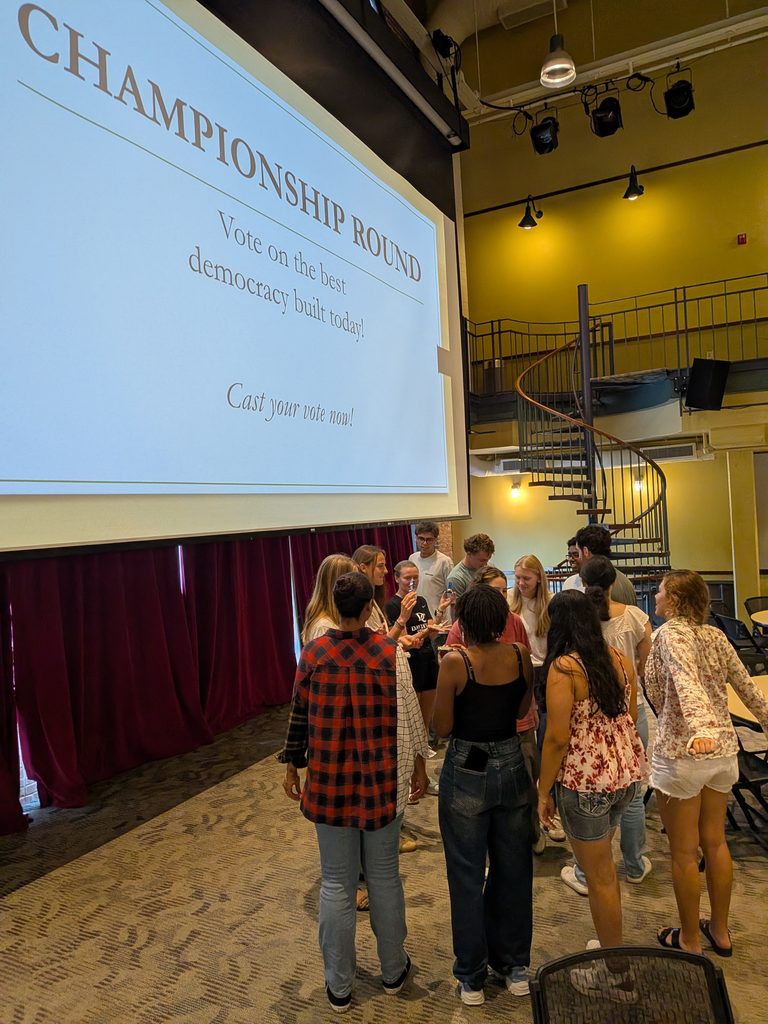
A group of students gathered around a large projection screen displaying voting instructions for the "Championship Round" during a Deliberative Citizenship Initiative (DCI) event.

Interested in joining the conversation this semester? Check out upcoming DCI D Teams, Deliberative Forums, and workshops to get involved!

Filed Under: DCI Posts

Reflections from the NextGen Roundtable

September 25, 2026 by Casey Scheiner

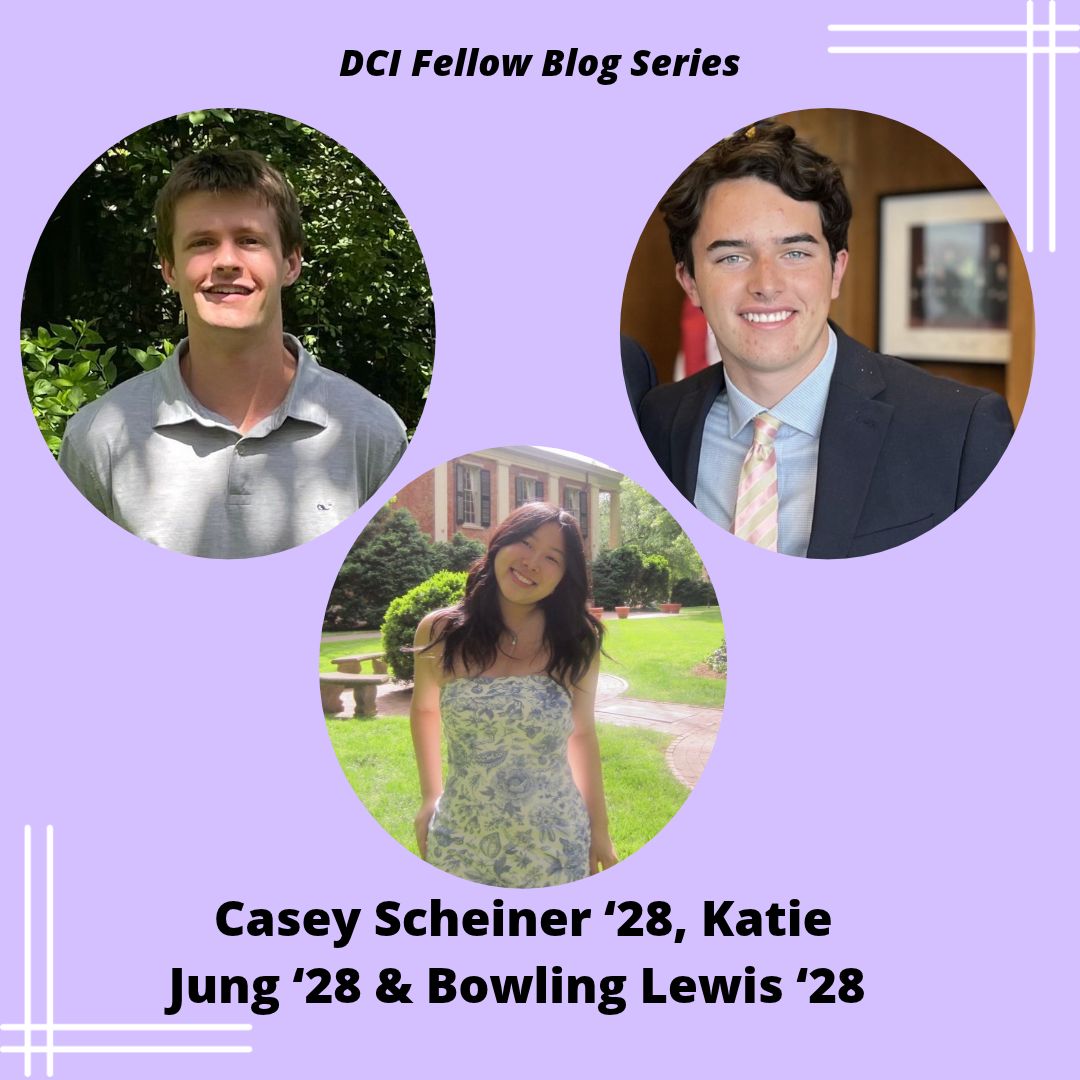
Photos of Bolling Lewis ‘28, Casey Scheiner ‘28, and Katie Jung ‘28

By Bolling Lewis ‘28, Casey Scheiner ‘28, and Katie Jung ‘28 (DCI Fellows)

This July, we (Bolling Lewis ‘28, Casey Scheiner ‘28, and Katie Jung ‘28) had the opportunity to moderate conversations at the NextGen Roundtable: Decision 2026. Sponsored by Stanford University’s Deliberative Democracy Lab, the Hoover Institution, the Close Up Foundation, and Generation Lab, the event brought 400 first-time voters ages 18-20 representing all 50 states to Washington D.C. to discuss some of the most pressing issues ahead of the midterm elections this fall.

As all three of us juniors were headed abroad for fall semester, we entered summer thinking we might not put our facilitator caps back on until January 2027. But in June when we opened an email from Dr. Bullock promoting an opportunity to moderate conversations with young voters (with a trip to Washington, D.C. included!), we jumped at the chance to facilitate again. We reached out and interviewed with CloseUp Senior Advisor Blake Kohn and before we knew it, we were in a hotel ballroom in Arlington, Virginia, getting ready for the NextGen Roundtable to get underway.

Due to the compressed nature of the program itself, the training process was more condensed than the DCI’s full two day boot camp. But in one afternoon, CloseUp’s staff gave new moderators a crash course while also sharpening our skills as more experienced facilitators. As with the DCI’s approach, it started with a presentation explaining both the philosophical underpinnings and practical techniques behind our roles. Then, we moved into a hands-on mock deliberation where we rotated in the moderator chair while being presented with “disruptor” situations. The mock deliberation doubled as a great way to get to know our fellow moderators for the week and engage with the subject matter we’d be discussing.

The next day, we returned to do what we came to Washington D.C. to do: facilitate! Like DCI’s programs, the deliberation aimed to empower a variety of voices (quiet and loud, liberal and conservative) and build shared understanding of the topic at hand. There was a similar amount of structure, with prepared questions/proposals to guide the conversation but also room for deliberators to drive the discussion in new directions. Still, the CloseUp approach featured a few key distinctions from the DCI model.

First, participants would read a deliberation guide establishing a common factual understanding of the issue. Then, a group of about 10-12 participants would join one of us for a 90 minute deliberation assessing multiple policy proposals related to the issue. We would spend the final few minutes formulating questions for a panel of experts on the subject before walking to the ballroom together to hear the experts share their insights and answer our questions. This format marked an inversion of the DCI approach we were accustomed to, where participants would deliberate after listening to an expert panel. 

Our role as moderators also looked slightly different from our role as DCI facilitators. An important component of the NextGen Roundtable was the poll that participants would take before and after to help researchers gauge young people’s sentiments on hot-button issues. As a result, our duties were more limited to keeping the poll results methodologically sound and preventing differences in facilitator styles from skewing the results. This made our job “easier” in the sense of having few obligations besides asking routine follow-up questions about the policy proposals, but it left us less empowered to take the conversation in other directions by introducing alternative perspectives or probing disagreements more deeply.

It was enriching to hear first-time voters’ thoughtful opinions on many weighty issues. Our three deliberations covered the economic and social implications of AI, US immigration & foreign policy, and democratic and electoral reforms. Coming from vastly different backgrounds, the participants exemplified the mosaic of different perspectives within our generation. Crucially, they were consistently enthusiastic participants and thoughtful listeners, contributing to genuinely productive conversations.

Even having discussed these topics at the Thanksgiving dinner table, the Chidsey dormitory lounge, and many a DCI deliberation, we all gained valuable insights from this experience. Casey observed that regardless of their political leaning or career interests, the students shared a certain anxiety regarding the disruptive potential of AI. Bolling noticed that there was an array of immigration views stemming from the diverse geographic locations in the conversations. Katie noted that despite disagreements and differing viewpoints, there was a shared consensus that staying politically informed and engaged was essential.

The NextGen Roundtable was an amazing opportunity for us to take our facilitation skills on the road and work with young participants of different geographic, social, and political backgrounds. More than anything, the experience confirmed to us that young people are excited to grapple with political issues together. As the DCI continues to place deliberation opportunities for young people at the center of its agenda, we were reminded in Washington D.C. of our generation’s powerful response to this opportunity to hear and be heard.

Filed Under: Fellow Posts

Deliberation, Inclusion, and “The Isolate”

September 25, 2026 by Chase Thomas

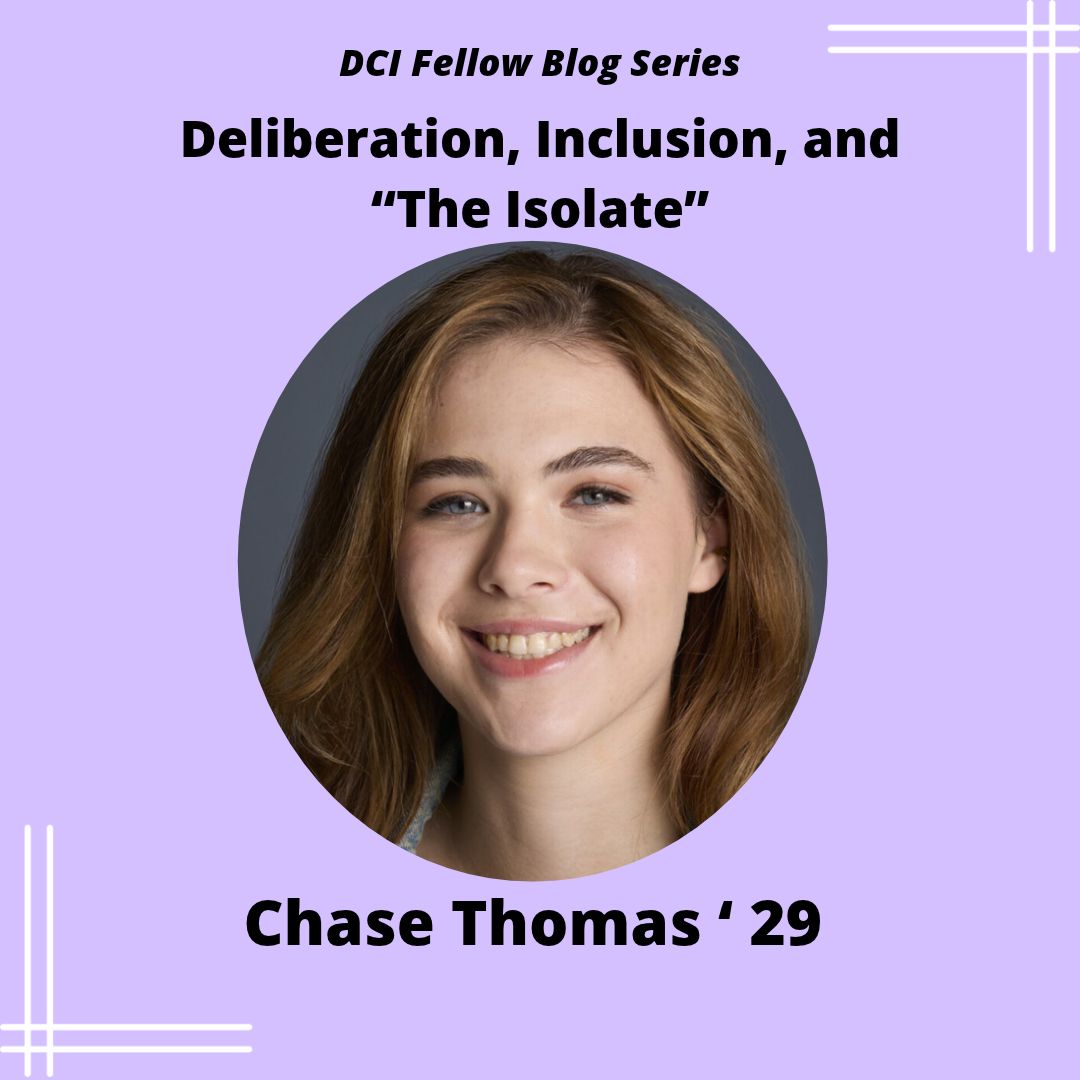
Photo of Chase Thomas

Chase Thomas ‘29 (DCI Fellow)

It had been 40 days since Charlie Kirk’s assassination, and yet I found myself in a Zoom room of people who hadn’t ever heard his name. On October 20, I led a deliberation surrounding the implications of Charlie Kirk’s death with the Global Futures Group.

Composed of doctors, social workers, businessmen, mechanical engineers, academics, housing advocates, and others over the age of 60, the Global Futures Group meets twice a month via Zoom to discuss the most pressing challenges facing humanity.

Inspired by The Millennium Project’s 15 Global Challenges, we discuss everything from the harms of artificial intelligence to the psychological impacts of political violence.

Towards the end of the deliberation, a participant declared he had questions specifically for me. I sat up straight and fiddled with my notes. One by one, each question punched me in the stomach. “Why are the youth resonating with these values? How could they believe all of this? Do your friends believe this?”

I was suddenly tasked with representing my entire generation. I threw up words until I realized the impossibility of providing a satisfactory answer to his questions. For weeks after the deliberation, I ruminated over his questions and my deficient response. I was caught up on one word: “resonating.” The word slipped from his lips as if it gestured toward something inherent and collective, an established commonality among those orbiting my age.

In A Nuts and Bolts Guide from the Public Conversations Project, Maggie Herzig and Laura Chasin emphasize the challenging dynamic of “The Isolate” in deliberations: “When someone has a different viewpoint than the rest, it makes that person both particularly valuable for the diversity they can bring and particularly vulnerable to feeling on the spot” (86).

Not only did I immediately feel this sense of heightened vulnerability during the deliberation, but I also realized that I felt trapped. Speaking for oneself frees the deliberator. On the other hand, speaking for or defending a “group” decreases nuance in the deliberation because the focus shifts to bigger divides, preventing the group from engaging with smaller points of difference.

As a deliberator-turned-facilitator, I ask what should I do if one aspect of an individual’s worldview is different from all the others present in the conversation?

Herzig and Chasin suggest the following:

  1. Check in with the individual during a break, privately
  2. Share observations with the entire group and say why this pattern concerns you
  3. After a few meetings, the facilitator can ask the group to consider the pros and cons of recruiting another member or two whose views are more similar to those of the isolate
  4. Make a suggestion or ask the participants about how the conversation may need to shift if the group is to achieve their purposes (This rests on the assumption that the group’s purposes were discussed and defined at the start, and that the facilitator told the group that everyone must speak for themselves)

You may ask, why should I speak for myself?

Herzig and Chasin posit that individuals potentially speak for others if they belong to a less individualistic society or have experienced systemic patterns of oppression and feel as though they have not been seen by others as individuals (10). However, collective group identity does have value; it is sometimes very important to focus on overall trends to identify systemic issues in order to foster social change and implement improvements for the betterment of certain communities. This “we” can also provide a sense of belonging, shared purpose, and psychological safety. Furthermore, deliberators may speak for others to increase perceived legitimacy, objectivity, or support for their case.

The goal of inclusion in deliberation is not blindness to the point of ignorance. Because society assigns meaning to constructs like race and gender, people’s life views are shaped by these categories to a certain extent, creating diverse, often unequal, experiences of the world. John Rawls’ famous veil of ignorance, as part of his theory of justice, proposed that participants should blind themselves to their own self-interests to be unaware of their standpoint. While his thought experiment is an important

democratic and egalitarian vision, it begins at the ideal instead of working towards it. We tell individuals in deliberation that they have an equal status in the deliberation, which does relate to Rawls’ ideals. However, it is important to achieve a balance between assuming equality in deliberation and working towards achieving equality in the world through deliberation.

Furthermore, as a facilitator, one can ensure that minority or absent perspectives are included in a deliberation by conducting a thorough stakeholder analysis and using the discussion guide.

On the other hand, it is crucial to speak for yourself to fight intra-group bias. You can have a different perspective than someone who looks like you, dresses like you, or wears the same political label as you. This is why it is consistently stressed in deliberative settings to avoid general, sweeping statements. Like intra-group bias, essentialism also posits that there are certain traits tied to categories humans have constructed, such as gender, race, religion, and political ideology. Therefore, speaking for yourself in deliberative contexts prevents prejudice, black-and-white thinking, and polarization. While speaking for (or with) others can bring justice into the conversation, so can your own individual perspective. You need to bring your unique lived experiences to the table, cultivating autonomy, trust, and introspection.

Filed Under: Fellow Posts

What is the Value of War? An Online Deliberation

September 25, 2026 by Keith Graves

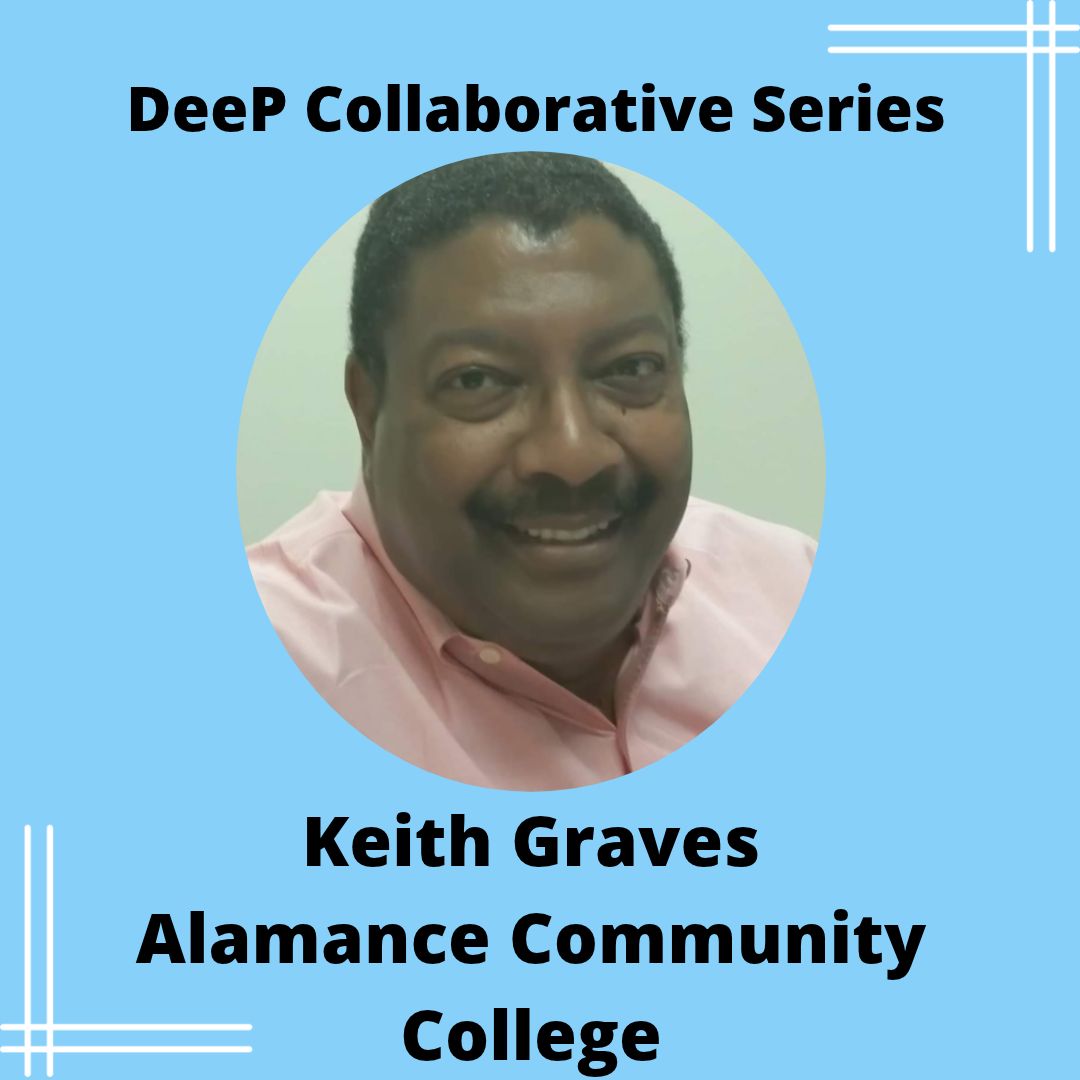
Photo of Keith Graves from Alamance Community College

The Deliberative Pedagogy (DeeP) Faculty Collaborative consists of faculty from Davidson College and other higher education institutions who are committed to learning and implementing new ways to improve and deepen the quality of their class discussions. These faculty come from a wide array of disciplines and backgrounds to study and discuss deliberative pedagogy methods, share their ideas and questions with one another, and work to embed deliberation in their classrooms. In this special blog series, members of the Collaborative describe and reflect on their experiences developing and teaching their deliberation-involved courses.

By Keith Graves (2023-24 Deliberative Pedagogy Collaborative Faculty Fellow)

A Little Background

Alamance Community College is one of the 58 Community Colleges in the North Carolina Community System. The College is located in Graham, NC, and currently has an enrollment of 5,222 students. At Alamance Community College, generally the degree program of study in Business Administration is sixty-eight credit hours for completion, and approximately 30% of the students are in high school, with the balance being students who are experiencing college for the first or second time in their lives and can vary in age from 18-45 years. Most are women, approximately 70%, and most of the students, close to 100% work part-time or full-time, and an estimate of approximately 50% have families with children!

There is a 100% acceptance rate for students that apply to the college and the college has a current student population of 5,222, with 150 studying Business Administration in the curriculum or college transfer programs. Students in the Business Administration Program must complete 67 credit hours to receive their Associate’s degree and be eligible to transfer to a four-year college for the completion of their bachelor’s degree.

I am a professor in the Business Administration Department and teach a series of courses that includes 100 Level Courses Introduction to Business, Principles of Management, Business Law, and 200 Level Courses Organizational Behavior, Business Ethics, and International Business. Of the six courses I teach, generally 5 are online with 1 on-campus.

Having taught Principles of Management at two community colleges, I noted that the students in this course tended to be more mature, in age and life experiences…and thus I decided to ‘try’ the deliberative process in this course as my sense was that this student population would engage in the deliberation directly and broadly as a function of a discussion forum. After some review of current topics, related to the news and subjects that have an implication or tie into business, and could be considered ‘controversial,’ I decided to have a deliberation on the subject of the Value of War.

Why the Value of War? The course I selected to facilitate the deliberation was  Business 137 (Principles of Management) as I felt that this course, with its objectives of presenting the basic but broad overview of the principles, strategies, and roles of organizational managers would be the best opportunity to facilitate a deliberative discussion forum on a subject that is controversial and presents the best opportunity for learning and engagement. Plus, I had 2 sections of this course with 37 students.

Both sections were to be offered online, so I decided to experiment with an asynchronous deliberative process through the exchange of ideas, perspectives, and arguments through a series of written discussion forums. Students would submit their responses to a general question on the topic, and then respond in writing to their classmate’s submissions.

Typically, although admittedly without any rigorous data, I have found that many or most of my business students do not pay attention to the news and have little awareness of the current conflicts and more specifically the ones that are supported by the United States as a matter of our foreign policy. Conflicts such as Israel and Hamas, the potential that China may invade Taiwan, and Russia’s invasion of Ukraine, for example.

The ever-expanding American military footprint covers nearly every continent. While the United States has long had a military presence in other nations, the scope significantly expanded following the passage of the 2001 Authorization for Use of Military Force, which, in the wake of 9/11, permitted the support of foreign forces against various terrorist groups. The U.S. has since had 173,000 troops deployed in 159 countries as of 2020 and currently maintains at least 750 foreign military bases across 80 countries, according to the Conflict Management and Peace Science journal.

As the top military power in the world, according to the Global Firepower Index, the U.S. has a vested interest in the national security of countries across the globe. In situations that do not warrant combative military intervention or would threaten relations with allies, the government may oversee or aid more minor disputes within countries, such as counterterrorism efforts. This type of involvement is known as a “shadow war,” a somewhat covert military operation conducted on behalf of and at the invitation of a smaller power.

Ok, now you know that the US is involved in a number of conflicts around the world, but the question remains where do the weapons come from, who manufactures them, how are they developed as a product, are these US companies, do they employ US workers, where are they located, and how do these companies fit within the Military Industrial Complex? These are some of the questions that I wanted students in the class to think about and grapple with, together.

Learning Prep Introduction

In structuring the intent and the learning outcomes of the exercise, I developed a set of learning competencies for the students with the expectation that all would participate in the online deliberative discussion forum, and they were:

  1. Learning to engage with the subject, as facilitated by the discussion forum questions.
  2. Developing critical thinking and problem-solving skills that will cause them to think about the problem and move into non-traditional thinking about how to solve the issue.
  3. Being intellectually curious
  4. Utilizing data for critical decision making
  5. Developing the ability to see issues as part of a broad system and as such think about the implications of that system in the development of resolutions.

I also aimed to broaden the thinking of the students beyond their current perspective of the value (or complete lack of value) of war by learning about the implications of war on a national economy and to think about the critical question – who benefits from war?

With that goal in mind, I intended to introduce and set the tone for the deliberative process by providing some initial opportunities for the students to learn about the practice and consequences of war. For example, I provided background textual material, a lecture about the ‘Military Industrial Complex,’ articles such as the “Cost of War” and the book, “The Business of War,”  for them to have as reading and learning materials during week 3 of the 16 week course.  

Teaching/Deliberation Strategy for the Online Learning Environment

I prepared the class for the non-traditional ‘deliberation’ portion of the class by providing them with (1) a lecture and reading on the subject of deliberation, (2) critical reading materials, and (3) the schedule for three deliberations in the course. I also let them know there would be a reflection assignment about the deliberations as well.

The first Discussion Forum focused on the question, “What Do You See as the Value of War?” The second and third Discussion Forums encouraged the students to take a look at what others in the class had written – to read and reflect on their words, particularly those who were opposed to their own point of view. They were asked to consider whether those perspectives challenged them to potentially change their thinking, and if so what impacted their thinking, why, and what did they learn from the viewpoints of others?

In Week 15, the students were asked to write a ‘Reflections’ paper on the learning from the deliberation exercise. The paper was expected to be 2-3 pages and the student was to document at least 3 key learnings from the process. As in all steps, the instructor has the responsibility to monitor, grade and provide feedback to the student. What I noticed in my reading of the summaries was that a majority of the students were impacted in the process in that they ‘changed’ their initial views and understood that from a business perspective that war has and can have an impact on a national economy, and that in itself might have some positive implications.

Summary

As a summary, each student who participated in the Deliberation was asked to provide feedback on the process and the facilitation of the deliberative discussions. Here are a few examples:

“The one thing I learned in the deliberative process is to first listen, deliberate, and then articulate. Most subjects or topics have a way of striking a nerve and sometimes we just jump to speak our minds…I understand that business can profit from war and business will do what needs to be done to survive in today’s economy. They are in business to make money after all but in the end losing just 1 life is too many and we have lost hundreds of thousands of lives to wars. I do think that this type of forum has value because it has gotten the students to engage in the process and understand what factors influence the economy.”

“I would say that my knowledge of the deliberative process in business was helpful but my ability to be objective, which has come in handy for several classes over the semesters…helped me more when it came to considering controversial topics and then discussing them.”

“I did not change my mind throughout the course of the forum’s entirety, but it was interesting to see other people’s reasoning as to their own views on the subject matter and question them as to why they thought in such a way.” 

“The process of deliberation was incorporated into the flow of this course with the intent of establishing an additional pedagogical methodology of learning…and through the use of the discussion forums and a controversial question that focused on the value of war….and with the intent of getting business students to understand the value of war, rather than the sociological consequences….my sense is that the deliberation facilitated a level of learning that was not expected and had a very positive effect on the students abilities and to develop the course competencies, (1) critical thinking and problem solving, (2) analytical reasoning, (3) learning to engage in controversial subjects, (4) being intellectually curious, and (5) learning how to view and solve critical issues as part of a system!”

Filed Under: Faculty Posts

  • « Go to Previous Page
  • Page 1
  • Page 2
  • Page 3
  • Page 4
  • Interim pages omitted …
  • Page 77
  • Go to Next Page »

Footer

Blog Post Categories

  • Announcements
  • Blog Posts
  • DCI Posts
  • Events
  • Faculty Posts
  • Fellow Posts
Image of a compass superimposed by the text "Deliberative Citizenship Initiative" and "Davidson College." Clicking on this image leads to the Initiative page.

Recent DCI Blog Posts

  • Making Conversation: A First Step to Understanding
  • The Costs of Changing Your Mind, and How to Overcome Them
  • ​Middle Schoolers: The Ones Who Taught Me the Most About Facilitation
  • Facebook
  • Twitter
  • Instagram
  • LinkedIn


Copyright © 2026 · Infinity Pro on Genesis Framework · WordPress · Log in