
• Skip to main content
  • Skip to footer

Deliberative Citizenship Initiative

Building Democracy One Conversation at a Time

  • The Initiative
    • Programs
      • Deliberation Across the Curriculum
      • Deliberation on Campus
      • Deliberation in the Community
      • Research on Deliberation
    • Motivations
      • Why Deliberative Citizenship?
      • Why Davidson? Why Now?
    • Who’s Involved?
      • DCI Fellows Cohorts
        • 2025-2026 Fellows
        • 2024-2025 Fellows
        • 2023-2024 Fellows
        • 2022-2023 Fellows
        • 2021-2022 Fellows
        • 2020-2021 Fellows
      • DeeP Collaborative Cohorts
        • 2024-2025 DeeP Collaborative Faculty
        • 2023-2024 DeeP Collaborative Faculty
      • Advisory Council
    • History
      • What Sparked the Initiative?
    • Key Deliberative Dispositions
    • Frequently Asked Questions (FAQ)
    • Annual Report
  • Get Involved!
    • Participate in a Forum
    • Join a D Team
    • Become a Fellow
    • Take Courses
    • Get Training
    • Come to Guest Lectures
  • Events
    • Upcoming Events
      • 250th Anniversary Deliberative Forum Series on American Values
    • Past Events
  • Connections
    • The Deliberative Citizen: The DCI’s Monthly Newsletter
    • Efforts on Campus
    • Efforts in the Community
    • Efforts Elsewhere
    • Readings and Resources
      • DCI-Published Guides
      • DCI Guide to One-on-One Conversations
      • How to Disagree
      • Demonstration of Facilitation Styles
      • Deliberative Pedagogy Mini-Course
    • How We Can Help: DCI’s LET’S DELIBERATE! Partnership Opportunities
    • DCI in the News
  • DCI Blog Posts
    • Recent Blog Posts
    • All Blog Posts

Jackson Strelo

The Costs of Changing Your Mind, and How to Overcome Them

October 19, 2026 by Jackson Strelo

Promotional graphic for the DCI Fellow Blog Series post titled "The Costs of Changing Your Mind, and How to Overcome Them" by Jackson Strelo '26.

By Jackson Strelo ‘26 (DCI Fellow)

Perhaps this is obvious, but one of our core human desires (or cravings, really) is control. Biologically and psychologically, it is an inherited desire central to survival, security, and mental health. While most humans no longer feel the need to engage with these biological risks to survival, they now primarily interact with the psychological pendulum, and one of these wrinkles of control entails a sense of control over what they know. This definitely tracks on a human level, as knowledge, especially in the information age, is assumed to be attached to important aspects of our life — our credentials, our salaries, our authority, and so forth.

However, on a higher level, our views on the world, influenced by what we think we know or personal values, are attached to our identities. Thus, it is natural to assume that threats to our knowledge have the potential to create a cascade of psychological costs, and an equal potential for responses to peers, loved ones, and society. These are important to tackle, for the ideals of open-mindedness that are preached in spaces of discourse cannot be realized without welcoming these small, or large, discomforts.

Another cost, loosely related to identity, is the social cost of updating beliefs. While this may be nullified in more private conversations, the threat of welcoming or accepting a new opinion by a peer, family member, or teammate may look like an act of capitulation to the “updater” that will be perceived by the group. Whether or not it matters to them that their partner in conversation changed their mind, in good faith or not, it may matter how they believe the “winning” belief party may react to this, or perhaps how their own belief party will treat them moving forward. Exhibit A: Congress, where political dissent has carried real career costs for representatives.

As mentioned earlier, costs to credibility are also a threat when weighing our beliefs. Unlike identity, credibility is more aligned with our purpose when it comes to evaluating one’s knowledge and opinions. For example, a parent may reinforce their purpose as a parent by providing reliable and effective guidance to their children. However, if someone or something threatens their concept of “correct” parenting, they may react by 1) taking a hit to their credibility, accumulated over years of life and parenthood invested into their children and 2) feeling a sense of failure towards the product of their purpose — their children.

While the examples provided may paint the picture of belief update costs as explicit and easily amenable, that’s far from the case. Another key feature of these costs is that while they manifest in impulses, they’re attached to beliefs that were heavily invested in — through education, relationships, trust, or even the confidence we’ve built in ourselves. Thus, it’s safe to say that these barriers against true open mindedness are difficult to just ignore, never pass completely, and exist everywhere. However, a better democracy doesn’t demand us to ignore our human instincts, but rather to lean into humanity.

The same investments I’ve just mentioned can be translated into a sort of “counter-investment”. The same way that successful New Years Resolutions are realized are almost fully attributable to the time investment associated with the desired goal or habit. Simply put, the most important part is just showing up, figuratively and literally. Practice “hearing them out” — actually listen to why that new experimental album was a masterpiece ahead of its time, why pineapple belongs on pizza (I’m still not buying this one, but I’ve forced myself to hear both sides), or any silly take that challenges what and who you attach yourself to. You may just hear yourself saying the words “I never thought about it that way before”.

However, I’ll end with an important caveat to this skill of belief-updating: the goal isn’t to become someone who changes their mind easily. Not only does that conclusion disagree with the aforementioned psychological tendencies of the human race, but it’s also simply not a fair expectation to place on yourself. You should care deeply about who you are and you should carry pride in your knowledge — it’s crucial for your mental health. The goal is to not let the occasional belief update chip away at those pillars. If more Americans could do so, perhaps there’d be less family feuds, less political violence, and more progress on the issues we all care about.
Filed Under: Fellow Posts Tagged With: 2026-2027

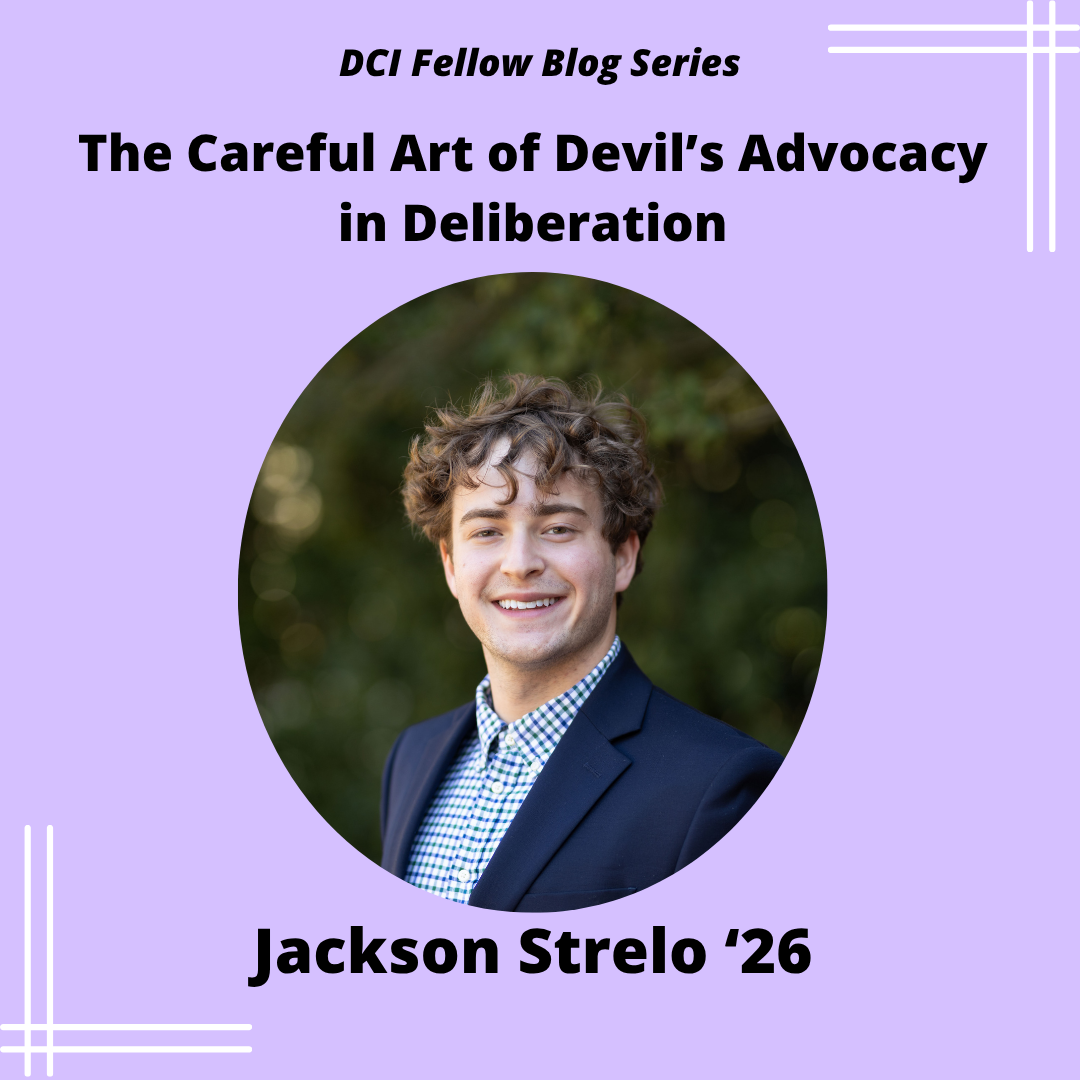
The Careful Art of Devil’s Advocacy in Deliberation

November 14, 2025 by Jackson Strelo

Jackson Strelo ’26 (DCI Fellow)

In a time where the answers to our pressing questions are often formed quickly – from the press of a button, or maybe from a 15-second clip from social media – it seems as if we’ve somewhat abandoned the art of holistic problem solving. At almost all stages of our lives, many of our learnings derived from thoughtless exploration. In our youth, we likely didn’t learn to not touch the hot stove because Google told us so, but rather because curiosity got the best of us. While not every conclusion that we draw requires us to dive off the high board, we must learn to occasionally draw some distance between an issue and our conclusions. In other words, we must practice the careful art of devil’s advocacy in deliberation.

Martin Carcasson (2014) identifies The Devil’s Advocate as one of his four primary deliberation styles. In his eyes, one playing this role raises perspectives that are not being expressed, a style that aims to complicate a particular discussion that may lack dimensionality or diversity. While this is essentially as far as the DCI Deliberation delves into Carcasson’s properties and goals of the Devil’s Advocate style, their limitations of its intention must be noted to truly understand its value and apply it in our dialogues.

As alluded to earlier, a good deliberation doesn’t need to be intensely probed to achieve the goals of this style, especially if the topic contains sensitive subject matter. I believe that the base of the philosophy of Devil’s Advocacy is the aim of challenging thinkers to avoid drawing too-swift conclusions. Thus, it’s important to understand that word choice in this role can be the difference between progression towards curious thinking or regression away from it. In our training, even as a participant in a mock deliberation, I made sure to be thoughtful about the climate at our table. Did anyone share particularly personal or intimate accounts of an interaction with this issue? Even if the answer was yes, was there a productive or empathetic opportunity to dig deeper? Depending on the answers to these questions, I may evaluate whether the topic is too “hot” to explore, or if there’s a chance to promote curiosity.

Furthermore, a Devil’s Advocate should strive to not lead participants – explicitly or implicitly – towards a counter-conclusion. For example, facilitators in a roundtable discussion on climate change should challenge the thinking or conditioning behind their ideas – “what if our community was a fracking haven, would that change your sense of our environmental policy?” – rather than their political orientation as it relates to an ideological attachment to the issue. Jamieson, Valdesolo, and Peters (2014) found that dissent roles affect both physiological and psychological needs, with targets of Devil’s Advocacy or similar dissenting styles displaying avoidance behaviors as well as threats to belonging, self-esteem, and other basic psychological needs. Of course, there is certainly some variance in the presence of these threats stemming from blindly executed devil’s advocacy, but much of it can be erased by following fair principles of deliberation.

One crucial requirement in effective and productive dissent is to strive to maintain an egalitarian attitude in terms of what perspectives the Devil’s Advocate challenges. While perfectly balancing the level and frequency of dissenting questions posed to the one, or many, sides of the issue isn’t always feasible within the structure of a deliberation, maximizing equality and minimizing partisan choices and implicit biases should be prioritized. This is not only necessary in terms of respect and fairness, but also in fostering a climate in which all participants are encouraged to voluntarily dig deeper as they contribute to the conversation.

The second requirement is anticipation – thinking about the potential immediate impact as well as the chain-reaction of a potentially contentious dissent. Will my attempt at a light-hearted dissent be viewed as such in the context of the topic, the language of choice, as well as the climate of the deliberation?  Have any parts of previous interactions or sections of the deliberation prompted the use of a more cautious approach to deepen discussion? Of course, it would be foolish and limiting to ignore creative methods to challenge the group to explore arguments and counterfactuals out of fear. However, the art of effective Devil’s Advocacy requires the ability to forecast for and prepare for friction, and to limit scenarios in which that friction violates the bounds of productive deliberation.

While I could write all day about how other guiding principles – empathy, attentiveness, humility, the list goes on – should bake into the ideal Devil’s Advocate, I want to end how I began by highlighting the growth potential of this noble art. In my facilitator training, DCI Fellows were advised to essentially “roleplay” their positions in our final mock deliberation. In doing so, understandably, we struggled at first to articulate our dialogues under these roles. On its face, it seemed like a bland attempt at preventing one-dimensional discussion. However, as the depth of thought required in our sections increased, we rose to the challenge of our given roles. How does this relate to Devil’s Advocacy? Well, that relation wasn’t apparent until we began our reflections. While most of us agreed that it was difficult to stand on our given positions, it also gave us each the chance to practice holistic argumentative inflection – the main goal of Devil’s Advocacy.

As I serve as a DCI Facilitator this year, I will be thinking of how to sharpen this tool, to both challenge my own beliefs as well my ability to invoke curiosity into my deliberations.

References

Jamieson, J. P., Valdesolo, P., & Peters, B. J. (2014). Sympathy for the devil? The physiological and psychological effects of being an agent (and target) of dissent during intragroup conflict. Journal of Experimental Social Psychology, 55, 221–227. https://doi.org/10.1016/j.jesp.2014.07.011

Filed Under: Fellow Posts

Footer

Blog Post Categories

  • Announcements
  • Blog Posts
  • DCI Posts
  • Events
  • Faculty Posts
  • Fellow Posts
Image of a compass superimposed by the text "Deliberative Citizenship Initiative" and "Davidson College." Clicking on this image leads to the Initiative page.

Recent DCI Blog Posts

  • Making Conversation: A First Step to Understanding
  • The Costs of Changing Your Mind, and How to Overcome Them
  • ​Middle Schoolers: The Ones Who Taught Me the Most About Facilitation
  • Facebook
  • Twitter
  • Instagram
  • LinkedIn


Copyright © 2026 · Infinity Pro on Genesis Framework · WordPress · Log in