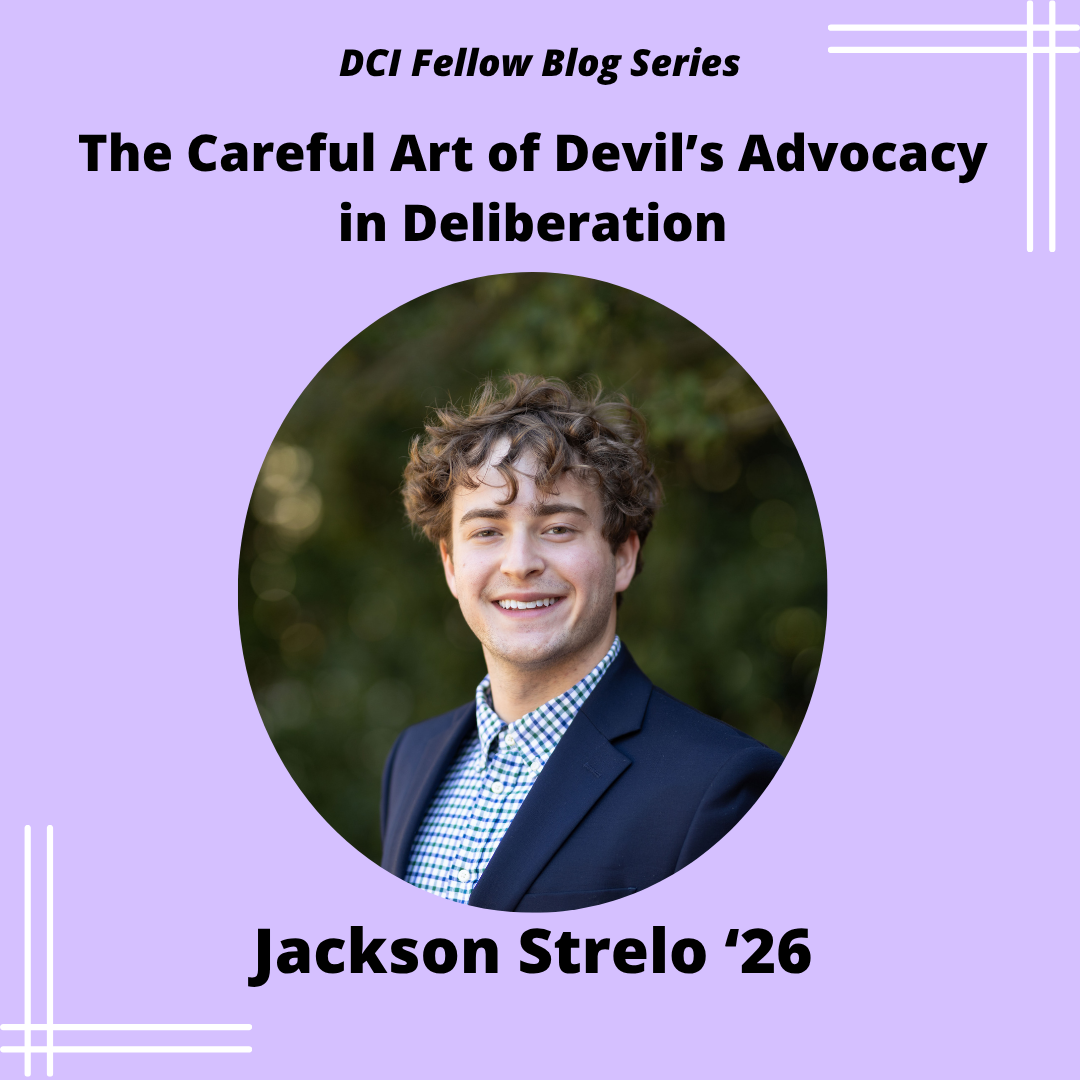
Jackson Strelo ’26 (DCI Fellow)
In a time where the answers to our pressing questions are often formed quickly – from the press of a button, or maybe from a 15-second clip from social media – it seems as if we’ve somewhat abandoned the art of holistic problem solving. At almost all stages of our lives, many of our learnings derived from thoughtless exploration. In our youth, we likely didn’t learn to not touch the hot stove because Google told us so, but rather because curiosity got the best of us. While not every conclusion that we draw requires us to dive off the high board, we must learn to occasionally draw some distance between an issue and our conclusions. In other words, we must practice the careful art of devil’s advocacy in deliberation.
Martin Carcasson (2014) identifies The Devil’s Advocate as one of his four primary deliberation styles. In his eyes, one playing this role raises perspectives that are not being expressed, a style that aims to complicate a particular discussion that may lack dimensionality or diversity. While this is essentially as far as the DCI Deliberation delves into Carcasson’s properties and goals of the Devil’s Advocate style, their limitations of its intention must be noted to truly understand its value and apply it in our dialogues.
As alluded to earlier, a good deliberation doesn’t need to be intensely probed to achieve the goals of this style, especially if the topic contains sensitive subject matter. I believe that the base of the philosophy of Devil’s Advocacy is the aim of challenging thinkers to avoid drawing too-swift conclusions. Thus, it’s important to understand that word choice in this role can be the difference between progression towards curious thinking or regression away from it. In our training, even as a participant in a mock deliberation, I made sure to be thoughtful about the climate at our table. Did anyone share particularly personal or intimate accounts of an interaction with this issue? Even if the answer was yes, was there a productive or empathetic opportunity to dig deeper? Depending on the answers to these questions, I may evaluate whether the topic is too “hot” to explore, or if there’s a chance to promote curiosity.
Furthermore, a Devil’s Advocate should strive to not lead participants – explicitly or implicitly – towards a counter-conclusion. For example, facilitators in a roundtable discussion on climate change should challenge the thinking or conditioning behind their ideas – “what if our community was a fracking haven, would that change your sense of our environmental policy?” – rather than their political orientation as it relates to an ideological attachment to the issue. Jamieson, Valdesolo, and Peters (2014) found that dissent roles affect both physiological and psychological needs, with targets of Devil’s Advocacy or similar dissenting styles displaying avoidance behaviors as well as threats to belonging, self-esteem, and other basic psychological needs. Of course, there is certainly some variance in the presence of these threats stemming from blindly executed devil’s advocacy, but much of it can be erased by following fair principles of deliberation.
One crucial requirement in effective and productive dissent is to strive to maintain an egalitarian attitude in terms of what perspectives the Devil’s Advocate challenges. While perfectly balancing the level and frequency of dissenting questions posed to the one, or many, sides of the issue isn’t always feasible within the structure of a deliberation, maximizing equality and minimizing partisan choices and implicit biases should be prioritized. This is not only necessary in terms of respect and fairness, but also in fostering a climate in which all participants are encouraged to voluntarily dig deeper as they contribute to the conversation.
The second requirement is anticipation – thinking about the potential immediate impact as well as the chain-reaction of a potentially contentious dissent. Will my attempt at a light-hearted dissent be viewed as such in the context of the topic, the language of choice, as well as the climate of the deliberation? Have any parts of previous interactions or sections of the deliberation prompted the use of a more cautious approach to deepen discussion? Of course, it would be foolish and limiting to ignore creative methods to challenge the group to explore arguments and counterfactuals out of fear. However, the art of effective Devil’s Advocacy requires the ability to forecast for and prepare for friction, and to limit scenarios in which that friction violates the bounds of productive deliberation.
While I could write all day about how other guiding principles – empathy, attentiveness, humility, the list goes on – should bake into the ideal Devil’s Advocate, I want to end how I began by highlighting the growth potential of this noble art. In my facilitator training, DCI Fellows were advised to essentially “roleplay” their positions in our final mock deliberation. In doing so, understandably, we struggled at first to articulate our dialogues under these roles. On its face, it seemed like a bland attempt at preventing one-dimensional discussion. However, as the depth of thought required in our sections increased, we rose to the challenge of our given roles. How does this relate to Devil’s Advocacy? Well, that relation wasn’t apparent until we began our reflections. While most of us agreed that it was difficult to stand on our given positions, it also gave us each the chance to practice holistic argumentative inflection – the main goal of Devil’s Advocacy.
As I serve as a DCI Facilitator this year, I will be thinking of how to sharpen this tool, to both challenge my own beliefs as well my ability to invoke curiosity into my deliberations.
References
Jamieson, J. P., Valdesolo, P., & Peters, B. J. (2014). Sympathy for the devil? The physiological and psychological effects of being an agent (and target) of dissent during intragroup conflict. Journal of Experimental Social Psychology, 55, 221–227. https://doi.org/10.1016/j.jesp.2014.07.011