• Skip to main content
  • Skip to footer

Deliberative Citizenship Initiative

Building Democracy One Conversation at a Time

  • The Initiative
    • Programs
      • Deliberation Across the Curriculum
      • Deliberation on Campus
      • Deliberation in the Community
      • Research on Deliberation
    • Motivations
      • Why Deliberative Citizenship?
      • Why Davidson? Why Now?
    • Who’s Involved?
      • DCI Fellows Cohorts
        • 2025-2026 Fellows
        • 2024-2025 Fellows
        • 2023-2024 Fellows
        • 2022-2023 Fellows
        • 2021-2022 Fellows
        • 2020-2021 Fellows
      • DeeP Collaborative Cohorts
        • 2024-2025 DeeP Collaborative Faculty
        • 2023-2024 DeeP Collaborative Faculty
      • Advisory Council
    • History
      • What Sparked the Initiative?
    • Key Deliberative Dispositions
    • Frequently Asked Questions (FAQ)
    • Annual Report
  • Get Involved!
    • Participate in a Forum
    • Join a D Team
    • Become a Fellow
    • Take Courses
    • Get Training
    • Come to Guest Lectures
  • Events
    • Upcoming Events
      • 250th Anniversary Deliberative Forum Series on American Values
    • Past Events
  • Connections
    • The Deliberative Citizen: The DCI’s Monthly Newsletter
    • Efforts on Campus
    • Efforts in the Community
    • Efforts Elsewhere
    • Readings and Resources
      • DCI-Published Guides
      • DCI Guide to One-on-One Conversations
      • How to Disagree
      • Demonstration of Facilitation Styles
      • Deliberative Pedagogy Mini-Course
    • How We Can Help: DCI’s LET’S DELIBERATE! Partnership Opportunities
    • DCI in the News
  • DCI Blog Posts
    • Recent Blog Posts
    • All Blog Posts

politics

Why Me?

February 7, 2024 by Auden White

Game pieces connected by a network

Auden White ’26 (DCI Fellow)

In the DCI’s fall forum, “The Challenge for Democracy,” one of the participants posed an important question: “Why me?” He was a student who was in the midst of a discussion about the role of United States military interventions, nation-building missions, and sanctions in promoting democracy abroad. He had just listened to expert professors, themselves conflicted by the track record of previous US efforts, navigate the topic for the last hour. He was unsure how to add to the conversation, chart a course, and direct policy for the future, given his lack of experience and knowledge.

His caution is justifiable. He was not as knowledgeable as an expert, nor did he have a strong personal connection to the topic. Despite this background, I pushed back against his hesitancy and urged him to participate in the discussion. He did so wonderfully and brought up some interesting points during the discussion.

The Deliberative Citizenship Initiative (DCI) is designed for the hesitant young man and everyone who wants to learn more about politics. It focuses on deliberations, not decisions. We are not focused on changing government policy. The issues we try to tackle are too large, too divisive, and too complicated to find the best solution in a short deliberation about US foreign policy. Additionally, implementing that solution is difficult given the DCI does not have an advocacy wing, nor any political power. While in the longer term one of the DCI’s goals is to catalyze creative solutions that respond to and accommodate the important concerns of all stakeholders, we work to achieve this goal by first fostering greater understanding of these concerns about the issues at hand.

This emphasis on fostering understanding rather than seeking immediate solutions is valuable. Creating a space for dialogue and deliberation can lead to increased empathy, tolerance, and a deeper comprehension of diverse perspectives. Its goal is to bring members of the Davidson community closer, to hear each other’s stories, all of them, and to walk away with a more complete understanding of the American experience. It can lead to understanding between the most ardent supporter of abortion and a pro-life absolutist, where the other is no longer demonized but seen as a person who went through a slightly different set of circumstances. For dialogue, solutions are helpful, but not required.

The DCI’s focus on bringing people together to share their stories and perspectives, even if they ultimately agree to disagree, promotes a more nuanced and interconnected community. It fosters an environment where individuals can appreciate the complexity of various viewpoints without the pressure of arriving at a definitive solution. In a world often driven by the need for quick decisions and immediate outcomes, the emphasis on deliberation for the sake of understanding aligns with the principles of participatory democracy. It recognizes that meaningful change often begins with thoughtful and informed conversations, even if the tangible results may take time to manifest.

The young man at my forum on democracy is not alone: only 40% of youth say they feel well-qualified to participate in politics. This low confidence contributes to low voter turnout and political participation amongst youth. Deliberations like the ones sponsored by the DCI inspire further political participation and foster a more vibrant democracy.

Image Credit: allinonemovie

Filed Under: Blog Posts, Fellow Posts Tagged With: deliberation, democracy, facilitation, politics

A Deliberative Forum on Artificial Intelligence

January 8, 2024 by Sara Copic

DCI-AI-Forum-Poster_Feb-5

Are you curious about artificial intelligence (AI) and how it is reshaping our world? Our Deliberative Forum on AI is designed for all of us to deliberate about the important questions posed by the recent breakthroughs in this technology. Whether you’re a computer science expert, a die-hard humanities lover, a doomsayer, a techno-optimist, or just want to learn more about what AI is and how we should live with it going forward, we invite you to join us on Monday, February 5th from 5-7 PM in the Lilly Gallery in person (or via Zoom)!

Who is hosting the Deliberative Forum?

The Deliberative Citizenship Initiative is excited to be co-hosting this event with Davidson’s Office of Technology and Innovation, Computer Science Department, Digital Studies Department and the Bonner Scholars Program.

What can you expect at the Deliberative Forum?

We will have a panel discussion for the first hour of the forum, in which three panelists will discuss what they take to be the most promising and the most concerning aspects of AI today and in the future. Following the panel discussion, participants will have small group discussions that will be facilitated by our DCI Fellows.

Who will be there?

  • Damien Williams is Assistant Professor of Philosophy and Data Science at the University of North Carolina – Charlotte. He studies philosophy, comparative religion, magic, artificial intelligence, human physical and mental augmentation, pop culture, and how they all relate. He teaches courses including Modeling and Society, Data and Society and Disability, Technology, and Artificial Intelligence, and much of his research focuses on the relationship between AI and bias as well as AI and consciousness. He has published articles on artificial intelligence in Wired, American Scientist, and the Journal of Responsible Innovation, among other outlets. Dr. Williams earned his PhD in Science, Technology, and Society at Virginia Tech and a Master of Arts in Philosophy and Religious Studies from Georgia State University.
  • Lauren Kahn is a Senior Research Analyst at Georgetown University’s Center for Security and Emerging Technology (CSET) focused on national security applications of artificial intelligence. Prior to CSET, she was a Research Fellow at the Council on Foreign Relations (CFR) within the National Security and Defense and Digital and Cyberspace Policy Programs, where she worked on defense innovation and the impact of emerging technologies on international security, with a particular emphasis on AI. Her work has appeared in outlets including Foreign Affairs, Lawfare, War on the Rocks, AI & Society, and the Journal forConflict Resolution, and has been featured in The Economist. Lauren holds a master’s in computer and information technology and a B.A. in international relations, both from the University of Pennsylvania.
  • Richard Boyd is a tech entrepreneur and expert on AI, machine learning, virtual worlds, computer gaming, and human/computer interfaces. He is the co-founder and CEO of AI and machine learning company Tanjo AI, which is dedicated to helping companies and individuals achieve a balance between human and machine effort and intelligence. Richard is also the co-founder and CEO of Ultisim Inc., a simulation learning company that utilizes gaming technology and AI. He works with a wide variety of industries including energy, healthcare, defense, education, and motion pictures, and he has been instrumental in creating several pioneering computer gaming companies including Red Storm Entertainment with author Tom Clancy; iRock Entertainment with Ozzy Osbourne; and Timeline Computer Entertainment with author Michael Crichton. 

  • Dr. Sara Copic, Assistant Director of the DCI, will be moderating the panel. Dr. Copic specializes in the philosophy of language with a focus on linguistic competence. She is an affiliate researcher of the UNC AI Project, and she will be teaching a WRI 101 course in the spring called, “AI: Its Nature and Significance,” which will focus on the ways large language models work, whether they can understand meaning, how this technology may be socially transformative, and what risks it may pose to humanity.

When and where is it happening?

The forum will take place on February 5, 2024 from 5-7 PM in the Lilly Gallery in Chambers Hall. There will also be a Zoom option.

How do I sign up?

This event is free and open to the public, but registration is required. Sign up here (be sure to indicate if you are attending in person or via Zoom). We hope to see you there!

Filed Under: Announcements, Blog Posts, Events Tagged With: deliberation, democracy, discourse, politics

You Are the Only Person You Will Ever Totally Agree With

December 12, 2023 by Charlotte Spears

Two people shaking hands

Charlotte Spears ’24 (DCI Fellow)

Long before I knew the difference between the Senate and the House of Representatives or what referendum meant, I helped my mother canvas for a state politician in Georgia. The politician was a young woman looking to represent a district in Atlanta. I could not tell you a single one of her policies, but something she said to me before we walked around her neighborhood and asked for votes has stuck with me. She said, “The only politician you will ever completely agree with is yourself.”

Many years later, I make a point to recite this quote to friends, classmates, and participants in the Deliberative Citizenship Initiative. I find it particularly helpful for a few reasons. The first reason was likely her intended message: it’s important to acknowledge that when voting, we can’t expect a politician to check every single box we demand of them. We may agree on eighty percent of pressing issues, but not all. This is an uncomfortable truth, but it aided her campaign by showing voters they did not need to completely agree with her in order to have a compelling reason to vote for her. (She did end up winning).

But the second reason is ultimately what has led this quote to stick with me. If the only politician you will ever completely agree with is yourself, then you are also probably the only person that you will ever totally agree with. There is no one on Earth that will ever side with you 100 percent of the time. So, when you step into a debate in a classroom or over drinks, be careful when grouping your peers into supporters and dissenters or into friends and foes. Because likely, you can agree with all of them on one thing and disagree with all of them on something else.

This mindset has changed how I participate in group conversations. Instead of ganging up on one person who thinks differently than the rest of the group, I try to find out what he and I have in common that will put us on the same side. From personal experience, it’s easy for someone else to do the same after it has been modeled. Eventually, conversations are no longer blue versus red, or male versus female, but a fluid mix of opinions and agreements. A healthy dose of humility in personal beliefs makes us realize that they aren’t necessarily widely held.

I have also seen this play out in the D Team deliberations that I facilitate. Some people can agree on their opinions regarding abortion but disagree on what type of speech should be regulated. Or, some people agree that abortion is morally bad, but disagree on whether or not the government should regulate it. There is very little hostility, if any at all, in these D Teams. And I believe it is due to the fact that people are free to agree and disagree with everyone. The more often these types of conversations are held, the more we realize the uniqueness of our own opinions, the less we group our opponents into a single box, and the less we commit ourselves to always and fully agreeing with a politician or an entire political party.

Filed Under: Blog Posts, Fellow Posts Tagged With: democracy, discourse, politics

Beyond Elitists and Deplorables: Deliberating with One Another as People

May 12, 2023 by Peter Beck

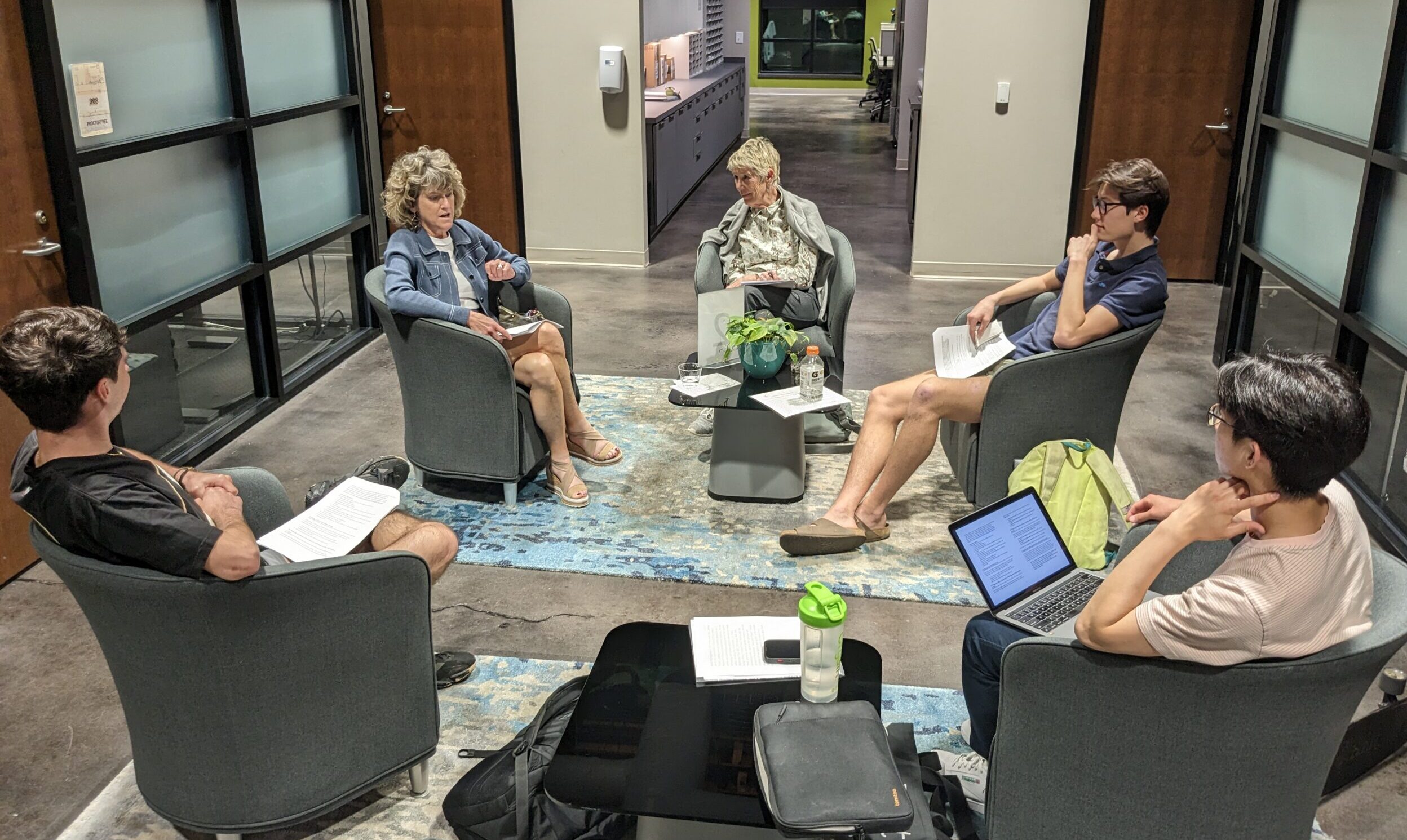
Group Discussion at the Jay Hurt Hub.

By Peter Beck ’26 (DCI Fellow)

Former Senior Counselor to the President Kellyanne Conway is infamous among Democrats, in part, for referring to “alternative facts” during a cable television interview. At the time, Democrats cited Conway’s comment as affirmation that then-President Trump and his retinue lived in a separate reality, where the truth lies beyond their comprehension or, at the very least, acknowledgment. The comment was a convenient way for Democrats to attack Republican policies on climate, racism, the pandemic, and a host of others.

Trump supporters, on the other hand, took advantage of a poor comment made by the Democratic nominee for President and former Secretary of State, Hillary Clinton, to portray Democrats as out-of-touch elitists. Clinton referred to Trump supporters as “deplorables,” which GOP supporters jumped on as an opportunity to cast Secretary Clinton and Democrats as snobs who believe only morally-corrupt people support Trump. To this day, some ardent Republicans call themselves and each other “deplorables” as a term of endearment.

“Alternative facts” and the “deplorables” comment impacted our political discourse and have continued to survive past the Trump presidency, indicating the comments’ weight reveals more significance than 24-hour partisan squabbles on the news. Republicans and Democrats both believe in their visions as best for the country’s future; some say those visions are separated more than at any time in history–as if Republicans and Democrats lived in two different worlds. Polarization is so severe that debates usually concentrate not on policy but on disputing another person’s intellect and grasp of reality–a stark contrast from Alexis de Tocqueville’s American ideal: “Town meetings are to liberty what primary schools are to science.”

As a DCI facilitator, I have to admit that I cringe a little whenever someone pulls out their phone or computer during deliberations to search for a fact on the internet. It is almost always from a place of curiosity rather than wanting to prove a point against someone else’s argument. Still, scenarios of an “alternative facts” versus “deplorables” debate play through my mind. Not only does the internet have a lot of dubious sources of information, but often a person can find a source verifying their precise claim without ever looking into other perspectives.

However, it seems unreasonable to ask participants to stop introducing outside facts. Unlike partisan attacks on an opponent’s character and background, D Team topics focus almost exclusively on policy. D Team participants can bring in only so much background knowledge for any subject. I am fortunate as a facilitator that so many D Team participants have experience and understanding of the topics we discuss. I am hosting two D Teams this semester focusing on climate, and each member of these teams has an intimate and passionate connection they could contribute to the conversation (although this could also be a sign of the worsening effects of climate change).

 I believe D Teams are at their best when these interactions occur: one person shares a meaningful, previously unknown perspective from their experience that the rest of the group did not consider. However, I still struggle with addressing two difficult priorities: the need for facts in productive conversations while preventing facts manipulated to fit certain narratives. The degrees of separation between perspectives highlight how divided we are into separate political camps. Ultimately, we need to work toward a political discourse that agrees on a list of common principles and facts that overcomes labels. Demonizing each other as elitist or dumb does nothing to address the problems we face, many of which we agree on.

My hope for D Team members is to use the deliberative space to understand and hear one another, above all else. Perhaps, this personal approach will allow us to overcome the partisan gap little by little and avoid devolving into narratives accusing each other of clinging to “alternative facts” or thinking all of your opponents are “Antifa communists.”

Filed Under: Blog Posts, Fellow Posts Tagged With: politics

Building Coalitions Through Deliberation

April 18, 2023 by Daniel Lee

Painting of Rodney King with quote "Can't we all just get along?" and "Born on April 2, 1965."

Daniel Lee ’26 (DCI Fellow)

April 30th, 1992. Fire blazed through the streets of Koreatown and South Central in Los Angeles. Korean Americans frantically ran about, attempting without much success to prevent looters from stealing from vandalized buildings. The police were nowhere to be seen—the people were on their own, helpless except for a few handguns and the presence of one another.

March 3rd, 1991. Rodney King, a Black construction worker, enjoyed a few drinks with his friends and drove down Interstate 210. A few officers noticed him speeding and pursued his vehicle. Determined to avoid being convicted and thus violating parole for a previous robbery, King led the police on a high-speed chase through Los Angeles. He was eventually arrested and beaten mercilessly by a swarm of officers.

The act of police brutality was recorded and distributed through the media, enraging Black communities. When King’s case was taken to court, the resulting verdict only furthered the brewing anger by favoring the position of the white officers. Infuriated, Blacks violently protested in the streets of Koreatown and South Central, destroying and burning property. The police dared not intervene, leaving residents to fend for themselves. Ultimately, an estimated 2,300 privately-owned businesses run by Korean Americans were harmed, measuring up to approximately $400 million in damages.

On its face, the 1992 LA Riots tell a story of police brutality and white supremacy. But in close examination, it also tells a story of the dysfunctional relationship between Black and Korean American communities. Cultural misunderstanding and prejudice directed at one another create unnecessary division among marginalized communities and make it difficult to develop meaningful coalitions to fight against greater structural problems. Often, this dysfunctional dynamic arises from differences in cultural etiquettes (e.g., norms surrounding eye contact and merchant-customer interaction) and faulty stereotypes that instill unreasonable fear and hatred in people’s minds. Without this unfortunate misperception, it seems unlikely that the 1992 LA Riots would have manifested in the way they did.

In this light, it is my sincere hope to break down existing cultural misunderstandings and work towards building productive coalitions between the AAPI community and other marginalized communities. Instead of being held at an impasse over our differences, we must work hand-in-hand to fight against the greater evil—structural racism and prejudice that weigh down our communities. This starts with intentional education that dissolves toxic stereotypes and respectful deliberations that allow communities to find common ground and see each other in a truer light.

Through the skills and life experiences I develop as a DCI Fellow, I hope to use deliberation to lead successful coalition-building between marginalized communities. The empowerment of future generations to create a more perfect society founded upon values of justice and inclusion starts with everyday conversations grounded in intellectual humility and genuine respect. Instead of being in conflict with each other, I dream of people from all different cultures and backgrounds standing together, hope dancing with our every heartbeat as we march on toward a brighter future.

Image by Cass Anaya used under Creative Commons License

Filed Under: Blog Posts, Fellow Posts Tagged With: facilitation, politics

  • « Go to Previous Page
  • Page 1
  • Page 2
  • Page 3
  • Go to Next Page »

Footer

Blog Post Categories

  • Announcements
  • Blog Posts
  • DCI Posts
  • Events
  • Faculty Posts
  • Fellow Posts
Image of a compass superimposed by the text "Deliberative Citizenship Initiative" and "Davidson College." Clicking on this image leads to the Initiative page.

Recent DCI Blog Posts

  • We Tried to Fix Jubilee’s “Middle Ground” – Here’s How It Went
  • A Case for Deliberation in the Natural Sciences
  • Welcoming New Staff to the DCI and DCN
  • Facebook
  • Twitter
  • Instagram
  • LinkedIn


Copyright © 2026 · Infinity Pro on Genesis Framework · WordPress · Log in