• Skip to main content
  • Skip to footer

Deliberative Citizenship Initiative

Building Democracy One Conversation at a Time

  • The Initiative
    • Programs
      • Deliberation Across the Curriculum
      • Deliberation on Campus
      • Deliberation in the Community
      • Research on Deliberation
    • Motivations
      • Why Deliberative Citizenship?
      • Why Davidson? Why Now?
    • Who’s Involved?
      • DCI Fellows Cohorts
        • 2025-2026 Fellows
        • 2024-2025 Fellows
        • 2023-2024 Fellows
        • 2022-2023 Fellows
        • 2021-2022 Fellows
        • 2020-2021 Fellows
      • DeeP Collaborative Cohorts
        • 2024-2025 DeeP Collaborative Faculty
        • 2023-2024 DeeP Collaborative Faculty
      • Advisory Council
    • History
      • What Sparked the Initiative?
    • Key Deliberative Dispositions
    • Frequently Asked Questions (FAQ)
    • Annual Report
  • Get Involved!
    • Participate in a Forum
    • Join a D Team
    • Become a Fellow
    • Take Courses
    • Get Training
    • Come to Guest Lectures
  • Events
    • Upcoming Events
      • 250th Anniversary Deliberative Forum Series on American Values
    • Past Events
  • Connections
    • The Deliberative Citizen: The DCI’s Monthly Newsletter
    • Efforts on Campus
    • Efforts in the Community
    • Efforts Elsewhere
    • Readings and Resources
      • DCI-Published Guides
      • DCI Guide to One-on-One Conversations
      • How to Disagree
      • Demonstration of Facilitation Styles
      • Deliberative Pedagogy Mini-Course
    • How We Can Help: DCI’s LET’S DELIBERATE! Partnership Opportunities
    • DCI in the News
  • DCI Blog Posts
    • Recent Blog Posts
    • All Blog Posts

DCI

DCI Spring Program Announcement: Commons Conversations

February 16, 2024 by Sara Copic

Commons-Conversations-8.5×11-2-1

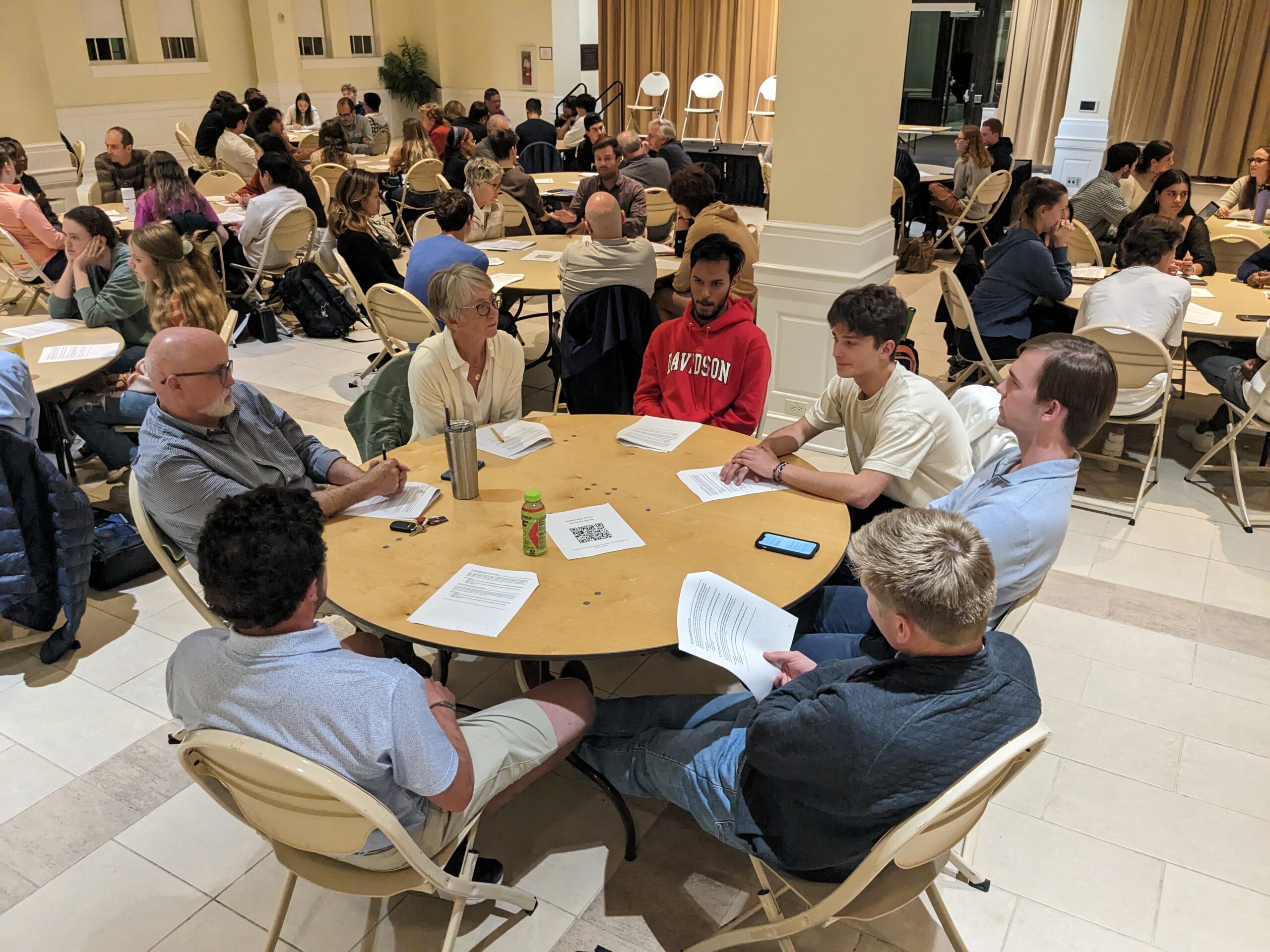
This spring, the DCI is partnering with Davidson faculty and staff to kick off a new iteration of our Commons Conversations program! Commons Conversations is a series of deliberative chats over lunch at Vail Commons and is open to all Davidson students. We have invited five faculty and staff members to host these conversations on topics relevant to their academic or professional expertise. At each session, these conversation hosts will briefly introduce the topic of conversation and share a few of their own insights on it. Students joining the lunch will then have an opportunity to discuss the topic with one another and the host in a conversation guided by our DCI Fellows, who are trained deliberation facilitators.

All Commons Conversations events will take place in the Vail Commons Annex. Meal swipes will be provided to all participants who are not on a full meal plan.

Below is our list of faculty and staff hosts that we have scheduled for this spring. A week or two before each Commons Conversation, we will share more information about the topic of conversation and how to register to attend (seats are limited and available on a first-come, first-serve basis).

We hope you’ll decide to join us for this series focused on the Davidson student community!

Friday, February 23, 11:15 am to 12:15 pm

Shelley Rigger, Vice President for Academic Affairs and Dean of Faculty, Brown Professor of Asian Politics

Friday, March 22, 11:15 am to 12:15 pm

Patricio Boyer, E. Craig Wall, Jr., Distinguished Teaching Professor in the Humanities and Director of the Humanities Program | Associate Professor of Hispanic Studies

Thursday, April 4, 12:15 am to 1:15 pm

Byron McCrae, Vice President for Student Life and Dean of Students

Thursday, April 18, 11:10 am to 12:10 pm

Shyam Gouri-Suresh, James W. Cannon Professor of Economics and Rizwan Zamir, Associate Professor of Religious Studies

Thursday, April 25, 11:10 am to 12:10 pm

Chris Clunie, Vice President & Director of Athletics
Filed Under: Announcements, Events Tagged With: DCI, deliberation, facilitation

The Power of Deliberation: Embracing New Ideas

November 2, 2023 by Florian Moser

DCI Fellow Florian Moser facilitating a deliberation

Florian Moser ’26 (DCI Fellow)

My initial interest in the Deliberative Citizenship Initiative was sparked last year in a conversation at the DCI kickoff party in the College Union. My group and our facilitator argued about a geopolitical topic on which I held a strong opinion. Therefore, I was trying to defend my point of view and counterargue opposing opinions. At that point, our facilitator interrupted me to ensure everybody could speak, forcing me to listen to other ideas. At that moment, I started to understand the difference between deliberation and debate. I want to compare these two approaches since, in today’s society, debate is the more prominent approach to conversation.

Confrontational vs. Collaborative: Debates and Deliberation

Debates are typically confrontational, with participants firmly entrenched in their positions, aiming to prove their viewpoint’s superiority. In contrast, deliberation is a more open and cooperative process focused on understanding different perspectives, reaching common ground, and appreciating diverse ideas. The key distinction lies in how people react to opposing views. In debates, individuals often defensively cling to their positions, sometimes at the expense of genuinely listening to others. Deliberation, however, encourages active listening and open-mindedness, fostering a collaborative environment that values constructive dialogue and the exploration of different viewpoints.

Since we are so used to debating, it is common for participants of DCI events to recognize the significant difference between deliberation and debate for the first time. In my first mock deliberation, during a DCI facilitator training, my facilitator ensured that every participant expressed their ideas in every round of the deliberation. This strong emphasis on equal-length speech contributions from all deliberations lets people formulate their ideas who might not be used to getting the chance to speak up. 

Instead of getting stuck in a debate about two specific viewpoints, participants gain many ideas they might not have considered before. The exchange of ideas and the practice of leaning into a different perspective holds two advantages. First, it is more valuable for the deliberators to gain new ideas, improving their worldview in the long run, than just winning an argument. Second, deliberations help to foster soft skills, strongly contributing to respectful and productive conversations. These soft skills help create a respectful and constructive environment in the long run, whether in debates or deliberations.

Here, I want to list some critical soft skills:

  1. Active Listening: In deliberation, listening isn’t passive; it’s an active effort to understand and appreciate the viewpoints of others.
  2. Open-Mindedness: Participants should be open to changing their views based on new information or insights.
  3. Respectful Communication: Encourage respectful and civil discourse, where participants can express themselves without fear of personal attacks.
  4. Seek Common Ground: Look for shared values and common objectives as a starting point for finding solutions.
  5. Value Diverse Perspectives: Recognize that diversity of thought leads to more creative and effective solutions.

The Benefits of Deliberation

Deliberation offers several advantages over debate. It promotes collaboration, reduces polarization, and fosters a sense of unity among participants. Moreover, drawing on broader ideas and perspectives can lead to better decision-making. In today’s complex and interconnected world, where many of the challenges we face require innovative solutions, deliberation is a practice that should be embraced and celebrated. It allows us to move beyond the limitations of our own perspectives and tap into the collective intelligence of diverse groups.

Conclusion

While debate has its place and can be a valuable tool for exploring differences, deliberation shines as a means to appreciate and harness new ideas. In deliberation, we see the true power of open-mindedness, empathy, and collaboration, and these qualities can help us navigate the complexities of our rapidly changing world. So, let us strive to embrace deliberation, for in doing so, we unlock the potential for collective growth, understanding, and progress.

Filed Under: Blog Posts, Events, Fellow Posts Tagged With: DCI, debate, deliberation, facilitation

Communication is Key

January 28, 2021 by Camryn Ellis Leave a Comment

image of keys in a door lock

By Camryn Ellis, DCI Fellow

I applied to become a fellow for the Deliberative Citizenship Initiative at Davidson College because it seemed to be an interesting and productive program. It being a space that encourages people to engage in deliberation on social issues that are hard to talk about and are usually only met with controversy was what caught my attention. Usually when I discuss political and social issues, I find that people are not really interested in changing their perspective. It’s always them ranting about all the reasons their beliefs are right and when I question them, the critique is taken personally and then it’s just a whole mess.

I’m not going to lie though, I, too, sometimes don’t always take critiques of my beliefs too well, either. I have recently realized that I sometimes think I’m more open to different ways of thinking than I actually am. I was interested in becoming a DCI Fellow because I want to challenge myself to learn how to listen better to people who feel differently than I do and to have and facilitate conversations that may be filled with controversy.

The DCI displayed itself to be a place where I could engage with people who have different perspectives and come together to productively and respectively deliberate on important social issues. I was excited to see the diversity of lived experiences I hoped to encounter. But after the first day, I knew that racial diversity would not really be in the cards for us this semester given that no one else in the cohort of fellows (except me) was Black.

This was disappointing and honestly not what I was expecting. Then when we received the topics that the cohort had suggested and ranked highest and we would be deliberating on, I was even more confused and unsure about how I felt about this program. While I think they are important social issues to discuss, the topics of Davidson’s history of enslavement and police brutality felt very overwhelming to me, especially since I would be the only Black person who would be participating in these cohort discussions.

I decided to talk to my DCI co-facilitator about this issue and she was so understanding and validating of my experience. She always reached out to see how I was feeling throughout the semester, especially when the week’s social issue was heavily influenced by racism. We were able to work out a solution where I would not serve as a facilitator during those weeks but would play a more active role in other weeks. As our DCI facilitator training emphasized, we may not always be able or ready to facilitate conversations on any and every topic, and that is okay.

In any case, as the weeks went by, the relationship between my co-facilitator and I made me feel that I was not so alone. And from our time together as DCI co-facilitators, we not only worked together, but also became friends.

From my experience, I have learned how important it is to truly listen to others, regardless of whether or not you share similar social identities and perspectives. Whether one is listening to a friend in need or is having a discussion about the current social and political realities of America, good communication is key. I have learned that the first step to good communication isn’t to make sure you are the loudest one in the room or that you use a great deal of jargon, but to instead listen to others, validate their lived experiences, and try to emphasize the ways that you can relate to one another, rather than highlighting all the ways that you don’t.

Filed Under: Blog Posts, Fellow Posts Tagged With: D Teams, DCI, facilitation, Fellows

Facilitation – A Key Ingredient to Productive Deliberation

August 13, 2020 by Graham Bullock Leave a Comment

badgeCreating spaces for constructive conversations about contentious topics seems like an overwhelming task.  Where should initiatives like the Deliberative Citizenship Initiative begin?  Deliberation scholars and practitioners generally agree that one of the most important ingredients for productive public discourse is strong facilitation by someone who is trained in bringing people together and being fair to all participants at the table.
For example, Laurie Mulvey, Executive Director of Penn State’s World in Conversation program, which has hosted more than 30,000 dialogues, asserts that just as we need referees when we play a game, “in dialogue we need conversation referees to be able to make the calls for us to help us through the process.”[i] And the literature on deliberation emphasizes the role that facilitators can play in introducing unmentioned topics, challenging consensus, and structuring communication in a way that empowers disadvantaged participants.”[ii]

For these reasons, the DCI started with an intensive four-session deliberation facilitation training program this past spring.  Each session lasted two hours and were facilitated by practitioners and professors familiar with different models of public discourse.  The training program revealed several important insights about creating opportunities for discourse among those disagree on difficult issues:

  • It’s a mindset: Both participants and facilitators need to adopt a set of dispositions that make productive deliberation possible. These include commitments to modeling egalitarianism, demonstrating openmindedness, and providing either experiential or factual evidence to support one’s claims.  To explore these mindsets, participants were asked to complete the OpenMinds modules, which discuss the value of engaging with those we disagree, the importance of intellectual humility, and the effects of the irrational mind and our “moral matrices.”  Using this framework, facilitators can help participants embrace a “deliberative mindset” that will enable them to work together to better understand a problem and generate transcendent solutions to it.
  • It’s a process: Our first two training sessions were led by an experienced facilitator from the Lee Institute, Chryrstal Joy, who emphasized the multifaceted nature of the facilitation process. It requires thoughtful preparation beforehand that clearly identifies roles, clarifies goals, and develops mutually accepted ground rules.  It also demands proactive moderation that guides, connects, motivates, questions, intervenes, and keeps participants on track during the deliberation itself.  We discussed the nuances of each of these steps, each of which have their challenges.  But by following a clear process, it becomes easier to practice the “passionate impartiality” that is necessary to bring everyone into the conversation.
  • It’s a model: Dialogue and deliberation initiatives have proliferated dramatically in the past three decades, and with them the number of models being used to facilitate public discourse have increased as well. In our third and fourth sessions, we learned and practiced two particular approaches that have been used in a wide range of contexts.  The first was the National Issues Forum model, which provides Issue Briefs for participants to read in advance and focuses on three distinct responses to the issue in focus.  The second was the Living Room Conversations model, which is more informal and involves three rounds of discussion – getting to know each other, exploring a topic, and reflecting on the conversation.

Through these sessions, we learned several important insights about deliberation facilitation.  By encouraging a deliberative mindset, following a clear process, and using a particular model, facilitators can increase the likelihood that a conversation will be engaging, productive, and rewarding.  At the same time, we also realized there is no perfect process or model or mindset, and flexibility and adaptability are important attributes for facilitators and deliberators alike.  Along these lines, we came to recognize that facilitation training is never fully complete, but is a lifelong process that occurs through practice, reading, and exposure to new approaches.

The 25 Davidson staff members, tenured and visiting faculty, and first year, sophomore, junior, and senior students who completed the DCI’s inaugural training program have completed a key first step in this journey.  They are now ready to help guide conversations on difficult topics, whether they are part of a Deliberative Forum or just between friends or family.  If you are interested in learning these skills yourself, sign up for updates below about upcoming DCI training opportunities.

Next week we’ll hear from Davidson’s new DCI Coordinator, Clare Magee, about her experience bringing together students with diverse perspectives when she served as the Executive Director of the Henry Clay Center for Statesmanship.  Stay tuned…!

Notes

[i] Democracy Works, “A Conversation about Conversation,” May 21, 2018, https://www.democracyworkspodcast.com/a-conversation-about-conversation/.

[ii] Archon Fung, “Deliberation’s Darker Side: Six Questions for Iris Marion Young and Jane Mansbridge,” National Civic Review, December 25, 2004; Todd Trenel and Seeta Peña Matthias, “Facilitation and Inclusive Deliberation,” in Online Deliberation: Design, Research, and Practice (Chicago, IL: CSLI Publications/University of Chicago Press, 2009), https://doi.org/10.13140/RG.2.1.4040.0883.

Filed Under: Blog Posts, DCI Posts Tagged With: DCI, facilitation

  • « Go to Previous Page
  • Page 1
  • Page 2

Footer

Blog Post Categories

  • Announcements
  • Blog Posts
  • DCI Posts
  • Events
  • Faculty Posts
  • Fellow Posts
Image of a compass superimposed by the text "Deliberative Citizenship Initiative" and "Davidson College." Clicking on this image leads to the Initiative page.

Recent DCI Blog Posts

  • We Tried to Fix Jubilee’s “Middle Ground” – Here’s How It Went
  • A Case for Deliberation in the Natural Sciences
  • Welcoming New Staff to the DCI and DCN
  • Facebook
  • Twitter
  • Instagram
  • LinkedIn


Copyright © 2026 · Infinity Pro on Genesis Framework · WordPress · Log in