• Skip to main content
  • Skip to footer

Deliberative Citizenship Initiative

Building Democracy One Conversation at a Time

  • The Initiative
    • Programs
      • Deliberation Across the Curriculum
      • Deliberation on Campus
      • Deliberation in the Community
      • Research on Deliberation
    • Motivations
      • Why Deliberative Citizenship?
      • Why Davidson? Why Now?
    • Who’s Involved?
      • DCI Fellows Cohorts
        • 2025-2026 Fellows
        • 2024-2025 Fellows
        • 2023-2024 Fellows
        • 2022-2023 Fellows
        • 2021-2022 Fellows
        • 2020-2021 Fellows
      • DeeP Collaborative Cohorts
        • 2024-2025 DeeP Collaborative Faculty
        • 2023-2024 DeeP Collaborative Faculty
      • Advisory Council
    • History
      • What Sparked the Initiative?
    • Key Deliberative Dispositions
    • Frequently Asked Questions (FAQ)
    • Annual Report
  • Get Involved!
    • Participate in a Forum
    • Join a D Team
    • Become a Fellow
    • Take Courses
    • Get Training
    • Come to Guest Lectures
  • Events
    • Upcoming Events
      • 250th Anniversary Deliberative Forum Series on American Values
    • Past Events
  • Connections
    • The Deliberative Citizen: The DCI’s Monthly Newsletter
    • Efforts on Campus
    • Efforts in the Community
    • Efforts Elsewhere
    • Readings and Resources
      • DCI-Published Guides
      • DCI Guide to One-on-One Conversations
      • How to Disagree
      • Demonstration of Facilitation Styles
      • Deliberative Pedagogy Mini-Course
    • How We Can Help: DCI’s LET’S DELIBERATE! Partnership Opportunities
    • DCI in the News
  • DCI Blog Posts
    • Recent Blog Posts
    • All Blog Posts

D Teams

Don’t Expect It, but Persuasion is Possible

January 31, 2023 by Brody Bassett

Stock Image of multiple headshots making the shape of a lightbulb.

By Brody Bassett ’25 (DCI Fellow)

Going into my first semester as a facilitator with the Deliberative Citizenship Initiative, I was excited to hopefully help people hear different opinions. I hoped to help facilitate discussion to break people out of potential “echo chambers,” so there could be more understanding between opposing viewpoints on and off Davidson’s campus. 

After my first week of facilitations, I was pleased with the development of the deliberations. The members of my group were openly conversing about their opinions and viewpoints. During the first session, I was able to see the different perspectives within the groups. These different perspectives led to differing political beliefs which were talked about during the discussion. I was happy to see that my deliberation team engaged with each other despite their differences in opinion.

One of the first deliberation topics of my session brought about a specific voting option: mail-in voting. People certainly had different opinions about this option and its effects on the overall electoral process.  Specifically, one person voiced the opinion that mail-in voting leads to a potential for less integrity within the voting system. Another individual from the deliberation voiced their own belief that mail-in voting allows more accessibility for working-class Americans. The two then began to weigh the pros and cons of the mail-in voting system, each expressing their own opinions. I was happy to facilitate this discussion, and both parties productively expressed their opinions while other members began to weigh in as well, leading to a fruitful exchange of ideas. My first facilitation lived up to my expectations as people shared different viewpoints, exposing each other to different opinions. In my next facilitation, however, the conversation did not follow my expectations.

As stated above, I was committed to being a facilitator of deliberation groups to hopefully show people different perspectives on politically contentious topics. I frankly did not realize the potential of deliberation groups to change people’s opinions on political topics. As facilitators, we don’t expect our group’s participants to necessarily alter their views on these topics; we are more focused on encouraging listening, sharing, and exploring new ideas together.  So my expectations were broken when I was pleasantly surprised that one of my D Team members humbly started our time by admitting that they conceded their viewpoint from the last deliberation. The member recounted specific details from the opposing point of view, leading them to the conclusion that they might be wrong. They shared this revelation with the group and thanked everyone for the discussion that helped change their viewpoint.

Following my second meeting with my D Team, I was impressed by the humility and the bravery the individual took to let go of their views and acknowledge to a group their change in opinion. This interaction showed me that deliberation groups were more than just tools to break people from their “echo chambers,” and that deliberations could bring people to accept new ideas. While not all the members of D Teams will come forward to share their change in opinion, the environment of a deliberation group does allow for the change of opinions in a healthy space. We shouldn’t expect it but it does happen and I was very pleased to see it firsthand.
Filed Under: Blog Posts, Fellow Posts Tagged With: D Teams, facilitation

Spring 2023 D Teams are Here! Register Today!

January 10, 2023 by Graham Bullock

D-Teams-Poster_Spring-2023

Following our successful fall deliberations about elections, this spring the Deliberative Citizenship Initiative (DCI) is hosting two tracks of discussions on important issues facing our society. The first single-topic track will take a deep dive on pressing issues relating to climate change, while the second multi-topic track will explore questions related to three key policy areas – climate change, immigration, and college admission policies. These were the highest priority issues identified in surveys of previous D Team members and discussions among the DCI Fellows and Co-Conveners. When registering, you will be able to indicate which is your preference (if you have one).

Climate Change (Single-Topic Track)

The last year witnessed record temperatures in North America, Europe and elsewhere, as well as record floods around the world, including in Kentucky, Pakistan, and Australia. Large majorities of scientists, policymakers, business leaders, and citizens now generally agree that climate change is occurring, but often differ on particular strategies to pursue and who should be responsible for implementing them. Over the course of three sessions, participants in this D Team track will take a deep dive into the topic of climate change, tackling three key questions:

  1. Climate Choices (Part I): What climate strategies, if any, should we pursue? Should we focus more on reducing carbon emissions, protecting communities from the impacts of climate change, or accelerating the development of innovations that can make it easier to do both?
  2. Climate Responsibilities (Part II): Who, if anyone, should be responsible for paying for these strategies? Should everyone pay an equal share, should polluters pay more, or should those with greater capacity pay more?
  3. Climate Responsibilities (Part III): Who, if anyone, should be responsible for implementing these strategies? Should governments, businesses, or consumers take the greatest responsibility for taking action on climate change?

    Immigration, College Admission Policies, and Climate Change (Multi-Topic Track)

    The DCI’s second track will also discuss our climate choices along with two other topics – immigration and college admissions policies.

    1. Immigration Choices: In 2022, there were a record number of migrant border crossing into the United States. Who should we welcome? What should we do? Should we welcome all immigrants and be a beacon for freedom, enforce the law and be fair to those who follow the rules, or slow down and re-build our common bonds? 
    2. College Admission Choices: In 2023, the Supreme Court will rule on two highly consequential cases related to the use of race in college admissions. How should applicants’ backgrounds be taken into account, if at all? To what extent should race, athletic performance, legacy status, gender, socio-economic status, and/or merit be used in the admission process?
    3. Climate Choices: What climate strategies, if any, should we pursue? Should we focus more on reducing carbon emissions, protecting communities from the impacts of climate change, or accelerating the development of innovations that can make it easier to do both?

      Registration

      Spring 2023 D Team Registration — CLICK HERE

      • To register for a spring D Team, click on the link above. The registration deadline is Monday, January 23rd.
      • You can choose from several dates and times. Please have your calendar ready and updated when you register and indicate all time slots that you will be available.
      • In consideration of others in your group, you are expected to attend all three sessions.
      • Group assignments, along with the date, time and the DCI Fellow leading your D Team will be emailed to you by Monday, January 30th.
      • We encourage you to invite someone who has different perspectives on the issues than you to join a D Team as well. Please this information with a colleague, friend, neighbor, or family member who you think might be interested. Everyone is welcome and encouraged to join!

      Dates

      • Registration deadline – Monday, January 23
      • D Team Assignments sent to participants – Monday, January 30
      • D Team Session 1 – Week of Monday, February 20th
      • D Team Session 2 – Week of Monday, March 20th
      • D Team Session 3 – Week of Monday, April 10th

      More Information

      See below for some comments from recent D Team participants (over 160 people participated on 19 different teams this past fall):

      “My D Team experience allowed me to have rich discussions with a mix of students, staff, and alumni. I particularly enjoyed the diversity in our ages and backgrounds. The written guides and our facilitator helped me feel prepared to participate in topics I had little experience in discussing, especially outside of my own friend group.”

      “The DCI experience is one of the rare opportunities in these contentious times that cross-generational and cross-political perspectives can be shared and engaged within a respectful discussion.”

      Click here to learn more and watch a short video about the D Team experience. You can also find out about the difference between SkillBuilder and BridgeBuilder Teams and read more testimonials from past participants.

      Filed Under: Announcements Tagged With: D Teams

      Fall 2022 D Teams

      January 7, 2023 by Graham Bullock

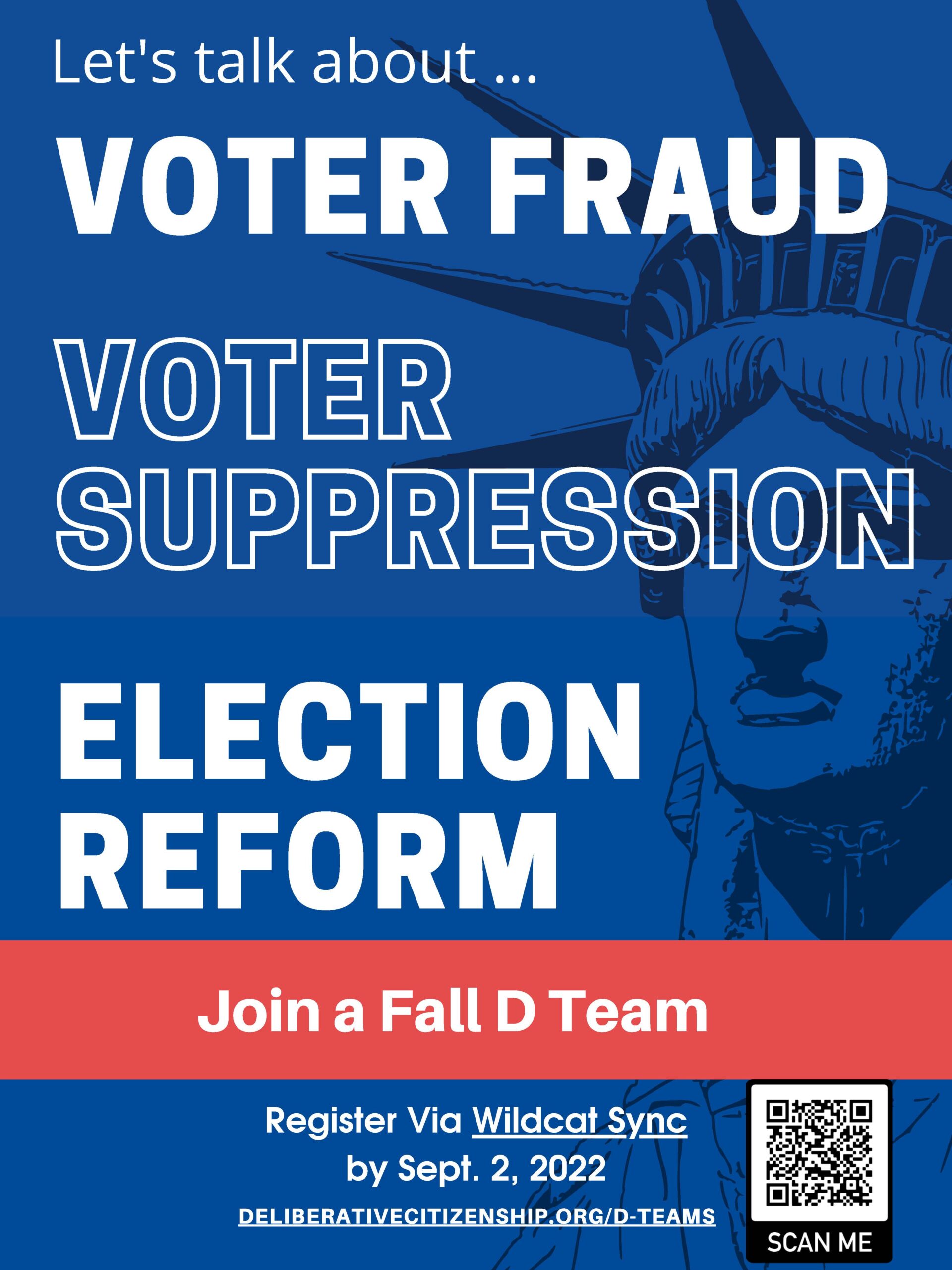
      Flyer for Fall D Team signup.

      Concerns surrounding elections have heightened in recent years as Americans worry about voter fraud and voter suppression, election security and election accessibility, and the fairness and inclusivity of the American electoral system. Various states have enacted stricter voting laws while other have attempted to expand access to the ballot box. As election season proceeded in the fall of 2022, the DCI’s D Teams focused on the issues, pressing challenges, and possible solutions related to voting and elections in America.

      D Teams Poster Fall 22

      Over three sessions, these D Teams deliberated about how we can make voting more accessible, more secure, and more fair. The first session focused on whether we should make voting more accessible through early voting, voting by mail, an increased number of polling places, and more. The second D Team meeting examined election security and whether we should reduce concerns about voter fraud through poll watching, use of better technology, voter ID laws, and other strategies. The third and final session addressed whether we should improve our elections by implementing reforms such as ranked choice voting, proportional representation, and the abolition of the electoral college.

      Over 160 people participated in 19 D Teams to discuss these topics. They met for two hours every couple of weeks either in person or online. Feedback was overwhelmingly positive, with over 96% reporting that they were satisfied or highly satisfied with their D Team experience.

      Fall 2022 D Team Testimonials

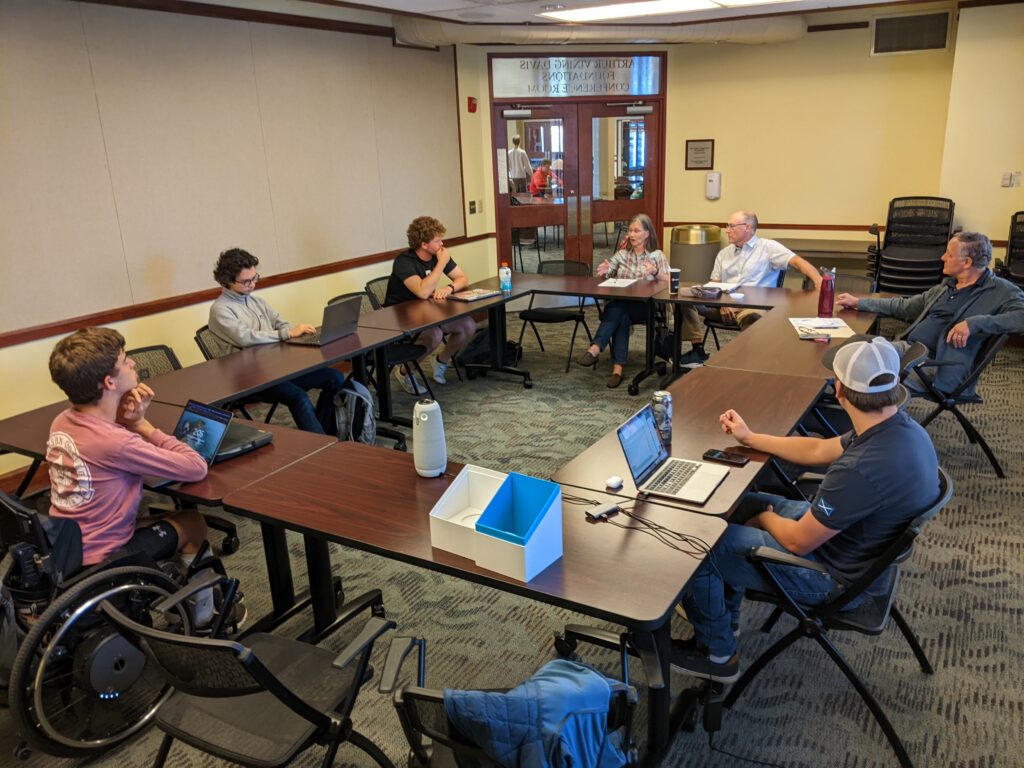
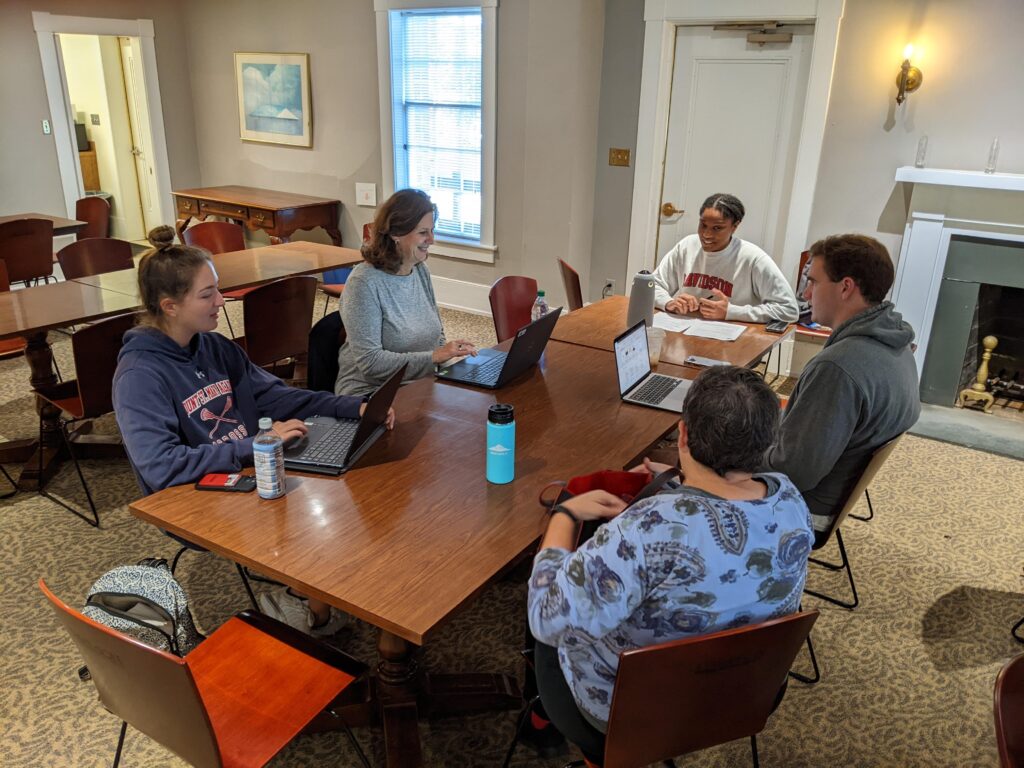
      Below are testimonials from some of the participants and some snapshots from some of our in-person D Team meetings:

      “I thoroughly enjoyed all the discussions in my D Team meetings. Despite participants from both sides of the political divide, it was refreshing to realize that we still have much in common. [Our facilitator] did a good job of pulling everyone in and keeping the discussions (or even disagreements friendly). The country would benefit from more such conversations.” Fall 2022 D Team Participant

      “I thoroughly enjoyed the three sessions and talking with the other participants. Our moderator did a great job of keeping us on schedule when that was needed and allowing us to take more time on a topic where we had a good discussion going.” Rick Whitener ’73

      “I had such a positive D Team experience. I really wasn’t sure what to expect and it absolutely exceeded my expectations. Our team had such interesting, thoughtful conversations that typically resulted in many of us saying, “You know, I realize I don’t know a lot about x” and going to do some additional research. It really helped me to see how much I don’t know about a lot of these topics, and even within a group of people who (I think) have fairly similar political leanings, there was a lot of diversity in our perspectives and priorities. We left our last session saying we’ll never look at elections in quite the same way again, because our conversations helped us to consider things we’d previously taken for granted (e.g., who in your state gets to vote, how do they get to vote, when can they vote?) – I feel a lot more informed and able to speak more confidently to both sides of the issues we discussed. Thanks so much for a fantastic opportunity! Fall 2022 D Team Participant

      “My experience on the D Team was rich and rewarding. The student facilitator was informed and engaged, encouraging each participant to share his or her voice in the discussion while also asking thoughtful questions and helping us reach meaningful insights. I look forward to the next opportunity to be involved in a D Team gathering.” Natalie Akin ‘05

      “I appreciated the DCI framework as it gave me a chance to discuss issues without as much polarizing language as public discourse seems to have currently. I was encouraged that while all may not have attributed issues to the same cause, all were open to common solutions to the problems.” Fall 2022 D Team Participant

      “Engaging in the DCI helped me step out of my localized bubble of friends and colleagues. Sharing time and ideas with people who all cared about Davidson, an institution that means a lot to me, was not only enjoyable, but it was rewarding. I’ll be back for more D Teams in the future! Stephen Powell

      “The D Team meeting proved to be a redemptive experience for me. When I was a student at Davidson in the 90s, I felt like such a political outlier. Politically active conservative students were frequently dismissive and rude towards my more liberal beliefs, which is not unexpected, but sometimes they crossed the line into anonymous threats, which made it difficult to feel like I was a valued part of a robust learning environment. Instead, I felt very much like an unwelcome outsider, an interloper into their cozy boys club.

      The conservative administrative leadership in the 90s didn’t help. It was patronizing and condescending to those of us trying to move the needle toward making Davidson a more inclusive environment. Thank goodness for the excellent professors and staff, particularly in the Campus Ministry and the College Union, who pushed against that administrative perspective. They are the adults who made me feel like I could belong in such a different place. They were the ones who held space for the square pegs who didn’t want to shave off our edges to fit in the conservative round holes.

      To have an opportunity to engage politically with a multi-generational group of students and alumni on the D Team, to feel heard and valued by those people, helped me contextualize those college years. Hearing that it is now conservative students who experience the discomfort that I felt back then also helped me build empathy. I have more confidence that Davidson can continue to move forward in building a community in which multiple contradicting political beliefs can be challenged without challenging the essential humanity of the individuals holding them.” Fall 2022 D Team Participant

      “It is so important that we learn to talk in meaningful ways about tough issues.  D Team allowed me to experience this in a safe, structured environment. Our D Team discussions have given me the confidence to expand my conversations about election related topics with all my friends and family.  That was so rewarding to me personally. I hope these continue and become a permanent part of what Davidson can give back to the community.” Kim McLendon

      “My D Team experience allowed me to have rich discussions with a mix of students, staff, and alumni. I particularly enjoyed the diversity in our ages and backgrounds. The written guides and our facilitator helped me feel prepared to participate in topics I had little experience in discussing, especially outside of my own friend group.” Amy, Davidson Staff Member

      “Outstanding opportunity. I learned much from the readings and even more from fellow participants. Respectful, open discussion. I reconsidered my view and perspective. I highly recommend others join.

      These were refreshing and nourishing conversations. I enjoyed hearing other people’s perspectives on issues I care very deeply about. The structure of the sessions led to good solid conversations.” Tom Moore

      “The DCI experience was exactly what I had envisioned — it was a chance to ‘practice’ being less judgmental, active listening, and expressing my views in a constructive way. Thank you to the students who both facilitated the conversations and who participated in the meetings — your presence really added to the experience. Lisa McNeilly ’86

      “I highly recommend joining a D team to help build appreciation for how diverse people’s views are and what it would take to build consensus with any proposed change.” Fall 2022 D Team Participant

      “This was a very engaging and insightful experience. I enjoyed interacting with persons of diverse opinions and locales. It is good not to be in an echochamber.” Fall 2022 D Team Participant

      “Our discussions were informative, stimulating and led me to think more thoroughly about the issues.” Fall 2022 D Team Participant

      “The DCI experience is one of the rare opportunities in these contentious times that cross-generational, and cross-political perspectives can be shared and engaged within a respectful discussion.” Fall 2022 D Team Participant

      “Not only did I learn more about the discussion topics, but I feel much more confident engaging with others having different perspectives, hopefully resulting in mutually respectful learning and sharing and sharing of ideas.” Fall 2022 D Team Participant

      “This D Team experience was amazing.  The participants spanned ages from 18 – 80.  The team included equal numbers of women and men.  The group included US born, an immigrant, and one from a foreign country.  In included on person for whom this was the first contact with Davidson. Consequently, there was a broad range of experience with the subject matter, as well as a fairly wide continuum of opinion about the voting practices.  Our DCI leader was able to glide us through our discussion in a seamless way. She introduced each section with ease and had a natural way of including members of the group which was very inviting. When there was a clustering of opinion, she would often introduce other perspectives to assure that we were thoroughly considering points of view that were not present in our discussion. After the three sessions I came to realize that I knew less about the subject than I thought I knew when I joined the group. As a result of the background reading, I feel that I have learned a great deal about elections and voting. Now, I feel a need to read and learn more in this subject matter.” Fall 2022 D Team Participant

      “The Deliberate Citizenship Initiative has been a very positive experience for me– exactly the kind of thing a college like Davidson should be doing. Learning across generations, out of our normal comfort zones, in many senses student-led, timely and relevant topics — all in all a worthy effort.  I am grateful for the opportunity to participate and encourage others to as well.” Fall 2022 D Team Participant

      “I signed up to participate in a D Team experience hoping to gain skills that would help me feel more equipped to engage in dialog across political difference, and I was not disappointed. The structure and content of the discussions were great – as was the opportunity to be in conversation with a humble and inquisitive group.” Erica Caloiero

      “My D Team experience was awesome! Turns out I really didn’t know much about election processes and nuances, but what a great opportunity this was to learn more. The discussions were interesting, engaging, respectful, and ably led by a great student facilitator.” Fall 2022 D Team Participant

      Filed Under: Announcements Tagged With: D Teams

      Deliberation in African Homes: Gamechanger

      January 5, 2023 by Divin Dushimimana

      mother and son silhouettes.

      Divin Dushimimana ’26 (DCI Fellow)

      I believe that one good conversation can shift the direction of change forever. When I look back, deliberation could have saved many Africans so much trouble in their family life. At least in my culture in Rwanda, the head of the family in many traditional households commands and everyone else follows – no discussion about it and the routine continues. Sometimes, it feels like you’re a computer being programmed on what to do.

      At first, it seems like it’s working until it doesn’t. This parenting style and lack of deliberation in African homes has been the main result of teenage misconduct and rebellion. I have seen a lot of my friends forsake their homes because of lack of meaningful conversations and lack of parent’s understanding that their children are old enough to dictate how they want to live their lives. The idea is that your parents are right and you are wrong hence you should listen to whatever they tell you to do without any form of discussion or compromise on the issue.

      Growing up in such an environment and doing debate in high school, the notion was the same. I had this idea that there is always this person who has the monopoly of knowledge. It was more of someone being right and another being wrong, nothing else. This process creates poor relationships between parents and children that consequently affect their ability to interact and engage on different topics like reproductive health or even mental health.

      At some points, it will seem like it is a child against a parent and vice versa. I know examples of children who have indulged in certain things just to make their parents angry because the children felt like they aren’t being heard; they felt like they aren’t  being given an opportunity to discuss issues that are meaningful to them, they aren’t being given an opportunity to deliberate and find a common ground on certain things.

      After participating in the ‘Parents & Teachers Forum’ this semester, I gained more understanding on how parents should play a vital role in what their children learn through deliberation. I realized that deliberation can create one conversation at a time in an African household. I think this can build meaningful communities and catalyze creative solutions. Indeed, I believe we would see cases of teenage pregnancies and youth suicide drop incrementally if deliberation is incorporated in the parenting style.

      I believe this would build parents’ active listening skills towards their children, giving them an opportunity to understand where they are coming from and what challenges they are facing. Furthermore, children will feel loved and free to engage in such meaningful conversations with their parents, which I believe will create a safe space for growth. 

      Furthermore, after being trained as a facilitator and actually facilitating three Deliberative Team meetings, I realized that people will not always agree on certain issues due to their different backgrounds or experiences with the issue at hand. However, if you free yourself from the idea of always winning or being right and open your ears to actively listening to someone else’s opinion, you’ll surely learn a lot. You’ll surely gain a certain mastery of letting go of your opinions when you’re introduced to new ideas.

      In this world of growing tensions and challenging issues, no one holds a monopoly on effective solutions. The world would change for the better if people would refrain from thinking that they are always right but rather open their hearts to learning. I believe that through deliberation, we can make significant progress on all of the issues affecting our world.

      Filed Under: Blog Posts, Fellow Posts Tagged With: D Teams, facilitation

      Digging Deeper: On the Challenges of Agreement

      December 21, 2022 by Lauren Collver

      digging with a shovel stock image

      Lauren Collver ’25 (DCI Fellow)

      There are many clear takeaways one expects from participating in a deliberation. New perspectives, deeper understandings, and opportunities to exercise constructive discussion. When going into my first facilitation experience, I prepared for disagreement, miscommunication, and heated discussions. In my mind, the biggest challenges I would face would be finding common ground, keeping track of a multitude of ideas and views, and keeping deliberators on time. These challenges turned out to be barely issues at all… 

      • Finding common ground? Almost the entire group was connected to the Davidson community, and excited to celebrate our differences.
      • Keeping track of ideas? I quickly developed a note-taking method to easily keep track of people’s main points and primary values.
      • Keeping people on time? Participants were often grateful for interruptions and reminders to keep us on time (a very pleasant surprise).

      With all of my main concerns out of the way, I found myself confronting the most unexpected challenge of all: agreement. With all of my preparation having gone towards preparing for disagreement and focusing on finding common ground, I found myself unexpectedly lost when in my first D-Team meeting the conversations continually came to a lull, with an increasing frequency of comments such as “my thoughts are very similar to the previous person” or “I’m not sure I have much more to add to the conversation, all of my thoughts seem to have been said.” The problem here was not so much the presence of agreement; it was my underlying sense that people had not actually found common ground so simply but were relying on the convenience and comfort of agreement.

      This problem makes sense in the context of a formal deliberation where a diverse group of people across a wide range of generations and experiences find courtesy and politeness more comfortable than disagreement. The statement “sure, that makes sense / I can see why you feel that way” is far more comfortable than statements like “I actually disagree with you on that” or “I’m not convinced that your point is entirely fair.” 

      It was here that I was able to fully realize my value as a facilitator. As someone without a stake in the deliberation or a point of view to defend, I was in a position to demonstrate paths towards constructive disagreement. I started using statements such as “If i might push you on that point a little bit there” or “So, I’m hearing that you think X because of Y, and I’m wondering if others in the group may have different perspectives on this point?” With this strategy, I was able to both invite deeper discussion and demonstrate to participants how they could do the same while maintaining the courtesy they found comfortable.

      With deeper discussions underway from our first meeting, the second two D-Team meetings led us to a great perspective on agreement. We realized that a lot of those initial statements expressing passive agreement came from a reflexive focus agreeing upon the existence of problems, rather than discussing the historic and cultural causes of such problems.

      For example, participants could agree that confidence in election security is an issue that the American government is currently facing, but could fundamentally disagree on the causes of the lack of confidence in the first place. When we realize that we can agree on the existence of problems while disagreeing on the root cause of the issue, we can focus on exploring solutions rather than getting caught in circles of disagreement.

      Filed Under: Blog Posts, Fellow Posts Tagged With: D Teams

      • « Go to Previous Page
      • Page 1
      • Page 2
      • Page 3
      • Page 4
      • Page 5
      • Go to Next Page »

      Footer

      Blog Post Categories

      • Announcements
      • Blog Posts
      • DCI Posts
      • Events
      • Faculty Posts
      • Fellow Posts
      Image of a compass superimposed by the text "Deliberative Citizenship Initiative" and "Davidson College." Clicking on this image leads to the Initiative page.

      Recent DCI Blog Posts

      • We Tried to Fix Jubilee’s “Middle Ground” – Here’s How It Went
      • A Case for Deliberation in the Natural Sciences
      • Welcoming New Staff to the DCI and DCN
      • Facebook
      • Twitter
      • Instagram
      • LinkedIn


      Copyright © 2026 · Infinity Pro on Genesis Framework · WordPress · Log in