
• Skip to main content
  • Skip to footer

Deliberative Citizenship Initiative

Building Democracy One Conversation at a Time

  • The Initiative
    • Programs
      • Deliberation Across the Curriculum
      • Deliberation on Campus
      • Deliberation in the Community
      • Research on Deliberation
    • Motivations
      • Why Deliberative Citizenship?
      • Why Davidson? Why Now?
    • Who’s Involved?
      • DCI Fellows Cohorts
        • 2025-2026 Fellows
        • 2024-2025 Fellows
        • 2023-2024 Fellows
        • 2022-2023 Fellows
        • 2021-2022 Fellows
        • 2020-2021 Fellows
      • DeeP Collaborative Cohorts
        • 2024-2025 DeeP Collaborative Faculty
        • 2023-2024 DeeP Collaborative Faculty
      • Advisory Council
    • History
      • What Sparked the Initiative?
    • Key Deliberative Dispositions
    • Frequently Asked Questions (FAQ)
    • Annual Report
  • Get Involved!
    • Participate in a Forum
    • Join a D Team
    • Become a Fellow
    • Take Courses
    • Get Training
    • Come to Guest Lectures
  • Events
    • Upcoming Events
      • 250th Anniversary Deliberative Forum Series on American Values
    • Past Events
  • Connections
    • The Deliberative Citizen: The DCI’s Monthly Newsletter
    • Efforts on Campus
    • Efforts in the Community
    • Efforts Elsewhere
    • Readings and Resources
      • DCI-Published Guides
      • DCI Guide to One-on-One Conversations
      • How to Disagree
      • Demonstration of Facilitation Styles
      • Deliberative Pedagogy Mini-Course
    • How We Can Help: DCI’s LET’S DELIBERATE! Partnership Opportunities
    • DCI in the News
  • DCI Blog Posts
    • Recent Blog Posts
    • All Blog Posts

Blog Posts

From the Big Picture to Micro-Deliberations: Argumentation Meets Deliberative Pedagogy

June 14, 2022 by Camille Lewis Leave a Comment

The Deliberative Pedagogy (DeeP) Faculty Collaborative consists of 15 faculty from Davidson College and five other Associated Colleges of the South institutions who are committed to learning and implementing new ways to improve and deepen the quality of their class discussions. Throughout the 2021-22 academic year, these faculty, who come from a wide array of disciplines, studied and discussed different deliberative pedagogy methods, shared their ideas and questions with one another, and worked to embed deliberation in their classrooms. In this special blog series, members of the Collaborative describe and reflect on their experiences developing and teaching their deliberation-involved courses.

The Deliberative Pedagogy strategies allowed my students to begin thinking about deliberation from 30,000 feet, which then improved their overall participation. I tested these strategies in my COM 301 Argumentation class in the Fall of 2021 at Furman University, where I serve as an Assistant Professor of Communication Studies. 

We started the semester digging into the Why We Argue? text, and I was kind of surprised at the results. The text is accessible but theoretical. My usual argumentation text is more practical—focusing on the nitty-gritty of things such as cause-effect reasoning and fallacy lists. But Why We Argue? worked in a way my usual text couldn’t. The students got a big-picture view of the reasons argumentation matters. 

For each class in those early weeks, the students crafted discussion questions, and I divided them up to tackle them. Thus, they learned how to write open questions that were provocative and argumentative. They took ownership of those questions since they had created them. The following Jamboard is one example of the resulting discussion. The second page especially reveals their thinking. They were getting under the hard issues in democratic deliberation—even exposing ourselves to white nationalism. These exercises benefitted the students by giving them a vocabulary to manage their expectations for class conversations and by privileging collaborative reflection. 

As we moved from the theoretical to the practical, I regularly used microdeliberations throughout the semester. A microdeliberation is a 5-minute concentrated focus on a small problem. For instance, when we played Cards Arguing in the Humanities—a game I created using the same format as Cards Against Humanity which reinforces that proposition building is largely and productively formulaic—I divided the students into small groups. After choosing one proposition, each group used the microdeliberation method to identify the single most significant problem that proposition would solve. Later we used the same method for them to identify the way it would solve that problem. This got them started on collaboratively building their argumentative case. Issues seem less daunting in short stints like that, and the time limit eliminates falderal. 

In future iterations of the course, I want to bring the students back to that 30,000-foot view. I need to add more reflection at the end of the course: perhaps another chapter in Why We Argue? to apply those standards to the argumentation they attempted in their class projects. Quite practically, the deliberative pedagogy made my students better participants throughout the whole semester. They were active and engaged. They listened wholly and carefully. They spoke up! Starting with the big picture allowed them to understand the value of their individual contributions. 

Next spring, I am teaching a capstone class, Communication Ethics, and I plan on using these same strategies. Instead of my instigating the deliberations among my students, however, they will facilitate the discussions. I am planning on including the DeeP handbook on the course reading list. Overall, the Deliberative Pedagogy gave my COM 301 class curriculum a new text and my students a new vocabulary and purpose for their argumentation. 
Filed Under: Blog Posts, Faculty Posts

Deliberation across Disciplines: Lessons from a Course in Gender and Sexuality Studies

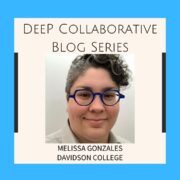
June 9, 2022 by Melissa Gonzales Leave a Comment

The Deliberative Pedagogy (DeeP) Faculty Collaborative consists of 15 faculty from Davidson College and five other Associated Colleges of the South institutions who are committed to learning and implementing new ways to improve and deepen the quality of their class discussions. Throughout the 2021-22 academic year, these faculty, who come from a wide array of disciplines, studied and discussed different deliberative pedagogy methods, shared their ideas and questions with one another, and worked to embed deliberation in their classrooms. In this special blog series, members of the Collaborative describe and reflect on their experiences developing and teaching their deliberation-involved courses.

The most important thing I learned from intentionally incorporating deliberation in my class (Introduction to Gender & Sexuality Studies) is that deliberative practices can be closely aligned with feminist pedagogy. Based on what I understood, at the time, about the primary domains of deliberation in rhetoric, philosophy, and political science at the start of DeeP, I was not expecting to encounter a high level of alignment with the feminist pedagogy I have been engaged in for almost two decades.

Given that I am often engaged as a teacher-scholar with cultural and feminist studies that not only study the racialized impacts of nationalism (Bebout 2016), but that also critique the very foundation of commonplace notions of citizenship and democracy (Beltrán 2020, Brandzel 2016), I knew that I could not approach the idea that developing deliberation skills makes us better citizens in any straightforward way. I wondered if there would be enough common ground to bring deliberation into my gender and sexuality studies classroom in a highly productive way. So, I entered the group with my own baggage and biases, as we always do. And I did start there; namely by reflecting on how I could expand our learning about cognitive biases in a way that both set the stage for the development of deliberative dispositions and engaged feminist, anti-racist, and queer ways of knowing. 

Despite the fact that the DeeP readings from political science and philosophy did not engage feminist studies, I found from the first day that there was fertile ground for thinking through some of the common aims of deliberation and feminist pedagogy. First, the communal orientation and egalitarianism were clearly compatible with feminist pedagogy. For my course, the communal orientation of setting up shared guidelines for deliberation dovetailed with my existing practice of collectively reviewing and revising shared agreements for our discussions with all students in the course, with the aim of establishing guidelines for discussion that are as inclusive as possible. I expanded the amount of time spent on gathering student input about what harms they had previously experienced, in classrooms that had shut down the sharing of ideas. This allowed us sufficient time to reflect on, revise, and commit to the shared agreements that would govern our class discussions and deliberations. I collected student experiences anonymously, using slido.com, and I also used this tool multiple times throughout the semester to foster a safer, more inclusive way of observing our own community’s range of experiences and perspectives on controversial issues, such as abortion. 

As DeeP progressed, I thought about how the broader definition of citizenship deployed by the DCI, alongside its focus on engagement with public life, was largely compatible with the forms of activism we study and analyze in Introduction to Gender & Sexuality Studies. Reflecting on this overlap inspired me to alter the Theory to Praxis assignment used in class. Instead of a proposal for a grant to effect change (a previous iteration of the assignment), students workshopped, drafted, peer-reviewed and produced a final version of a Deliberation Guide, using previous DCI guides as models. Workshopping and peer-reviewing the Deliberation Guide required them to collaborate intellectually across their differences, as did many mini-deliberations in class. Repeatedly, students observed that they were encountering previously unknown perspectives on different aspects of the human experience, which is expected in this course, and they engaged these with curiosity and respect for difference. I observed that intentionally incorporating deliberation in the class allowed for more metacognitive engagement with the benefits of active listening and shaping questions that invite more divergent than convergent answers. 

What inspired me to get involved in DeeP was knowing that, whenever and wherever teacher-scholars get together to share their strategies and stories about the classroom, magic happens. This proved true. I was also pleasantly surprised to discover the ways that intentionally and explicitly featuring and studying deliberation enhanced the inclusivity of the classroom and extended the reach of my feminist pedagogy. I believe that next semester, I can use my reflections on my own biases and engagement across difference to help students better understand the aims and outcomes of deliberation. 


Works Cited

Bebout, Lee. Whiteness on the Border: Mapping the US Racial Imagination in Brown and White. NYU Press: 2016.

Beltrán, Cristina. Cruelty as Citizenship: How Migrant Suffering Sustains White Democracy. Minnesota UP: 2020.

Brandzel, Amy L. Against Citizenship: The Violence of the Normative. University of Illinois Press: 2016.

Filed Under: Blog Posts, Faculty Posts

Student-Driven, Curiosity-Focused Deliberation in a Chinese Religions Course

June 7, 2022 by Rachel Pang Leave a Comment

The Deliberative Pedagogy (DeeP) Faculty Collaborative consists of 15 faculty from Davidson College and five other Associated Colleges of the South institutions who are committed to learning and implementing new ways to improve and deepen the quality of their class discussions. Throughout the 2021-22 academic year, these faculty, who come from a wide array of disciplines, studied and discussed different deliberative pedagogy methods, shared their ideas and questions with one another, and worked to embed deliberation in their classrooms. In this special blog series, members of the Collaborative describe and reflect on their experiences developing and teaching their deliberation-involved courses.

This year, I participated in the Deliberative Citizenship Initiative’s (DCI) DeeP Collaborative. The course that I chose as my deliberations course was REL288: The Religious Question in Modern China. I chose this course because it is usually smaller than my introductory-level survey course and it requires more in-depth engagement with the material. Moreover, this course usually attracts a mix of participants with varying backgrounds in East Asian Studies. I thought the deliberations might be a good way to get more in-depth dialogue among participants. 

One of the best things about participating in the DeeP Collaborative was the chance to engage with a group of experienced and creative pedagogues at Davidson and other ACS institutions. During the first semester, in both our large group sessions and smaller group meetings, I was able to gradually build the deliberative components of the course. One of the greatest things about this group was that everyone was willing to share their knowledge and experiences with others. The DCI also had some wonderful resources such as a facilitator’s handbook and several sample deliberation guides for learning how to set up deliberations. 

Based on consultations with my DeeP Collaborative group members, I ended up deciding to hold a deliberation for each major unit in the course: Confucianism, Daoism, Buddhism, and Islam/Tibetan Buddhism/Christianity. At the end of each unit, participants were tasked with designing and executing a deliberation. They would work with the same group the entire semester and were responsible for distributing the workload in an even manner. They would rotate through the roles of designer, facilitator, and deliberator throughout the semester. They needed to come up with a deliberation guide for each deliberation session. I would circulate amongst the discussion groups throughout the class session, listening to their deliberations in a non-invasive manner.

The question of how to evaluate the deliberations was something that I struggled with as I designed the course. I wanted to strike the right balance between keeping the students accountable and not creating so much pressure that it would inhibit quality discussion. In the end, I chose to use the rubric that Dr. Graham Bullock and Dr. Daniel Layman shared from their second-year politics course. However, instead of a faculty member grading them, I had the students do self-evaluations throughout the semester. In order to encourage intellectual risk taking I told them to reflect on what they thought they could improve on, what they learned, and their personal growth throughout the semester. I did not ask them to evaluate each other because I wanted to promote co-operation, not competition. I also thought it would be too much to focus on both the deliberation and evaluating others.

When I surveyed participants at the end of the semester, the feedback was overwhelmingly positive. They described: 

  • gaining a deeper and broader level of understanding of the course material in comparison to essay writing 
  • having practiced active and engaged listening skills
  • learning to have empathy for others and different perspectives
  • having the space and time to explore others’ ideas further in comparison to traditional class discussion 
  • learning how to facilitate a discussion, including time management skills and how to step back and draw out others’ ideas 
  • finding it valuable to hear others’ perspectives because it stimulated their own learning 

In terms of motivations for speaking during the deliberations, they described: 

  • speaking because they had something to say, rather than to accumulate participation points 
  • feeling motivated to listen to, understand, and build on each others’ comments rather than responding only to the instructor

Finally, in their written reflection journals, participants described being anxious and skeptical about the deliberation exercise at the beginning of the semester. Because I had made the groups where I purposely grouped students together who did not know each other, they also described the initial deliberations to be a bit awkward. They described the quality of deliberations improving as they got to know each other better and became more familiar with the format.

Students’ descriptions of the deliberations largely corroborated with my in-class observations. Their written reflection journals also provided me insights that I could not gain from simply observing them. In my observations, students were well prepared for discussion, having clearly reviewed the readings and class notes. It was much easier to determine whether or not they had done the reading assignments than in traditional discussion formats. It was also really interesting to listen to the students and hear all the excellent insights they had on the material. The deliberations were learner-driven rather than instructor-driven. Finally, I was really impressed by how students all adopted a respectful attitude towards Chinese culture and religions despite the majority of them not having grown up in it. There was a wonderful exchange between students with familiarity with Chinese culture and those without. 

In the end, I think the greatest thing gained from having the students do these deliberations is that it provided an all-around better learning experience that was managed by the students rather than imposed by the instructor. Students took ownership over their intellectual journeys and simultaneously developed strong listening, analytic, and communication skills through the deliberations. In my opinion, two participants summed it up best: 

  • “[The deliberations] allowed me to focus my learning more on curiosity than on grades and…completely changed the course for the better.”
  • “While writing and learning to write are very important, I think that writing a paper on a subject fails to capture a lot of the “color” of a debate. Without other people to challenge you on your ideas you can become very static. Additionally, it is very easy to accidentally get a straw-man idea of someone else’s opinion simply because they aren’t there to better flesh it out.”

These two comments center student learning, enjoyment in intellectual inquiry, and the space to really listen to, think through, understand and respond to arguments. The fact that the exercise was “ungraded” also made it “low stress” and “effective” as a learning tool, to use the phrasing of several respondents. 

Implementing the deliberations into REL288 with the support of the DeeP Collaborative was a pedagogically transformative experience this year. Next semester, I’d like to try it with larger classes to see if this exercise can be scaled. I may also mix up the groups mid-semester as some students suggested doing so in order to give them a chance to work with different people. Finally, students had personal distance from the majority of the topics we discussed in this class in that for the majority of participants, it was about a culture that they did not grow up in. We did not discuss topics that were as high stakes as abortion, immigration, and racism, for example. However, it created the type of environment where participants trusted each other enough that one day they might be able to breach such topics with sensitivity, respect, and empathy. 

Filed Under: Blog Posts, Faculty Posts

Enclave Deliberation: How to Highlight Common Goals and Develop Creative Solutions

June 2, 2022 by Kevin Garcia-Galindo Leave a Comment

By Kevin Garcia-Galindo, DCI Fellow

For my DCI Fellowship Project, I decided to center on the issues of diversity and inclusion that have been so pertinent on campus throughout my time at Davidson. I, however, chose to experiment more with different kinds of deliberations.

Specifically, my DCI project centered on something very different from the goals of the DCI’s usual style of deliberation. My project could be categorized as an enclave deliberation, meaning that there was a clear selection bias that I took into account when I chose my participants. The goal of my deliberation was not to try to change anyone’s opinions but rather to encourage the dispersion of ideas within a group who all share one common characteristic.

Research often gives the practice of enclave deliberation a bad name. Some question how if it is so easy to wall oneself off from views from the other side (through who you follow on social media or which cable news stations you watch, for example), then why should we focus any more on bringing similarly minded people together? Moreover, political scientists often argue that enclave deliberation can lead to increased group polarization.

Enclave deliberation, however, is the most common type of deliberation we encounter in daily life, and it is a fundamental part of a healthy working democracy. This is because most of us learn about our own stances and positions from people who are most like us. Furthermore, because enclave deliberations tend to be less formal and structured, more people tend to be more comfortable attending them, especially with how much work a more structured deliberation can seem to require.

I believe my DCI personal project proves that enclave deliberations do not have to encourage political polarization, and even more, enclave deliberations can actually lead to a broad diffusion of diverse ideas even when most of the members share at least one major characteristic together.

For my personal project, the point of connection for all my participants was that they were all part of the Chidsey Leadership Fellows program. As a Fellow myself, I knew that If I wanted to talk about diversity and inclusion with student campus leaders, then there was no better way to do this than to talk directly with the group on campus that focuses on forming a group of diverse leaders. Moreover, I knew that because of the high level of diversity within Chidsey Leadership, they would be disproportionately more likely to have been affected by recent controversies on campus.

To give a short synopsis of these issues: Students in the past year have expressed resentment towards Davidson’s administration because they have perceived some of its decisions as disproportionately and negatively affecting low-income, first-generation, gender and racial minority students. From the current controversy around the administration preventing Dining Dollars being used to buy Plan B, and the past controversies that came and went, such as the movement to add Asian Studies as a major, the petition to change the name of Chambers, and the ruckus that was caused when students heard that our Summit coffee shop could be shut down, many students on campus believe that the administration takes issues of diversity and inclusion far too lightly. As a first gen person of color (POC) student myself, I was privy to a lot of the conversations that happened directly around these issues, and I can confirm they reinforced many of the feelings about how POC were being valued on campus.

The issue, however, was not that there was not enough communication between administration and students, but rather what I personally saw was that there was not enough communication among affinity groups and students for them to be able to reach common ground on these issues. Student government and the quotidian student petition of the day signaled to me that there was already enough student-administration communication; whether it was effective was not something I could really determine or had the energy to do.

As a result, I instead focused on creating an enclave deliberation where I could bring together this already close-knit group to discuss an issue that they were all being affected by. A difference I would point out between what I did here as opposed to the kind of enclave deliberation that most of the research points to is that my participants only related to each other in one specific way as opposed to sharing a multitude of characteristics. As a result, I am more inclined to call this a hybrid style of deliberation that had characteristics of both a more structured and broad-based style of deliberation and an enclave deliberation.

The goal of my deliberation was not necessarily to change anyone’s mind but to encourage people from different groups to share their own perspectives on an issue that affects all of them. The defining difference between what I did here and a more traditional deliberation is that I did not focus on discussing whether diversity and inclusion is an issue to begin with, but rather I focused on bringing together people who had already reached that conclusion and instead focused on encouraging them to work together to find solutions.

Spending so much time on just discussing the validity of an issue and never getting to proposing a solution is something that you see ad nauseam in many kinds of debates. For example, we often see this dynamic in debates around abortion where the pro-life and pro-choice sides never change their opinions but rather opt instead only to make small adjustments to their proposals. Consider how pro-life advocates who believe that abortion is immoral in all cases concede allowing abortion in cases of rape or incest, or how even pro-choice absolutists sometimes concede banning the most invasive and late-term types of abortions. Rarely is there anyone brave enough to concede more than is necessary to still come out winning.

But what happens when the most common proposals are not so concretely defined? Or when the topic is centered directly at giving those who normally do not have an outlet a chance to speak? What I think you get is an enclave deliberation where you truly get the chance to work together to find solutions and proposals.

Some may critique my thinking by saying that this kind of deliberation is not very effective at bringing the complete spectrum of ideas into discussion and that no meaningful consensus can ever be found unless you bring together people who represent the entire spectrum of possible views. To this I respond by saying that the task of my deliberation was not to start and end the debate around diversity and inclusion, but rather it was to create an effective starting point for a future more-representative deliberation.

I am very aware that there is still a lot of dialogue that needs to happen, but I take my project to represent a starting point for students to be better equipped to engage with the administration robustly, thoughtfully, and productively by first deliberating among themselves. Without this type of enclave conversation, I think it would be hard to be able to move very far in an actual deliberation between the administration and students.

What I think my deliberation proves is that there can exist many ways to maneuver through a difficult issue using structured deliberation as a tool. The approach we took represents an important way to do so that brings together different stakeholders who may not otherwise have the opportunity to reflect on their shared objectives.

Filed Under: Blog Posts, Fellow Posts Tagged With: facilitation

“Seeing Many More Angles than Usual”: Deliberative Pedagogy in a Spanish Course on Feminism, Democracy, and Utopia

May 31, 2022 by Luis Gonzalez-Barrios Leave a Comment

The Deliberative Pedagogy (DeeP) Faculty Collaborative consists of 15 faculty from Davidson College and five other Associated Colleges of the South institutions who are committed to learning and implementing new ways to improve and deepen the quality of their class discussions. Throughout the 2021-22 academic year, these faculty, who come from a wide array of disciplines, studied and discussed different deliberative pedagogy methods, shared their ideas and questions with one another, and worked to embed deliberation in their classrooms. In this special blog series, members of the Collaborative describe and reflect on their experiences developing and teaching their deliberation-involved courses.

My name is Luis González Barrios and I work as an Assistant Professor of Spanish at Spelman College, Atlanta. This semester, spring 2022, I have introduced for the first time in my classes elements of deliberative pedagogy studied during my participation with the DeeP Collaborative 2021/2022 (through Davidson College). To this purpose I selected my course S451 (Intellectual Tradition of Women in Spanish) in advanced Spanish. The title of the course was: “Feminism, Autonomist Democracy, and Utopia: Expanding the Limits of our Political Imagination,” with a total of seven students, majors and minors in Spanish, and met with a frequency of two days per week (MW 4 pm-5:15 pm).

After my first semester with DeeP in which I learned the basic concepts and practices of the deliberative model, I introduced some of these elements in my new course. I chose the syllabus whose content (feminism and democracy) best suited this deliberative approach. The planning process of the course was very interesting, since it not only made me think about the new DeeP materials, but also about the way of organizing the sessions, the periodization of the modules, and of course the forms of evaluation. I mean, it made me rethink my entire pedagogical approach. After all, a course on democracy and social change, to be consistent with the topic, had to somehow introduce practices of deliberative democracy, and not just content.

I introduced periodic readings on deliberation (from DeeP´s manual and the books Why We Argue and The Political Classroom), three mini-deliberation exercises on central themes of the course (dissent, political violence, and media control), and three short reflection essays on the themes of the course. Both their final presentation (on Democracy, Femininity and Elitism at Spelman College) and the materials they used for this presentation (Collaborative materials) arose from discussions among the seven students using the deliberative format. This was a complex and controversial topic, but very close and relevant to the group, that allowed them to evaluate the connection between democratic values, feminism, tradition, and social change at this particular Historically Black College or University (HBCU) called Spelman.

The result was a short video and a final presentation that was, in my opinion, very successful since it reflected the different points of view of the group, as well as different points of view within the institution itself (Spelman College). They also reflected on the process of producing the video and some internal and external obstacles they had to face. Finally, in the self-evaluation session, the group had to reflect in a circle on the deliberative model, as well as their thoughts and assessments on their performance in the class. The group agreed that this pedagogical approach pushed them to look at a problem from many more angles than usual, and to be less dogmatic in their initial positions. In other words, the consensus process, the search for positive changes, and the unity of action of the group forced them to look for a middle ground in situations of dissent.

I believe that this last conclusion was also my main learning as an instructor, and it made me reflect on the balance that every facilitator must seek between intervention and freedom in class activities. This is something that I must work on, since sometimes my leadership role ended up conditioning certain discussions too much. How to moderate without leading students to certain conclusions? Another problem was that I tried to introduce too many topics and concepts in one semester. I believe I was too “ambitious” in my first experiment. Combining three complex case studies, deliberative pedagogy, and second language learning may need to be more progressive.

If I were to teach this class again, I would focus on a single case study (Chiapas), and the elements of deliberative pedagogy that deal specifically with styles and forms of discourse and managing dissent within an assembly. In general, the students responded very well to the mini-deliberations and the readings, but as I said, introducing concepts in a more spaced manner and more clearly would help in the future. As a matter of fact, their level of commitment and maturity with the materials increased in the second part of the semester, when almost all decisions about the course depended on them.

Based on this experience, I would like to introduce deliberative pedagogy in future courses, and in particular in a course on “democracy and mass media” that I will offer in the near future. Experiential learning and democratic deliberation seem to me necessary pedagogical approaches in times of constant “noise” and polarization.


Filed Under: Blog Posts, Faculty Posts

  • « Go to Previous Page
  • Page 1
  • Interim pages omitted …
  • Page 27
  • Page 28
  • Page 29
  • Page 30
  • Page 31
  • Interim pages omitted …
  • Page 38
  • Go to Next Page »

Footer

Blog Post Categories

  • Announcements
  • Blog Posts
  • DCI Posts
  • Events
  • Faculty Posts
  • Fellow Posts
Image of a compass superimposed by the text "Deliberative Citizenship Initiative" and "Davidson College." Clicking on this image leads to the Initiative page.

Recent DCI Blog Posts

  • We Tried to Fix Jubilee’s “Middle Ground” – Here’s How It Went
  • A Case for Deliberation in the Natural Sciences
  • Welcoming New Staff to the DCI and DCN
  • Facebook
  • Twitter
  • Instagram
  • LinkedIn


Copyright © 2026 · Infinity Pro on Genesis Framework · WordPress · Log in