• Skip to main content
  • Skip to footer

Deliberative Citizenship Initiative

Building Democracy One Conversation at a Time

  • The Initiative
    • Programs
      • Deliberation Across the Curriculum
      • Deliberation on Campus
      • Deliberation in the Community
      • Research on Deliberation
    • Motivations
      • Why Deliberative Citizenship?
      • Why Davidson? Why Now?
    • Who’s Involved?
      • DCI Fellows Cohorts
        • 2025-2026 Fellows
        • 2024-2025 Fellows
        • 2023-2024 Fellows
        • 2022-2023 Fellows
        • 2021-2022 Fellows
        • 2020-2021 Fellows
      • DeeP Collaborative Cohorts
        • 2024-2025 DeeP Collaborative Faculty
        • 2023-2024 DeeP Collaborative Faculty
      • Advisory Council
    • History
      • What Sparked the Initiative?
    • Key Deliberative Dispositions
    • Frequently Asked Questions (FAQ)
    • Annual Report
  • Get Involved!
    • Participate in a Forum
    • Join a D Team
    • Become a Fellow
    • Take Courses
    • Get Training
    • Come to Guest Lectures
  • Events
    • Upcoming Events
      • 250th Anniversary Deliberative Forum Series on American Values
    • Past Events
  • Connections
    • The Deliberative Citizen: The DCI’s Monthly Newsletter
    • Efforts on Campus
    • Efforts in the Community
    • Efforts Elsewhere
    • Readings and Resources
      • DCI-Published Guides
      • DCI Guide to One-on-One Conversations
      • How to Disagree
      • Demonstration of Facilitation Styles
      • Deliberative Pedagogy Mini-Course
    • How We Can Help: DCI’s LET’S DELIBERATE! Partnership Opportunities
    • DCI in the News
  • DCI Blog Posts
    • Recent Blog Posts
    • All Blog Posts

Camille Lewis

A Rubric for Taking-it-to-the-Streets

May 19, 2023 by Camille Lewis

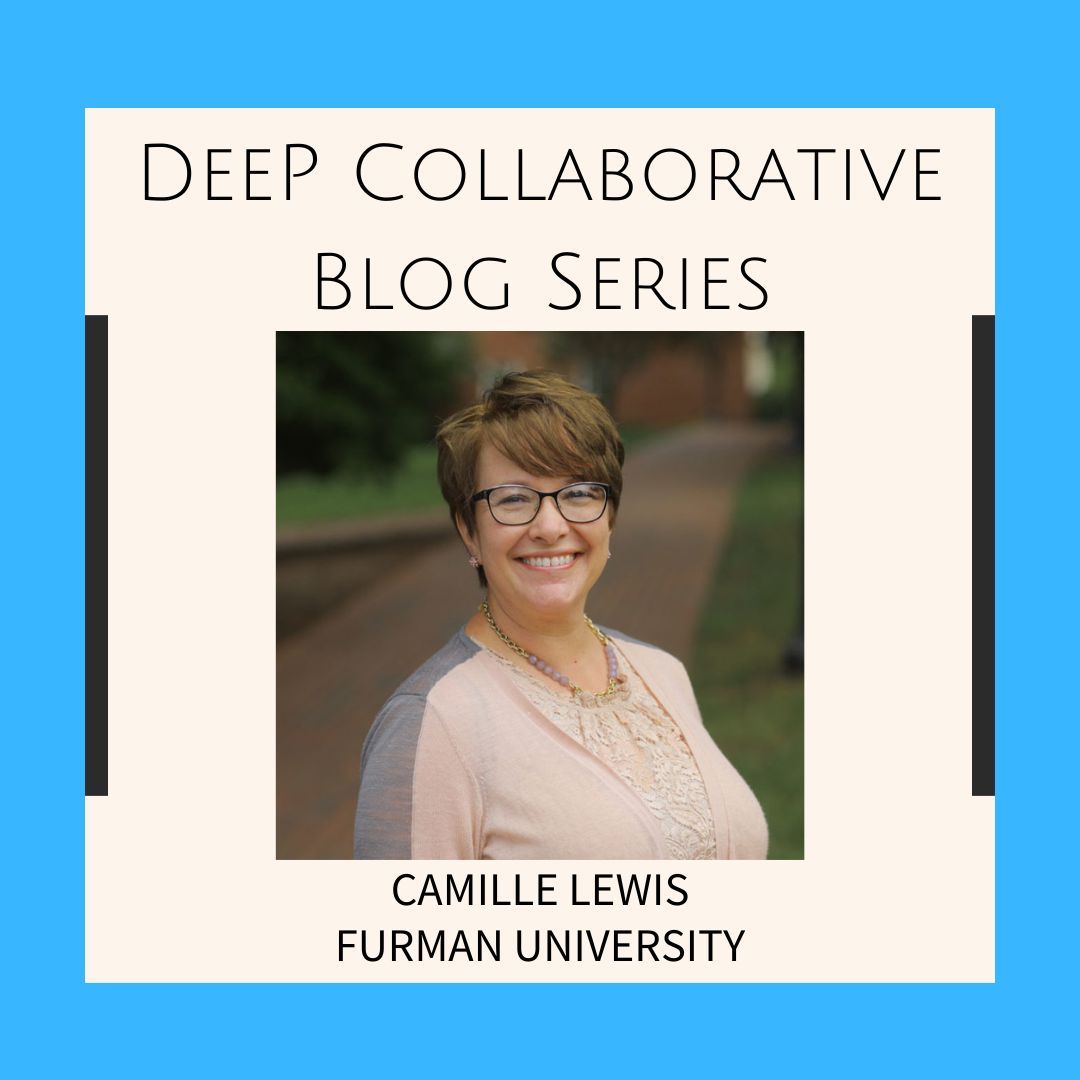
DeeP Collaborative Blog Series Introductory Slide for Camille Lewis.

By Camille K. Lewis (DeeP Collaborative Member)

The Deliberative Pedagogy (DeeP) Faculty Collaborative consists of 20 faculty from Davidson College and five other Associated Colleges of the South institutions who are committed to learning and implementing new ways to improve and deepen the quality of their class discussions. These faculty come from a wide array of disciplines and backgrounds. They come together to study and discuss different deliberative pedagogy methods, share their ideas and questions with one another, and work to embed deliberation in their classrooms. In this special blog series, members of the Collaborative describe and reflect on their experiences developing and teaching their deliberation-involved courses.

Isocrates, the first settled teacher of rhetoric, found the dead-end of eristic speech (or argument-for-argument’s sake) to be unethical. For him, phronêsis or “practical wisdom” was the goal of a rhetorical education. As my professor used to say, “We need to get out of the ivory tower. We need to take it to the streets!”

Toward that end for the Spring 2023 semester, I revamped Furman University’s Communication Studies capstone course COM 460 Communication Ethics to give our students that kind of high impact experience in phronêsis. Over the semester, the students heard subject-matter experts present the problems of prison reform, anti-Critical-Race-Theory legislation, decolonizing the archive, medical care for BIPOC women, the societal barriers limiting public art, and refugee resettlement legislation. This is a broad variety of problems from across the university—public health, libraries, education, politics, and art.

Students were required to listen, research, assess, create a solution, and then present their solution a week later. The curriculum design compels them to engage across disciplinary and interpersonal differences so that they can find new ways of thinking and responding to these real-world problems. At the end of this course, students should be able to:

  • Define the boundaries of real-world problems with empathy and through active listening.
  • Analyze those problems by conducting research in order to document its causes and effects.
  • Establish criteria integrating trade-offs and tensions.
  • Synthesize and reflect on the causes, effects, and criteria by imagining and choosing solutions which are ethical, workable, and creative.
  • Collaborate productively with peers in order to come to shared decisions for the sake of the common good.
  • Build substantive relationships with peers, experts and the community.
  • Present eloquent and effective public messages that address the problems and its solutions using complex reasoning.
  • Integrate and reflect on frequent feedback (both formal and informal) into future performance.

But this kind of interdisciplinary conversation can get unwieldly. To foreground good deliberative practice, I have adapted the Deliberative Pedagogy Learning Outcomes rubric created by Sara A. Mehltretter Drury, Leila R. Brammer, and Joni Doherty to the outcomes of COM 460.[1] Their rubric was more generic, and I needed the assessment to feature my class’s specific outcomes taken from the steps in John Dewey’s Reflective-Thinking Sequence. I used this adapted rubric for every class discussion group—with at least one student consistently assessing the group dynamic along with me.

To familiarize the students with the rubric, I had the students arrive on the first day having read Drury’s chapter, “Cultivating Dialogue and Deliberation through Speech, Silence, and Synthesis.” After discussion, I wanted them to test their active listening by playing a RadioLab podcast, “Dixie Disappearance,” from Dolly Parton’s America. I brought quiet puzzles, coloring books, and other stim toys to occupy their fingers while they listen. After we discussed that active listening strategy, I divided them up randomly into three groups for them to follow the reflective-thinking process. During their discussion, I assessed their discussion practices using the deliberative rubric. This rubric became, as Drury et al state, a “robust tool for instruction, learning, and assessment” in order to prepare my students to resist siloing their education in the ivory tower and “take it to the streets.”


Notes

[1] Sara A. Mehltretter Drury, Leila R. Brammer, and Joni Doherty, “Assessment through a Deliberative Pedagogy: Learning Outcomes Rubric,” in Maxine S. Thomas, Idit Manosevitch, Nicholas V. Longo, and Timothy J. Shaffer, Deliberative Pedagogy: Teaching and Learning for Democratic Engagement, (East Lansing: Michigan State University Press, 2017), muse.jhu.edu/book/52064.

Filed Under: Blog Posts, Faculty Posts

From the Big Picture to Micro-Deliberations: Argumentation Meets Deliberative Pedagogy

June 14, 2022 by Camille Lewis Leave a Comment

The Deliberative Pedagogy (DeeP) Faculty Collaborative consists of 15 faculty from Davidson College and five other Associated Colleges of the South institutions who are committed to learning and implementing new ways to improve and deepen the quality of their class discussions. Throughout the 2021-22 academic year, these faculty, who come from a wide array of disciplines, studied and discussed different deliberative pedagogy methods, shared their ideas and questions with one another, and worked to embed deliberation in their classrooms. In this special blog series, members of the Collaborative describe and reflect on their experiences developing and teaching their deliberation-involved courses.

The Deliberative Pedagogy strategies allowed my students to begin thinking about deliberation from 30,000 feet, which then improved their overall participation. I tested these strategies in my COM 301 Argumentation class in the Fall of 2021 at Furman University, where I serve as an Assistant Professor of Communication Studies. 

We started the semester digging into the Why We Argue? text, and I was kind of surprised at the results. The text is accessible but theoretical. My usual argumentation text is more practical—focusing on the nitty-gritty of things such as cause-effect reasoning and fallacy lists. But Why We Argue? worked in a way my usual text couldn’t. The students got a big-picture view of the reasons argumentation matters. 

For each class in those early weeks, the students crafted discussion questions, and I divided them up to tackle them. Thus, they learned how to write open questions that were provocative and argumentative. They took ownership of those questions since they had created them. The following Jamboard is one example of the resulting discussion. The second page especially reveals their thinking. They were getting under the hard issues in democratic deliberation—even exposing ourselves to white nationalism. These exercises benefitted the students by giving them a vocabulary to manage their expectations for class conversations and by privileging collaborative reflection. 

As we moved from the theoretical to the practical, I regularly used microdeliberations throughout the semester. A microdeliberation is a 5-minute concentrated focus on a small problem. For instance, when we played Cards Arguing in the Humanities—a game I created using the same format as Cards Against Humanity which reinforces that proposition building is largely and productively formulaic—I divided the students into small groups. After choosing one proposition, each group used the microdeliberation method to identify the single most significant problem that proposition would solve. Later we used the same method for them to identify the way it would solve that problem. This got them started on collaboratively building their argumentative case. Issues seem less daunting in short stints like that, and the time limit eliminates falderal. 

In future iterations of the course, I want to bring the students back to that 30,000-foot view. I need to add more reflection at the end of the course: perhaps another chapter in Why We Argue? to apply those standards to the argumentation they attempted in their class projects. Quite practically, the deliberative pedagogy made my students better participants throughout the whole semester. They were active and engaged. They listened wholly and carefully. They spoke up! Starting with the big picture allowed them to understand the value of their individual contributions. 

Next spring, I am teaching a capstone class, Communication Ethics, and I plan on using these same strategies. Instead of my instigating the deliberations among my students, however, they will facilitate the discussions. I am planning on including the DeeP handbook on the course reading list. Overall, the Deliberative Pedagogy gave my COM 301 class curriculum a new text and my students a new vocabulary and purpose for their argumentation. 

Filed Under: Blog Posts, Faculty Posts

Footer

Blog Post Categories

  • Announcements
  • Blog Posts
  • DCI Posts
  • Events
  • Faculty Posts
  • Fellow Posts
Image of a compass superimposed by the text "Deliberative Citizenship Initiative" and "Davidson College." Clicking on this image leads to the Initiative page.

Recent DCI Blog Posts

  • We Tried to Fix Jubilee’s “Middle Ground” – Here’s How It Went
  • A Case for Deliberation in the Natural Sciences
  • Welcoming New Staff to the DCI and DCN
  • Facebook
  • Twitter
  • Instagram
  • LinkedIn


Copyright © 2026 · Infinity Pro on Genesis Framework · WordPress · Log in