• Skip to main content
  • Skip to footer

Deliberative Citizenship Initiative

Building Democracy One Conversation at a Time

  • The Initiative
    • Programs
      • Deliberation Across the Curriculum
      • Deliberation on Campus
      • Deliberation in the Community
      • Research on Deliberation
    • Motivations
      • Why Deliberative Citizenship?
      • Why Davidson? Why Now?
    • Who’s Involved?
      • DCI Fellows Cohorts
        • 2025-2026 Fellows
        • 2024-2025 Fellows
        • 2023-2024 Fellows
        • 2022-2023 Fellows
        • 2021-2022 Fellows
        • 2020-2021 Fellows
      • DeeP Collaborative Cohorts
        • 2024-2025 DeeP Collaborative Faculty
        • 2023-2024 DeeP Collaborative Faculty
      • Advisory Council
    • History
      • What Sparked the Initiative?
    • Key Deliberative Dispositions
    • Frequently Asked Questions (FAQ)
    • Annual Report
  • Get Involved!
    • Participate in a Forum
    • Join a D Team
    • Become a Fellow
    • Take Courses
    • Get Training
    • Come to Guest Lectures
  • Events
    • Upcoming Events
      • 250th Anniversary Deliberative Forum Series on American Values
    • Past Events
  • Connections
    • The Deliberative Citizen: The DCI’s Monthly Newsletter
    • Efforts on Campus
    • Efforts in the Community
    • Efforts Elsewhere
    • Readings and Resources
      • DCI-Published Guides
      • DCI Guide to One-on-One Conversations
      • How to Disagree
      • Demonstration of Facilitation Styles
      • Deliberative Pedagogy Mini-Course
    • How We Can Help: DCI’s LET’S DELIBERATE! Partnership Opportunities
    • DCI in the News
  • DCI Blog Posts
    • Recent Blog Posts
    • All Blog Posts

Savannah Dowtin

Making Conversation: A First Step to Understanding

October 19, 2026 by Savannah Dowtin

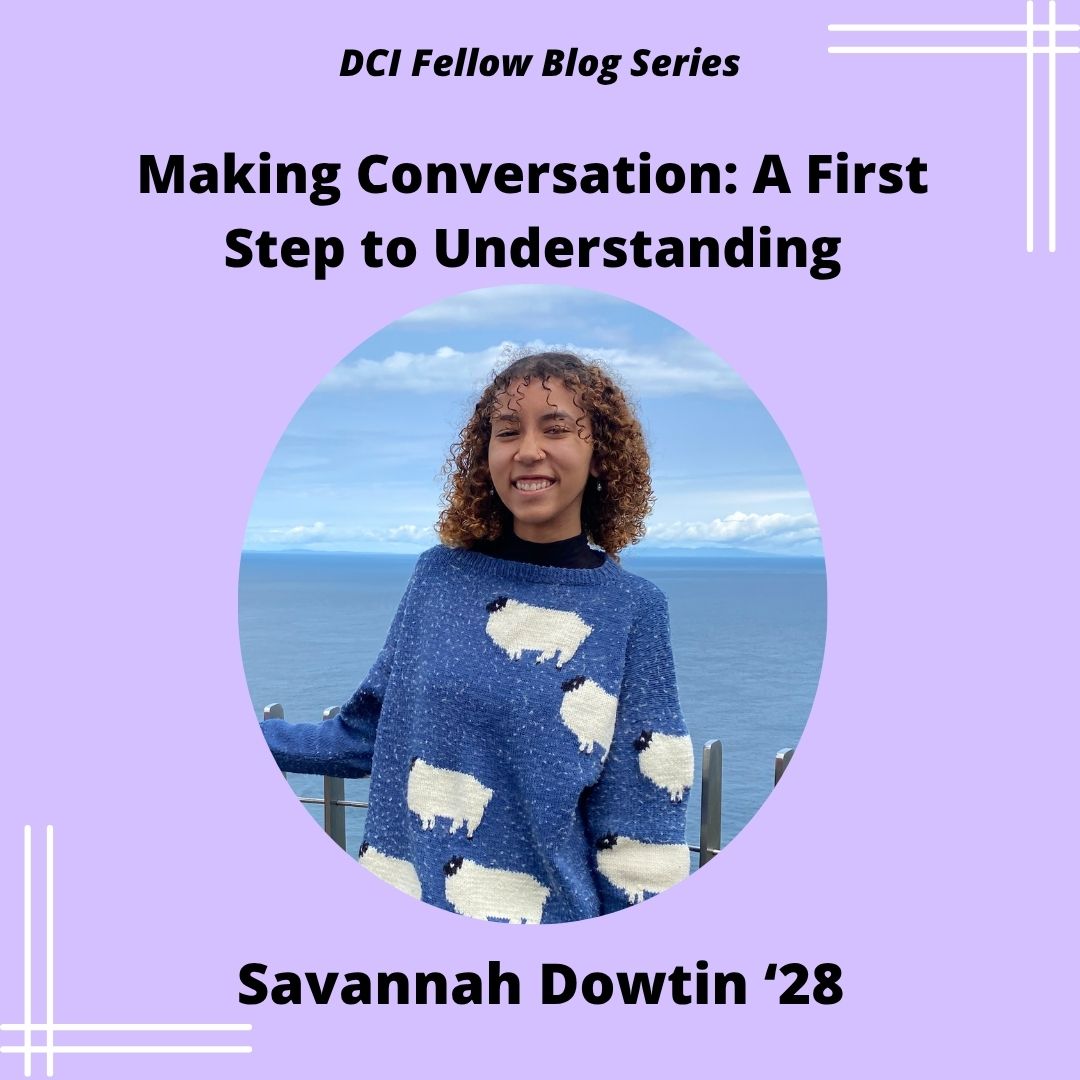
Promotional graphic for the DCI Fellow Blog Series post titled "Making Conversation: A First Step to Understanding" by Savannah Dowtin '28.

By Savannah Downtin ‘ 28 (DCI Fellow)

While the Deliberative Citizenship Initiative encourages and fosters deliberative discussion on polarizing issues, my experience as a fellow has made me not only a better facilitator but also a better conversationalist. Conversation is a key building block to connection, creating bridges that bond people across personal and geographical gaps.

If conversation were a recipe, the first ingredient would be curiosity. Serving as one of our DCI deliberative dispositions, curiosity can make or break a conversation. Having a curious outlook naturally opens doors to new topics and encourages intellectual humility; it helps counter instinctive judgment that might arise during a conversation when someone expresses different viewpoints. Instead of writing these off, curiosity empowers us to look deeper and investigate the root cause of the opinion. 

Although many conversations don’t start with a concrete end goal like a deliberation or debate might, there is almost always the underlying motive to try to get to know the other person better. Every time someone offers new information about themselves in a conversation — say, mentioning summer plans or aspects about their family — it’s a chance to let curiosity take hold and ask follow-up questions. A curious person never runs out of things to talk about because they continuously pull on the threads that others leave. 

In my work as a facilitator, the deliberation guides often do a lot of the heavy lifting when it comes to creating new topics of conversation. However, I have also found that when the water is too still, and everyone seems to agree on a specific topic, pulling on the threads can often expose knots and tangles of underlying disagreements.  Like most of us, the participants within my D Teams had the polite tendency to brush over their contentions early on with the well-meaning intention of keeping the peace. In these situations, it’s necessary to directly bring up these contentious matters to have a more fulfilling discussion. My experiences have reinforced my belief that refraining from discussing disagreements entirely can be just as detrimental as talking about them unproductively.

Diving off the deep end into discussing controversial issues is easier said than done, which is why scaffolding these conversations can increase the longevity of the deliberation. I always enjoy hearing what my D Team participants say during the Getting to Know You portion, whether it’s hearing about their connection to Davidson or what time in history they’d travel back to. Although this section would be easy to skip over for time, it helps set the tone for the rest of the deliberation by establishing a semblance of understanding among deliberators. 

While it seems like one of the most mundane or trivial conversation topics, talking about the weather is widely and commonly used because it’s one of the easiest ways to find common ground with a conversation partner. Virtually anyone can talk about the weather because it’s something we all experience and have enough information to form opinions about. 

One thing that sets deliberations apart from debates is the intentional effort to find common ground with those you’re discussing with, acknowledging both areas of agreement and disagreement. Additionally, finding common ground in values can help participants trust one another and treat their fellow deliberators’ opinions with validity and respect, knowing that their differing beliefs still stem from a place of common principles. 

Furthermore, conversation goes beyond building relationships among individuals and can directly impact the effectiveness of our democracies. Robert Putman’s Making Democracy Work unpacks how reciprocal trust within communities is vital for maintaining working democratic systems because it increases the likelihood that those members will follow laws and exercise civic duties. His research in Italy showed that the most direct predictor of good democracies was the number of choral societies in the region. Although this may seem like a data analysis fluke, he goes on to explain that choral societies represent the presence of civic community: organizations that foster trust, shared responsibility, and social capital among their members. Increasing opportunities for individuals to regularly come together helps bolster each person’s stake in democracy. 

So the next time you’re on the way to class, take the extra minute to have a conversation with someone you pass, because that small connection means a step towards trust, which is a step toward democracy. 

Filed Under: Fellow Posts Tagged With: 2026-2027

Would You Rather

January 20, 2026 by Savannah Dowtin

By Savannah Dowtin ’28 (DCI Fellow)

“Would you rather be reincarnated as Trisha Paytas or Jojo Siwa?” I break the silence of the solemn lunch table as my friends look up with confused expressions, scoffing through bites of spaghetti. These types of outrageous Would You Rather questions are far from rare in our Commons table conversations. On the surface, they seem ridiculous, random, and you may start to wonder what type of person even comes up with something like that. But they all have one thing in common: they spark deliberation.

The first deliberation skill my friends employ is the ability and willingness to disagree with one another. What happens when everyone in the room says they would rather have toes for fingers when having fingers for toes seems like the obviously more advantageous option? Unlike problems that plague our world today, these questions don’t suggest a level of expertise is necessary to solve them. When discussing the former, it is important to acknowledge that everyone as citizens in the public sphere can bring value to a conversation with their unique experiences and local expertise. But while one might hesitate to contribute to a discussion on immigration if they feel ill-prepared, anyone can jump into a Would You Rather debate with equal ethos. Thus, the deliberative disposition, egalitarianism, is not only exercised but encouraged in these conversations because entertainment arises within disagreement.

What follows shortly after the initial proposition are the qualifiers: “If I’m Trisha Paytas, do I have to act like her? Am I Jojo Siwa currently, or when she was on Dance Moms?” To engage in proper deliberation, we crave complete context, even when discussing a problem that is entirely fabricated and hypothetical. Unfortunately, having complete context is a near-impossible feat. Instead, as Scott F. Aikin and Robert B. Talisse write in their book, Why We Argue, we must exercise earnestness and responsibility, meaningfully addressing as many arguments as we can with respect and validity. When we disagree with people, there is a common assumption that because we went through a logical process to arrive at our conclusion, there must be a gap in logic on the opposing side. This reflects the tendency to underestimate the power of context, framing, and information available about an issue.

Another deliberative aspect infused in this example is the flexibility and expectation that one’s opinion will change as new information is given. At first, one might argue that being the worst player on the best sports team is better than being the best player on a worst sports team, because they’re considering what’s beneficial for the team as a whole as opposed to prioritizing their personal achievements. However, someone might counter that being the best player on the worst sports team means that their contributions are meaningful to the team, and this way, they aren’t weighing the team down as the worst player. In both of these arguments, the team is valued most, but the conclusions differ based on the interpretation of the information. This illustrates how disagreements can still arise when people harbor the same core values; the steps a person takes from the data to their decision must be well understood to understand their belief. Additionally, reassessing our beliefs as we gain new information, and practicing what Aikin and Talisse describe as cognitive hygiene, is crucial to maintaining the productivity of deliberations and remaining authentic with ourselves and our communities.

Unlike a Would You Rather question, real issues rarely only have two sides. Being able to tease apart the nuance within problems helps us understand the various pinpoints of disagreement more clearly and address them with attuned focus. Oftentimes, we are forced to use our citizenship responsibility to make binary choices, like choosing to elect person A or person B, when in actuality, both of these options represent a plethora of other Would You Rather questions. However, if we can take the time to disagree with our peers and defend our opinions using emotion and experience to motivate instead of blind us when the stakes are Trisha Paytas versus Jojo Siwa, then there is hope that we can exercise these principles on issues that affect our communities, our schools, and our nation.

Filed Under: Fellow Posts

Footer

Blog Post Categories

  • Announcements
  • Blog Posts
  • DCI Posts
  • Events
  • Faculty Posts
  • Fellow Posts
Image of a compass superimposed by the text "Deliberative Citizenship Initiative" and "Davidson College." Clicking on this image leads to the Initiative page.

Recent DCI Blog Posts

  • Making Conversation: A First Step to Understanding
  • The Costs of Changing Your Mind, and How to Overcome Them
  • ​Middle Schoolers: The Ones Who Taught Me the Most About Facilitation
  • Facebook
  • Twitter
  • Instagram
  • LinkedIn


Copyright © 2026 · Infinity Pro on Genesis Framework · WordPress · Log in