• Skip to main content
  • Skip to footer

Deliberative Citizenship Initiative

Building Democracy One Conversation at a Time

  • The Initiative
    • Programs
      • Deliberation Across the Curriculum
      • Deliberation on Campus
      • Deliberation in the Community
      • Research on Deliberation
    • Motivations
      • Why Deliberative Citizenship?
      • Why Davidson? Why Now?
    • Who’s Involved?
      • DCI Fellows Cohorts
        • 2025-2026 Fellows
        • 2024-2025 Fellows
        • 2023-2024 Fellows
        • 2022-2023 Fellows
        • 2021-2022 Fellows
        • 2020-2021 Fellows
      • DeeP Collaborative Cohorts
        • 2024-2025 DeeP Collaborative Faculty
        • 2023-2024 DeeP Collaborative Faculty
      • Advisory Council
    • History
      • What Sparked the Initiative?
    • Key Deliberative Dispositions
    • Frequently Asked Questions (FAQ)
    • Annual Report
  • Get Involved!
    • Participate in a Forum
    • Join a D Team
    • Become a Fellow
    • Take Courses
    • Get Training
    • Come to Guest Lectures
  • Events
    • Upcoming Events
      • 250th Anniversary Deliberative Forum Series on American Values
    • Past Events
  • Connections
    • The Deliberative Citizen: The DCI’s Monthly Newsletter
    • Efforts on Campus
    • Efforts in the Community
    • Efforts Elsewhere
    • Readings and Resources
      • DCI-Published Guides
      • DCI Guide to One-on-One Conversations
      • How to Disagree
      • Demonstration of Facilitation Styles
      • Deliberative Pedagogy Mini-Course
    • How We Can Help: DCI’s LET’S DELIBERATE! Partnership Opportunities
    • DCI in the News
  • DCI Blog Posts
    • Recent Blog Posts
    • All Blog Posts

Mohamed Mustafa

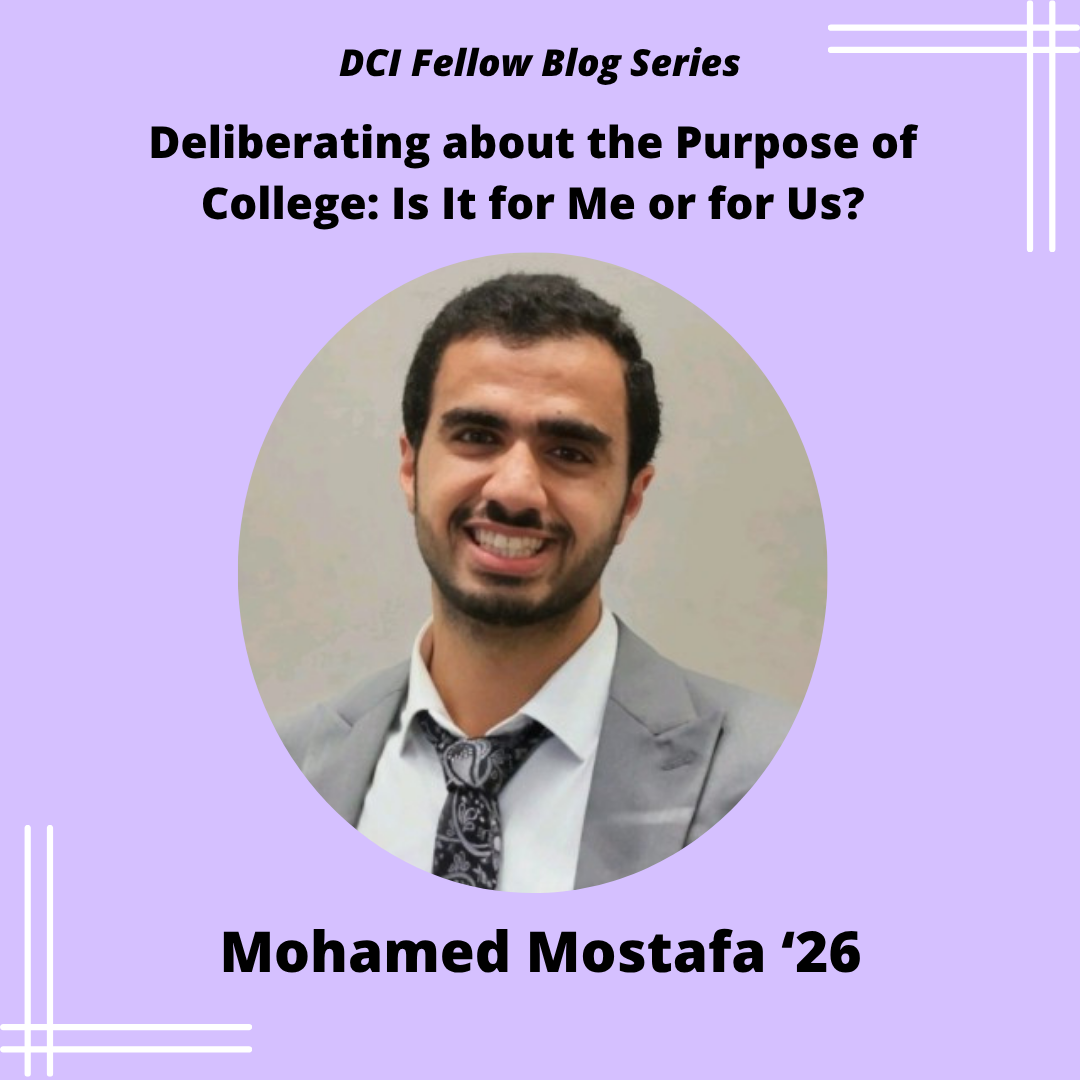
Deliberating about the Purpose of College: Is It for Me or for Us?

July 7, 2026 by Mohamed Mustafa

By Mohamed Mostafa ’26 (DCI Fellow)

As a senior, I have found that some of the most meaningful conversations I’ve had about the future did not happen in classrooms or career workshops but with friends trying together to make sense of what comes next.

In one of those conversations, a friend told me plainly that he did not see a social responsibility tied to his career choice. For him, the goal was stability: a well-paying job to support his family. He wasn’t dismissive of social impact or contribution but rather that those considerations came second, if at all. What struck me was not the position itself, but how often I had heard it before.

Across conversations with classmates, a pattern began to be obvious. Many of us had entered college with language about making a difference, contributing to society, or pursuing meaningful careers. Yet as senior year approached, those ideas often became harder to prioritize. Conversations shifted toward job security, salaries, and the pressure to “figure it out.” The question was no longer just what we cared about, but what felt safe and financially rewarding.

In many ways, this shift is understandable. College is often framed as an investment and something we pursue to secure our futures, justify its cost, and create stability for ourselves and our families. For some students, especially those navigating financial pressures or immigration constraints, choosing a stable and predictable path is not simply a preference but a responsibility. In this light, prioritizing individual success can reflect responsibility and obligation rather than self-interest alone.

Yet, this framing feels incomplete.

At Davidson, we are reminded that education is not only about personal advancement, but about preparing students “for lives of leadership and service.” Implicit in that vision is the idea that our choices, especially those related to our careers, are not neutral. They shape not only our own lives, but also the communities and systems we become part of.

This is where the tension becomes more difficult to ignore. If college is both a private good and a public one, therefore the decisions we make are not simply about what we can achieve, but about how we choose to contribute. Yet in practice, the structures surrounding us (recruiting cycles, prestige hierarchies, and cultural expectations) often reward paths that are relatively safe, stable, and individually beneficial. In that environment, it becomes easier to measure success by outcomes we can point to, rather than impact that is harder to quantify.

Still, the conversations I’ve had suggest that this is an unresolved question. When friends speak about choosing more secure paths, they often do so with a quiet awareness of what may be left out of the conversation. And when others pursue work more explicitly oriented toward service or impact, they usually do so with an understanding of the risks involved. Neither path is arbitrary. Both are shaped by values, constraints, and competing responsibilities.

What feels missing is not clarity, but space to deliberate about these tradeoffs more openly. Too often, decisions are made under pressure, guided by urgency rather than reflection. We compare outcomes without fully understanding the motivations behind them. We assume that certain paths are more responsible than others, without asking responsible to whom?

Deliberation offers a way to approach these questions differently. It does not resolve the tension between personal success and social impact, but it allows us to examine it more honestly and understand where each position is coming from. It asks us to consider not only what we want, but what we owe to our families, to our communities, and to the society we are part of.

One concrete example of creating such space at Davidson was the Values and Vocations Forum, a dialogue program Coralyn Cairns ’29 and I helped organize in partnership with the Matthews Center for Career Development, Center for Student Diversity and Inclusion. This 90-minute interactive session brought together students, staff, and faculty to reflect on how personal values like impact, integrity, and non-compromise areas intersect with career choices amid real-world tradeoffs, such as organizational missions, business practices, and ethical complexities. Through structured activities including individual reflections, pair-shares, and small-group case studies on scenarios like working for education tech firms or defense companies with mixed impacts, participants engaged in honest, non-prescriptive deliberation that revealed shared tensions between stability, personal beliefs, and societal contribution. This event fostered the exploration of “for me or for us” that has felt missing in other similar conversations.

As I prepare to leave Davidson College, I find myself thinking less about finding The Answer and more about asking better questions. What does it mean to live a life of service in practical terms? How do we balance stability with contribution? And perhaps most importantly, what are we willing to prioritize when those goals come into conflict?

While I have come to better understand how attractive stability and individual success are, I am also left with the sense that an education like this asks something more of us. Not necessarily that we reject personal ambition, but that we position it within a broader sense of responsibility. That we remain attentive to the impact of our choices, even when they are difficult to measure or pursue.

If college has prepared us for anything, it may not be certainty about what comes next, but a deeper awareness of the stakes involved in our decisions. In that sense, the question is not simply whether college is for ourselves or for something larger. It is whether we are willing to carry both and to act with intention when they pull us in different directions.

Filed Under: Fellow Posts

Seeing in Color: Why Deliberation Shouldn’t Be Black and White

May 21, 2025 by Mohamed Mustafa

Image of black and white conversation next to conversation in color

By Mohamed Mustafa ’26 (DCI Fellow)

In a world where issues are often reduced to binary choices, we tend to jump to conclusions without acknowledging the nuances of complex topics. This black-and-white approach may be convenient, but it doesn’t reflect the reality of our diverse motivations, experiences, and values. Life is far more complex than a simple “right” or “wrong.” Deliberation offers a way to step back, suspend judgment, and embrace this complexity, helping us see beyond simplistic divisions.

At the start of the DCI Fellows journey, deliberation often seemed like a tool for finding compromise. But as I began engaging in conversations about difficult issues, I soon saw it as much more. Deliberation invites us to understand the “why” behind people’s beliefs and to appreciate the different motivations that drive their perspectives. One D Team discussion I recently facilitated on defensive democracy illustrated this dynamic, reminding me how deliberation can help unpack seemingly opposing views and reveal the complex motivations behind each stance.

Defensive democracy—a concept associated with the tension between protecting democratic principles and restricting certain freedoms in the name of security—tends to trigger strong emotions. For some, imposing restrictions on groups with anti-democratic agendas seemed essential for protecting democracy from internal threats. For others, any restriction on freedom seemed to risk eroding the very principles that democracy is meant to uphold. At first glance, it’s easy to view it as a black-and-white issue: either democracy is defended by limiting certain freedoms, or democracy is protected by preserving civil liberties at all costs. Yet as my D Team participants explored the topic, they discovered each perspective was rooted in motivations that were simultaneously personal, nuanced, and deeply held.

Some participants argued that limiting certain freedoms—such as banning groups with anti-democratic intentions—was crucial to safeguarding democracy itself. They highlighted examples from history where democracies fell because they allowed bad actors to act freely within their borders. Their approach was not about endorsing authoritarianism but about preserving democratic values by preventing harmful ideologies from undermining them.

Others voiced concerns that imposing restrictions, even in the name of democracy, might set a dangerous precedent. They emphasized the slippery slope, suggesting that banning one group could pave the way for further erosions of liberty. They viewed true democracy as strong enough to withstand dissenting voices, since suppressing ideas would betray democratic principles. For these participants, defending democracy meant holding firm to civil liberties, even at the risk of some vulnerability.

Deliberation allowed us to move beyond judging each stance as either “pro-democracy” or “anti-freedom.” Instead, this space provided a framework for examining the motivations behind each position. Listening to one another, participants began to realize that defensive democracy isn’t a straightforward issue with an easy answer; it’s a balancing act shaped by people’s lived experiences and their own personal interpretations of what democracy requires.

Perhaps the hardest part of this discussion—and of deliberation in general—was resisting the urge to label ideas as “right” or “wrong.” Through this experience, participants found that curiosity is essential in deliberative settings. When they approached each other’s motivations with curiosity rather than judgment, they opened themselves to new insights and ways of thinking. This curiosity allowed participants to understand not only each other’s concerns about freedom and security but also the complex values that guide their own views on defensive democracy.

Consider a hypothetical example where two groups debate banning extremist organizations to protect democratic stability. In a deliberative setting, participants from both sides would share why they feel as they do. Those advocating for restrictions might express fears about instability, sharing historical examples of democracies dismantled from within. Meanwhile, those defending free expression could argue that suppressing even dangerous ideas drives them underground, where they might thrive in secrecy. Through deliberation, each side could gain a fuller picture of the risks and values that shape the other’s position, seeing that their motivations stem from shared concerns for democracy, even if their conclusions differ.

Deliberation doesn’t mean everyone will end up on the same page. But it does foster a community in which we see each other as individuals with complex and diverse motivations. In the DCI Fellows Program and my individual D Team, I’ve seen how deliberation nurtures a more humane and compassionate community, one where people look for understanding rather than conflict. This empathy and respect are essential for a healthy democratic society, reminding us to pause, listen, and look for the colors in between the black and white arguments that are being made in a world increasingly polarized by oversimplified narratives.

Filed Under: Fellow Posts

Footer

Blog Post Categories

  • Announcements
  • Blog Posts
  • DCI Posts
  • Events
  • Faculty Posts
  • Fellow Posts
Image of a compass superimposed by the text "Deliberative Citizenship Initiative" and "Davidson College." Clicking on this image leads to the Initiative page.

Recent DCI Blog Posts

  • We Tried to Fix Jubilee’s “Middle Ground” – Here’s How It Went
  • A Case for Deliberation in the Natural Sciences
  • Welcoming New Staff to the DCI and DCN
  • Facebook
  • Twitter
  • Instagram
  • LinkedIn


Copyright © 2026 · Infinity Pro on Genesis Framework · WordPress · Log in