By Mohamed Mustafa ’26 (DCI Fellow)
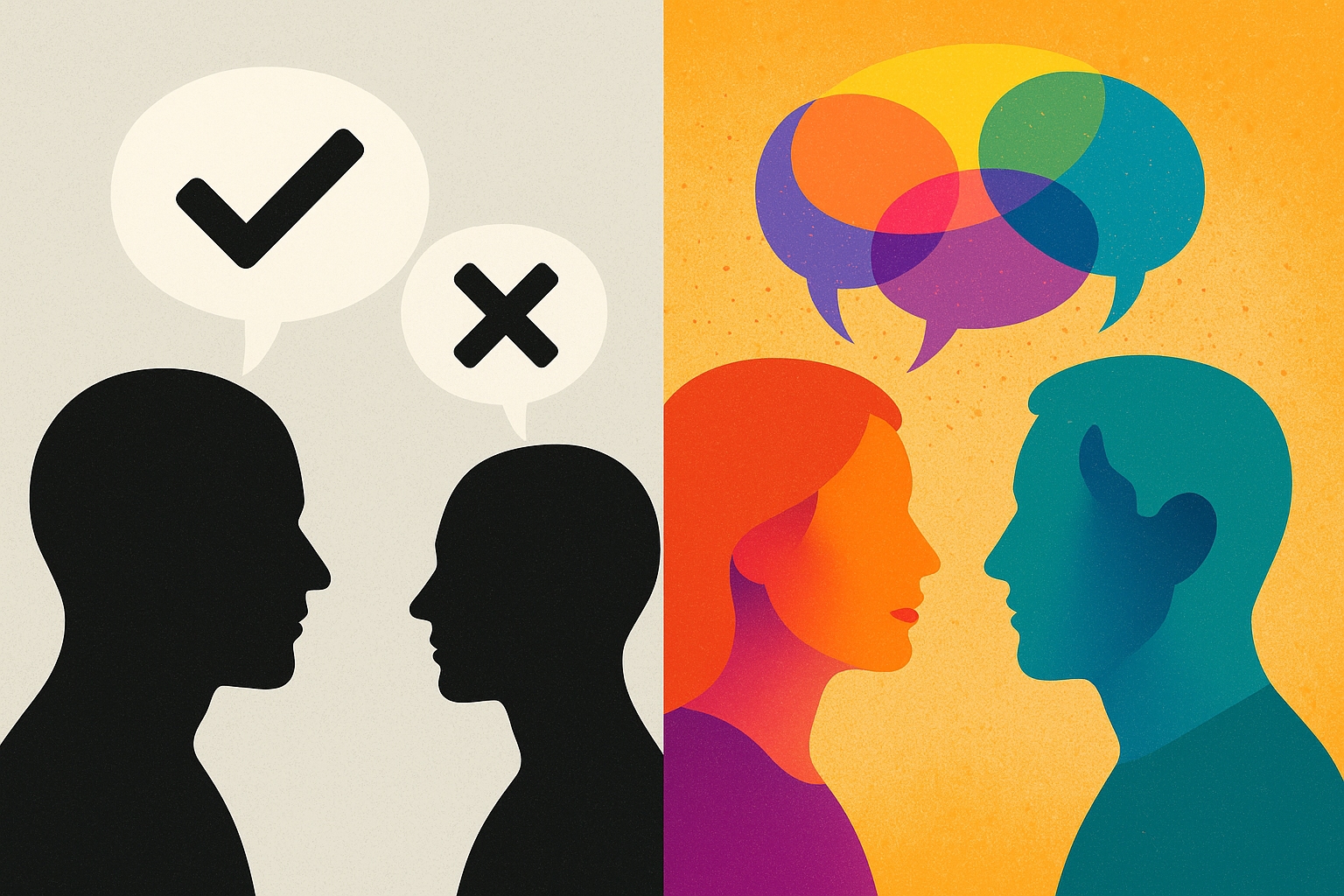
In a world where issues are often reduced to binary choices, we tend to jump to conclusions without acknowledging the nuances of complex topics. This black-and-white approach may be convenient, but it doesn’t reflect the reality of our diverse motivations, experiences, and values. Life is far more complex than a simple “right” or “wrong.” Deliberation offers a way to step back, suspend judgment, and embrace this complexity, helping us see beyond simplistic divisions.
At the start of the DCI Fellows journey, deliberation often seemed like a tool for finding compromise. But as I began engaging in conversations about difficult issues, I soon saw it as much more. Deliberation invites us to understand the “why” behind people’s beliefs and to appreciate the different motivations that drive their perspectives. One D Team discussion I recently facilitated on defensive democracy illustrated this dynamic, reminding me how deliberation can help unpack seemingly opposing views and reveal the complex motivations behind each stance.
Defensive democracy—a concept associated with the tension between protecting democratic principles and restricting certain freedoms in the name of security—tends to trigger strong emotions. For some, imposing restrictions on groups with anti-democratic agendas seemed essential for protecting democracy from internal threats. For others, any restriction on freedom seemed to risk eroding the very principles that democracy is meant to uphold. At first glance, it’s easy to view it as a black-and-white issue: either democracy is defended by limiting certain freedoms, or democracy is protected by preserving civil liberties at all costs. Yet as my D Team participants explored the topic, they discovered each perspective was rooted in motivations that were simultaneously personal, nuanced, and deeply held.
Some participants argued that limiting certain freedoms—such as banning groups with anti-democratic intentions—was crucial to safeguarding democracy itself. They highlighted examples from history where democracies fell because they allowed bad actors to act freely within their borders. Their approach was not about endorsing authoritarianism but about preserving democratic values by preventing harmful ideologies from undermining them.
Others voiced concerns that imposing restrictions, even in the name of democracy, might set a dangerous precedent. They emphasized the slippery slope, suggesting that banning one group could pave the way for further erosions of liberty. They viewed true democracy as strong enough to withstand dissenting voices, since suppressing ideas would betray democratic principles. For these participants, defending democracy meant holding firm to civil liberties, even at the risk of some vulnerability.
Deliberation allowed us to move beyond judging each stance as either “pro-democracy” or “anti-freedom.” Instead, this space provided a framework for examining the motivations behind each position. Listening to one another, participants began to realize that defensive democracy isn’t a straightforward issue with an easy answer; it’s a balancing act shaped by people’s lived experiences and their own personal interpretations of what democracy requires.
Perhaps the hardest part of this discussion—and of deliberation in general—was resisting the urge to label ideas as “right” or “wrong.” Through this experience, participants found that curiosity is essential in deliberative settings. When they approached each other’s motivations with curiosity rather than judgment, they opened themselves to new insights and ways of thinking. This curiosity allowed participants to understand not only each other’s concerns about freedom and security but also the complex values that guide their own views on defensive democracy.
Consider a hypothetical example where two groups debate banning extremist organizations to protect democratic stability. In a deliberative setting, participants from both sides would share why they feel as they do. Those advocating for restrictions might express fears about instability, sharing historical examples of democracies dismantled from within. Meanwhile, those defending free expression could argue that suppressing even dangerous ideas drives them underground, where they might thrive in secrecy. Through deliberation, each side could gain a fuller picture of the risks and values that shape the other’s position, seeing that their motivations stem from shared concerns for democracy, even if their conclusions differ.
Deliberation doesn’t mean everyone will end up on the same page. But it does foster a community in which we see each other as individuals with complex and diverse motivations. In the DCI Fellows Program and my individual D Team, I’ve seen how deliberation nurtures a more humane and compassionate community, one where people look for understanding rather than conflict. This empathy and respect are essential for a healthy democratic society, reminding us to pause, listen, and look for the colors in between the black and white arguments that are being made in a world increasingly polarized by oversimplified narratives.