• Skip to main content
  • Skip to footer

Deliberative Citizenship Initiative

Building Democracy One Conversation at a Time

  • The Initiative
    • Programs
      • Deliberation Across the Curriculum
      • Deliberation on Campus
      • Deliberation in the Community
      • Research on Deliberation
    • Motivations
      • Why Deliberative Citizenship?
      • Why Davidson? Why Now?
    • Who’s Involved?
      • DCI Fellows Cohorts
        • 2025-2026 Fellows
        • 2024-2025 Fellows
        • 2023-2024 Fellows
        • 2022-2023 Fellows
        • 2021-2022 Fellows
        • 2020-2021 Fellows
      • DeeP Collaborative Cohorts
        • 2024-2025 DeeP Collaborative Faculty
        • 2023-2024 DeeP Collaborative Faculty
      • Advisory Council
    • History
      • What Sparked the Initiative?
    • Key Deliberative Dispositions
    • Frequently Asked Questions (FAQ)
    • Annual Report
  • Get Involved!
    • Participate in a Forum
    • Join a D Team
    • Become a Fellow
    • Take Courses
    • Get Training
    • Come to Guest Lectures
  • Events
    • Upcoming Events
      • 250th Anniversary Deliberative Forum Series on American Values
    • Past Events
  • Connections
    • The Deliberative Citizen: The DCI’s Monthly Newsletter
    • Efforts on Campus
    • Efforts in the Community
    • Efforts Elsewhere
    • Readings and Resources
      • DCI-Published Guides
      • DCI Guide to One-on-One Conversations
      • How to Disagree
      • Demonstration of Facilitation Styles
      • Deliberative Pedagogy Mini-Course
    • How We Can Help: DCI’s LET’S DELIBERATE! Partnership Opportunities
    • DCI in the News
  • DCI Blog Posts
    • Recent Blog Posts
    • All Blog Posts

Atyantika Mookherjee

Walking the Talk – Is Widespread Deliberation Feasible?

April 22, 2024 by Atyantika Mookherjee

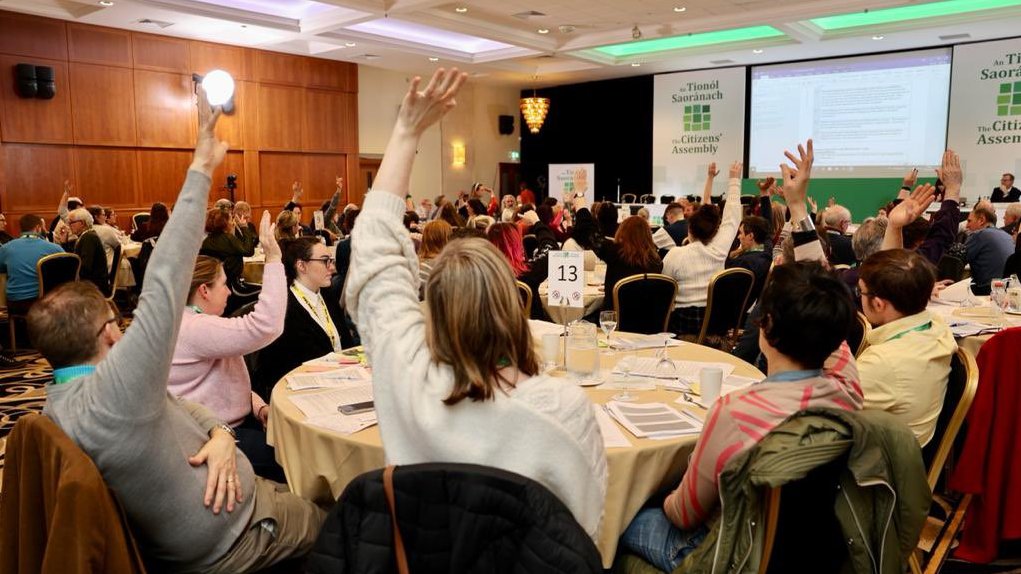
Citizens Assembly in Ireland.

Photo credit: Citizens’ Assembly of Ireland

By Atyantika Mookherjee ’27

At the Deliberative Citizenship Initiative, our D Teams, Deliberative Forums, and events aim to bring together a multitude of individuals to discuss conscientious topics to promote tolerance. In these deliberations, there is an emphasis on the importance of thoughtful exchange of ideas, diverse perspectives, and rational discourse to reach well-considered decisions. Nonetheless, while at Davidson and other college campuses, such an initiative is an active method to foster civic engagement, the question arises: is widespread deliberation truly feasible at the national level in modern societies?

At its core, widespread deliberation requires active participation from a broad spectrum of society. It entails creating platforms where individuals from diverse backgrounds can come together to discuss issues, share insights, and collaboratively seek solutions. However, one of the primary challenges to widespread deliberation is the issue of accessibility. Structural barriers such as socioeconomic disparities, geographic distance, and technological limitations can hinder broad participation. Not everyone has equal access to platforms for deliberation. Bridging these accessibility gaps requires proactive efforts to ensure that marginalized communities, including those with limited resources or marginalized voices, have avenues to participate meaningfully in deliberative processes.

Moreover, ensuring inclusivity within deliberative spaces is paramount for their effectiveness. Diversity of perspectives, experiences, and identities enriches discussions and leads to more comprehensive decision-making outcomes. However, achieving true inclusivity entails overcoming biases, discrimination, and power imbalances that can marginalize certain groups within society. Furthermore, the success of widespread deliberation depends on the willingness of individuals to engage in constructive dialogue. In an era marked by polarization, echo chambers, and information silos, fostering a culture of open-mindedness, empathy, and critical thinking is essential. People must be willing to listen to opposing viewpoints, challenge their assumptions, and engage in civil discourse even amidst disagreement.

Despite these challenges, there are promising examples of widespread deliberation being implemented in various contexts around the world. The Citizens’ Assembly initiative in Ireland, established in 2016, engages randomly selected citizens to deliberate on key societal issues. Notably, it played a crucial role in recommending abortion law reforms. Through informed deliberation, it successfully fostered inclusive decision-making and contributed to shaping public policy in Ireland, modeling an example of how deliberation is viable at the national level. Similarly, consensus conferences and participatory budgeting are initiatives that have the potential for inclusive decision-making processes that incorporate deliberative principles.

Technology further offers new opportunities to expand the reach of deliberative processes. Online platforms, social media, and digital tools can facilitate broader participation, enable diverse voices to be heard, and promote transparency in decision-making. However, it is crucial to address algorithmic biases and privacy concerns to ensure that technological innovations in deliberation uphold democratic values and principles.

Therefore, while the idea of widespread deliberation may seem daunting, it is not inherently unattainable. By addressing challenges related to accessibility, inclusivity, and civic culture, societies can move closer to realizing the vision of deliberative democracy. Embracing deliberation as a foundational principle of governance holds the promise of fostering informed societal discourse and advancing collective well-being.


Filed Under: Blog Posts, Fellow Posts

Commons Conversation Reflection: Discussing Safe Spaces with Dr. Boyer

April 19, 2024 by Atyantika Mookherjee

11×17-CC-w-Patricio-Boyer-FINAL-1

By Atyantika Mookherjee ’27

On Friday, March 22nd, a group of Davidson students gathered over lunch to discuss the concept and role of safe spaces with Dr Patricio Boyer. Dr Boyer, Director of the Humanities Program, had interesting ideas about the differing roles of safe spaces. The conversation began with an overview of the DCI’s Conversation Agreements and a round of introductions, allowing students from different majors and class years to share their reasons for interest in the topic and fostering a sense of inclusivity.

Dr Boyer then provided an overview of the topic, presenting his thoughts around how the question of a college being a safe space is a compelling one as it not only is a meeting ground for students, but also a place for faculty and staff to express their thoughts. He then opened the conversation up to the students. What followed was an engaging conversation that touched on trigger warnings, the type of media present in the classroom, and the difference between safe and brave places on college campuses.

It was incredibly interesting seeing students grapple with the question of if the classroom ought to be a safe space and the tug between content that requires a trigger warning and a comprehensive education. While – like most conversations at the DCI – there may be no easy answer, the experience was a rewarding one for all involved as we each walked away with new perspectives, more questions, and the skills to bring about productive conversations.

Filed Under: Blog Posts, Events

Emotion in Deliberation: A Necessity Rather Than an Impediment

December 19, 2023 by Atyantika Mookherjee

Brain and Heart

Atyantika Mookherjee ’27 (DCI Fellow)

It is common to consider emotion as the antithesis of reason and logic. After all, emotions are seen as spontaneous, subjective, and sometimes even irrational, while reason and logic is associated with objectivity and rationality. In public discourse, the interplay of these elements is of prime importance, influencing the course of an argument. Playing into an emotion/reason binary, it is often considered that debate should be centered on facts, leaving no room for the informal fallacy of appealing to emotion. Before joining the DCI as a Fellow, I, too, believed that emotion was a dispensable part of facilitating a productive conversation. However, in learning more about deliberation, I’ve come to recognize the importance of emotion, how it can be effectively communicated through storytelling, and why we should not just “set our feelings aside” when deliberating about public issues.

In his article, “Impassioned Democracy: The Roles of Emotion in Deliberative Theory,” Michael Neblo explores this intersection between emotion and deliberative theory, making the case that despite what many people think, the two are not mutually exclusive. He goes on to outline twelve distinct roles that emotion plays in the process of deliberation. These include contributing to the motivation to deliberate, providing inputs through experiences that harden into critical propositions, and ensuring a reciprocal and empathetic backdrop for the deliberation to occur.

In practice, I see how emotions contribute to better deliberations and agree with many aspects of Neblo’s argument. During the deliberation sessions I hosted as a DCI fellow for Davidson students, alums, and community members, I noted many individuals falling back on personal experiences and how they felt about them in formulating their arguments. Many of their responses to each other were rooted in shared events and outlooks. In retrospect, even my motivation to be part of the DCI comes from my travels to Pakistan as a young Indian girl, seeking to clarify misconceptions both countries have about each other’s communities as I saw them. In this manner, I now understand the role of emotion in deliberation to be critical and be expressed through a medium one would also not commonly associate with deliberation: storytelling.

Stories aim to inspire empathy and provide a deeper, more vibrant understanding of contexts the way facts fail to. Through the use of the Perspectives platform that seeks to encourage individuals to participate in constructive dialogue, I was able to glean more of an understanding of the role of storytelling in deliberation. Stories that are honest, important, and effective play a crucial role in setting the tone for peoples’ opinions and allow deliberators to connect, making for a more fruitful discussion. Naturally, the cornerstone for all such stories is emotion. People remember how an experience made them feel and use this to formulate the values they eventually contemplate during deliberations. They listen to other peoples’ emotions and compare them to their own in reaching their conclusions.

This is not to say that the influence of emotion in deliberation is always straightforward. In certain instances, emotions might sway deliberations towards options that align with immediate gratification or deeply ingrained beliefs, bypassing logical reasoning. Nonetheless, acknowledging and understanding emotions in deliberation can lead to more informed and balanced decision-making. From my own experiences, I’ve realized that successful deliberation often involves integrating emotional intelligence with rationality. This integration allows for a more comprehensive evaluation of choices, considering both the logical implications and the emotional resonance of decisions. In collaborative deliberative processes, recognizing and respecting diverse emotional responses among participants can lead to more inclusive and nuanced outcomes.

Filed Under: Blog Posts, Fellow Posts Tagged With: deliberation, discourse, facilitation

Footer

Blog Post Categories

  • Announcements
  • Blog Posts
  • DCI Posts
  • Events
  • Faculty Posts
  • Fellow Posts
Image of a compass superimposed by the text "Deliberative Citizenship Initiative" and "Davidson College." Clicking on this image leads to the Initiative page.

Recent DCI Blog Posts

  • We Tried to Fix Jubilee’s “Middle Ground” – Here’s How It Went
  • A Case for Deliberation in the Natural Sciences
  • Welcoming New Staff to the DCI and DCN
  • Facebook
  • Twitter
  • Instagram
  • LinkedIn


Copyright © 2026 · Infinity Pro on Genesis Framework · WordPress · Log in