By Stephen Walker ’26 (DCI Senior Fellow and Co-Convener)
This Fall, Deliberative Citizenship Initiative Fellows Saeran Daewar ‘28 and Oliver Genovese ’28 and Senior Fellows Casey Scheiner ‘28 and Stephen Walker ‘26 worked with the guidance of DCI Director Graham Bullock and Professor Ike Baliey to host a Campus Conversation entitled “Civic Discourse in the Wake of Political Violence: How Can We Foster the Campus Culture We Want to Have?” on Thursday, November 20th.
The event builds on the work that they have been doing together this semester as they’ve thought about how Davidson can best respond to the assassination of Charlie Kirk and rising political violence in general. The work was motivated by the interest from students in following up on an opinion-editorial in The Davidsonian, in which the large political organizations on Davidson’s campus came together to condemn all forms of political violence.
Student participants, many of whom represented political organizations and student publications on campus, were treated to snacks and ice cream in the 900 Room of the College Union as the student fellows discussed the pertinent issues and the task of moving forward from it as a campus community.
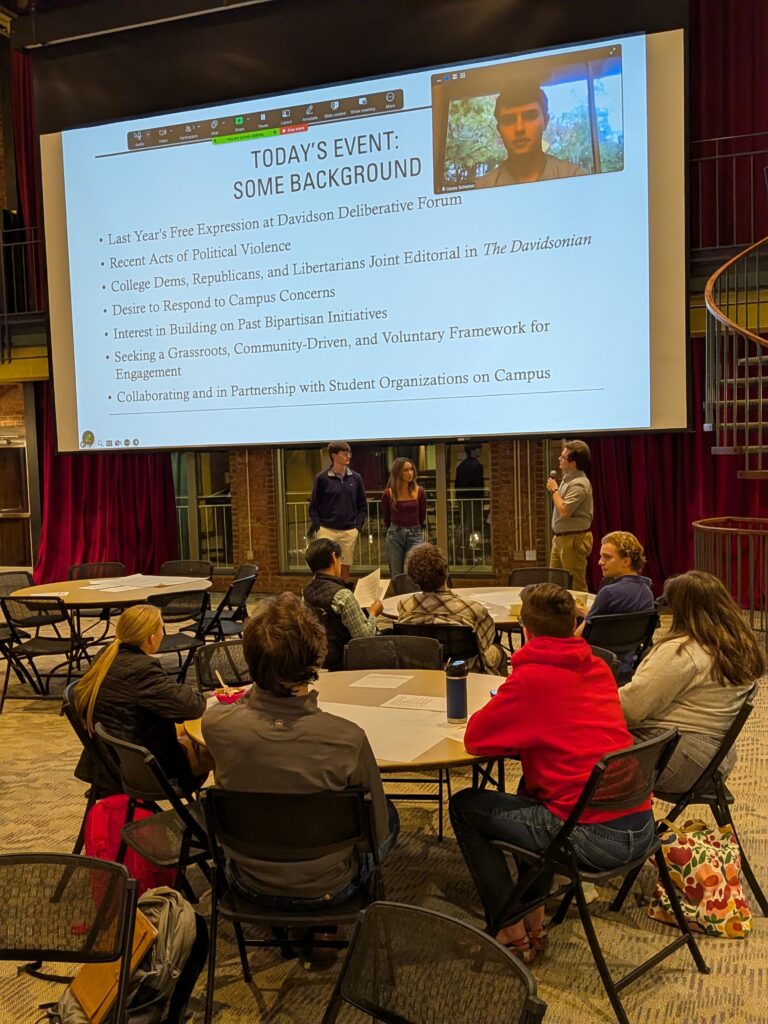
The fellows began the presentation by walking attendees through relevant background details concerning free expression and campus discourse at Davidson, so all participants had some context before entering into the conversation portion of the event. This included strategies for maintaining a healthy political culture and past work to determine how that is best done at Davidson.
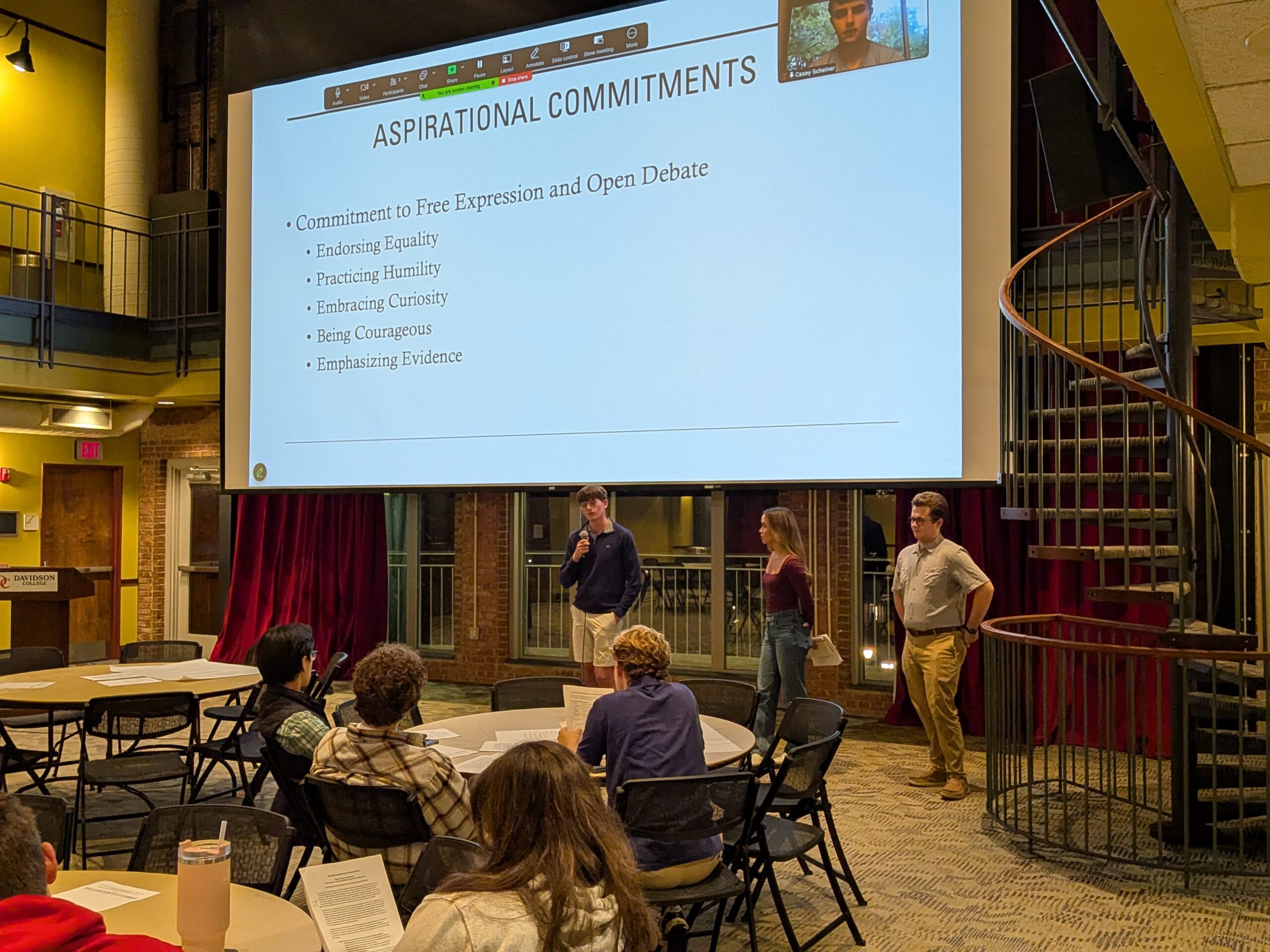
The Fellows also introduced themselves and their work to produce a list of aspirational commitments meant to bring community groups together around a set of community standards for engaging in public discourse. These standards were framed as rooted in the spirit of students’ shared decision to attend Davidson and agree to uphold an Honor Code and the college’s statement of purpose at all times.
Specific core components of the aspirational commitments document included a commitment to free expression and open debate, the inherent worth and dignity of all people, and organizing opportunities for respectful engagement across the political spectrum. The fellows then discussed a selection of passages from the College Constitution pertaining to free expression and rights of students, as well as the different terms at the heart of the commitment and the process by which students determine definitions for those terms.
The commitments document was designed to serve as a framework to start a conversation between participants, who were encouraged to discuss what they liked and thought should be added or changed in the document itself. The goal is to create a document truly shaped by the community it is designed to represent.
The participants were then asked to discuss the following questions to determine what their priorities were and how they would amend, if at all, the commitments document:
- How can we foster civic discourse in the wake of political violence?
- What should civic discourse look like on campus?
- What value(s) or aspirational commitment(s) are most important to you in the context of civil discourse?
After sharing with other participants seated next to them and writing out their answers on a whiteboard, students shared their answers with the full group so everybody could see what their views on the three questions were.
The conversation then transitioned to several rounds of scenarios related to controversial expressions of speech. Participants were asked to discuss hypothetical situations and rank them on a scale ranging from 5 for maximum allowance to 1 for the least permissible forms of expression. Students were asked to contemplate the scenarios and discuss what specific facts influenced their ratings.
Then, students were asked to share with the full group before moving on to another round of hypotheticals. Each one was designed to demonstrate the nuance of a particular situation and the importance of a variety of relevant factors in determining whether a certain behavior was acceptable or not. It pointed towards the value of a document like the set of aspirational commitments that can serve as a point of reference in the future.
Such determinations are difficult, and the attending students showed careful consideration for the specifics of the document, the scenarios, and the issue of political violence at large. Being able to practice their analytical skills while contributing to a community document was a meaningful experience for the presenting fellows and participants in the audience. The conversations also provided important insights that will inform future revisions of the aspirational commitments document as it is further developed. Stay tuned for more updates coming soon!