• Skip to main content
  • Skip to footer

Deliberative Citizenship Initiative

Building Democracy One Conversation at a Time

  • The Initiative
    • Programs
      • Deliberation Across the Curriculum
      • Deliberation on Campus
      • Deliberation in the Community
      • Research on Deliberation
    • Motivations
      • Why Deliberative Citizenship?
      • Why Davidson? Why Now?
    • Who’s Involved?
      • DCI Fellows Cohorts
        • 2025-2026 Fellows
        • 2024-2025 Fellows
        • 2023-2024 Fellows
        • 2022-2023 Fellows
        • 2021-2022 Fellows
        • 2020-2021 Fellows
      • DeeP Collaborative Cohorts
        • 2024-2025 DeeP Collaborative Faculty
        • 2023-2024 DeeP Collaborative Faculty
      • Advisory Council
    • History
      • What Sparked the Initiative?
    • Key Deliberative Dispositions
    • Frequently Asked Questions (FAQ)
    • Annual Report
  • Get Involved!
    • Participate in a Forum
    • Join a D Team
    • Become a Fellow
    • Take Courses
    • Get Training
    • Come to Guest Lectures
  • Events
    • Upcoming Events
      • 250th Anniversary Deliberative Forum Series on American Values
    • Past Events
  • Connections
    • The Deliberative Citizen: The DCI’s Monthly Newsletter
    • Efforts on Campus
    • Efforts in the Community
    • Efforts Elsewhere
    • Readings and Resources
      • DCI-Published Guides
      • DCI Guide to One-on-One Conversations
      • How to Disagree
      • Demonstration of Facilitation Styles
      • Deliberative Pedagogy Mini-Course
    • How We Can Help: DCI’s LET’S DELIBERATE! Partnership Opportunities
    • DCI in the News
  • DCI Blog Posts
    • Recent Blog Posts
    • All Blog Posts

Fellow Posts

The Complementary Roles of Deliberation and Disruptive Communication in Political Discourse

May 31, 2024 by Emre Guvenilir

Graphics showing protestors and people deliberating around a table

By Emre Guvenilir ’25

In my view, deliberation is a tool that can help facilitate healthy conversation. When done correctly, it can bring together those who hold opposing views to find common values or goals, which can in turn orient policy solutions in less extreme directions. This is critical in a free democracy, where everyone is given a voice and empowered to advocate for different policy solutions and points of view in a respectful manner. A good deliberation is a peaceful, reasonable discussion that involves individuals with different perspectives, a clear shift from what is often portrayed on national television between politicians and the most outspoken advocates.

It is important to recognize that political discourse comes in many forms, including protest and other forms of citizen activism. A few weeks ago, the DCI Fellows had an opportunity to read a paper titled “Deliberation and Non-Deliberative Communication” by Edana Beauvais at Harvard University. The article develops a typology of communication that distinguishes between communication that is collectively-oriented and communication that is reason-giving. This raises the question concerning how deliberative communication fits into the wider political discourse, and if viewed within the context of a deliberative framework, whether more disruptive political communication can be considered part of a healthy deliberative democracy.

To address the first question, we must identify who engages and does not engage in political communication. In my view, political engagement in rallies, protests, and other events typically involves the most partisan among us. Then, there are those who may be loosely engaged with politics by reading and watching news stories, or through social media. Finally, there are those who are turned off from the nature of political discourse, so do not engage. However, it is important to recognize that all these people still have values that are important to them.

The hardest group to engage are those disconnected from politics. However, we can make deliberation more attractive to this group if it is focused through a lens of values, rather than concrete political issues. This means focusing on larger scale topics such as family, individualism, equality, and other core values. Those who are already engaged in partisan politics might be inclined to participate in a deliberation. However, when they engage for the first time with those who hold directly opposing views, even for this group, deliberation should also focus on values rather than specific issues. This will help everyone find common ground or at least better understand how they are emphasizing different values.

To answer the second question of how more disruptive political communication fits in to our broader political discourse, it is important to recognize that acts like protests aim to publicize a particular perspective and influence government and public opinion. Generally speaking, the aim of protesting is not to understand the other side. In my view, this differs from the goal of deliberation, and therefore deliberative theorists do not need to classify those forms of political communication as forms of deliberation.

However, deliberation can fail. To me, deliberation fails if deliberators fail to uphold the conversation agreements. This could happen for any number of reasons; for example, some involved in the deliberation feel they cannot express their thoughts because of a power imbalance that exists, deliberators fail to respect each others’ values, or any number of reasons. If deliberation fails, deliberative theorists should recognize that more disruptive acts can give a platform for stakeholders to come back to the table. As Edana Beauvais explains, “disruptive communication…is an effective tool for calling people to arms, to capture their interest, focus their energies, draw them tightly together.”

If deliberative communication fails partly because of a perceived power imbalance, protest can aid in bringing a voice to those who feel they do not have one and get the attention of those who are perceived to hold power. When individuals turn to disruptive forms of political communication, deliberation may appear to be the antithesis of what is needed. Protesters do not usually demand compromise; they demand the entirety of what they are fighting for. This leaves those in power resistant to any change since it seems to be an “all or nothing” deal. When that point is reached, I believe deliberation is a tool that should be used to better understand the differences of the parties involved and find common ground where possible.

So, to bring it back to the bigger question: where does deliberation fit into the larger political discourse? As Edana Beauvais concludes, different types of communication play different roles in public discourse. It is important for deliberative theorists to understand that deliberation has its limits, and only works when individuals are willing to recognize that others may be focusing on different values than they are. If individuals are willing to take this step and acknowledge that their own views may be wrong (or at least limited), deliberation can indeed be used as a tool that helps us move beyond competing slogans and sound bites, and empower us to create a more inclusive, functional, and dynamic democracy.


 [BG1]Can you say more about what you mean here?

Filed Under: Blog Posts, Fellow Posts

Accessibility As a Priority: A Perspective From the DCI

May 30, 2024 by Zoe Moseley

Image of stairs and ramp with upwards arrow and text stating Increasing Accessibility

By Zoe Moseley ’26

At a Deliberative Citizenship Fellows meeting in November, we discussed an article published by Colorado State University’s Center for Public Deliberation titled, “Inclusion Around the Cycle.” This reading aligned well with what I was doing at Davidson that week, helping the Davidson Disability Alliance lead a conversation about event accessibility with student organizations. The argument the reading was trying to refute was that all deliberations are necessarily and equally exclusionary. Power dynamics and certain people speaking more, or more freely than others, are two examples of ways deliberations may not be completely inclusive.

“Inclusion Around the Cycle” started by discussing two types of exclusion, external and internal. External exclusion was described as the fact that some voices will not be present for the event.  Internal exclusion, however, is the idea that non-dominant voices may be overlooked during the event. The article emphasizes that strategies to reach sufficient inclusion are entirely possible, especially when implemented before, during, and after events.

I would say the idea that not every voice at a deliberation could be present or heard felt very disappointing throughout working with the DCI. However, I did not know how to fix it. As someone who works towards access and inclusion on campus, I was confused about why I could not think of feasible ways to bring this perspective to the DCI. I was therefore excited to read, “deliberative practitioners should not allow the perfect to be the enemy of the good in public processes” (Maldonado, 6).

The article opened my eyes to the opportunity that deliberation presents us with on the subject of inclusivity, which is improving every time. I was surprised I had not viewed it this way before, as this was advice I gave to student organization leaders regarding accessibility. To me, accessibility, making resources available to all people, is the key to inclusion. During the meeting, we stressed that full accessibility is almost impossible since disability and need vary drastically. The article said the same thing about inclusion: “It is important to note that there is no way to ensure complete inclusivity” (Maldonado, 6).

The article touched on inclusivity efforts I realized the DCI was already making, such as offering almost all events via Zoom, training facilitators to make sure every voice gets a chance to speak, and asking for constant feedback. I tried to emphasize more minor things within my D Team when it came to inclusion, such as continuously asking if everyone could hear me, ensuring that the heavy door was propped open when participants arrived, and zooming one participant in when they were ill. By making it clear that we care about access, I hope participants feel more comfortable to show ways we can improve. After reading this article, I have ideas for more efforts I can make next semester, taking to heart the idea of improving each time. For example, I’d like to ask participants throughout the semester if there are the things we can do to improve the inclusivity of our meetings and then incorporate their ideas on the matter.

I am curious to see what those who argue that deliberations are not inclusive would say to Maldonado’s argument that while it is impossible to create a “perfectly inclusive forum,” we should nonetheless strive for sufficient inclusion. I appreciate the optimism of the Center for Public Deliberation on this front and hope other deliberative organizations put inclusion at the forefront of their discussion. I believe that the values of deliberation align well with the idea of inclusivity: respecting every voice, discussing differences, and assuming the best intentions.

Works Cited:

Maldonado, Samantha. “Inclusion Around the Cycle.” Center for Public Deliberation, Colorado State University, Spring 2017.

Filed Under: Blog Posts, Fellow Posts

Are all topics worthy of deliberation?

May 17, 2024 by Monty Krakovitz

Strepsiades and Pheidippides are discussing, Socrates is hanging in the air in a basket. Scene from Aristophanes's comedy Clouds.

By Monty Krakovitz ’25

Recently, in my Politics and Literature class with Dr. Ahrensdorf, we read Aristophanes’ The Clouds, a play discussing tradition, religion, and morality in comparison with a priori reason, philosophy, and science. Socrates, the representative of philosophy and naturalism convinced Pheidippides using reason and philosophy that it is actually just to beat his father, Strepsiades. Strepsiades, wanting to cast off his superstitious belief in Zeus, was convinced by his son’s argument for father beating. It was only once Pheidippides made the same argument for mother beating that Strepsiades got angry and proceeded to burn down Socrates’ school.

While Pheidippides clearly won the debate with his father over the justice of beating one’s parents from the perspective of a priori reason, his conclusion strongly challenged Strepsiades’ moral conscious and natural impulses.

After no one in the class could come up with a foolproof way using philosophy alone and ignoring instinctual aversion to beating one’s mother, another question was raised: if a son can beat his mother, why can’t he sleep with his mother? Once again, students in the class could not think of a reason to refute this idea without appealing to natural repulsions to such a heinous act of incest. We all intrinsically know we ought not to beat our mothers, just as we all intrinsically know it is wrong and shameful to sleep with our mothers. We know this even if we cannot clearly articulate why.

There are topics that we find so repulsive that we are not willing to debate them. In The Clouds, Strepsiades draws the moral line at his son beating his mother. I presume most of us are not willing to debate and are certainly not willing to change our minds on the morality of incest. This raises the question: what are the limits to deliberation, if any? Is it proper to debate something like the morality of a son sleeping with his mother, or does this stray into territory that we are unwilling to discuss?

I personally would argue that it is not proper to debate the morality of incest. This is because it goes against our prejudices, and deliberating something based on reason alone without recognizing the importance of the moral conscience is an error that can normalize behavior that we all agree is immoral and should not be tolerated. Likewise, it is not proper to deliberate the morality of cold-blooded murder without holding a properly informed moral conscience in the highest regard.

But what about capital punishment? Most would not find a debate over capital punishment to be beyond the scope of debate. Why is this the case? Both involve killing, but murder is done out of injustice and capital punishment (some argue) is done out of justice. This may be because virtually no one will defend the morality of murder, but many will defend the morality of capital punishment. Considering a large proportion of the population today and in our western tradition support the death penalty, this may be the reason why most consider it within the realms of debate while cold-blooded vigilantism murder is not.

It is natural for people, living in democratic times, to value the opinions of their fellow citizens and put away their pride out of the assumption that all of our voices hold equal value. When an opinion is held by a wide swath of the population, we naturally see it as an opinion worth discussing because to not do so would be to ignore our fellow citizens in an inegalitarian manner. When an opinion is not held by a large number of people, such as the morality of incest and murder, we generally do not find these issues worthy of debate.

While we should maintain our ability to provide reasons for our positions on these issues (particularly as we educate children about the difference between right and wrong), given that there is not unlimited time in the day to deliberate certain topics, we ought to be selective in which ones are actively debated. Maybe popular opinion ought to be the litmus test for if a topic is within the scope of deliberation. Maybe it shouldn’t. Nevertheless, the topics that are within the sphere of deliberation is an important question, and one that is crucial not only for the DCI, but for society as a whole.

Image: Strepsiades and his son Pheidippides are in the foreground with Socrates hanging in the air in a basket. This is a scene from Aristophanes’s comedy The Clouds. This work is in the public domain in its country of origin and other countries and areas where the copyright term is the author’s life plus 70 years or fewer.

Filed Under: Blog Posts, Fellow Posts

Commons Conversation Reflection: Discussing Faith and Freedom of Speech with Dr. Gouri Suresh and Dr. Zamir

May 17, 2024 by Arshiya Husain

sign for Commons Conversation about free speech and faith

By Arshi Husain ’26 and Monty Krakovitz ’25

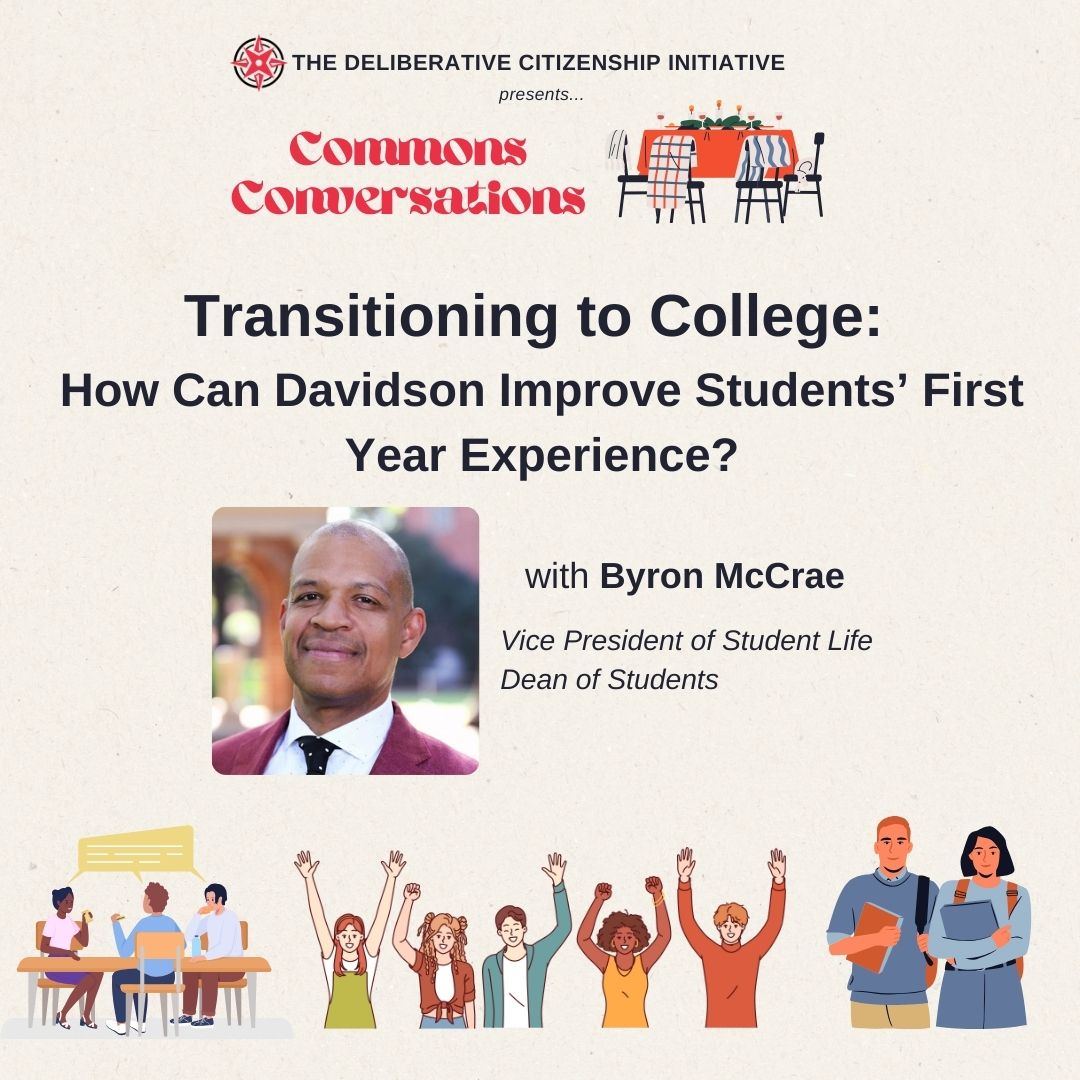
On April 18, 2024 in the Commons Annex Room, the Deliberative Citizenship Initiative hosted a Commons Conversation on “Deliberating Tensions between Faith and Freedom of Speech in South Asia.” The conversation was facilitated by DCI Fellows Arshi Husain ’26 and Monty Krakovitz ’25, the authors of this post. We were joined by Professor of Economics Dr. Shyam Gouri Suresh and Associate Professor of Religious Studies Dr. Rizwan Zamir, who helped jumpstart the conversation by sharing their perspectives on the topic at hand. The students then contributed their thoughts and questions, and a lively and engaging discussion followed.

Our conversation centered on the tension that sometimes arises between faith and free speech, specifically in the South Asian area. However, not only South Asian students from India and Pakistan joined the conversation but also students from around the US and various countries such as Greece and Egypt. In total, a group of 12 students from a range of different backgrounds participated in the deliberation.

One of the professors leaned more towards the position that offending the religious sentiments of citizens in the India/Pakistan area should not be punished by the government because citizens should be able to critique ideas without interference. The other professor leaned towards the position that free expression can be a virtue in some circumstances, but there are other virtues that are more important and are often forgotten on the never-ending quest for inclusivity. In other words, arguments tend to become complicated when we are weighing one virtue (freedom of speech) against another virtue (inclusivity). 

Interestingly, the conversation spread away from the South Asian area and took on a more global perspective. We further discussed the benefits and drawbacks of putting secularism and inclusivity above truth and virtue. Dr. Zamir stressed that the art of discourse lies in understanding how a particular culture works, and how we can construct our arguments to best fit the mold of a broader society. In other words, in order to see eye-to-eye with others, we often need to be able to view the world from their eye-level.

Dr. Gouri Suresh also shed light on the Indian Penal Code (IPC), which includes several sections that limit free speech. Section 295A prohibits speech intended to outrage religious feelings (enacted by the British in 1927), Section 124 prohibits speech “that excites, or attempts to excite…hatred, contempt, or disaffection” towards the Indian government (enacted by the British in 1870), and Section 153A prohibits speech intended to cause disharmony between groups (enacted in 1860 by the British).[1] This poses the question: how do we navigate questions about free speech in countries that have hindered it for centuries? India, for example, was among the first countries to ban Salman Rushdie’s “Satanic Verses” in 1988—a novel that one Indian elected official claimed was a “deliberate insult to Islam.”[2]

To recapitulate, while our conversation began with a focus on the South Asian region, we were quickly able to draw global connections, understanding that this is an issue that needs to be considered carefully worldwide. We also gained a greater recognition of the historical and legal contexts that continue to play a big role in shaping the discussion around religious liberty, freedom of expression, and inclusivity.


[1] Hate speech laws in India. Wikipedia. https://en.wikipedia.org/wiki/Hate_speech_laws_in_India; India Code: Section 124A Details https://www.indiacode.nic.in/show-data?actid=AC_CEN_5_23_00037_186045_1523266765688&orderno=133#:~:text=%2D%2DComments%20expressing%20disapprobation%20of,an%20offence%20under%20this%20section; Ananya Bhatia, Weaponization of Colonial-Era Sedition Law: The Future of India’s Free Speech, Columbia Undergraduate Law Review, https://www.culawreview.org/current-events-2/the-future-of-indias-free-speech.

[2] Rewind & Replay | The Satanic Verses: Why it was never just about the book. 2022. Indian Express. https://indianexpress.com/article/political-pulse/rewind-replay-the-satanic-verses-why-it-was-never-just-about-the-book-8091982/.

Filed Under: Blog Posts, Fellow Posts

The Role of Deliberation in Career Development

May 10, 2024 by Valeriia Kruzhkova

creative image of possible career paths

By Valeriia Kruzhkova ’26

Embarking on a career journey involves a series of crucial decisions that have an impact on both professional and personal aspects of life. Deliberation plays a key role in guiding individuals through this process, helping them make well-informed choices. In the realm of career exploration, deliberation takes on various forms, from conversations with professors to job interviews and beyond.

Deliberation goes beyond being just an action. It is a mindset with a natural tendency towards careful thought and contemplation. In the context of career pursuits, having a deliberational mindset prompts individuals to carefully assess options, contemplate potential outcomes, and ponder over their aspirations. Practicing deliberation is vital for moving away from black and white thinking and embracing a more nuanced understanding of career paths.

For instance, deciding on a specific profession may not be solely about choosing between passion and practicality. By engaging in deliberative thinking, individuals can explore various possibilities that balance personal values with job stability.

Career choices are often framed as either/or decisions, such as a high paying job versus a passion, stability versus innovation, corporate job versus startup. Through careful consideration, these oversimplified views can be broken down into many pieces, revealing a range of possibilities that blend different elements in unique ways.

For example, deliberation can help individuals realize that following a passion does not necessarily mean sacrificing financial security and working in a corporate setting does not automatically stifle creativity. By carefully weighing the pros and cons of each option, individuals can shape career paths that align with their needs and goals.

Schools act as a foundational space for nurturing deliberation skills. Learning environments that promote open dialogue, critical thinking and exposure to diverse viewpoints help students develop the ability to make informed decisions effectively. Having discussions with professors and other students helps to navigate the uncertainties that come with exploring different career options.

By integrating real world scenarios related to career decision making into the curriculum, students can further sharpen their decision-making abilities. Through structured discussions on career related subjects, students gain proficiency in expressing their thoughts and making choices that align with their long-term goals.

Deliberation is an essential tool for advancing one’s career development by promoting personal growth and resilience for changes. By nurturing the habit of reflection, individuals can navigate the complexities of their professional journeys with confidence. Whether it’s in educational settings, during job hunts or at critical career turns, practicing deliberation empowers individuals to create career paths that reflect their values, needs and goals.

Filed Under: Blog Posts, Fellow Posts

  • « Go to Previous Page
  • Page 1
  • Interim pages omitted …
  • Page 13
  • Page 14
  • Page 15
  • Page 16
  • Page 17
  • Interim pages omitted …
  • Page 32
  • Go to Next Page »

Footer

Blog Post Categories

  • Announcements
  • Blog Posts
  • DCI Posts
  • Events
  • Faculty Posts
  • Fellow Posts
Image of a compass superimposed by the text "Deliberative Citizenship Initiative" and "Davidson College." Clicking on this image leads to the Initiative page.

Recent DCI Blog Posts

  • We Tried to Fix Jubilee’s “Middle Ground” – Here’s How It Went
  • A Case for Deliberation in the Natural Sciences
  • Welcoming New Staff to the DCI and DCN
  • Facebook
  • Twitter
  • Instagram
  • LinkedIn


Copyright © 2026 · Infinity Pro on Genesis Framework · WordPress · Log in