Luna Noguchi ’25 (DCI Fellow)
When I host and facilitate deliberation during DCI D Team sessions, I am very conscious of whether I am including enough diverse perspectives into the conversation as possible. Healthy deliberation is sparked through exploration of individual differences, and they make for a rich understanding of the issue being discussed. Without fostering inclusion, important voices lack a platform to share their experiences, and this can shape harmful norms surrounding the types of perspectives that should be shared. When preparing for a deliberation session, it is important to think about fostering both external and internal inclusion.
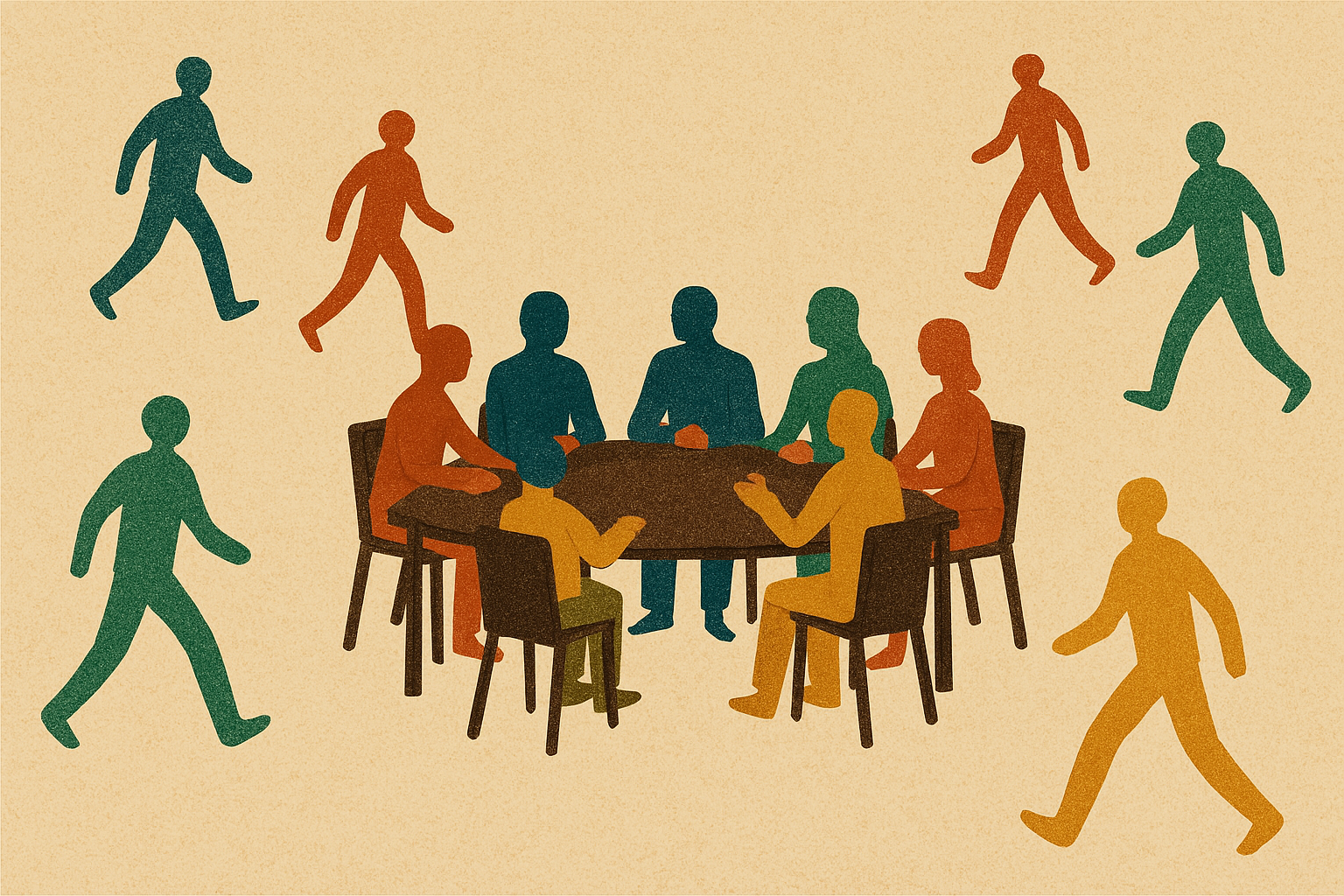
One of the most prominent barriers to productive deliberation at Davidson is the issue of exclusion. As a fellow, I see an important aspect of my role as fostering both internal and external inclusion. External inclusion involves dissolving the various physical barriers that prevent individuals from being involved in a D Team or a deliberative forum. Internal inclusion involves conceptual barriers to full participation and engagement in the deliberation process, like power dynamics.
I strive to use the framework set by Carcasson and Sprain to foster both internal and external inclusion in my D teams (1). They designed a cyclical process meant to improve the quality of public engagement in deliberation. The 5 steps are deliberative issue analysis, convening, facilitating deliberative engagement, and action.
During deliberative issue analysis, participants gain a deeper understanding of the topic or issue by learning about it through a thorough deliberation guide that cites research and historical events. The right deliberation guide includes a broad range of voices, is objective, and presents accurate and relevant information to participants. In my role as a fellow, I evaluate drafts of deliberation guides to check for areas where the background information could be presented in a more inclusive way.
Convening involves getting a representative sample to participate in the deliberation event. This is important for having a diverse and rounded group of people whose conclusions can be reflective of the broader whole. Removing barriers to people’s attendance to my D teams is essential. This can involve any planning details which make attending more accessible. For example, D teams which occur on campus are made accessible to many students through advertising, scheduling, and location.
Facilitating deliberative engagement is at the core of my role as a fellow. Through deliberation training, I have a strong understanding of how to frame conversation goals, lay down ground rules, prompt deeper thinking, and draw conclusions among participants. To foster internal inclusion, I introduce excluded perspectives into the conversation and ask questions that diversify participants’ way of thinking about the issue. When my group is on the larger side, I initiate smaller group discussions that may help someone feel more comfortable sharing their experiences.
In reporting the content of the deliberation, one should prioritize accurately capturing the perspectives of participants and the conclusions that were drawn from them. This may involve including important background information on the event, like the host of the event, the issue, the questions, and the people involved. It is important to follow up with participants and leave opportunities for further engagement. Inviting them to share thoughts they refrained from sharing during the event ensures their voices are included.
Ideally, the event would result in an attempt at acting on the issue. It should hinge on the conclusions drawn from the deliberation and represent the collective of diverse perspectives. Taking action on a wicked problem takes multiple trips around the cycle, as it can be very difficult to foster inclusion at this stage without hearing as many voices as possible. It can be helpful to inspire members to create a separate project or initiative that works to address the issue. It is also relevant to discuss methods that members can tackle the issue in their own communities.
Each stage of the cycle should build on themselves by fostering external and internal inclusion. This should promote the norm of listening and inviting diverse perspectives. Ideally, the momentum created by including more voices may contribute to a culture of deliberation in daily democratic engagements. While it is very difficult to reach sufficient inclusion with every event, following the outlined guidelines can be a good start.
Note:
(1) Martín Carcasson and Leah Sprain, “Beyond Problem Solving: Reconceptualizing the Work of Public Deliberation as Deliberative Inquiry,” Communication Theory 26, no. 1 (2015): 41–63.