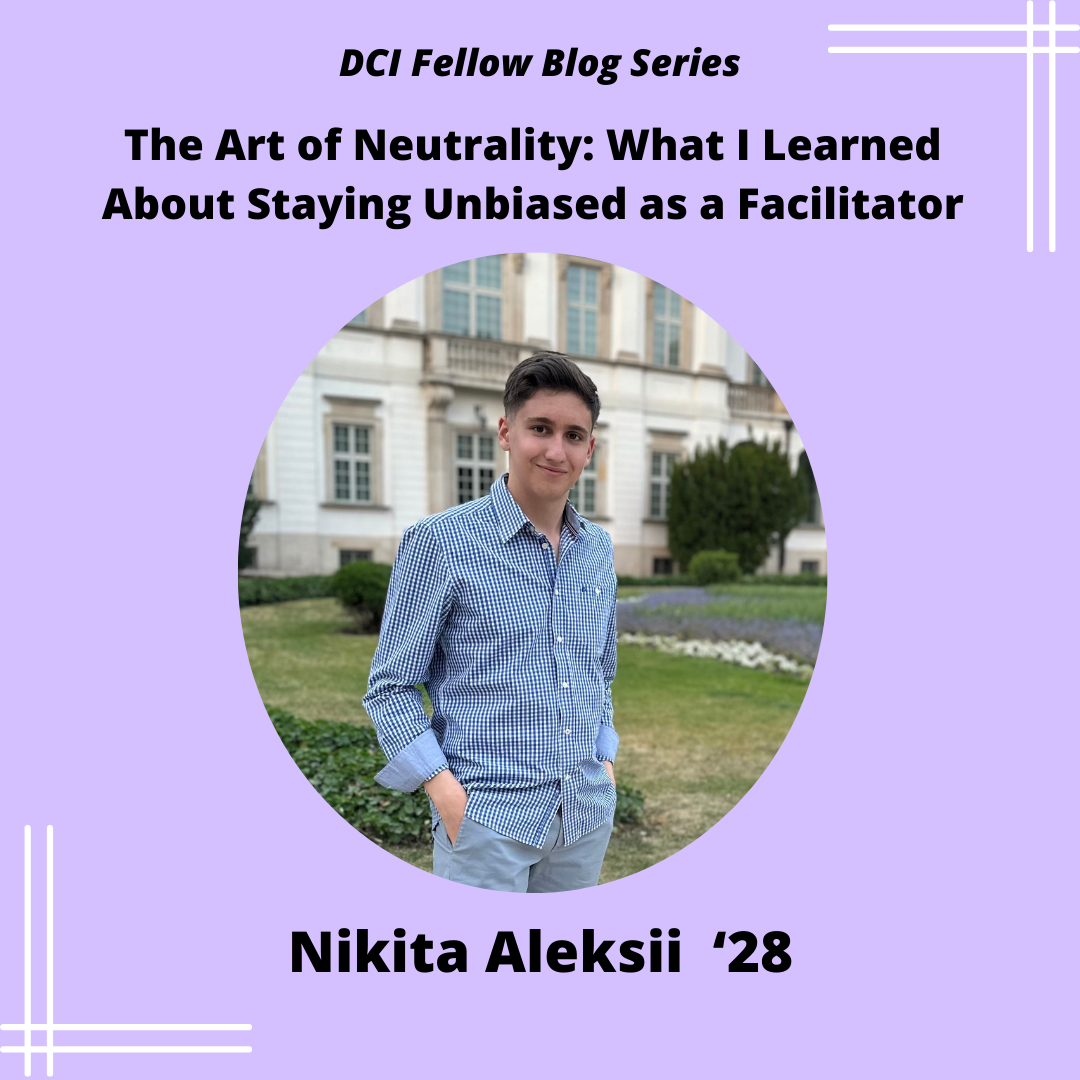
By Nikita Aleksii ’28 (DCI Fellow)
As a DCI fellow and international student, I facilitated my first deliberation on a contentious and timely issue – how to manage the already overwhelmed U.S. immigration system. Before my D Team meeting, I prepared robustly to facilitate an overarching and respectful deliberative discourse on immigration by reading different background information, discussing the issue with my DCI peers, and, most importantly, reflecting on immigration myself. Yet despite all that preparation, nothing prepared me for how complex genuine neutrality would be.
I had always assumed that being unbiased simply meant avoiding taking sides out loud. But I quickly learned that neutrality is not silence – it is an intentional practice that requires constant self-awareness, restraint, and a willingness to step back even when you want to lean forward. Oftentimes, I had to suppress the emotional aspect that usually guides me to encourage robust deliberation and ensure that every voice has space to be heard. As a facilitator, I had to learn to manage not only what I said, but also how I carried myself – my body language, my reactions, and even my pauses.
During preparation, I also realized that immigration, as a topic, holds layers of personal meaning for me. As someone who has navigated visas, borders, and cultural transitions, I naturally brought my own lived experiences into the room. Neutrality did not mean erasing those experiences but rather making sure they didn’t unconsciously shape the conversation. I had to ask myself: Am I creating space for every perspective, even the ones that might challenge my own story? That question followed me throughout the entire deliberation.
When the session began, the difficulty of neutrality became even more real. Facilitation is not passive– it is active work. Every time someone spoke, I had to listen for balance: Who has not spoken yet? Is one perspective dominating? The challenge was to guide the conversation without guiding the content.
One of the moments that taught me the most was when participants expressed strong emotional reactions. In those moments, my instinct was to respond with sympathy or agreement. But as a facilitator, my role was different. My job was not to match their sentiment but to foster a culture of free expression and diverse views. Neutrality, I realized, is not the absence of care. It is care expressed through fairness.
By the end of the deliberation, I realized that neutrality is a skill I am still learning. It requires confidence but not dominance, empathy without alignment, and structure without direction. It is an art precisely because it is practiced, refined, and never fully mastered. And in a world where people often rush to take positions, defend views, and prove points, choosing to stay neutral may be one of the most challenging – and most valuable – skills we can develop. This experience reaffirmed for me why deliberation matters. It reminds us that conversations do not need winners and losers; they need space, patience, and a willingness to understand rather than convince. And that begins with the art of neutrality.