• Skip to main content
  • Skip to footer

Deliberative Citizenship Initiative

Building Democracy One Conversation at a Time

  • The Initiative
    • Programs
      • Deliberation Across the Curriculum
      • Deliberation on Campus
      • Deliberation in the Community
      • Research on Deliberation
    • Motivations
      • Why Deliberative Citizenship?
      • Why Davidson? Why Now?
    • Who’s Involved?
      • DCI Fellows Cohorts
        • 2025-2026 Fellows
        • 2024-2025 Fellows
        • 2023-2024 Fellows
        • 2022-2023 Fellows
        • 2021-2022 Fellows
        • 2020-2021 Fellows
      • DeeP Collaborative Cohorts
        • 2024-2025 DeeP Collaborative Faculty
        • 2023-2024 DeeP Collaborative Faculty
      • Advisory Council
    • History
      • What Sparked the Initiative?
    • Key Deliberative Dispositions
    • Frequently Asked Questions (FAQ)
    • Annual Report
  • Get Involved!
    • Participate in a Forum
    • Join a D Team
    • Become a Fellow
    • Take Courses
    • Get Training
    • Come to Guest Lectures
  • Events
    • Upcoming Events
      • 250th Anniversary Deliberative Forum Series on American Values
    • Past Events
  • Connections
    • The Deliberative Citizen: The DCI’s Monthly Newsletter
    • Efforts on Campus
    • Efforts in the Community
    • Efforts Elsewhere
    • Readings and Resources
      • DCI-Published Guides
      • DCI Guide to One-on-One Conversations
      • How to Disagree
      • Demonstration of Facilitation Styles
      • Deliberative Pedagogy Mini-Course
    • How We Can Help: DCI’s LET’S DELIBERATE! Partnership Opportunities
    • DCI in the News
  • DCI Blog Posts
    • Recent Blog Posts
    • All Blog Posts

Miles Charles

Polarization and Deliberation on College Campuses

April 24, 2023 by Miles Charles

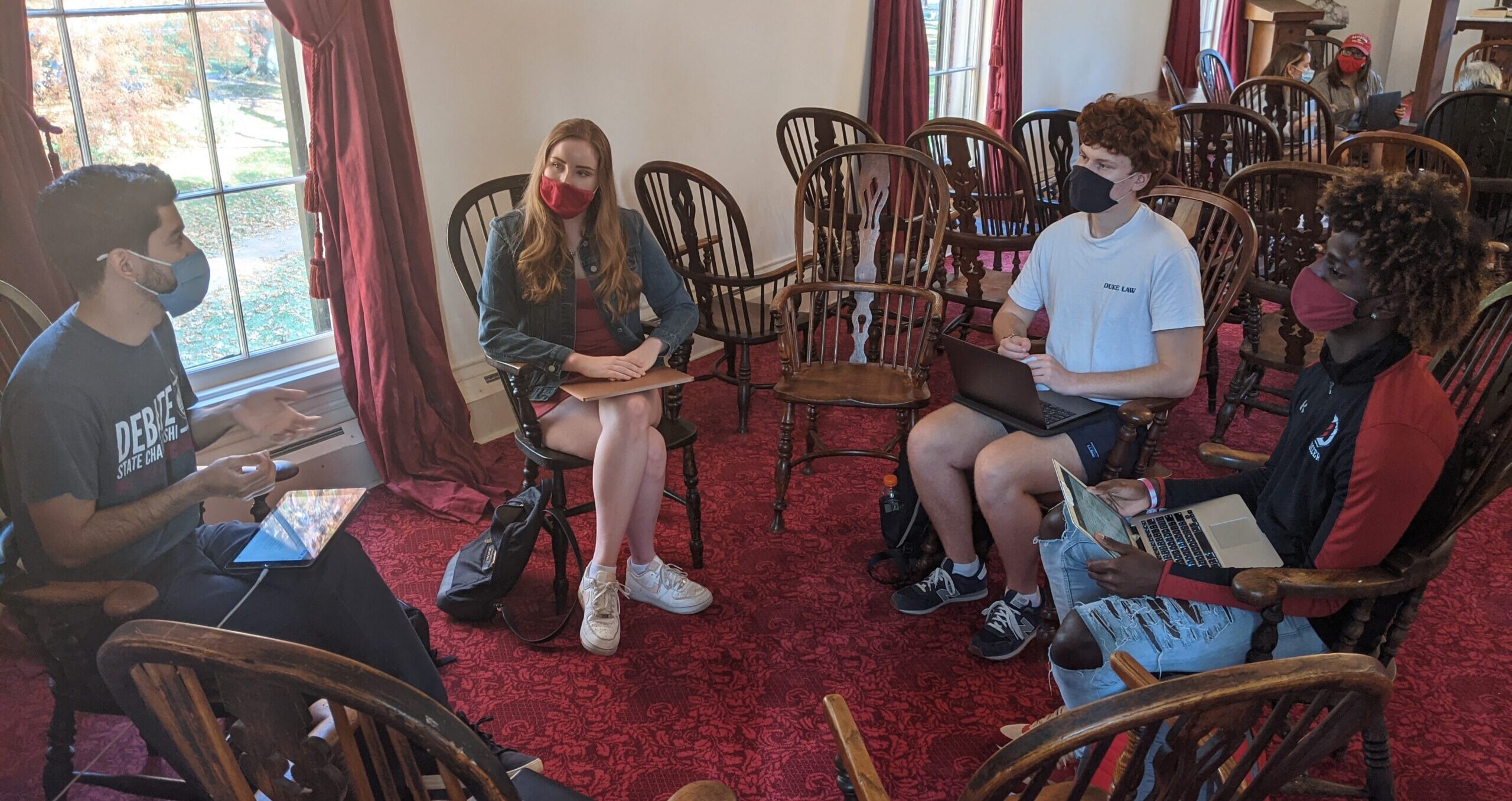
Group of Students talking in a circle.

By Miles Charles ’25 (DCI Fellow)

College campuses are often microcosms of society at large, with students from a wide range of backgrounds and experiences coming together in one place. However, these diverse communities are not immune to the challenges of polarization and division that are currently plaguing our society. Whether it’s disagreements over politics, social issues, or campus policies, tensions can run high on college campuses. But there is hope: deliberation can be a powerful tool for bringing together a divided college campus.

Deliberation involves the careful consideration and discussion of issues, with an emphasis on active listening, respectful communication, and a willingness to engage with others in good faith. When applied to the context of a college campus, Davidson College for example, deliberation opens the opportunity to foster a deeper sense of community past simply being a wildcat and promote a culture of constructive dialogue.

One way to incorporate deliberation on a college campus, as DCI has done at Davidson, is through the implementation of deliberative groups and forums. These groups are facilitated and led by trained Davidson Students to better encourage student participation. As a student facilitator, I have seen and experienced firsthand how student led deliberations create a space in which all voices are heard and respected, regardless of political affiliation, background, or personal beliefs.

Another innovative approach is to incorporate deliberation into the curriculum itself. Various colleges and universities have already begun to do so, incorporating courses on topics such as civil discourse, conflict resolution, and intergroup dialogue. Within the Davidson context, deliberation is being incorporated in courses across the curriculum by faculty participants in the DCI’s Deliberative Pedagogy Collaborative. Expanding these efforts will expose students to different perspectives and teach them skills needed to engage in productive class discussions, dialogues, and promote a more inclusive community.

Deliberation can also be effective in addressing specific issues or conflicts on a college campus. For example, as a student, a controversial issue is the limited number of parking spots on campus. By employing the deliberative process, the various stakeholders such as administration, students, employees, visitors, and more can be brought together to engage in constructive dialogue. This can help to identify common ground and find solutions that are acceptable to all parties involved.

In order for deliberation to be effective, it is important to create a culture that values respectful communication and open-mindedness. This can be achieved through workshops, trainings, and other educational initiatives that teach students and staff the skills necessary to engage in productive dialogue. It is also important to ensure that all voices are represented and that everyone feels comfortable participating in the process.

In conclusion, deliberation is a powerful tool for bringing together a divided college campus. By creating spaces for respectful and constructive dialogue, incorporating deliberative approaches into the curriculum, and addressing specific issues through a deliberative process, colleges and universities can foster a more inclusive and welcoming campus community.

*Photo above is from students participating in a deliberation designed and facilitated by students in a course on ethics and policymaking in the fall of 2021. Over a dozen such deliberation-involved courses have been taught by faculty participants in the DCI’s Deliberative Pedagogy (DeeP) Collaborative.

Filed Under: Blog Posts, Fellow Posts

Contending with Contentious Issues: The Power of Deliberation

September 28, 2022 by Miles Charles

DCI Fellow

Miles Charles

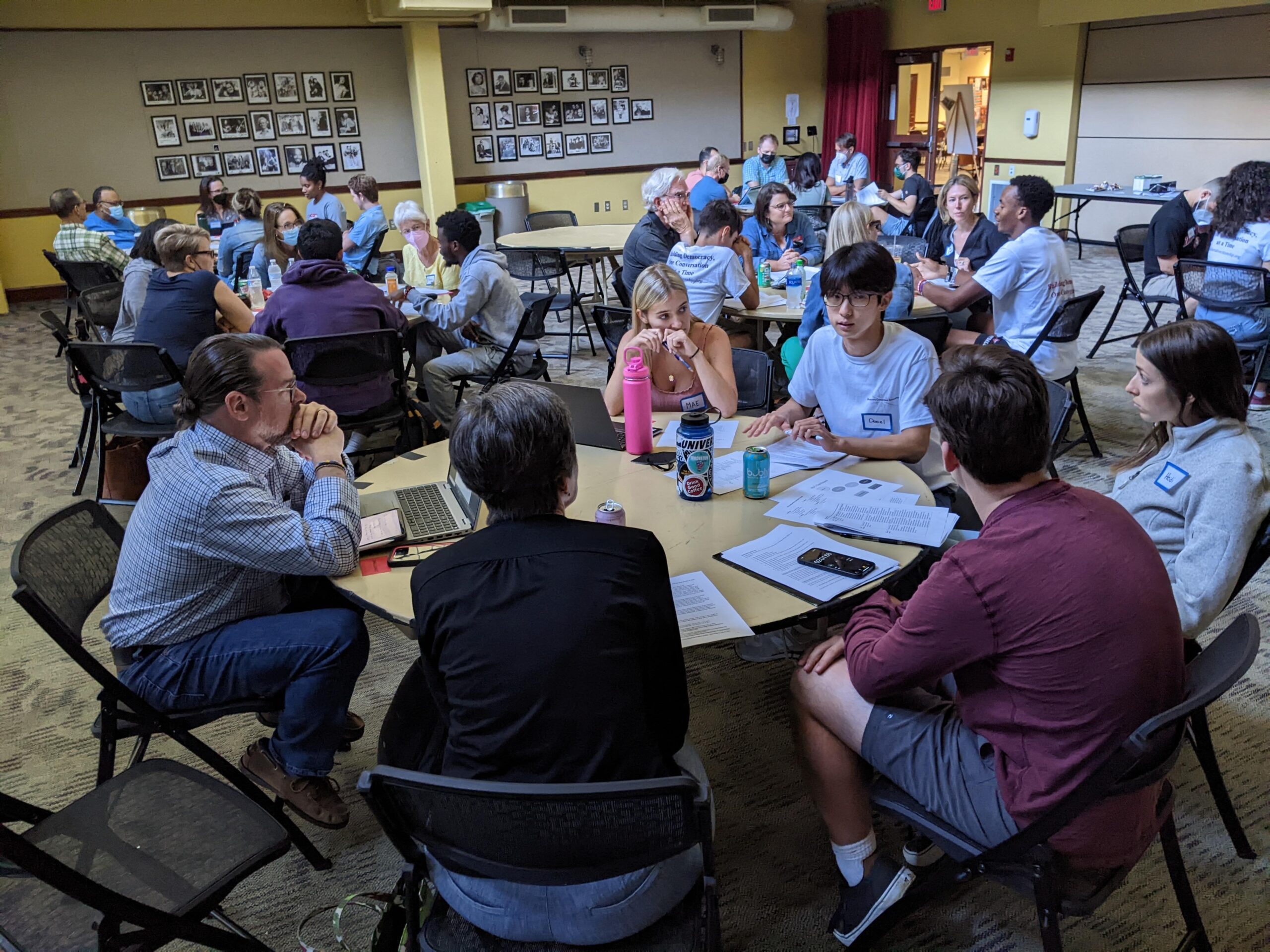
Students training for DCI Deliberations at round tables in the Davidson College 900 Room.

Deliberation, as defined by Longo and Shaffer in their work “Discussing Democracy,” is a process in which a diverse set of individuals convene and move towards making a collective decision on a contentious issue. Deliberation has the power to change the discourse in our country, away from the harmful rhetoric currently used and towards open dialogue, where everyone’s opinions on every facet of the political spectrum are heard and understood.

 While issues such as race, abortion, religion, and more have always carried a certain weight and importance within American society, throughout the past several years these issues have become more and more relevant in everyday American lives. It has culminated to a point where it is almost taboo to even mention any of the previously named topics. This is where I see the greatest potential of deliberation. It allows us to pry open issues such as race and abortion, open them to dialogue, and begin the process of understanding or at a minimum hearing the other side. 

Contentious issues, such as race, abortion, and religion, are like a powder keg. They are issues that are real, extremely prevalent, and are not going away; and by ignoring them we are simply adding powder to the keg, making the explosion of these issues worse and worse. We saw a preview of this dynamic during the summer protests of 2020 where millions of dollars worth of public and private property were destroyed nationwide. The result of negligence towards these issues is all too clear; a different approach must be taken. Deliberation and its advantages offer that opportunity.

Through my 10+ hours of facilitator training and readings, such as Longo and Shaffer’s “Discussing Democracy,” I’ve already been able to comprehend opposing viewpoints at a level I was unable to beforehand. For example, when deliberating whether to teach critical race theory (CRT) in the classrooms I was presented with a viewpoint I had yet to consider. This was the idea that while CRT is a must-teach topic, it is too complex for youth to understand. This raised the question in my mind of when and how to introduce CRT to our youth and allowed me to understand CRT, not only as a way to learn about race, but instead, view it also as a way to help young people connect with each other and understand, accept and celebrate our differences.

This broadening of my understanding is a small example of the power deliberation holds. A better example is Xernona Clayton, the civil rights legend who befriended a KKK leader and changed his mind. Xernona Clayton was leading the Model Cities Program, a federally funded program to end urban poverty, and despite the strong presence of the KKK, began to drop by Calvin Craig’s Atlanta office in an attempt to befriend him. Appealing to his Christian beliefs, Xernona would teach Clayton to change his use of words, understand the concept of black suffrage, and open his mind to desegregation.


Filed Under: Blog Posts, Fellow Posts Tagged With: facilitation

Footer

Blog Post Categories

  • Announcements
  • Blog Posts
  • DCI Posts
  • Events
  • Faculty Posts
  • Fellow Posts
Image of a compass superimposed by the text "Deliberative Citizenship Initiative" and "Davidson College." Clicking on this image leads to the Initiative page.

Recent DCI Blog Posts

  • We Tried to Fix Jubilee’s “Middle Ground” – Here’s How It Went
  • A Case for Deliberation in the Natural Sciences
  • Welcoming New Staff to the DCI and DCN
  • Facebook
  • Twitter
  • Instagram
  • LinkedIn


Copyright © 2026 · Infinity Pro on Genesis Framework · WordPress · Log in