• Skip to main content
  • Skip to footer

Deliberative Citizenship Initiative

Building Democracy One Conversation at a Time

  • The Initiative
    • Programs
      • Deliberation Across the Curriculum
      • Deliberation on Campus
      • Deliberation in the Community
      • Research on Deliberation
    • Motivations
      • Why Deliberative Citizenship?
      • Why Davidson? Why Now?
    • Who’s Involved?
      • DCI Fellows Cohorts
        • 2025-2026 Fellows
        • 2024-2025 Fellows
        • 2023-2024 Fellows
        • 2022-2023 Fellows
        • 2021-2022 Fellows
        • 2020-2021 Fellows
      • DeeP Collaborative Cohorts
        • 2024-2025 DeeP Collaborative Faculty
        • 2023-2024 DeeP Collaborative Faculty
      • Advisory Council
    • History
      • What Sparked the Initiative?
    • Key Deliberative Dispositions
    • Frequently Asked Questions (FAQ)
    • Annual Report
  • Get Involved!
    • Participate in a Forum
    • Join a D Team
    • Become a Fellow
    • Take Courses
    • Get Training
    • Come to Guest Lectures
  • Events
    • Upcoming Events
      • 250th Anniversary Deliberative Forum Series on American Values
    • Past Events
  • Connections
    • The Deliberative Citizen: The DCI’s Monthly Newsletter
    • Efforts on Campus
    • Efforts in the Community
    • Efforts Elsewhere
    • Readings and Resources
      • DCI-Published Guides
      • DCI Guide to One-on-One Conversations
      • How to Disagree
      • Demonstration of Facilitation Styles
      • Deliberative Pedagogy Mini-Course
    • How We Can Help: DCI’s LET’S DELIBERATE! Partnership Opportunities
    • DCI in the News
  • DCI Blog Posts
    • Recent Blog Posts
    • All Blog Posts

Meggie Lasher

Great Expectations: Growing into the Facilitator Role

April 29, 2022 by Meggie Lasher Leave a Comment

By Meggie Lasher, DCI Fellow

As a participant in DCI, I was eager to step into the role of facilitator. I had an excellent experience with my past facilitators, Dalton and Steve, and was hopeful about developing my own facilitator persona. The step from participant to facilitator quickly seemed like a leap — the careful consideration and compassion from Dalton and Steve seemed nearly impossible to achieve when I began training.

My initial hurdle as a facilitator wasn’t a surprise to me. I undoubtedly have the gift of gab. I can speak extemporaneously, chat with anyone, and really don’t mind public speaking. Frustratingly, this loquaciousness does not lend well to deliberative space. It may seem contradictory to struggle with talking too much when deliberation requires us to talk to each other. Yet, talking to fill a lull or void quickly felt disruptive during my first deliberation as a facilitator. Instead of validating and demonstrating my own intentional listening, I slipped into wandering with my words.

Looking back, since these sessions are recorded on Zoom, I was not visibly nervous per se, but I looked a little lost. I struggled to really be with the group, to lead and follow each stage of the conversation. I was married to the deliberation guide and hesitated to move from it. I owe much of my growth and ability to reflect to that first group of participants. They helped me de-center myself and talkative nature as the driving outcome for deliberation and showed me how to step back and let things flow.

As Fellows, we have access to others’ tools and opportunities to grow our skills. I especially appreciate the video series Beyond Bigots and Snowflakes. These short videos from the University of Illinois Urbana-Champaign’s Dr. Ilana Redstone are accessible and informative as we wrestle with the highs and lows present in facilitating difficult conversations. They’re worth the watch! My favorite so far is “The Problem with Telling People to Stay in Their Lane.”

Additionally, we have campus members and outside speakers come to our weekly meetings. Recently, Dr. Daniel Layman from Davidson’s Philosophy Department visited. We talked about how sometimes people present something that sounds awfully close to an argument but when you invite them to distill it in a few words, they wiggle out of it. We also discussed how you don’t have to be “fancy” to participate in discourse, which resonated with me and my value of deliberative spaces aiming for accessibility and approachability.

We also heard from Dr. Leila Brammer, who visited from the University of Chicago during Davidson’s Freedom of Expression Week. I attended her evening lecture, “Revitalizing Public Discourse on Campus and Beyond.” I found her description of how public discourse often tugs people into extremes to be particularly helpful with our hot topics this semester like gun control and abortion policy. She spoke of how even middle school students slip into the polarity; I used her technique of introducing an outside, third perspective to offer a perspective in the middle of the two radical poles in a recent deliberation. I’m looking forward to reading her book chapter about integrating deliberative pedagogy into first-year curricula.[1]

Now in my second semester, I have two groups meeting for two hours. Last-semester me would have croaked! I work with a virtual group that is a mix of alumni and students as well as a special in-person group at a local 55+ active living community. With the tools and confidence I’ve gained, I am a radically different facilitator. I ask deeper questions, connect with participants, and dare I say, have fun? Now I know when I make space and hold it for others, their voices come pouring in.

[1] Leila R. Brammer. “Deliberative Pedagogy as a Central Tenet: First-Year Students Develop a Course and a Community.” In Deliberative Pedagogy, 51–. Michigan State University Press, 2017.

Filed Under: Blog Posts, Fellow Posts Tagged With: facilitation

Finding Balance

December 9, 2021 by Meggie Lasher Leave a Comment

By Meggie Lesher, DCI Fellow

As a research librarian at Davidson, I regularly run into controversy, whether it is cutting edge yet contested scientific findings or problematic interpretations of historical events. I am often reminded that “a truly great library has something in it to offend everyone,” a quote from fellow librarian Jo Goodwin that circulates widely during Banned Books Week or when censorship issues fire up on social media.[1] Libraries have a long tradition of navigating a delicate balance between being public spaces for all and the need to regulate these spaces.

For example, most public libraries allow community groups to use meeting rooms and similar spaces within the library building. Not long ago, the American Library Association (ALA) revisited the Library Bill of Rights as it pertained to meeting room policies. A white supremacist group booked a public library meeting room, which sparked controversy over who can use library spaces. The ALA’s Intellectual Freedom Committee proposed the following language about library meeting rooms:

“Public libraries are bound by the First Amendment and the associated law governing access to a designated public forum. A publicly funded library is not obligated to provide meeting room space to the public, but if it chooses to do so, it cannot discriminate or deny access based upon the viewpoint of speakers or the content of their speech. This encompasses religious, political, and hate speech.

“If a library allows charities, non-profits, and sports organizations to discuss their activities in library meeting rooms, then the library cannot exclude religious, social, civic, partisan political, or hate groups from discussing their activities in the same facilities.”[2]

This language was adopted by the ALA in June 2018, and this decision did not go over well; library staff took to Twitter to share #NoHateALA and demonstrated their disagreement with the inclusion of hate groups in the guidance. The ALA subsequently voted to rescind this interpretation and return to the original language of the Library Bill of Rights released in 1991, included below:

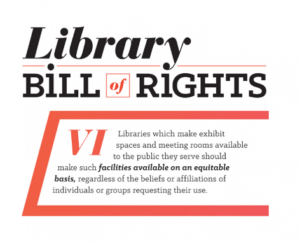
“VI. Libraries which make exhibit spaces and meeting rooms available to the public they serve should make such facilities available on an equitable basis, regardless of the beliefs or affiliations of individuals or groups requesting their use.”[3]

Concerned parties, both from the public and library staff, wanted the ALA to go further and affirm that hate speech and hate groups did not belong in the library. Returning to an older version of the Library Bill of Rights seemed like a step in the wrong direction to many critics of the decision. Yet, libraries have the responsibility to maintain access to information and public spaces no matter the affiliation or activities of the groups desiring to use the space. Libraries must call on agreements, such as the Library Bill of Rights, to ensure fairness. While affirming its commitment to intellectual freedom, the ALA has also encouraged libraries to “adopt and enforce user behavior policies that protect library users and staff from harassment.”[4]

The balance between fairness and regulation reminds me of the figurative space we enter together when preparing to deliberate. Just like libraries, there is a real need to regulate such spaces. For those new to DCI, we begin each deliberation with our conversation agreements. These agreements cover the ground rules for how we treat each other as well as guidelines about how to approach the discussion. Essentially, they hold us together while keeping us accountable. Regulation may seem like too strong of a word for our conversation agreements, yet we completed plenty of training about how to create an environment conducive to reaching a deliberative state— another type of delicate balance! We foster a shared understanding when we follow our conversation agreements and participate in difficult conversations together. Without at least some regulation, the deliberative space seems untenable and difficult to maintain. Let’s consider those agreements below.

Conversation Agreements

Each of these agreements suggests both norms to follow in the conversation as well as behaviors to avoid. For example, “be an attentive and active listener” suggests showing clearly – e.g., through your body language and your responsiveness to what others say — that you are listening to other members of the group. This agreement also suggests that being an inattentive and passive listener – playing with your phone, getting distracted, interrupting, not acknowledging others’ views – is not appropriate behavior in a deliberative context. Most of the time these agreements are internalized and followed without any problem, but sometimes the group or the facilitator may need to intervene to remind everyone of them (and in rare occasions enforce them).

Another way to consider the need for coordination and agreement in deliberative spaces is to reflect on what debate looks like in our daily lives. “Debate” is often acrimonious, combative, and rarely conclusive or inspiring. It’s more for entertainment on TV rather than an opportunity to learn from each other as we grapple with difficult questions. This style of TV debate lacks the regulation that we employ in deliberation. I see the parallels with the ALA issues on meeting spaces; without regulation, we are not nearly as democratic as we can be. Even though everyone may not agree with the ALA’s current guidance related to library spaces, the decision reflects the necessary structures that encourage democracy, just as the structures within deliberation allow us to fully participate together. As we honor structures like the conversation agreements, we are better able to enter deliberative spaces with as much equity, access, and shared respect as possible.

Image Link: https://www.oif.ala.org/oif/wp-content/uploads/2018/07/OIF-post-meeting-rooms-e1531248052538-730×589.png


[1] Learn more about censorship on this podcast episode from Brooklyn Public Library’s Borrowed Podcast.
https://www.bklynlibrary.org/podcasts/something-offend-everyone

[2] Yorio, Lisa Peet & Kara. “ALA Rolls Back Inclusion of Hate Groups in Bill of Rights Revision.” Library Journal. Accessed November 06, 2021. https://www.libraryjournal.com?detailStory=free-speech-debate-erupts-with-alas-inclusion-of-hate-groups-in-revision-of-bill-of-rights-interpretation.

Image: LaRue, Jamie. “Library Meeting Rooms for All.” Intellectual Freedom Blog (blog), July 10, 2018. https://www.oif.ala.org/oif/?p=14997.

[3] American Library Association. “Library Bill of Rights.” https://www.ala.org/advocacy/intfreedom/librarybill

[4] American Library Association. “Meeting Rooms: An Interpretation of the Library Bill of Rights.” https://www.ala.org/advocacy/intfreedom/librarybill/interpretations/meetingrooms


Filed Under: Blog Posts, Fellow Posts

Footer

Blog Post Categories

  • Announcements
  • Blog Posts
  • DCI Posts
  • Events
  • Faculty Posts
  • Fellow Posts
Image of a compass superimposed by the text "Deliberative Citizenship Initiative" and "Davidson College." Clicking on this image leads to the Initiative page.

Recent DCI Blog Posts

  • We Tried to Fix Jubilee’s “Middle Ground” – Here’s How It Went
  • A Case for Deliberation in the Natural Sciences
  • Welcoming New Staff to the DCI and DCN
  • Facebook
  • Twitter
  • Instagram
  • LinkedIn


Copyright © 2026 · Infinity Pro on Genesis Framework · WordPress · Log in