Last spring, I took my Critical Writing for Dance students to see Alvin Ailey American Dance Theater perform at the Fox Theatre in Atlanta. They were tasked with writing a critical analysis of at least one of the works on the triple bill and all arrived with their notepads and pens in hand. After the first work, they sat in a row (dressed to the nines!) and scribbled out thoughts and first impressions as I had suggested. A nearby audience member, curious to see ten Spelman women furiously writing at the same time, asked what they were doing. One of my students answered, and the audience member responded: “Why? It’s not that deep.”
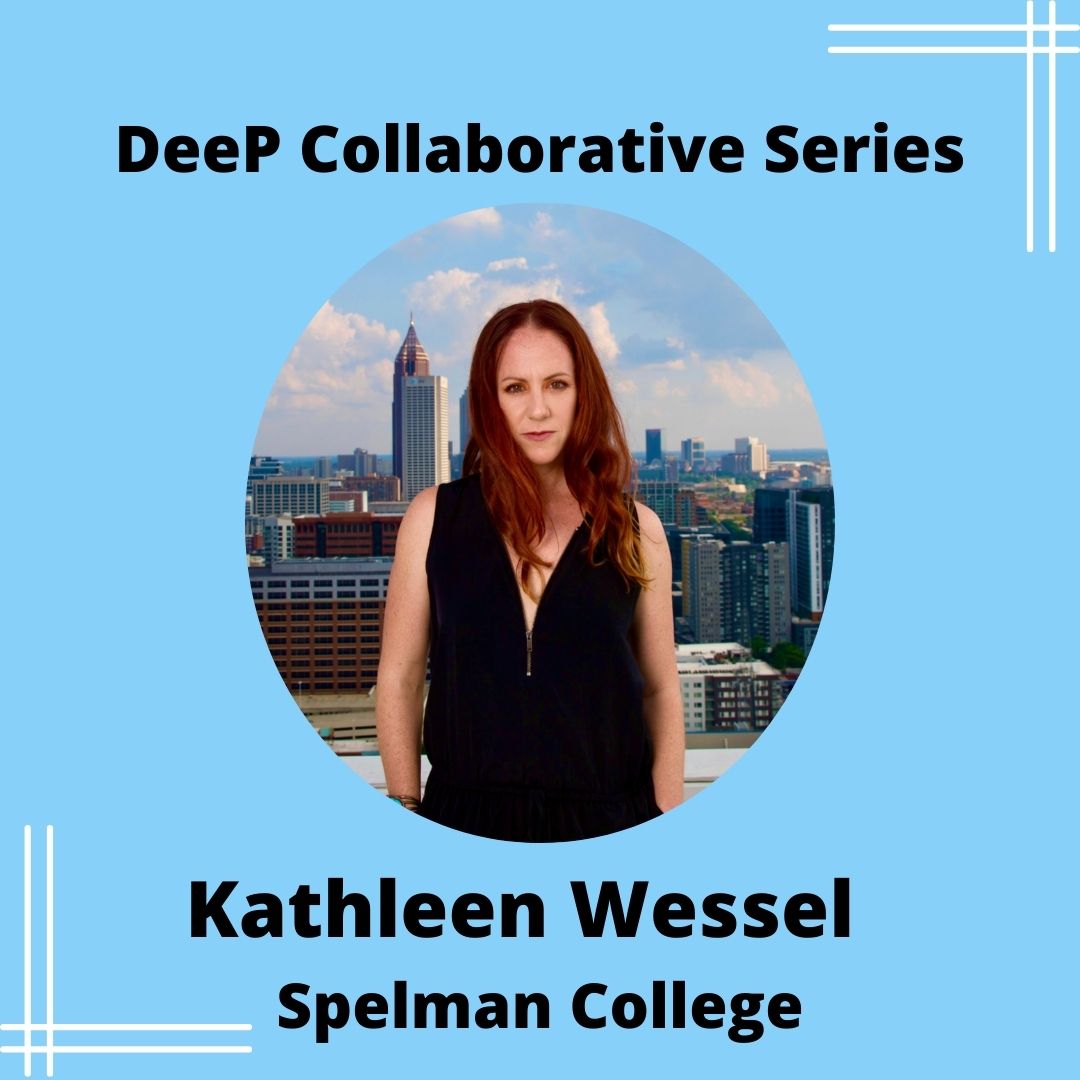
As the sole faculty member representing the arts in the 2023-24 Deliberative Pedagogy (DeeP) Collaborative cohort, I can attest: it is that deep. But both those who study dance and those who teach it in higher education often feel we must prove ourselves, and that burden can be exhausting. Identifying “wicked problems” and controversial topics to deliberate in a Peace and Conflict Studies or a Philosophy class seems like par for the course. Dance is trickier because it tends to be characterized in popular culture as either individual expression / catharsis or pure entertainment, neither of which – on the surface at least – affords much need for deliberation or critical analysis. And people can get defensive when scholarship, texts, research, and writing are introduced into sacred, emotionally charged movement spaces. Let’s not overthink it, I hear, dance is just about releasing and having fun.
Like all art forms, dance can serve as cultural communication, social commentary, public protest, and historical archive, all of which must be viewed through a critical lens. One of my main learning objectives in Critical Writing for Dance has been to simply get students to see dance as something worthy of analysis, to learn to construct a viable, thought-provoking argument and prove it using evidence from the work rather than writing a book report-style account of the event.
When I joined the DeeP cohort last summer, I looked forward to the spring, imagining my Critical Writing for Dance students engaging in rich dialogue about what a dance meant, posing questions addressing its cultural and social impact, and discussing biases and blind spots held by a majority white pool of professional dance and art critics. As I reworked my syllabus to include deliberative components, I incorporated difficult questions like:
- Are BIPOC and/or LGBTQIA+ identifying choreographers obligated to represent and/or address their identity in their work?
- What is Black dance? Is there such a thing? Is that term helpful or harmful?
- Is there anything a writer should, by default, not review? Is bias in criticism inevitable? Is claiming bias useful?
They were good questions, I thought, but in practice some were either too messy or not messy enough. I was challenged by how difficult it was to get students to take different sides on many of the issues and questions I presented. I considered forcing them to take one side or another but that felt too much like a debate, a different form of discourse. One outgoing person would speak up, most others would agree, and the deliberation would start to deflate. But as time went on and I started incorporating small group deliberations moderated by students, the group deliberations became more robust.
For the first deliberation, I had students read the Alvin Ailey American Dance Theater mission statement on the company website, attend the show, then deliberate on whether the work exemplified or contradicted their mission statement. My intention was to get the students to think critically about a company that [outside of New York City where the critics have seen it all and speak their minds] is often put on a pedestal. I wanted them to see that arts criticism builds dialogue, enhances integrity, and archives what happened and therefore what we should remember. I asked the students to build arguments around what a company intends versus what it produces. In the end, all agreed that the Alvin Ailey American Dance Theater work exemplified the mission statement perfectly. No notes. The deliberation fell flat.
Things progressed a bit with our second deliberation, “What is good writing?” for which the students read a critical analysis of Beyoncé’s “Lemonade” by bell hooks. I was worried I tried to do too much with this deliberation because we were focusing on the idea of “good writing” as a measurable absolute (based on standards and rules created by white men) using a legendary Black feminist writer’s controversial opinion about (arguably) the most beloved pop singer in the world. hooks posited that Beyoncé’s “Lemonade” is “capitalist money-making at its best” and delved into her argument while maintaining the utmost respect for Queen Bey. Even though the students all agreed that the article exemplified “good writing,” they had to confront its controversial content. I think what came out of this deliberation was the understanding that work produced by “untouchable” icons like Alvin Ailey, bell hooks, and Beyoncé is even more interesting when viewed through a critical lens. Critical thinking is good for everyone, viewer and artist alike, and is not the same thing as trashing or trolling. A win!
Oftentimes, the deliberations took left turns, especially when I had the students come up with their own topic and vote on which one they would deliberate. The chosen topic was, Have the comments sections on social media replaced the need for and relevance of traditional long-form arts criticism? I did not expect my class to engage in a deliberation on the validity of my entire course. This was tough for me, but we had a GREAT deliberation on the state of arts criticism in social media and on this issue, students were solidly divided. The reflections were extremely positive, and it had me rethinking assignments for the next time I teach this course, which is always something I welcome.
Another big win came near the end of the semester when I posed the question, “What is Black dance?” During the small group deliberations, I overheard a student say, “I hate this question” then proceed to say all dance is Black dance, a viable argument given the history of dance forms and cultural appropriation in America and on social media. I love it when that which was seen as foundational is called into question, be it my question or… gulp… my entire course. That’s how change comes about. It tells me students are engaging with one another, moving towards productive and respectful discourse, forming arguments that differ from others, and recognizing that opposing opinions on art and the state of arts criticism is how we move forward as a culture.
Even though we spent less time discussing the mechanics of writing, we spent more time constructing, deconstructing, editing, and reworking good arguments. Looking back – and with the looming realization that AI has already replaced the need to teach and learn basic writing skills – developing skills of critical analysis through the deliberative process was the most rewarding and impactful outcome from my time as a member of the DeeP cohort.