• Skip to main content
  • Skip to footer

Deliberative Citizenship Initiative

Building Democracy One Conversation at a Time

  • The Initiative
    • Programs
      • Deliberation Across the Curriculum
      • Deliberation on Campus
      • Deliberation in the Community
      • Research on Deliberation
    • Motivations
      • Why Deliberative Citizenship?
      • Why Davidson? Why Now?
    • Who’s Involved?
      • DCI Fellows Cohorts
        • 2025-2026 Fellows
        • 2024-2025 Fellows
        • 2023-2024 Fellows
        • 2022-2023 Fellows
        • 2021-2022 Fellows
        • 2020-2021 Fellows
      • DeeP Collaborative Cohorts
        • 2024-2025 DeeP Collaborative Faculty
        • 2023-2024 DeeP Collaborative Faculty
      • Advisory Council
    • History
      • What Sparked the Initiative?
    • Key Deliberative Dispositions
    • Frequently Asked Questions (FAQ)
    • Annual Report
  • Get Involved!
    • Participate in a Forum
    • Join a D Team
    • Become a Fellow
    • Take Courses
    • Get Training
    • Come to Guest Lectures
  • Events
    • Upcoming Events
      • 250th Anniversary Deliberative Forum Series on American Values
    • Past Events
  • Connections
    • The Deliberative Citizen: The DCI’s Monthly Newsletter
    • Efforts on Campus
    • Efforts in the Community
    • Efforts Elsewhere
    • Readings and Resources
      • DCI-Published Guides
      • DCI Guide to One-on-One Conversations
      • How to Disagree
      • Demonstration of Facilitation Styles
      • Deliberative Pedagogy Mini-Course
    • How We Can Help: DCI’s LET’S DELIBERATE! Partnership Opportunities
    • DCI in the News
  • DCI Blog Posts
    • Recent Blog Posts
    • All Blog Posts

Graham Bullock

The DCI Has a New Assistant Director!  

July 10, 2023 by Graham Bullock

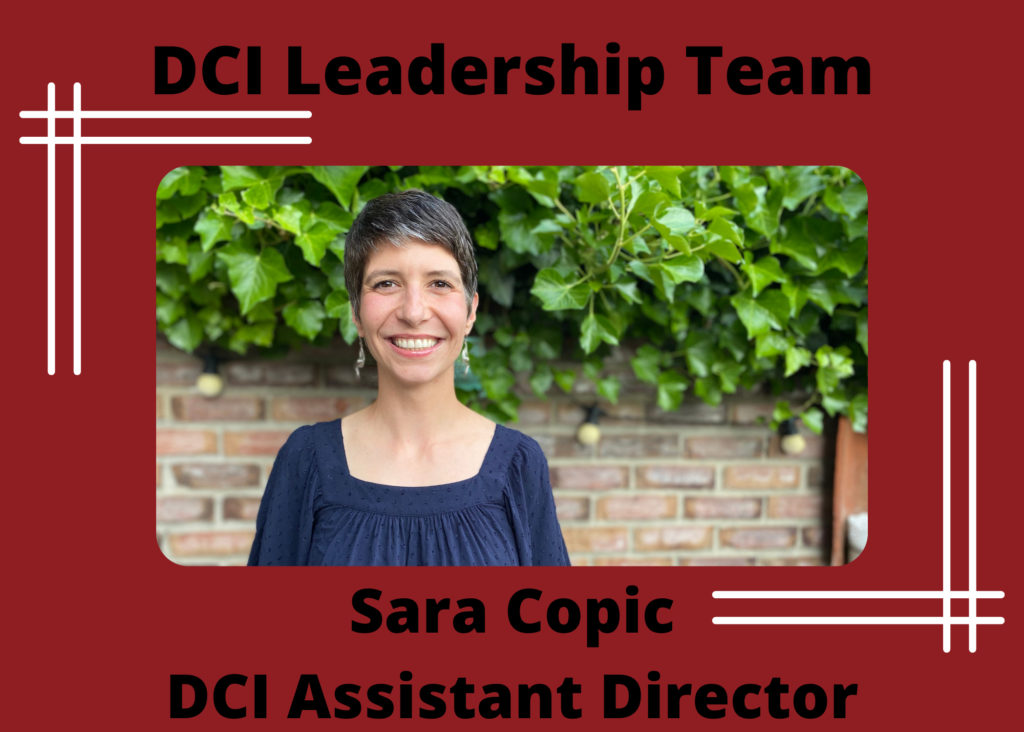
The DCI welcomes Sara Copic as our new Assistant Director! Dr. Copic will be responsible for assisting with the development, implementation, and assessment of the DCI’s programs and operations. Dr. Copic’s experience at both the University of North Carolina at Chapel Hill and the University of Notre Dame prepares her exceedingly well to help lead the DCI’s efforts to create opportunities for productive dialogue and deliberation in diverse classroom settings, outside of the classroom, and in the community.

Dr. Copic received her PhD in philosophy from UNC-Chapel Hill, where she recently served as Visiting Teaching Assistant Professor of Philosophy and taught courses in practical ethics, bioethics, the ethics of peace, war, and defense, language and communication, and more. In her research, Dr. Copic specializes in the philosophy of language. She writes about the relationship our ordinary discourse has to truth and social cooperation, and how these goals determine different types of linguistic meaning. Her teaching and research thus directly relate to some of the themes that the DCI engages with on a regular basis.

Dr. Copic has also worked as Design Project Manager in the Office of Digital Learning at the University of Notre Dame, where she led over 12 different digital education projects to successful completion, including the University’s digital resiliency initiative during the Covid-19 pandemic and projects on tech and innovation ethics, poverty, and interfaith dialogue. Dr. Copic’s experience leading complex education projects will be another asset to the DCI, where she will help design and implement programs in all of its focus areas.

In this work, Dr. Copic will apply lessons she has learned as a scholar-teacher who focuses on utilizing active learning strategies that foster an inclusive classroom environment and bridge achievement gaps between students from different backgrounds. In her teaching, she has also focused on helping students practice reflection and critical thinking not only on their own but also in community with one another.

In addition to her duties as the DCI’s Assistant Director, Sara looks forward to teaching a course at Davidson on the nature and significance of artificial intelligence in the College Writing Program in Spring 2024. Dr. Copic is an affiliate of the AI Project at UNC Chapel Hill and also writes about what lessons we can learn about meanings by studying large language models. AI is a hot topic ripe for deliberation, and Dr. Copic’s course will enable students to grapple with both its challenges and opportunities and connect with any programming the DCI organizes around this important issue. 

All to say, we are excited that Dr. Copic has joined the DCI’s leadership team! Watch out for blog posts and emails from Dr. Copic, and say hi to her if you see her on campus or in the community.

Filed Under: Announcements, DCI Posts

2023-24 D Team and Forum Topics Survey Now Open!

June 21, 2023 by Graham Bullock

Voting box with sign "Vote Here" displayed on the front.

We are working on identifying and prioritizing topics for the DCI’s 2023-24 Deliberative Forums and D Teams, and would love your feedback on the ideas we are considering in the brief survey below. Thank you to those of you who have submitted ideas – we received a lot of great suggestions and have tried to incorporate them into the options listed. If you’d like to provide your input on the options we are considering, please complete the survey below by June 30. Thanks!

DCI 2023-24 Topics Survey

Pages: Page 1 Page 2

Filed Under: DCI Posts, Events

DeeP Collaborative Continues for a Third Year

June 8, 2023 by Graham Bullock

faculty discussion

The DCI invites all full-time faculty members to apply to participate in the third year of its Deliberative Pedagogy (DeeP) Collaborative. Applications to join the Collaborative are welcome from faculty in all departments who wish to enhance their ability to embed more deliberation about questions and issues involving important disagreements in their classes. The DCI is able to provide a stipend of $2000 for participants in the Collaborative this year. Applications are due June 26, 2023.

So far over 20 faculty members from Davidson and five other Associated Colleges of the South (ACS) institutions (Furman, Morehouse, Rollins, Southwestern, and Spelman) have participated in the Collaborative. Collaborative members spend an academic year learning about and discussing deliberative pedagogy theory and techniques, embedding them into their own course plans and syllabi, and then actually teaching courses that are infused with deliberation in a multitude of ways. They have come from a wide range of social science, humanities, and natural science disciplines, including archaeology/classics, chemistry, communications, economics, environmental studies, gender and sexuality studies, history, philosophy, physics, political science, public health, and more.

Check out the comments from some of the Collaborative’s members below:

  • Luis Gonzalez-Barrios (World Languages and Cultures, Spelman College): “The planning process of the course was very interesting, since it not only made me think about the new DeeP materials, but also about the way of organizing the sessions, the periodization of the modules, and of course the forms of evaluation. I mean, it made me rethink my entire pedagogical approach…Experiential learning and democratic deliberation seem to me necessary pedagogical approaches in times of constant “noise” and polarization.”
  • Rachel Pang (Religious Studies, Davidson College): “One of the best things about participating in the DeeP Collaborative was the chance to engage with a group of experienced and creative pedagogues at Davidson and other ACS institutions.”
  • Caleb Stroup (Economics, Davidson College): “Overall, I think students benefited greatly from structured deliberation aimed at developing their abilities to reach collective agreement about competing values embedded in scientific research conclusions.”
  • Emily Sydnor (Political Science, Southwestern University): “Overall, I found the deliberative discussions and affiliated assignments achieved my course goals and were interesting and engaging for both me and the students. In their reflections on deliberation, several participants commented that in spite of their initial anxiety about talking politics with their peers, they had found the discussions to be a positive experience.” 

You can read more about faculty reflections on their experiences as members of the Collaborative in their blog posts that are posted on the DCI Blog and listed below:

  • Luis Gonzalez-Barrios (Spelman; World Languages and Cultures): “’Seeing Many More Angles than Usual:’ Deliberative Pedagogy in a Spanish Course on Feminism, Democracy, and Utopia”
  • Rachel Pang (Davidson; Religion): “Student-Driven, Curiosity-Focused Deliberation in a Chinese Religions Course”
  • Melissa Gonzalez (Davidson; Gender and Sexuality Studies/Hispanic Studies/Latin American Studies): “Deliberation across Disciplines: Lessons from a Course in Gender and Sexuality Studies”
  • Camille Lewis (Furman; Communication Studies): “From the Big Picture to Micro-Deliberations: Argumentation Meets Deliberative Pedagogy” 
  • Joshua Yesnowitz (Davidson; Writing Program/Political Science): “Writing Deliberatively”
  • Kata Chillag (Davidson; Public Health): Conversations about Cases: Integrating Deliberation into a Public Health Ethics Seminar
  • Nathan Nobis (Morehouse; Philosophy): A “Fair and Balanced” Approach to Deliberation in a Philosophical Ethics Course
  • Kyra Kietrys (Davidson; Hispanic Studies/Global Literary Theory): Deliberating about Collective Memory in a Hispanic Studies Course on the Comics and Graphic Novels of Spain
  • Robert Vander Poppen (Rollins; Art and Art History): Saving the Republic: Re-Enacting and Learning from a Key Deliberative Moment in Roman History
  • Caleb Stroup (Davidson; Economics): Mapping Arguments and Weighing Values in an Economics Seminar
  • Emily Sydnor (Southwestern; Political Science) Psyching Ourselves Out: Applying Political Psychology to Deliberative Discussion
  • Greg Snyder (Davidson; Religion) “What does the Bible Say?” Deliberating Across Difference in a Course on the Bible and Modern Moral Issues
  • Jessica Worl (Davidson; Environmental Studies): The Political Classroom in Practice: Roleplaying Deliberations in a Political Ecology Course
  • Eric Anderson (Furman; Philosophy) Hot-Button Issues in Three Acts: Promoting Deliberation in a Social and Political Philosophy Course

Blog posts from our 2022-23 Collaborative members were recently submitted and will be published soon (you can sign-up for updates on the DCI’s website). More on the background, goals, and expectations of the Collaborative is provided in the attached invitation and on the DCI’s “Deliberation Across the Curriculum” webpage. 

This year’s cohort will include faculty from both Davidson and other institutions of higher education – if you know someone who might be interested, encourage them to apply – all faculty are welcome! If you have any questions about the Collaborative, please reach out to the DCI’s Faculty Director, Graham Bullock (grbullock@davidson.edu), or any of the Collaborative’s faculty members.

DeeP-Collaborative-Poster

Filed Under: Announcements, Faculty Posts

DCI Fellowship Application is Now Open!

June 1, 2023 by Graham Bullock

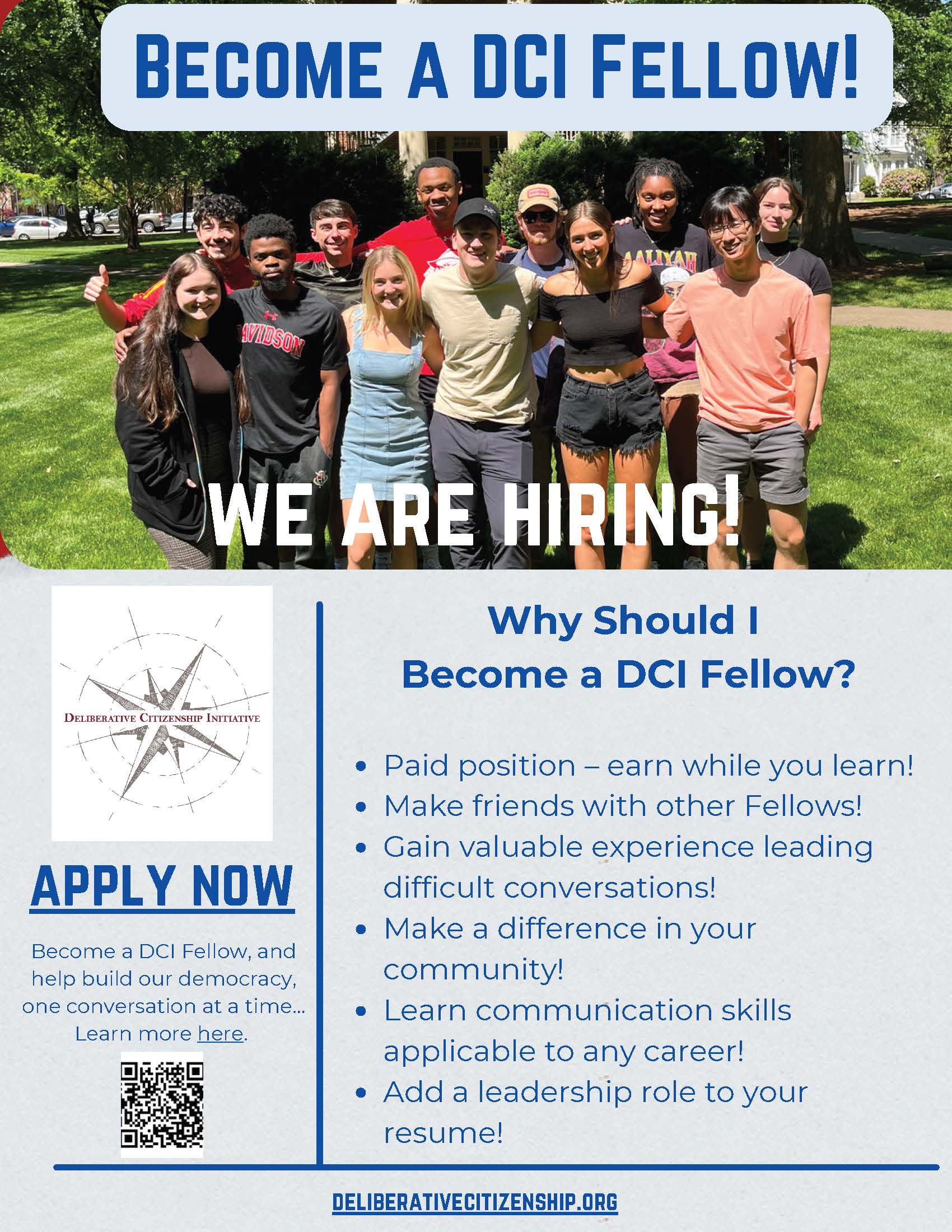
DCI Fellow Sign-Up Flyer.

Davidson students, the DCI is hiring! Apply to be a paid DCI Fellow for the 2023-24 academic year — earn while you learn, make friends with other Fellows, and gain valuable experience leading difficult conversations. You’ll also make a difference in your community, learn important communication skills applicable to any career, and be able to add a leadership role to your resume.

The purpose of the Deliberative Citizenship Initiative (DCI) is to create opportunities for Davidson students, faculty, staff, and members of the community to productively engage with one another on difficult and contentious issues facing our community and society. The Fellows Program offers interested Davidson students academic-year positions working with the DCI.

The DCI will select 12-15 students to work as Fellows for the 2023-2024 academic year. Fellows will meet weekly as a group with the DCI Faculty Director and Assistant Director to work towards achieving the DCI’s mission and goals – to teach deliberative skills, reinforce humane instincts, build meaningful community, catalyze creative solutions, and research deliberation. Fellows will also meet monthly with their Deliberative “D” Teams, small groups of 5-10 individuals who commit to engaging with one another on difficult issues.

Throughout the year, Fellows will immerse themselves in deliberative theory and methods by completing weekly curriculum assignments, deliberating among themselves, facilitating robust deliberations during D Team meetings and deliberative forums, learning from deliberative guest speakers, completing an individual deliberation project, and writing blog posts and reflections that document their experience. Fellows will also contribute to the planning of DCI programs by assisting with research, community engagement, and deliberation guide development. Fellows also play a leadership role in the DCI by serving as deliberative ambassadors demonstrating the skills of deliberation on campus and in the communities and organizations they are a part of.

In this age of intense feelings, rapid change, and hyper-polarization, Fellows will have the opportunity to contribute to the urgent and important work of bringing people together to explore how and why their perspectives are both similar and different – and begin building common solutions to our collective challenges. In the process, they will also enhance their ability to reason, engage in “good argument,” articulate their values, and help others do the same. These are life-long skills that will benefit fellows in their personal lives, in the classroom, and in their careers after Davidson. The ability to bring people together to tackle difficult challenges is in high demand across sectors, professions, and industries, and DCI Fellows will improve their capacity to do this critical work in a wide variety of settings.  

Program Components

The DCI Fellows program requires a commitment to learning about and doing deliberation. It empowers participants with new skills and knowledge to build community and promote more productive public discourse through deliberation. Key activities include:

  • Orientation – Fellows are required to complete an 8-hour deliberation facilitator training and orientation program in September.
  • Fellows Cohort Meetings – Fellows will meet as a group once a week during the Tuesday Common Hour to discuss deliberative topics covered in assigned readings, videos, and other materials, to debrief about their facilitation experiences, to plan DCI activities, and to deliberate as a group on important topics. Fellows will also serve on different committees focused on DCI goals and will provide committee updates and ideas during cohort meetings.
  • D Teams – Fellows will facilitate monthly Deliberative “D” Teams, which consist of 5-10 students, faculty, staff, alumni, and community members who are interested in engaging with one another over multiple sessions to discuss difficult issues. D Teams may meet both in-person or virtually.
  • Deliberative Forums and Other Events – Fellows will play key leadership roles in the DCI’s Deliberative Forums and other public events. These events enable one-time discussion and learning opportunities for students, faculty, staff, and community members and may be conducted in partnerships with other groups and organizations. The DCI hosts 1-2 deliberative events per semester.
  • Reflections and Blog Posts– Each Fellow will contribute one post per semester to the DCI Blog. Fellows will also be asked to reflect and write about their experiences throughout the year with the aim of informing the DCI about what worked well, what did not work well, and specific insights or takeaways, new ideas, and suggestions for program development.
  • Personal Deliberation Project– Fellows will organize, host, and facilitate a deliberative event that connects to their personal interests, exposes participants to the deliberation process, and builds Fellows’ capacity to conduct deliberative activities after they have completed the DCI Fellowship program.

Time Commitment and Compensation

Individuals can expect to commit approximately 5 hours every week to their work as a DCI Fellow. These hours may vary depending on the timing of scheduled events and activities. Fellows must be available for a 1-hour weekly cohort meeting during the Tuesday Common Hour and a 10-hour orientation and facilitation training at the start of the semester – 12:30 pm to 5:30 pm on September 10 and September 16 (including lunch both days). Per Davidson College’s Human Resources policies and guidance, Fellows will be compensated as follows: Fellows will be employed with the DCI as student workers to receive hourly compensation at a rate of $12.00 per hour, with maximum annual earnings of $1,800.

Eligibility

All students are eligible to apply on WildcatSync to become a 2023-2024 DCI Fellow. Approximately 12-15 students will be selected. Students in a work study program are eligible to apply their funding towards a job as a DCI Fellow. Davidson students who are part of scholarship and service programs such as the Bonner Scholars program may be able to apply their DCI Fellows experience towards program service hour requirements in lieu of compensation. Students should check with their respective program directors.

Deadline/How to Apply

To submit your application, please complete the ‘Deliberative Citizenship Initiative – Fellows Application’ form on WildcatSync. The priority application deadline is June 30. However, applications will remain open and new submissions accepted on a rolling basis until August 4th or once all positions have been filled by qualified candidates. Click here to access WildcatSync and complete your application. If you have any questions about your application, please email dci@davidson.edu.

Filed Under: Events Tagged With: facilitation

Registration for Upcoming Deliberative Forum on Social Media is Open!

March 15, 2023 by Graham Bullock

Image of Social Media: How should we engage and/or regulate it, if at all.

With Elon Musk’s recent acquisition of Twitter, the Supreme Court’s upcoming rulings on two cases (Gonzalez v. Google and Twitter v. Taameh) related to online content, and continuing concerns about the effects of online interactions on the mental health of teenagers in the news, questions about the role of social media in our lives have never been more salient. These questions exist at both the micro-level of personal decisions and interactions and the macro-level of society, politics, and democracy. Should we be on social media? Should we regulate it? If so, how and to what extent? Some argue that social media is generally positive for both individuals and society, while others assert that its harms far outweigh its benefits – at least as it currently operates.

To explore these questions, Davidson College’s Deliberative Citizenship Initiative, Digital Studies, Political Science, and Psychology Departments, and Jay Hurt Hub for Innovation and Entrepreneurship invite you to join us for a Deliberative Forum on “Social Media: How Should We Engage and/or Regulate it, If at All?” This Deliberative Forum will enable participants to actively engage with this important issue, first by hearing from an online panel of experts with diverse perspectives on the topic, and then by actively deliberating with one another in facilitated small group discussions (either in person or virtually) on how best to engage with and regulate social media (if at all). This is a fantastic opportunity to learn from experts, listen to the viewpoints of others, and share your own ideas about this challenging and complex topic.

The event is free but registration is required. We request that all registrants plan to attend both the panel and the small group discussions, which are designed to complement each other. Participants may join both in-person and online. Spaces are limited due to the number of trained DCI facilitators we have available to moderate the small group discussions. You may be placed on a waitlist if our capacity is reached; we will let you know if spaces open up. We will do our best to accommodate as many people as we can so please don’t hesitate to get on the waitlist. The Zoom link will be sent to online participants after they register.

Register on EventBrite
Social-Media-Forum-Poster_4.5.23

Panelist Bios:

Emily Dreyfuss is a journalist who covers the impacts of technology on society, with a focus on social media and information systems. She was a 2018 Nieman Berkman Klein fellow, a senior editor at WIRED and CNET, and a founding editor of the tech news website Protocol. Ms. Dreyfuss is currently Senior Editor and Research Fellow at the Harvard Kennedy School’s Technology and Social Change Project, where she co-leads the Harvard Shorenstein News Leaders Program and edits the Media Manipulation Casebook, a research platform that advances knowledge of misinformation and its threats to democracy, public health, and security. Ms. Dreyfuss is also a co-author of the 2022 book, Meme Wars: The Untold Story of the Online Battles Upending Democracy in America.

Melissa Hunt is the Associate Director of Clinical Training in the Department of Psychology at the University of Pennsylvania, where she also earned her PhD in psychology. Dr. Hunt conducts ongoing research on the cognitive and affective bases of depression, anxiety, and chronic gastrointestinal disorders, and has published two books on these topics for both patients and clinicians. In 2018, Dr. Hunt published the first experimental study on Facebook, Snapchat, and Instagram use, and found a causal link between time spent on these platforms and increased loneliness and depression. The study, “No More FOMO: Limiting Social Media Decreases Loneliness and Depression,” was published in the Journal of Social and Clinical Psychology and has been cited over 700 times.

Darius Kazemi is an internet artist and researcher who has been working on federated, decentralized social media since his Mozilla Open Web Fellowship in 2018. He maintains several federated social media software projects including Hometown, and published Run Your Own Social, a guide to hosting a small social media site for your friends. He is a Senior Software Engineer at Meedan where he works on Check, a software tool for content moderators and fact-checkers. He has been interviewed by The Wall Street Journal and The New York Times about the difficulty of identifying bot accounts on social media, and The Boston Globe has described him as “one of the most closely watched and pioneering figures at the intersection of technology, cultural commentary, and what feels to many like a new kind of Web-native art.”

Jacob Mchangama is CEO of the think tank Justitia and directs the organization´s Future of Free Speech Project. Jacob has written and commented extensively on free speech and human rights in international media outlets, including the Economist, L.A. Times, Washington Post, BBC, CBS News, NPR, CNN, Foreign Affairs, Foreign Policy, The Wall Street Journal, and Politico as well as top-tier academic and peer-reviewed journals. Jacob frequently appears on international TV and radio providing expert commentary on issues related to free speech, tech and human rights. Jacob is the producer and narrator of the podcast “Clear and Present” Danger: A History of Free Speech and author of the critically acclaimed book Free Speech: A History From Socrates to Social Media, published by Basic Books in 2022.

Mark Sample, Chair and Professor of Digital Studies at Davidson College, will serve as the moderator of the panel.

Filed Under: Events

  • « Go to Previous Page
  • Page 1
  • Interim pages omitted …
  • Page 17
  • Page 18
  • Page 19
  • Page 20
  • Page 21
  • Page 22
  • Go to Next Page »

Footer

Blog Post Categories

  • Announcements
  • Blog Posts
  • DCI Posts
  • Events
  • Faculty Posts
  • Fellow Posts
Image of a compass superimposed by the text "Deliberative Citizenship Initiative" and "Davidson College." Clicking on this image leads to the Initiative page.

Recent DCI Blog Posts

  • We Tried to Fix Jubilee’s “Middle Ground” – Here’s How It Went
  • A Case for Deliberation in the Natural Sciences
  • Welcoming New Staff to the DCI and DCN
  • Facebook
  • Twitter
  • Instagram
  • LinkedIn


Copyright © 2026 · Infinity Pro on Genesis Framework · WordPress · Log in