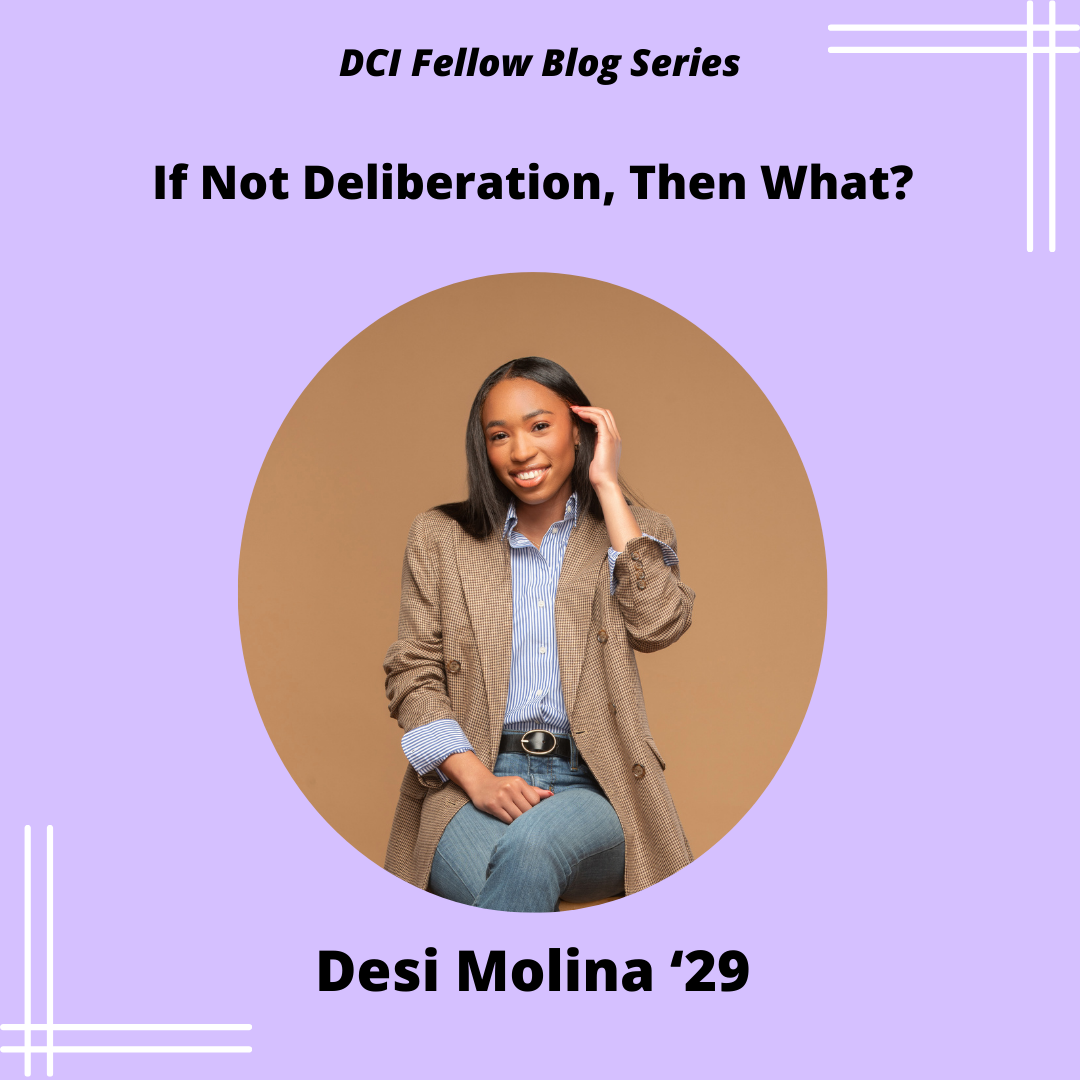
By Desi Molina ’29 (DCI Fellow)
Growing up in such a divisive political environment, misinformation and polarization feel like a new normal. As a college student stepping into this landscape, being tasked with fixing a world that feels unmendable, I often find myself wondering what’s the point of debating or talking across the aisle, when no one seems to listen? The art of true deliberation, and the willingness to participate in it, feels almost lost.
In DCI, we’ve been reading Why We Argue by Robert Talisse and Scott Aikin, a book that has discussed why argument isn’t just inevitable but essential in free society. One discussion we had on this book was led by Professor Layman of the Philosophy Department. As someone who has always found philosophy to be both fascinating and frustrating – circles of endless questions and no definitive answers – I wasn’t sure what I’d make of this conversation. During the discussion I very predictably found myself moving back and forth between perspectives, firm in one belief, then agreeing with the opposite moments later.
Despite the conversation proving to be a bit dizzying for me, the end of it left me with a question that is still echoing in my head: if not argumentation or deliberation, then what else can we resort to?
This question has in part reshaped the way I think about deliberation. As exhausting and sometimes disheartening discourse can be, the alternative can be much worse. Without argument, humans lose the ability to challenge our own assumptions, build understanding with those we may differ from, or even coexist peacefully. Deliberation may not always lead to neat conclusions or universal agreement, but it keeps us human.
I think framing deliberation around this question is what our society needs right now. While there are many reasons why one may not want to deliberate with their peers, it’s important to keep in mind that if we don’t deliberate, what else is there? Deliberating through discomfort is a sign of love, as Dr. Bullock would say. It shows that you’re willing to wrestle with complexity instead of retreating into simplicity and polarization. In a time when shouting matches often replace meaningful conversations, choosing to deliberate, listen, question, and reflect is itself an act of hope. While entering this polarized world still feels daunting to me, I’ve come to understand the necessity of deliberation within it. If not deliberation, then what else must we resort to?