• Skip to main content
  • Skip to footer

Deliberative Citizenship Initiative

Building Democracy One Conversation at a Time

  • The Initiative
    • Programs
      • Deliberation Across the Curriculum
      • Deliberation on Campus
      • Deliberation in the Community
      • Research on Deliberation
    • Motivations
      • Why Deliberative Citizenship?
      • Why Davidson? Why Now?
    • Who’s Involved?
      • DCI Fellows Cohorts
        • 2025-2026 Fellows
        • 2024-2025 Fellows
        • 2023-2024 Fellows
        • 2022-2023 Fellows
        • 2021-2022 Fellows
        • 2020-2021 Fellows
      • DeeP Collaborative Cohorts
        • 2024-2025 DeeP Collaborative Faculty
        • 2023-2024 DeeP Collaborative Faculty
      • Advisory Council
    • History
      • What Sparked the Initiative?
    • Key Deliberative Dispositions
    • Frequently Asked Questions (FAQ)
    • Annual Report
  • Get Involved!
    • Participate in a Forum
    • Join a D Team
    • Become a Fellow
    • Take Courses
    • Get Training
    • Come to Guest Lectures
  • Events
    • Upcoming Events
      • 250th Anniversary Deliberative Forum Series on American Values
    • Past Events
  • Connections
    • The Deliberative Citizen: The DCI’s Monthly Newsletter
    • Efforts on Campus
    • Efforts in the Community
    • Efforts Elsewhere
    • Readings and Resources
      • DCI-Published Guides
      • DCI Guide to One-on-One Conversations
      • How to Disagree
      • Demonstration of Facilitation Styles
      • Deliberative Pedagogy Mini-Course
    • How We Can Help: DCI’s LET’S DELIBERATE! Partnership Opportunities
    • DCI in the News
  • DCI Blog Posts
    • Recent Blog Posts
    • All Blog Posts

Deliberative Pedagogy

The DCI’s Fourth Deliberative Pedagogy Faculty Panel

Faculty members with wide range of backgrounds and expertise have participated in the DCI’s Deliberative Pedagogy (DeeP) Collaborative, and this diversity was highlighted in our recent DeeP Faculty Panel and Lunch. Professors who have embedded deliberation on difficult topics in courses on contemporary economic issues, sports communication, the philosophy of love and sex, and race on film all shared their deliberative pedagogy approaches and discussed both their successes and where they want to continue to improve in the future.

On Thursday, March 20 from 11:05 am to 12:15 pm, Professors Maggie McCarthy (German Studies, Davidson College), Rebecca Alt (Communications, Lenoir-Rhyne College), Rebecca Harrison (Philosophy, Vassar College), and Shyam Gouri Suresh (Economics, Davidson College) shared their work as members of the Deliberative Pedagogy (DeeP) Collaborative. Over 60 faculty members from 18 different institutions have participated in the Collaborative, which enables professors from across the humanities, natural sciences, and social sciences to work together on developing and implementing innovative ways to stimulate deeper discussions in their courses. 
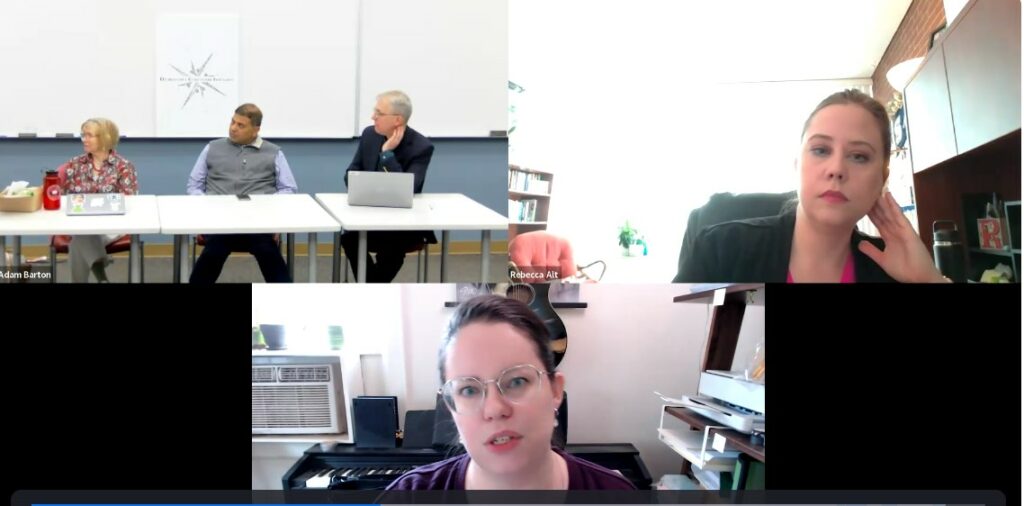
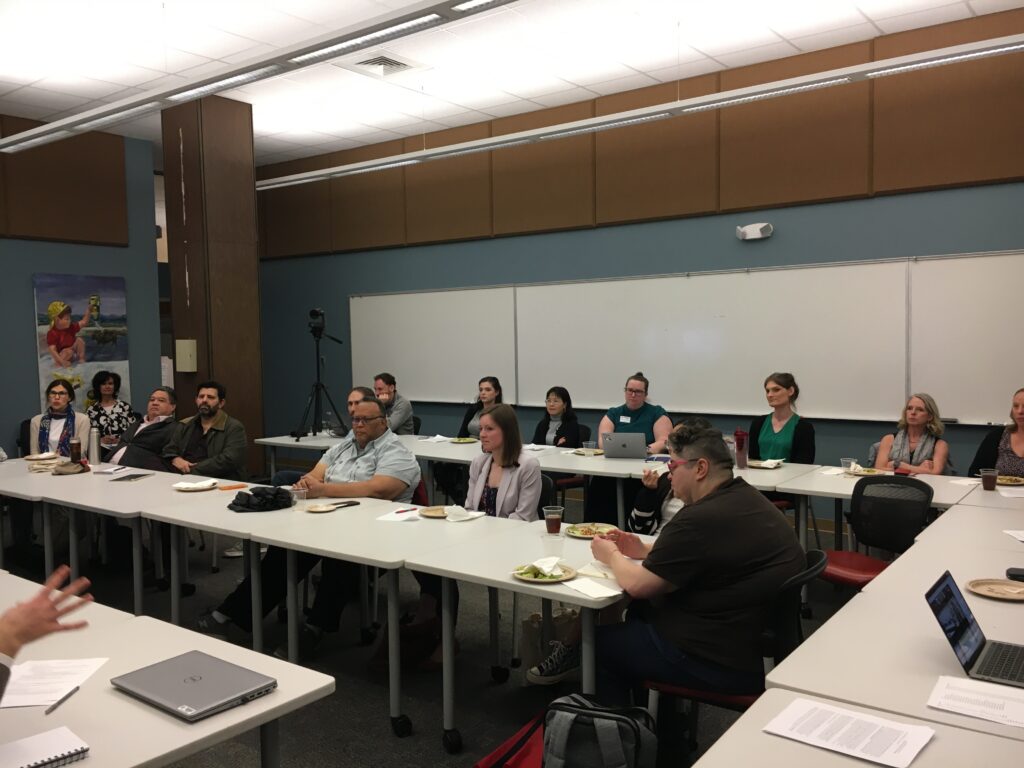
photo of in-person and virtual panelists

Nearly 40 people (22 online and 15 in-person) attended the panel and were able to ask questions of the panelists about their courses. You can watch the video below of the panel discussion moderated by Professor Graham Bullock, Faculty Director of the DCI. To learn more about the Deliberative Pedagogy Collaborative, the DCI’s Deliberation Across the Curriculum Program, and the upcoming panel, check out the attached flyer, this webpage, and these blog posts by faculty members who have participated in the Collaborative over the past two years.

You can start with these blog posts by the four faculty members who participated in this panel discussion:

Deliberative Discussions in Class “Bridge the Gap between Film and Reality”

Maggie McCarthy, Davidson College

Deliberative Discussions in Class “Bridge the Gap between Film and Reality”

From Skeptic to Advocate: The Power of Deliberation in Economics Education

Shyam Gouri Suresh

From Skeptic to Advocate: The Power of Deliberation in Economics Education

From “Small Group Discussions” to Micro-Deliberations: Transforming Everyday Student-Centered Discussion

Rebecca Harrison,  Vassar College

From “Small Group Discussions” to Micro-Deliberations: Transforming Everyday Student-Centered Discussion

Tackling Difficult Conversations in the Classroom: Sport as a Barrier-Breaker

Rebecca Alt, Lenoir-Rhyne University
Tackling Difficult Conversations in the Classroom: Sport as a Barrier-Breaker

Deliberative Pedagogy in Action: Highlights from the Annual DeeP Collaborative Workshop

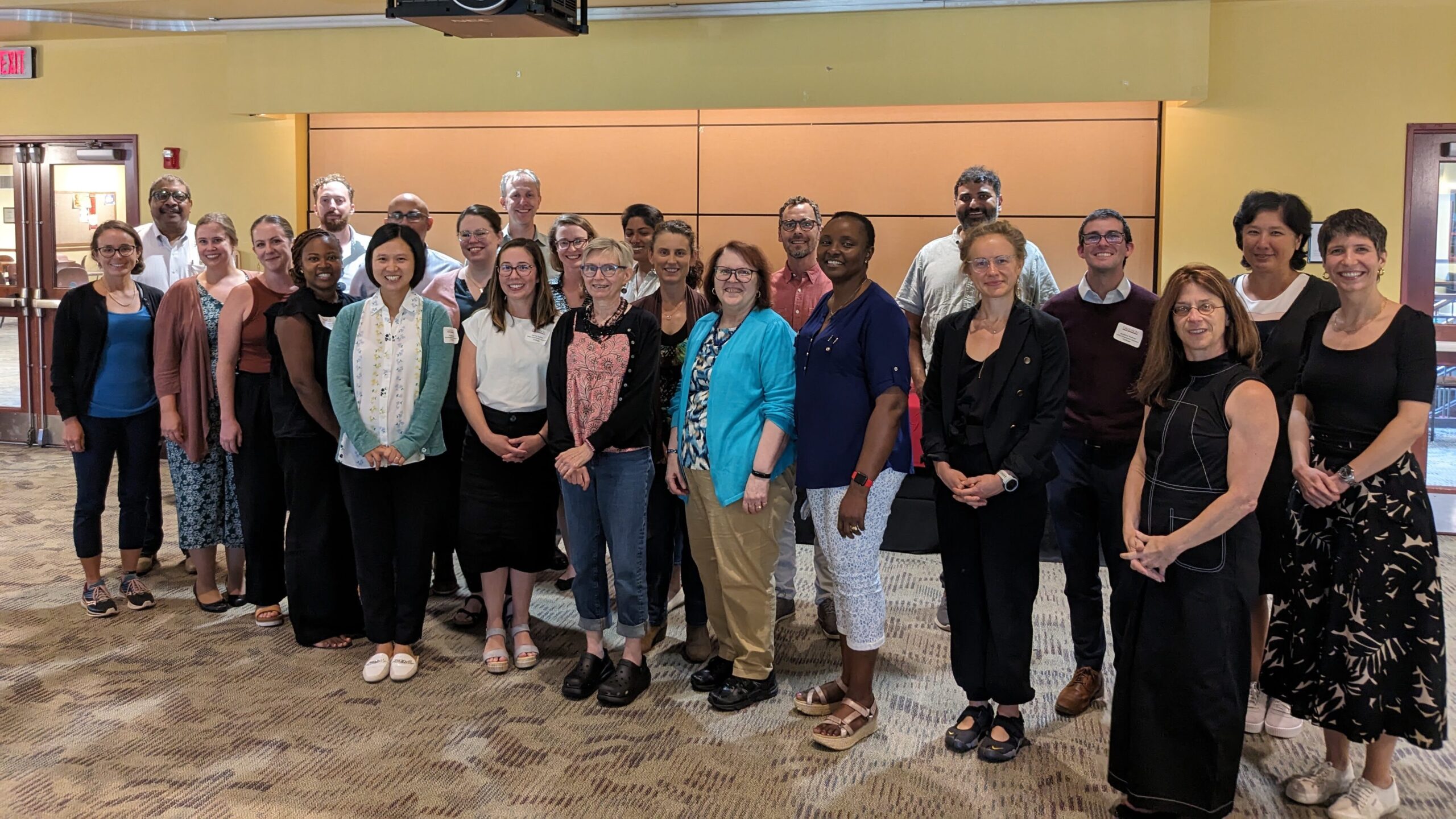
On August 8th, we kicked off our fourth installment of the Deliberative Pedagogy (DeeP) Faculty Collaborative with our annual DeeP Collaborative Orientation Workshop. This year’s cohort brings together 18 new faculty collaborators who specialize in over 13 different academic disciplines, including anthropology, biology, communication studies, economics and business, health sciences, Hispanic studies, history, mathematics, natural sciences, political science, psychology, sociology, and writing.

They also come from 14 different institutions, including Colorado College, Davidson College, Denison University, Drexel University, Furman University, Hendrix College, Johnson C. Smith University, North Carolina A&T State University, Rhodes College, Rollins College, Sewanee: The University of the South, The University of Texas at San Antonio, Western Carolina University, and Wingate University.

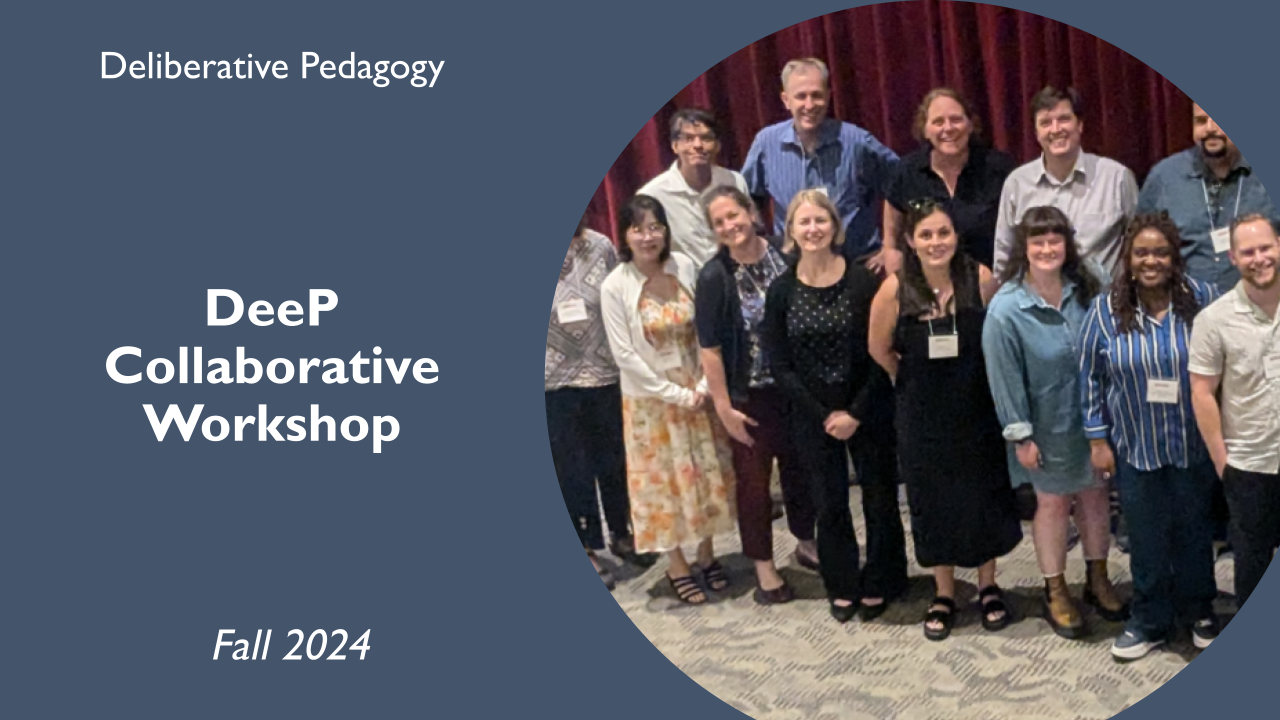
The goals of this workshop were to introduce our new Collaborative members to the key principles and practices of deliberative pedagogy, to build community among the cohort members—who will be working together over the coming academic year—and to begin mapping out their goals for the fall semester, during which they will explore how they will apply deliberative pedagogy to their future courses.

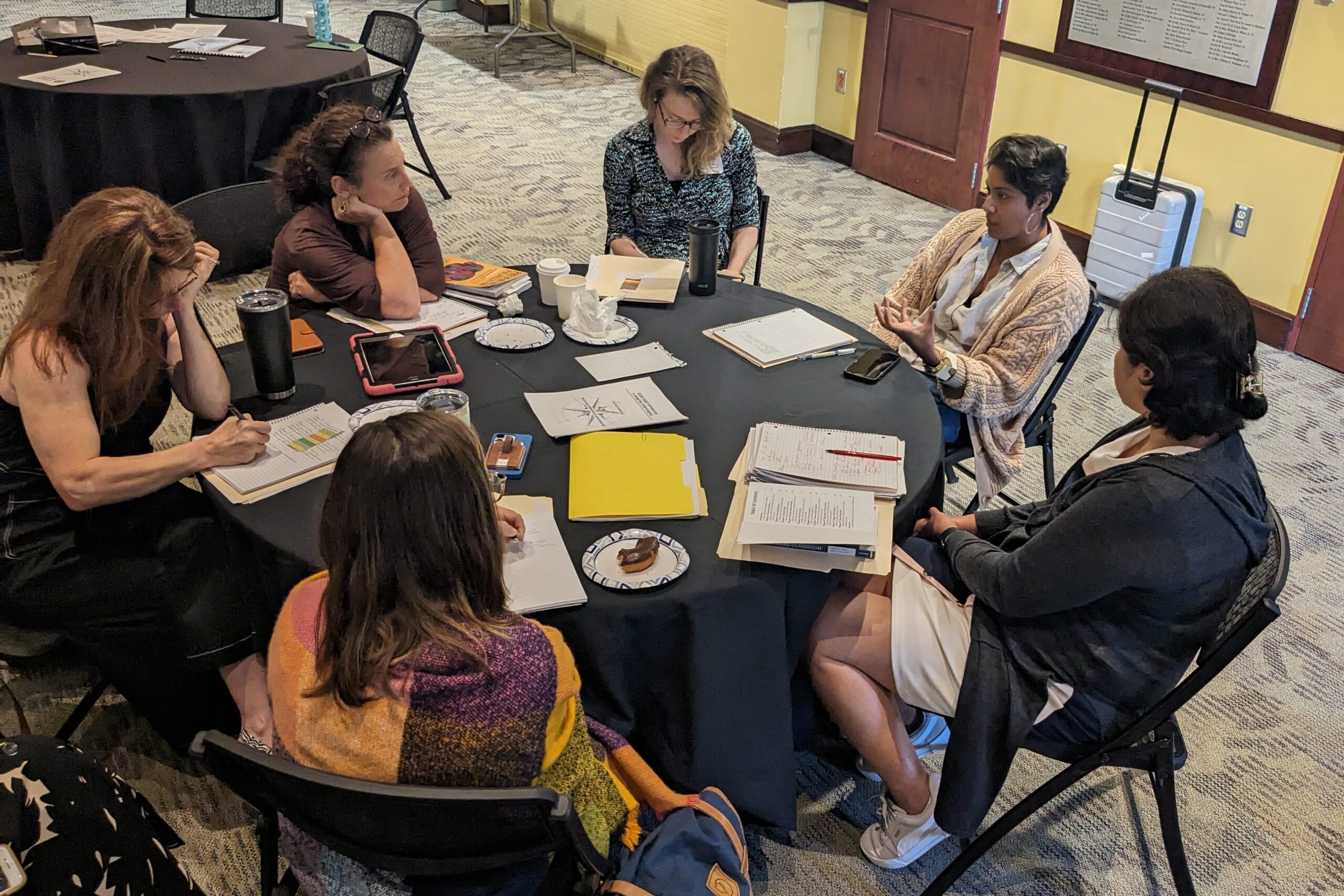
DCI Faculty Director Dr. Graham Bullock led the workshop, using both active learning and deliberative strategies to introduce the motivations for using deliberative pedagogy practices, the most relevant concepts and frameworks, specific deliberative teaching methods and tools, and case studies of deliberation-involved courses.

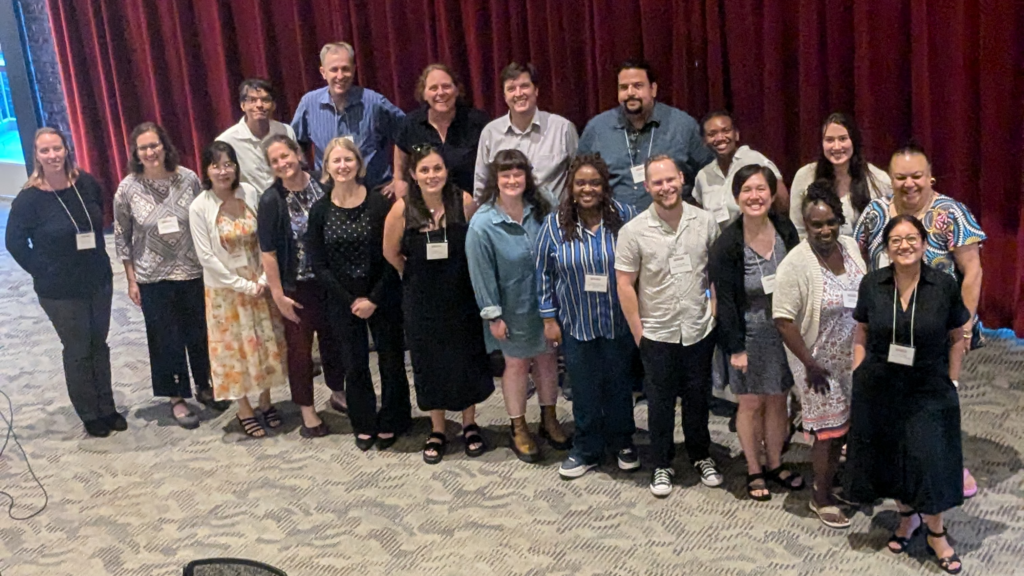
group photo of faculty.

What is deliberative pedagogy? In short, deliberative pedagogy is a teaching practice that involves the use of structured deliberative activities to teach learners how to express different viewpoints about an issue or approaches to a problem, how to evaluate these viewpoints or approaches critically, and how to identify both areas of agreement and disagreement through the course of their deliberative discussions.

The key to practicing deliberative pedagogy well is to setup deliberations in the classroom so that they include multiple viewpoints on the issue at hand, allow all voices to be heard, and promote the assessment of arguments for and against the variety of viewpoints on the table. One way to do so is by introducing conversation agreements, or ground rules for good discursive practices. Another way is to have a facilitator present who can ensure the deliberation represents multiple viewpoints and voices. (Want to learn how to become a trained facilitator for deliberative events in OR out of the classroom? Learn more about our upcoming Deliberation Facilitator Training Program here!)

Deliberative pedagogy is also connected to the concept of deliberative democracy, a type of democratic engagement in which reason-giving – broadly-defined – is used as a means for citizens to make progress on practical issues facing their community.

Some of the lively discussions among our faculty cohort members focused on how deliberative pedagogy can be employed beyond courses that focus explicitly on public policy, including courses in the arts and the sciences. Groups also discussed how deliberative pedagogy can be a form of inclusive pedagogy and how faculty can navigate the apparent tension between affirming our lived experiences as individuals while assessing reasons for and against policy decisions that impact those experiences.

Others discussed whether or in what circumstances instructors should remain neutral during debates about normative issues that do not have straightforward answers and about which there can be reasonable disagreement among deliberators. None of these questions have easy answers, but we look forward to diving deeper with our ’24-’25 DeeP Collaborative cohort on these and other important topics in the coming year. Look out for blog posts from this year’s participants next year, once they have begun applying what they have taken from our interactive learning sessions in the fall to their various teaching contexts.

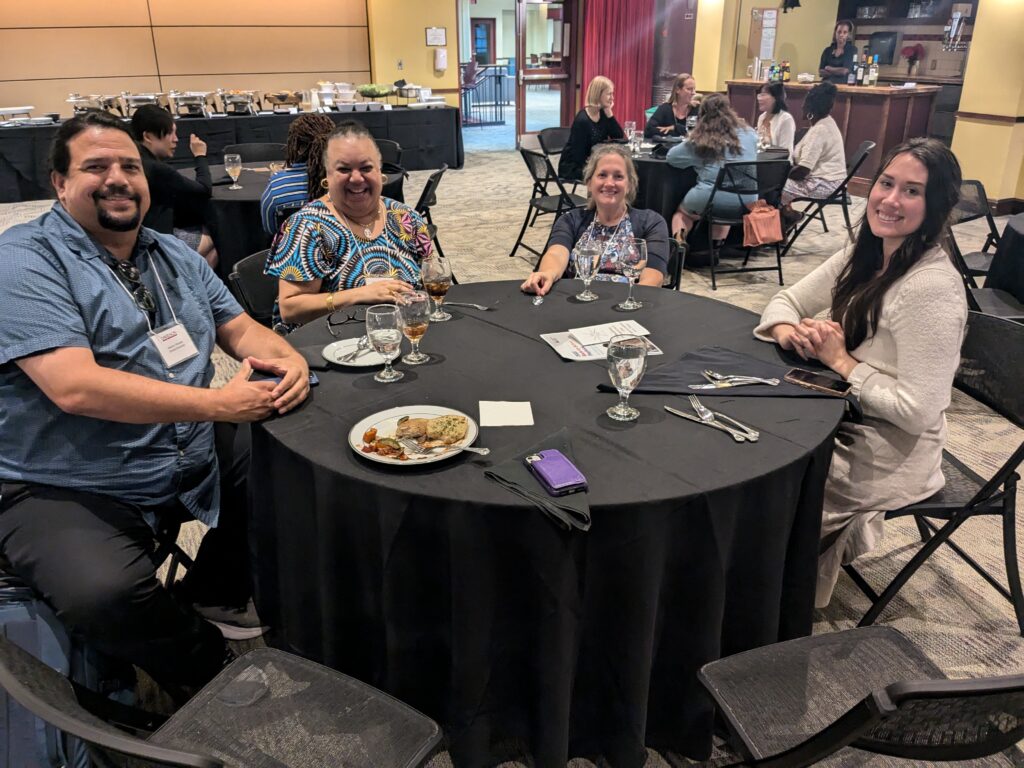
table of faculty

Bridging Theory and Practice: Reflections from the Fall DeeP Collaborative Panel

On Friday, September 27, an engaged group of 20 faculty members, professional staff, and community members from various universities and colleges gathered for the Fall 2024 DeeP Collaborative Panel to explore the integration of deliberation into higher education classrooms. Professors Jason Blum (Davidson), Yingling Liu (North Central College), and Mindy Adnot (UNC Charlotte) shared their insights and experiences as part of the Deliberative Pedagogy (DeeP) Collaborative. 

These educators are not only experts in their fields—Writing, Sociology, and Honors Program Leadership—but they also bring a wealth of experience in fostering discussions around complex topics in their classrooms. Each panelist discussed their unique approaches in courses such as Religion in the Public Square, Introduction to Sociology, and Labor, Leisure, Learning, and a Good Life.

To start off the event, Graham Bullock, Faculty Director of the Deliberative Citizenship Initiative, provided a brief overview of what constitutes a “deliberative classroom.” Attendees also engaged in discussions on how to implement these strategies in their own teaching practices.

Here is what our panelists had to say about their involvement in the DeeP Collaborative: 

“[The] DeeP Collaborative is really great for bringing new stuff into the classroom.  No matter where you are, in disciplinary terms, I think it can be super useful.” – Jason Blum

“The training, the reading, the materials were great, the cohort, and the exposure to other people’s pedagogical ideas and innovations. It was all wonderful.”  – Mindy Adnot

“I will say my experience was very rewarding and given that I wasn’t sure  how it was going to play out with my school situation. I think it all worked out well. I would definitely recommend to others.”  – Yingling Liu

Are you a faculty or professional staff member eager to enhance deliberative practices within your courses? We invite you to explore our DeeP Collaborative program, designed to empower educators like you to cultivate meaningful discussions and engagement among students. This is a fantastic opportunity to deepen your skills and transform your teaching methods. Be sure to keep an eye out for next year’s application process; we would love to have you join us in this initiative. Your involvement can play a crucial role in fostering a more interactive and thoughtful learning environment that benefits both you and your students.

Due to inclement weather associated with Hurricane Helene, the panel was held online over Zoom. You are welcome to check out the recording of the event below.

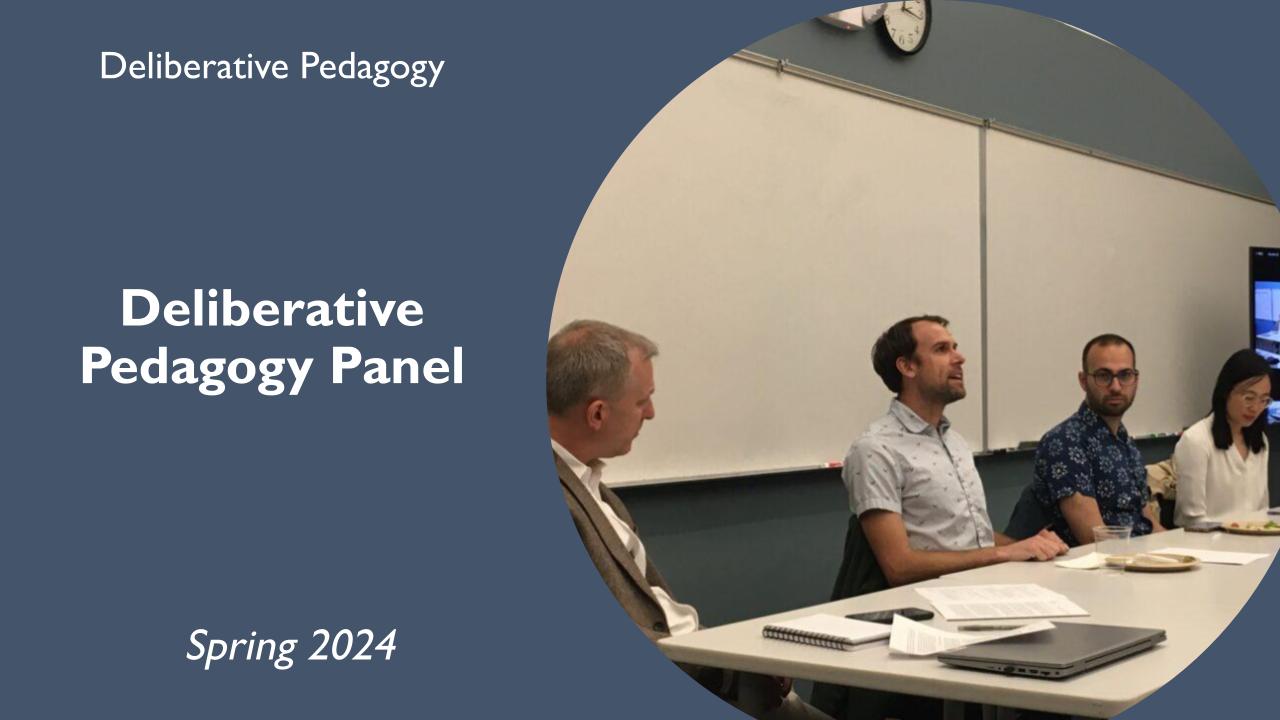
Deliberative Pedagogy Panel (Spring 2024)

On Friday, March 15th, faculty from Davidson and beyond gathered to learn from Professors Emily Sydnor (Political Science, Southwestern University), Rachel Pang (Religious Studies, Davidson College), Bassil El-Zaatari (Chemistry, Davidson College), and Anthony Kuchera (Physics, Davidson College) about how to integrate deliberative practices into their classrooms over lunch. The panelists spoke about best practices for hosting deliberations in the classroom, facilitating deliberation, providing feedback, and the improved learning outcomes they found in the courses where they had started to practice deliberative pedagogy.

For example, Professor El-Zaatari encouraged STEM faculty not to shy away from deliberative pedagogy in their courses. And Professor Pang spoke about increased student engagement and how students felt an increased sense of ownership over the course in her deliberative religious studies course. All in all, participants walked away with new knowledge about how to update their teaching practice with deliberative practices.

The event highlighted the work that all four professors did as members of the DCI’s Deliberative Pedagogy (DeeP) Collaborative, which is a year-long, paid fellowship program that helps faculty embed deliberation about contentious topics into their courses related to their content. Attendees of the panel and lunch learned about how professors from very different disciplines can update their teaching practice with deliberative practices.

Graham Bullock, Faculty Director of the DCI, moderated the panel and announced that the applications to join the 2024-25 cohort of the Deliberative Pedagogy (DeeP) Collaborative are now being accepted. Review of applications will begin on April 22 and will continue until all positions are filled. If participating in the Collaborative sounds intriguing to you, learn more and apply to be a Faculty Fellow in next year’s Deliberative Pedagogy (DeeP) Collaborative here.

You can learn more about the Collaborative and hear what the panelists had to say yourself by checking out our recording of the panel discussion below…

Deepening Class Discussion: This Year’s DeeP Collaborative Orientation Workshop

On August 10th, we kicked off our third installment of the Deliberative Pedagogy (DeeP) Faculty Collaborative with our annual DeeP Collaborative Orientation Workshop. This year’s cohort brings together 22 new faculty collaborators – a record number – who specialize in over 15 different academic disciplines, including anthropology, biology, business administration, communication studies, dance, economics, education, English, environmental studies, German studies, philosophy, political science, public health, peace and conflict studies, and sociology.

They also come from 13 different institutions, including Alamance Community College, Birmingham Southern College, Davidson College, Guilford College, Hendrix College, Lenoir-Rhyne University, Macalester College, Rollins College, Sewanee: The University of the South, Spelman College, Swarthmore College, UNC Charlotte, and Vassar College.

The goals of this workshop were to introduce our new Collaborative members to the key principles and practices of deliberative pedagogy, to build community among the cohort members—who will be working together over the coming academic year—and to begin mapping out their goals for the fall semester, during which they will explore how they will apply deliberative pedagogy to their future courses.

DCI Faculty Director Dr. Graham Bullock led the workshop, using both active learning and deliberative strategies to introduce the motivations for using deliberative pedagogy practices, the most relevant concepts and frameworks, specific deliberative teaching methods and tools, and case studies of deliberation-involved courses.

What is deliberative pedagogy? In short, deliberative pedagogy is a teaching practice that involves the use of structured deliberative activities to teach learners how to express different viewpoints about an issue or approaches to a problem, how to evaluate these viewpoints or approaches critically, and how to identify both areas of agreement and disagreement through the course of their deliberative discussions.

The key to practicing deliberative pedagogy well is to setup deliberations in the classroom so that they include multiple viewpoints on the issue at hand, allow all voices to be heard, and promote the assessment of arguments for and against the variety of viewpoints on the table. One way to do so is by introducing conversation agreements, or ground rules for good discursive practices. Another way is to have a facilitator present who can ensure the deliberation represents multiple viewpoints and voices. (Want to learn how to become a trained facilitator for deliberative events in OR out of the classroom? Learn more about our upcoming Deliberation Facilitator Training Program here!)

Deliberative pedagogy is also connected to the concept of deliberative democracy, a type of democratic engagement in which reason-giving – broadly-defined – is used as a means for citizens to make progress on practical issues facing their community.

Some of the lively discussions among our faculty cohort members focused on how deliberative pedagogy can be employed beyond courses that focus explicitly on public policy, including courses in the arts and the sciences. Groups also discussed how deliberative pedagogy can be a form of inclusive pedagogy and how faculty can navigate the apparent tension between affirming our lived experiences as individuals while assessing reasons for and against policy decisions that impact those experiences.

Others discussed whether or in what circumstances instructors should remain neutral during debates about normative issues that do not have straightforward answers and about which there can be reasonable disagreement among deliberators. None of these questions have easy answers, but we look forward to diving deeper with our ’23-’24 DeeP Collaborative cohort on these and other important topics in the coming year. Look out for blog posts from this year’s participants in the spring, once they have begun applying what they have taken from our interactive learning sessions in the fall to their various teaching contexts.

Footer

Blog Post Categories

  • Announcements
  • Blog Posts
  • DCI Posts
  • Events
  • Faculty Posts
  • Fellow Posts
Image of a compass superimposed by the text "Deliberative Citizenship Initiative" and "Davidson College." Clicking on this image leads to the Initiative page.

Recent DCI Blog Posts

  • We Tried to Fix Jubilee’s “Middle Ground” – Here’s How It Went
  • A Case for Deliberation in the Natural Sciences
  • Welcoming New Staff to the DCI and DCN
  • Facebook
  • Twitter
  • Instagram
  • LinkedIn


Copyright © 2026 · Infinity Pro on Genesis Framework · WordPress · Log in