• Skip to main content
  • Skip to footer

Deliberative Citizenship Initiative

Building Democracy One Conversation at a Time

  • The Initiative
    • Programs
      • Deliberation Across the Curriculum
      • Deliberation on Campus
      • Deliberation in the Community
      • Research on Deliberation
    • Motivations
      • Why Deliberative Citizenship?
      • Why Davidson? Why Now?
    • Who’s Involved?
      • DCI Fellows Cohorts
        • 2025-2026 Fellows
        • 2024-2025 Fellows
        • 2023-2024 Fellows
        • 2022-2023 Fellows
        • 2021-2022 Fellows
        • 2020-2021 Fellows
      • DeeP Collaborative Cohorts
        • 2024-2025 DeeP Collaborative Faculty
        • 2023-2024 DeeP Collaborative Faculty
      • Advisory Council
    • History
      • What Sparked the Initiative?
    • Key Deliberative Dispositions
    • Frequently Asked Questions (FAQ)
    • Annual Report
  • Get Involved!
    • Participate in a Forum
    • Join a D Team
    • Become a Fellow
    • Take Courses
    • Get Training
    • Come to Guest Lectures
  • Events
    • Upcoming Events
      • 250th Anniversary Deliberative Forum Series on American Values
    • Past Events
  • Connections
    • The Deliberative Citizen: The DCI’s Monthly Newsletter
    • Efforts on Campus
    • Efforts in the Community
    • Efforts Elsewhere
    • Readings and Resources
      • DCI-Published Guides
      • DCI Guide to One-on-One Conversations
      • How to Disagree
      • Demonstration of Facilitation Styles
      • Deliberative Pedagogy Mini-Course
    • How We Can Help: DCI’s LET’S DELIBERATE! Partnership Opportunities
    • DCI in the News
  • DCI Blog Posts
    • Recent Blog Posts
    • All Blog Posts

2021-2022

Democracy and Freedom of Expression: Revitalizing Public Discourse on Campus and Beyond

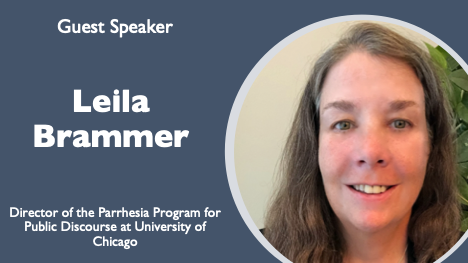
The Deliberative Citizenship Initiative and Davidson College Writing Program sponsored a public lecture, Democracy and Freedom of Expression: Revitalizing Public Discourse on Campus and Beyond, featuring Leila Brammer, Director of the Parrhesia Program for Public Discourse at the University of Chicago on March 22, 2022.


In her remarks, Dr. Brammer addressed how freedom of expression in academic and civic environments recognizes the centrality of multiple perspectives, differences, and disagreements to test and develop the best thinking to address collective challenges. Public discourse today is often critiqued for divisiveness that fails to reflect these foundational practices and leaves many unwilling to enter into essential conversations that should animate a healthy democracy. Dr. Brammer explored how the lens of discourse theory exposes the limits of our current modes of discourse and suggested important ways to reimagine and transform how we engage with one another on campuses and in our communities.
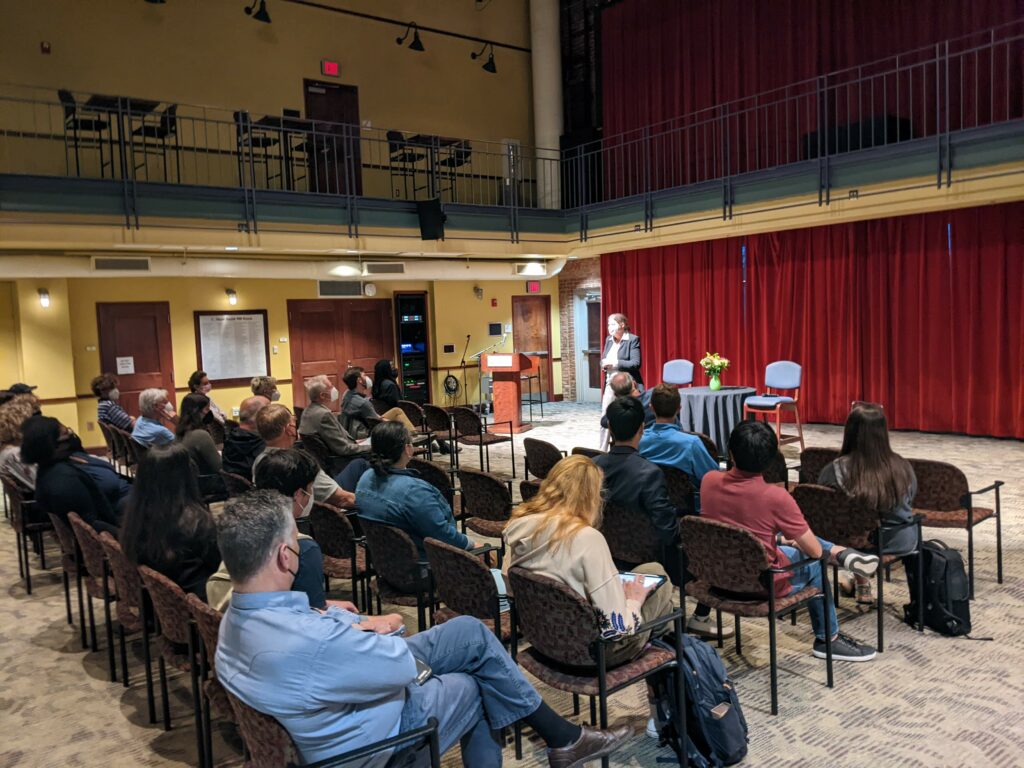
This lecture is part of Davidson College’s “Freedom of Expression Week 2022: Speak. Listen. Learn. Do.”

Dr. Brammer also spoke on Democratic Discourse in the Classroom: Lessons from the University of Chicago’s Parrhesia Program at 4 pm on March 22 on Zoom and in the Davidson Library Open Tutoring Room. In this talk focused on deliberative pedagogy, Dr. Brammer discussed how discourse rests at the nexus of academic inquiry, freedom of expression, democratic practices, and civic education. The testing and refining of ideas necessary for academic and civic inquiry depend on the ability to seek out and engage multiple perspectives, differences, and disagreements. Through an examination and application of discourse theory, this session explored principles and practices to develop student capacities for engaging and facilitating vigorous, inclusive, and productive discourse.
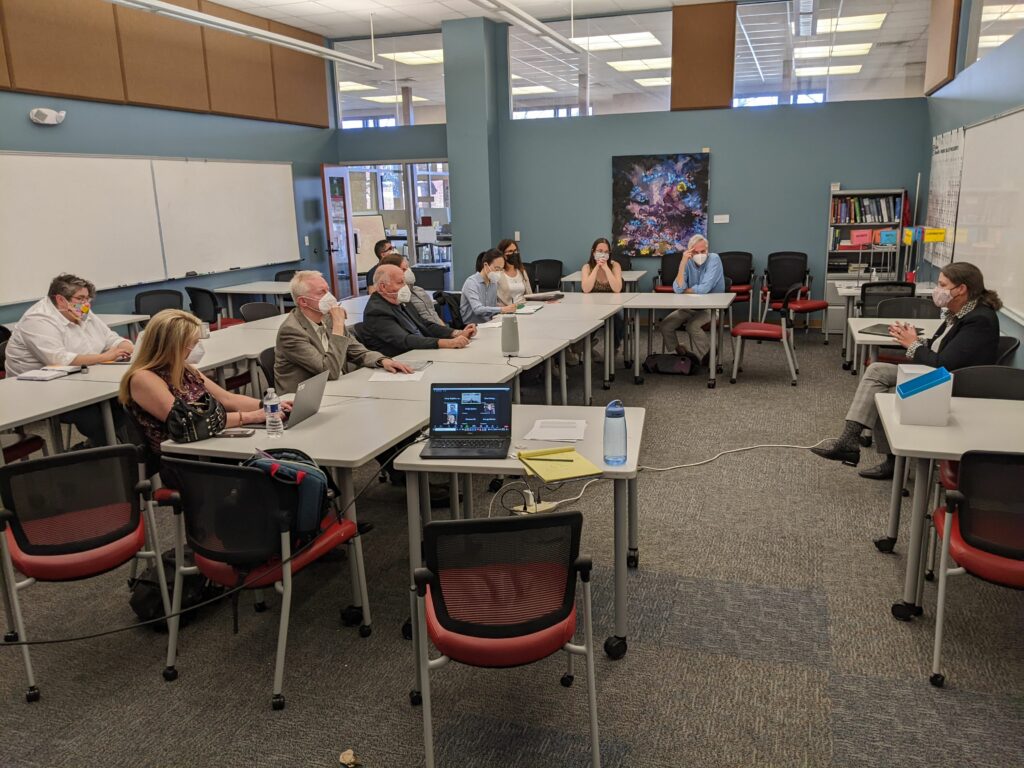
Leila Brammer is the Director of the Parrhesia Program for Public Discourse at the University of Chicago. Rooted in the Chicago Principles of Freedom of Expression, the Parrhesia Program curricula, programming, and outreach seek to foster the capacity for vigorous, inclusive, and productive discourse in the classroom, campus, and civic life. Building on the history and theory of freedom of expression and rhetoric, the curriculum and programming promote and model academic and civic practices of dialogue, deliberation, and advocacy. Outreach efforts include workshops and seminars for college/university and high school faculty and students to explore and embed both the principles and practices of open discourse in curricula, campus life, and surrounding communities.

Previously, Dr. Brammer developed a civic engagement curriculum and public deliberation and dialogue program at Gustavus Adolphus College that were recognized nationally by the American Association of Colleges and Universities and the National Communication Association. In her work in public deliberation and dialogue, Dr. Brammer builds and facilitates frameworks in which community members come to understand problems from multiple perspectives and work together to develop evidence-based approaches to address challenging civic issues.

Economic Mobility Forum

The Davidson College Deliberative Citizenship Initiative, Davidson College Center for Civic Engagement, and North Mecklenburg Economic Mobility Collaborative hosted an online deliberative forum to discuss Economic Mobility: How Can the American Dream Be More Achievable for Everyone? 

Economic-Mobility-Forum-Poster


Check out the deliberation guide below:

DCI Economic Mobility Deliberation Guide

In November 2020, Harvard-based research group Opportunity Insights, led by Professor Raj Chetty, issued a report ranking Mecklenburg County 96th overall among the nation’s 100 largest counties for upward economic mobility. This came after a 2013 study from the same researchers named Charlotte last in economic mobility among the 50 largest metro areas in the United States. Nationally, people across the United States are beginning to question the concept of the American dream as income inequality rises, poverty deepens, and access to education and healthcare opportunities appear unequally distributed.

If the American dream does exist, how might we begin to understand this abstract concept? In our everyday lives, how do we define this idea of economic mobility, and what different ideas have been proposed to make it more achievable for everyone?

This DCI Deliberative Forum enabled participants to explore these important questions, first by hearing from a panel of three leading experts on this issue, and then by actively deliberating with one another in facilitated small group discussions on how best to understand and pursue economic mobility. This was a fantastic opportunity to learn from experts, listen to the perspectives of others, and share ideas about economic mobility.

Panelist Bios:

Sherri Chisholm is the Executive Director of Leading on Opportunity, a local non-profit organization created in 2017 that is dedicated to ensuring that “within a generation every child in Charlotte-Mecklenburg will have an equal chance to achieve social and economic success.” Ms. Chisholm joined the organization in 2020, after serving as the founding Executive Director of Urban Alliance Detroit and founder and CEO of FreeSpace Consulting Group. Holding master’s degrees in education from Harvard University and the Broad Center for the Management of School Systems, Ms. Chisholm has worked as a management consultant and has also held leadership roles with Teach for America, the School District of Palm Beach County, FL, and the Fulton County School System in Metro-Atlanta.

Kieth Cockrell is the President of Bank of America Charlotte and also leads Bank of America’s efforts to leverage its resources to address social and economic concerns, build strong communities, and support the health and safety of its employees. He has worked at Bank of America for 28 years in leadership positions related to consumer and small business services, global technology and operations, and customer service. Mr. Cockrell has also served as vice chair of the bank’s Global Diversity and Inclusion (D&I) Council and received two D&I awards within the company. A current member of Davidson College’s Board of Visitors, he has also been an active community leader and has served on the boards of multiple local organizations, including My Brothers Keeper (Charlotte-Mecklenburg), the Charlotte Regional Business Alliance, and the United Way.

Patrick Garry is a professor at the University of South Dakota’s School of Law and Director of the Hagemann Center for Legal & Public Policy Research. The author of over 40 scholarly articles and 22 books, Professor Garry has spoken and published extensively on poverty, limited government, and conservatism, including his books, The False Promise of Big Government: How Washington Helps the Rich and Hurts the Poor and Conservatism Redefined: A Creed for the Poor and Disadvantaged, and his essays, “Conservatism and the Real Problems of Income Inequality” and “Education as the Key to Opportunity and Upward Mobility.” Dr. Garry has also served as a visiting scholar at Columbia University’s School of Law and earned his JD and PhD from the University of Minnesota.

Free Speech and Inclusion Forum

Free Speech and Inclusion Forum Slide.

On Nov. 4, 2021, The Deliberative Citizenship Initiative (DCI) hosted an online Deliberative Forum to discuss Free Speech and Inclusion: Are They in Conflict or Are They Complementary? How Should They Be Effectively Supported on College Campuses? This event included both an expert panel (moderated by Professor Dan Layman) and small group discussions (moderated by our trained DCI facilitators).


Check out the Event Deliberation Guide below:

Free Speech a

Campus communities today seek both free speech and inclusion for their members. Some believe that promoting freedom of expression and practicing inclusivity are reconcilable goals; others assert they are inherently in conflict. On one side of this debate are those who believe campus leaders have an obligation to protect students, particularly individuals from historically and currently marginalized groups, from potentially harmful speech. On the other side are those who assert that limiting speech stifles academic rigor and insulates students from engaging with varying perspectives, which undermines the mission of educational institutions.

Are free speech and inclusion indeed in tension with one another? What benefits and harms do they each potentially entail? Can they both be promoted and supported simultaneously? If so, how do we create campus communities that allow for academic rigor while also being sensitive to efforts to promote diversity, equity, and inclusion? If not, which of these values should we prioritize? Important and timely though they are, these questions are hard to answer—or even to approach productively—if we disagree about what inclusion and free speech amount to in the first place. Thus, we must examine both inclusion and free speech themselves before taking up the purported tension between them.

This DCI Deliberative Forum enabled participants to do so, first by hearing from a panel of three leading experts on this issue, and then by actively deliberating with one another in facilitated small group discussions on how best to understand and pursue free speech and inclusion on college campuses. This was a fantastic opportunity to learn from experts, listen to the perspectives of others, and share ideas about free speech and inclusion.

Panelists include:


Keith Whittington is the William Nelson Cromwell Professor of Politics at Princeton University. He is the author of Speak Freely: Why Universities Must Defend Free Speech (Princeton University Press, 2018) and numerous publications on American constitutional theory and history, judicial politics, and academic freedom, including “The Value of Ideological Diversity Among University Faculty” in Social Philosophy and Policy and “Free Speech and the Diverse University” in the Fordham Law Review. Professor Whittington received his BA from the University of Texas, Austin and his masters and PhD from Yale University.


Pareena Lawrence is Visiting Professor of Economics at Yale-NUS and a Senior Fellow at Yale University. She has served as the President of Hollins University and Provost at Augustana College. Professor Lawrence has extensive experience dealing with the nexus between inclusion and free speech on college campuses, which she discusses in an article she wrote for the Association of American Colleges and Universities, “When Core Values Collide: Diversity, Inclusion, and Free Speech.” Professor Lawrence received her Master of Arts in Economics from the Delhi School of Economics, and a Master of Science and Doctor of Philosophy in Economics from Purdue University.


Susan Brison is the Eunice and Julian Cohen Professor for the Study of Ethics and Human Values and Professor of Philosophy at Dartmouth College and, in 2021-22, Visiting Professor of Philosophy at Princeton University. She is the author of Aftermath: Violence and the Remaking of a Self, co-editor of Contemporary Perspectives on Constitutional Interpretation and Free Speech in the Digital Age, and has written extensively on hate speech, trauma theory, and freedom of expression, including, most recently, “Free Speech Skepticism” in the Kennedy Institute of Ethics Journal.


The panel discussion was moderated by Davidson College Associate Professor of Philosophy Dan Layman.

Our Housing Future: Needs, Goals, and Solutions

Forum Slide for Our Housing Future.

On Tuesday, March 30, 2021, the Davidson College Deliberative Citizenship Initiative and Center for Civic Engagement, in partnership with the North Mecklenburg Economic Mobility Collaborative, hosted a deliberative forum and expert panel on pressing issues in housing.

Communities across the United States and in Charlotte and the Mecklenburg County region face significant challenges related to issues in housing and affordable housing. The changing housing landscape and needs of different stakeholders are driving increased attention to pressing problems such as cost and availability of housing, housing education and literacy, development and gentrification, evictions, segregation, and more. Many of these problems intersect with one another and other challenges related to education, economic mobility, and community development, and there are a multitude of perspectives and ideas about how to address these problems to create a brighter housing future for all.

Members of the Davidson College campus and the wider public were invited to engage with these ideas by hearing from a panel of local stakeholders and experts and joining facilitated small groups in breakout rooms to deliberate on which goals and solutions were most important.

Spring Deliberative Speaker Series: Debra Hawhee

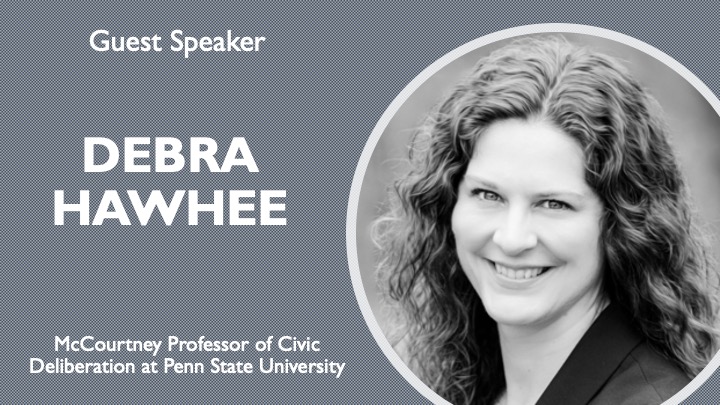
Introductory Slide for Debra Hawhee.

The DCI and Davidson College Writing Program were pleased to host Debra Hawhee, McCourtney Professor of Civic Deliberation at Penn State University, for a guest lecture series March 8-11, 2021. In addition to an informal chat about her work on climate rhetoric and deliberation in the Penn State curriculum, Professor Hawhee delivered two lectures: “Imagining Our Shared Future: Rhetoric, Deliberation, and Democratic Life,” and “The Original-Scholar Athlete: Athletics and Rhetoric in Ancient Greece.”

“Imagining Our Shared Future: Rhetoric, Deliberation, and Democratic Life”

https://www.youtube.com/watch?v=YprGl1Oy8kU

In her keynote address, Professor Hawhee presented deliberation as an art of imagining shared futures together. She spoke about Aristotle’s On Rhetoric, the relationship between deliberative dispositions and feelings, and her work on deliberation during crisis at Penn State. Professor Hawhee infuses her approach to deliberation with insights drawn from humanities and the arts, insights drawn from her training in rhetoric (the art of effective communication) and her experience incorporating deliberation into an integrated speaking and writing course at Penn State. This approach emphasizes imagination, listening, and attention to dispositions.

“The Original Scholar-Athlete: Athletics and Rhetoric in Ancient Greece”


In her second lecture, Professor Hawhee shared the curious early connections between athletic and rhetorical education, connections that she first noticed as she was finishing up her career as a basketball player at the University of Tennessee. Professor Hawhee explored the layout of the ancient Greek gymnasium and the expectation that individuals be trained in both bodily and mental arts.

Footer

Blog Post Categories

  • Announcements
  • Blog Posts
  • DCI Posts
  • Events
  • Faculty Posts
  • Fellow Posts
Image of a compass superimposed by the text "Deliberative Citizenship Initiative" and "Davidson College." Clicking on this image leads to the Initiative page.

Recent DCI Blog Posts

  • We Tried to Fix Jubilee’s “Middle Ground” – Here’s How It Went
  • A Case for Deliberation in the Natural Sciences
  • Welcoming New Staff to the DCI and DCN
  • Facebook
  • Twitter
  • Instagram
  • LinkedIn


Copyright © 2026 · Infinity Pro on Genesis Framework · WordPress · Log in