By Owen Brent-Levenstein ’27 (DCI Fellow)
During my spring D-team meeting on the opioid crisis, the group of nine community members and students were clearly eager to start deliberating. Before we could get started, I had to remind everyone that to start, we had to read over the conversation agreements. While reading over the conversation agreements is no one’s favorite part of a deliberation, it plays an important role. By making everyone formally acknowledge that they were agreeing to these norms, the participants felt a responsibility to uphold them, and kept the conversation agreements in mind throughout the deliberation. The participants ended up getting what they signed up for, a civil discussion on an important topic troubling our country.
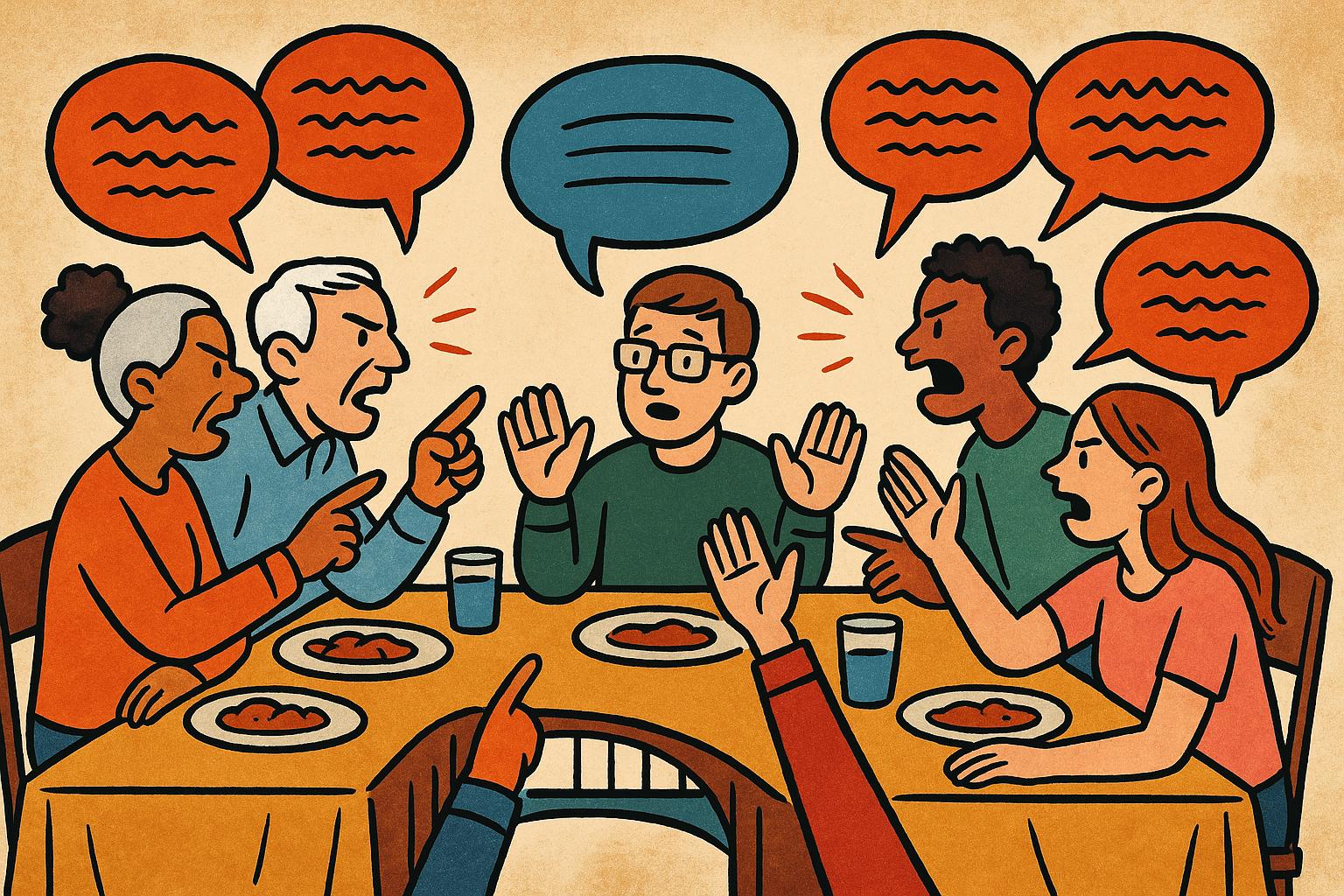
Unfortunately, the majority of deliberation does not happen under these ideal conditions. Whether it is debating with friends about the NBA Finals or arguing with family members over contentious political issues, disagreements often occur in unmediated spaces. Most of the time, people do not agree to disagree civilly, follow a certain set of norms, or allow a facilitator to step in when conversation gets overly contentious.
While our facilitator training can be useful when facilitating DCI events, when working with people who are not accustomed to the norms of proper deliberation, it can be a struggle to help conversation stay productive and civil. Furthermore, in everyday conversation and debate there is no facilitator to lean on, and people have not already agreed defer to you as the person who will keep the conversation civil and on track. Reminding a family member to “approach fellow deliberators’ stories, experiences, and arguments with curiosity, not hostility” will likely not lead to tremendous results. Thus, it is crucial that we find ways of impacting and deepening everyday conversations outside of our formal deliberation techniques.
To do so, I believe that leading by example is crucial. While there may not be an allotted time for everyone to read through conversation norms before a disagreement, by modeling productive deliberative behavior, one can strengthen a conversation. Instead of telling others that they need to be more respectful in deliberation, it is crucial that we put our money where our mouth is and do the work ourselves. While it is easy to point out what you think others are doing poorly, making a real effort to be as productive and respectful as possible takes real work, and will likely garner the respect of others.
If one can commit to being respectful of differing opinions, not talking over others, taking other people’s arguments at their highest, looking for common ground, and accepting that winning an argument isn’t the goal, it’s coming to a mutual understanding, then others are more likely to follow suit. When a member of a conversation is incredibly respectful, it becomes uncomfortable for people to be disrespectful and illuminates others’ unproductive behavior.
While leading by example may not always be enough, it is the best place to start. It changes one’s role from being a facilitator of a deliberation to being a model deliberator in a conversation. By ensuring you exemplify the behavior you want to see from others, you can practice what you preach and ensure that even without the formal constraints of a DCI deliberation, everyday disagreements go as smoothly as possible.